
Turn recordings into transcripts and summaries in minutes
Upload audio or video for multilingual transcription, AI notes, and action items
In a recent sales meeting, I watched my manager spend 20 minutes searching for a commitment made during a customer visit six months earlier. Everyone had Excel files on their computers, but versions differed, fields were inconsistent, and we ended up piecing things together from memory. That's when I realized: the tool isn't the problem—the problem is that we weren't treating visit notes as "trackable data."
Many sales teams don't actually lack tools; they lack a method for continuously accumulating, searching, and handing off customer histories. This article covers 6 customer visit recording software options I've personally tested, from AI recording tools to the simplest free solutions, and explains how I made my final choice.
Why You Need Customer Visit Recording Software
If visit notes live only in personal notebooks or scattered Excel files, they're hard to share across the team, track commitments, or hand over completely when people change roles. A good recording solution should do a few things: capture the audio or key points from the visit, automatically organize them into readable summaries, clearly list action items, and turn all of that into a searchable asset for the team.
Below, I introduce 6 software options I recommend, ordered from "most comprehensive" to "most streamlined."
Tinrec (秒听錄音)—The Most Complete AI Customer Visit Recording Assistant
I put Tinrec first because it solves the three issues I care most about in customer visit recording: capturing, organizing, and tracking.
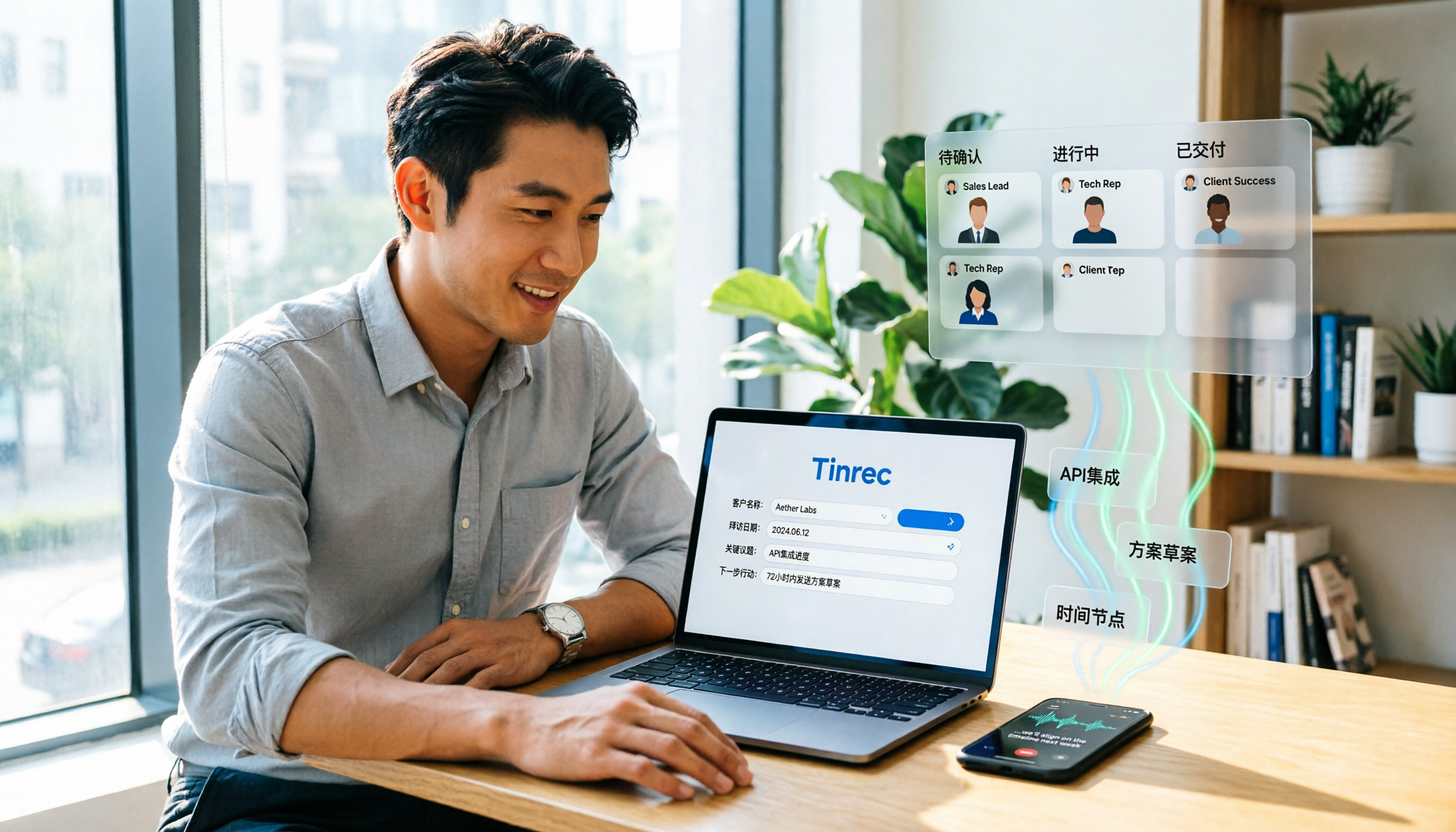
Tinrec's core isn't just "speech-to-text"; it turns customer visit meetings into actionable data. You can record online meetings directly from your computer (no bot needed) or use your phone to record in-person visits. After recording, transcripts, summaries, chapters, and action items are generated automatically. I particularly love its AI Q&A feature—you can ask, "What objections did the customer raise about pricing during the last visit?" and the system pulls answers from all past records. That's way faster than manual searching.
For sales teams, Tinrec's team space is invaluable. All visit records are stored centrally, new members can view historical data, managers can control seats and usage, and when someone leaves, their data doesn't disappear—it's transferred to other members. Pricing: individuals can try basic features for free, while team plans are per-seat, making it suitable for teams that need to build a long-term customer data repository.
If you need more than just recording—you want every visit to become a traceable team asset—Tinrec is my top recommendation to start with.
Otter.ai—A Mature English Meeting Recording Assistant
Otter is well-known for English meeting notes, with integrations for Zoom, Teams, and other platforms, and reliable transcription and summarization. If you have many English customer meetings, it's a solid choice. However, its interface and workflow are geared toward English business contexts, and its handling of Chinese visit notes is average. The free plan offers 300 minutes per month; Pro is about USD 8.49/month billed annually. Best for users with lots of English meetings who don't mind an English interface.
Fireflies.ai—Meeting Automation and Sales Analytics
Fireflies excels at meeting automation—it can automatically join and record meetings, and offers AI summaries and sales analytics reports. But its "bot joins" model might be off-putting to clients who don't want extra participants in meetings. Pricing: the free plan includes basic features; Pro is USD 10/seat/month. Best for teams that value sales process automation and are comfortable with a bot joining meetings.
Stop organizing recordings by hand
Upload audio or video and automatically get a transcript, summary, and action items
Notta—Multilingual Transcription and Translation
Notta supports transcription and translation in multiple languages. If you're in cross-border business and need to translate visit content into another language, it's convenient. However, Notta's post-processing capabilities—like AI Q&A, action item extraction, and team spaces—aren't as comprehensive as Tinrec's. The free plan offers 120 minutes per month; Pro is about USD 8.17/month billed annually. Best for users who need multilingual transcription but not necessarily deep team collaboration.
Granola—AI Meeting Notes Without a Bot
Granola, like Tinrec, uses a bot-free approach: it records system audio via a desktop app and combines it with your own notes to generate key points. It emphasizes "your handwritten notes + AI enhancement." However, it doesn't support uploading pre-recorded audio files, nor does it retain meeting audio. If you like taking notes during meetings, Granola offers a great experience; but if you want to upload recordings later for processing, it won't help. The Business plan is USD 14/user/month.
Free Option: Build Your Own Visit Log with Excel or Google Sheets
If you have zero budget and visit infrequently, creating your own fields in Excel or Google Sheets is an option. You can design columns for customer name, visit date, key points, action items, etc. But the drawbacks are clear: everything must be done manually, there's no automatic transcription or search, and team sharing often leads to version chaos. It's suitable for individuals who record occasionally, not for teams that need to track many visits.
With So Many Options, How Do You Choose?
Here's a selection guide based on your needs:
- Want the most complete AI features: automatic transcription + AI Q&A search + team space + action item tracking → Tinrec (the only option with all these features)
- Need Chinese visit notes, don't want a bot in meetings, and value team data handover → Tinrec (bot-free desktop recording, ideal for Asian teams)
- Lots of English meetings and need mature English summaries → Otter
- Need sales analytics automation and don't mind a bot joining → Fireflies
- Multilingual visits and need translation, but don't require deep post-processing → Notta
- Prefer taking handwritten notes during meetings and don't need to upload audio files → Granola
- Zero budget and very few visits → Excel/Google Sheets DIY
My practical advice: if you're looking for a long-term customer visit recording solution for your sales team, start with Tinrec's free plan to experience its transcription and AI Q&A, then evaluate whether you need the team space. Don't choose the simplest tool just to save money, because the cost of organizing and tracking later is often higher.
4 Things to Know Before Using Customer Visit Recording Software
- Get client consent before recording: Regardless of the software, you should inform the client and obtain consent before recording or transcribing. This isn't just a legal issue; it's the foundation of trust. Tinrec has clear interface prompts during recording to help you build this habit.
- Don't just store transcripts; organize action items: Transcripts are raw material, not the final product. Good recording software automatically extracts action items—for example, Tinrec lists things like "send quote next week." You should review and confirm action items on the same day as the visit.
- Store records in a team space, not personal folders: Personal records are lost when someone leaves or changes computers. Tinrec's team space allows all members (even those without editing seats) to view historical records, which is crucial for handovers.
- Regularly use AI Q&A to review history: Don't let old records become dead data. Every so often, use Tinrec's AI Q&A to review a customer's visit highlights from the past six months—you'll discover many forgotten commitments.
Summary
The value of customer visit recording isn't in "how much you record," but in "whether you can find, understand, and track it when needed." Each of the 6 tools I tested suits different scenarios. But if your team needs Chinese records, bot-free meetings, and—most importantly—turning visit data into a collaborative asset, I recommend starting with Tinrec. It's not just a recording tool; it's a way to turn customer visits into team memory.
Try it with your own customer visit scenarios, starting with one visit recording, and gradually build a recording process that works for your team.
References
- No matter who you visit, always prepare well before meeting clients! - Customer Management System
- How long are you willing to wait for your clients? Real examples of customer follow-up and a customer tracking sheet - Tingyu's Jazz Workplace Life
- No development needed! Easily create a "Customer Visit Record" data structure
- Customer Visit Records_Customer Visit Service Record Content-CSDN Blog
- Baidu
Turn every recording into actionable outcomes
Get 60 free transcription minutes when you sign in. No credit card required.
Related Reading
You might also like

2026 Speech-to-Text Tool Buying Guide: 2 Tools Tested and Selection Tips
Is Yating Transcription good? Who is Tinrec for? This guide compares two tools from a workflow perspective rather than just recognition accuracy, covering post-transcription organization, meeting recording, team collaboration, and localization features, helping you avoid the pitfall of getting transcripts you can't act on.

2026 Hands-On Comparison of 2 Transcription Apps: Tinrec vs Yating, Which One Suits Hong Kongers?
A hands-on comparison of Tinrec and Yating transcription tools across five dimensions: AI features, free tier, cross-platform support, language support, and team collaboration, to help Hong Kong professionals choose the right transcription tool and save overtime hours.

2026 Comparison of 3 Speech-to-Text Tools: Yating, Notta, and Tinrec – Which Is Best for Taiwan Users?
Still wondering if Yating is any good? This article compares three speech-to-text tools – Yating, Notta, and Tinrec – covering accuracy, speed, AI summarization, team collaboration, and pricing, to help you choose the best solution for meeting notes.

4 Best Speech-to-Text Tools Compared in 2026: Is Yating STT Still Worth It?
Wondering if Yating STT is worth it? This hands-on comparison of 4 speech-to-text tools—Yating STT, Tinrec, Otter.ai, and Notta—covers accuracy, AI features, cross-platform convenience, and free tiers to help you pick the most efficient option for your needs.

2026 Voice-to-Text Tool Comparison: Yating Transcript Cost vs. Tinrec Free Plan – Which Is More Worth It?
This article tests three voice-to-text tools, including Yating Transcript and Tinrec, comparing costs, accuracy, and AI features to help you decide if Yating Transcript is worth it and whether Tinrec is better for users in Taiwan.

2026 Comparison of 3 Customer Visit Recording Platforms: Which One Turns Conversations into Trackable Actions?
Customer visit recording is more than just pressing record—it's about turning conversations into searchable, trackable, and collaborative actions. We tested Tinrec, Notta, and Otter across recording methods, post-transcription processing, team collaboration, and pricing to help you find the best platform for your sales team.

2026 Hands-On Comparison of 4 Recording-to-Text Apps: Is Yating Transcript Good? Is Tinrec More Time-Saving?
Is Yating Transcript worth using? This article compares Yating, Tinrec, Good Tape, and Notta, analyzing free quotas, accuracy, and suitability for Hong Kong users, to tell you which one saves the most time.

2026 Client Visit Log Tool: Auto-Generated Summaries + To-Do Lists
Still using Excel to log client visits? This article tests Tinrec, which transcribes recordings in seconds, and shows you how to use AI to automatically generate visit summaries and to-do lists, and build a collaborative client visit logging platform for your team.

Best AI Transcription Tools in 2026: We Tested 4, and Tinrec Beats Yating
Many people wonder where Yating Transcription is from. The answer: it's developed by a Taiwanese team. But choosing a tool shouldn't be based on nationality alone. This article tests 4 AI transcription tools and explains why Tinrec is more comprehensive for meeting notes, AI summarization, and team collaboration.