
Turn recordings into transcripts and summaries in minutes
Upload audio or video for multilingual transcription, AI notes, and action items
For many administrative staff, graduate students, or media professionals, transcribing recordings in Taiwanese (Hokkien) or mixed Mandarin-Taiwanese is often the most time-consuming part of the job. Most speech-to-text tools on the market work reasonably well for standard Mandarin, but when it comes to Taiwanese or dialect accents, accuracy plummets, leaving you to spend hours manually listening and correcting.
This article reviews the recording transcription tools that offer dialect support in 2026, analyzing them from three angles: transcription accuracy, ease of use, and AI post-processing capabilities. If you want the bottom line: for simple short dictation, Google Voice Typing will suffice; for long interviews with automatic summarization, an integrated multi-language AI tool (like Tinrec) is a more efficient choice.
Why Is Taiwanese Transcription So Hard? Three Common Pain Points
Before choosing a tool, it's important to understand why traditional tools fail with Taiwanese—these are the key criteria for selection:
1. Difficulty Recognizing Code-Switching
In Taiwanese workplaces or interviews, conversations are rarely pure Taiwanese or pure Mandarin. Instead, they often switch between languages mid-sentence or even mid-phrase. Older single-language models require manual language switching, failing to adapt to this natural flow and producing garbled text or homophone errors.
2. Lack of Context Understanding and Punctuation
Taiwanese has many interjections (e.g., lah, hiann, hoh). Traditional dictation tools often misinterpret these as content words and fail to insert punctuation automatically. The result is a dense wall of text that is painful to read and edit.
3. Text Only, No Highlights
Even if the transcription is accurate, a one-hour interview can yield tens of thousands of words. Extracting conclusions or action items still demands significant mental effort. Modern workers need AI that "tells me what matters," not just a dictation machine.
2026 Popular Taiwanese Speech-to-Text Tools: Comparative Review
To help you decide quickly, we compared different types of solutions on the market, including general-purpose features from tech giants, professional AI transcription tools (using Tinrec as an example), and open-source models for developers.
| Comparison Dimension | Tinrec (MiaoTing Recorder) | Google Voice Typing | OpenAI Whisper (Raw Model) | Basic Recorder Apps |
|---|---|---|---|---|
| Taiwanese Recognition | ⭐⭐⭐⭐ (Multi-language support) | ⭐⭐ (Requires manual language switch) | ⭐⭐⭐⭐⭐ (Depends on model version) | ⭐ (Mostly Mandarin only) |
| Code-Switching Handling | Auto-detection supported | Weak, often drops words | Strong, but requires technical setup | Not supported |
| Real-Time | Live transcription + post-upload | Real-time dictation only | Post-recording processing | Recording only |
| AI Summary/Tasks | Auto-generate meeting notes/todos | None | None (requires separate GPT integration) | None |
| Export & Integration | Word/TXT/PDF + AI chat | Copy-paste | Subtitle files (SRT/VTT) | Audio only |
| Price/Free Tier | Free plan: 100 minutes/month | Completely free | Pay per hour / open-source free | Free with hardware purchase |
Stop organizing recordings by hand
Upload audio or video and automatically get a transcript, summary, and action items
Analysis Summary: If you're a technical user, using Whisper directly can yield very high accuracy. If you prefer an "out-of-the-box" experience and need recordings to be turned directly into working notes, an integrated tool like Tinrec offers a more complete workflow, especially since it solves the pain point of "having to organize key points after transcription."
Deep Dive: How Tinrec Handles Dialect Scenarios
Tinrec (MiaoTing Recorder), as a next-gen AI recording assistant, addresses two key issues in Taiwanese transcription: "can't understand" and "can't remember." Unlike tools that only provide plain text, Tinrec's core logic is a complete workflow: "from recording → understanding → action."
1. Multi-Language Support and Auto-Detection
Tinrec supports 10 languages including Chinese, Taiwanese, English, and Japanese. In common Taiwanese meeting scenarios, it captures meaning relatively accurately. For interview recorders, this means no more switching between recording software and translation tools.
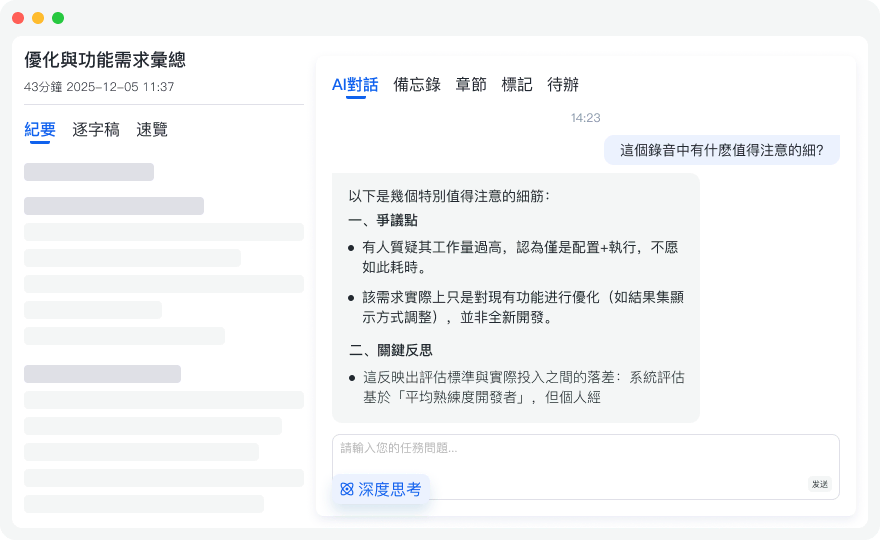
2. AI Smart Summaries and Chat Query
This is the biggest differentiator from traditional dictation tools. For a one-hour Taiwanese interview, Tinrec doesn't just provide a transcript—it also automatically generates meeting minutes and action items.
Additionally, its "AI Chat Query" feature lets you ask questions about the recording in natural language. For example, you can type: "What does the interviewee think about the transformation of traditional markets?" and the AI will summarize based on the recording—far more accurate than Ctrl+F keyword search.
Tutorial: How to Quickly Transcribe a Taiwanese Interview with AI
Using Tinrec as an example, here's how to turn a dialect interview into usable text quickly.
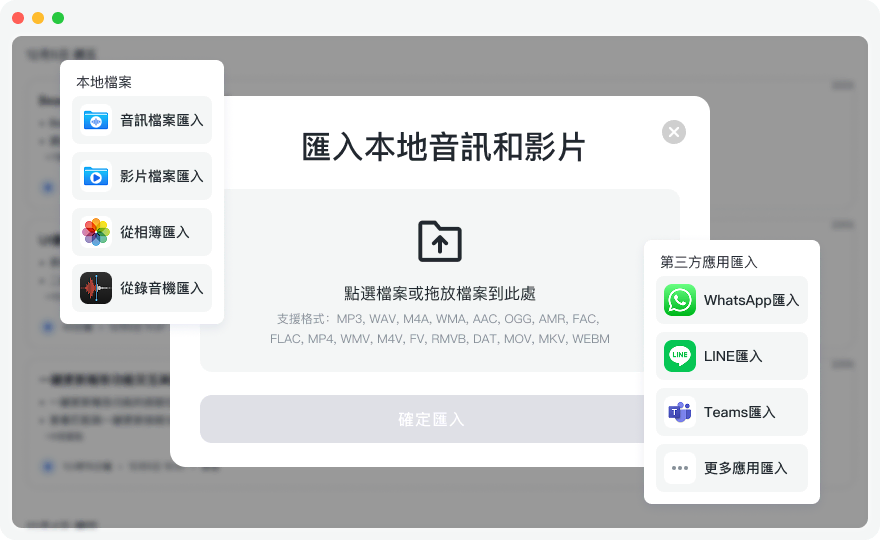
Step 1: Choose Recording Mode
Tinrec works across iOS, Android, and Web. You can:
- Live Recording: Open the app or web version, tap "Start Recording," and it transcribes in real time.
- Import File: If you have an existing MP3/M4A file, simply upload it.
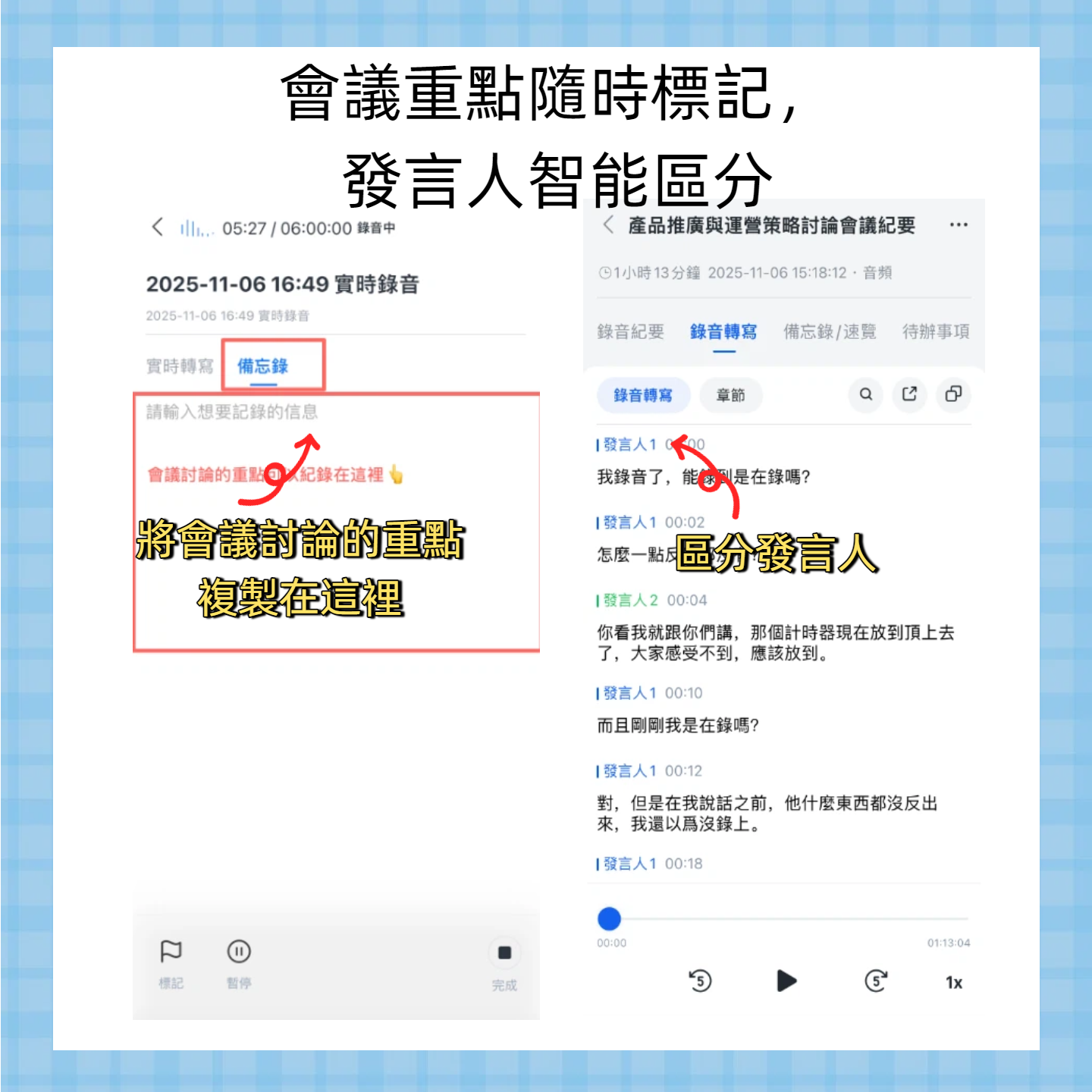
Step 2: Review Transcript and Identify Speakers
After recording, the system auto-generates a transcript. For multi-speaker conversations, Tinrec uses voiceprint recognition to automatically label speakers (Speaker A, Speaker B). This is crucial for interview transcripts, saving you the time of manually marking who said what.

Step 3: One-Click Summary and Action Items
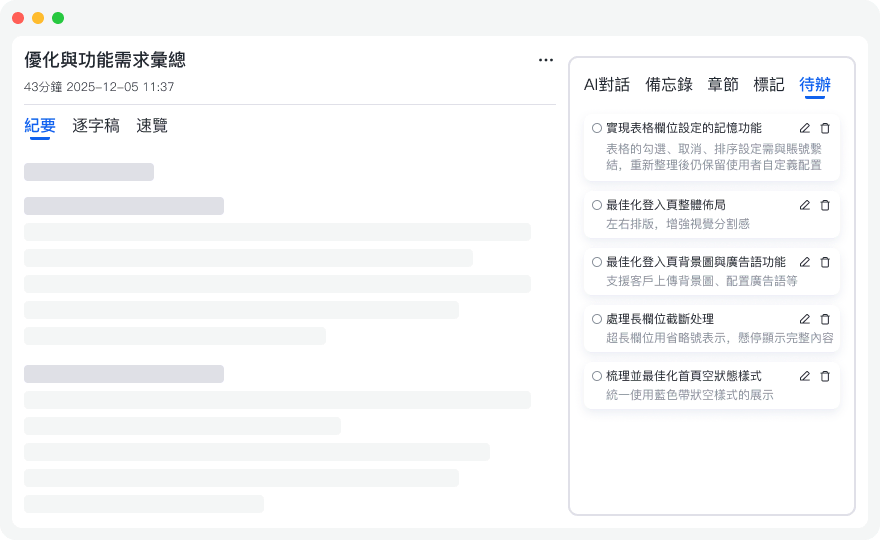
This is the key time-saver. Click the AI summary button, and the software analyzes the entire conversation to produce structured key notes. For meetings, it also generates a to-do list.
Step 4: AI Query for Unclear Parts
If some Taiwanese parts are unclear or you need to quickly recall a detail, use the AI chat window on the right to ask the AI to "re-listen" and explain that section.
FAQ
Q1: Is there a completely free Taiwanese speech-to-text software? Most high-quality AI transcription services require computing costs, so they are usually "partially free." For example, Google Voice Typing is completely free but basic; Tinrec offers 100 minutes per month free, suitable for light users or students.
Q2: Does background noise affect Taiwanese recognition? Yes. All speech recognition is sensitive to noise. We recommend using a directional microphone or keeping the device close to the speaker. If using a tool like Tinrec that supports file import, you can denoise the audio first for better results.
Q3: Can iPhone users use Tinrec? Yes. Tinrec supports iOS, Android, and web, with cloud-synced accounts. You can record on your phone and edit/export on your computer, solving the problem of exporting voice memos from iPhone.
Q4: Some Taiwanese words don't have standard Chinese characters—how does the software display them? Current AI models usually select the closest Chinese character or common informal writing based on context. For very obscure dialect words, it may output homophones or romanization. We recommend a final manual proofread after exporting to Word.
Q5: Can I transcribe Taiwanese videos from YouTube? Yes. Tinrec supports pasting YouTube or podcast links for direct parsing and summarization, very useful for content creators who need to process online material.
Q6: Can the AI handle very long recordings (over 1 hour)? Professional tools are optimized for long recordings. Tinrec supports stable transcription and summarization for long sessions, a major difference from free dictation tools that often crash.
Turn every recording into actionable outcomes
Get 60 free transcription minutes when you sign in. No credit card required.
Related Reading
You might also like

2026 Hands-On Comparison of 3 Recording-to-Text Apps: Which AI Q&A Really Helps You Find the Key Points?
Struggling to choose a recording-to-text app? This article tests three tools—Tinrec, Otter.ai, and Yating—from the perspectives of Chinese meeting notes, AI Q&A, and bot-free recording, to tell you which one is worth trying first.

Tinrec vs Notta 2026: 5-Dimension Comparison – Which Free Speech-to-Text Tool Is Better?
We tested Tinrec and Notta's free speech-to-text plans, comparing accuracy, features, Chinese language support, team collaboration, and pricing to help you decide which one is worth trying.

Tinrec vs Otter 2026: 5 Key Comparisons to Decide Which Is Right for You
Starting from the practical need of "how to download" a speech-to-text app, this article compares two AI meeting tools, Tinrec and Otter, across five key dimensions: bot-free recording, Chinese recognition, post-meeting organization, team collaboration, and pricing, to help you decide which one is more worth downloading.

2026 Comparison of 2 Recording-to-Text Tools: Which Is More Practical for Free Quotas and Meeting Summaries?
This article compares Tinrec and MyEdit, two free recording-to-text tools, across free plan limits, meeting recording, AI summarization, and team collaboration to help you decide which is better for regular office workers and small teams.

2 Speech-to-Text Tools Compared in 2026: Understand What It Means Before Choosing Tinrec or Notta
Speech-to-text technology automatically converts meetings, interviews, or audio files into transcripts and summaries. This article compares Tinrec and Notta from a mid-level manager's perspective, explaining definitions, key differences, and buying considerations.
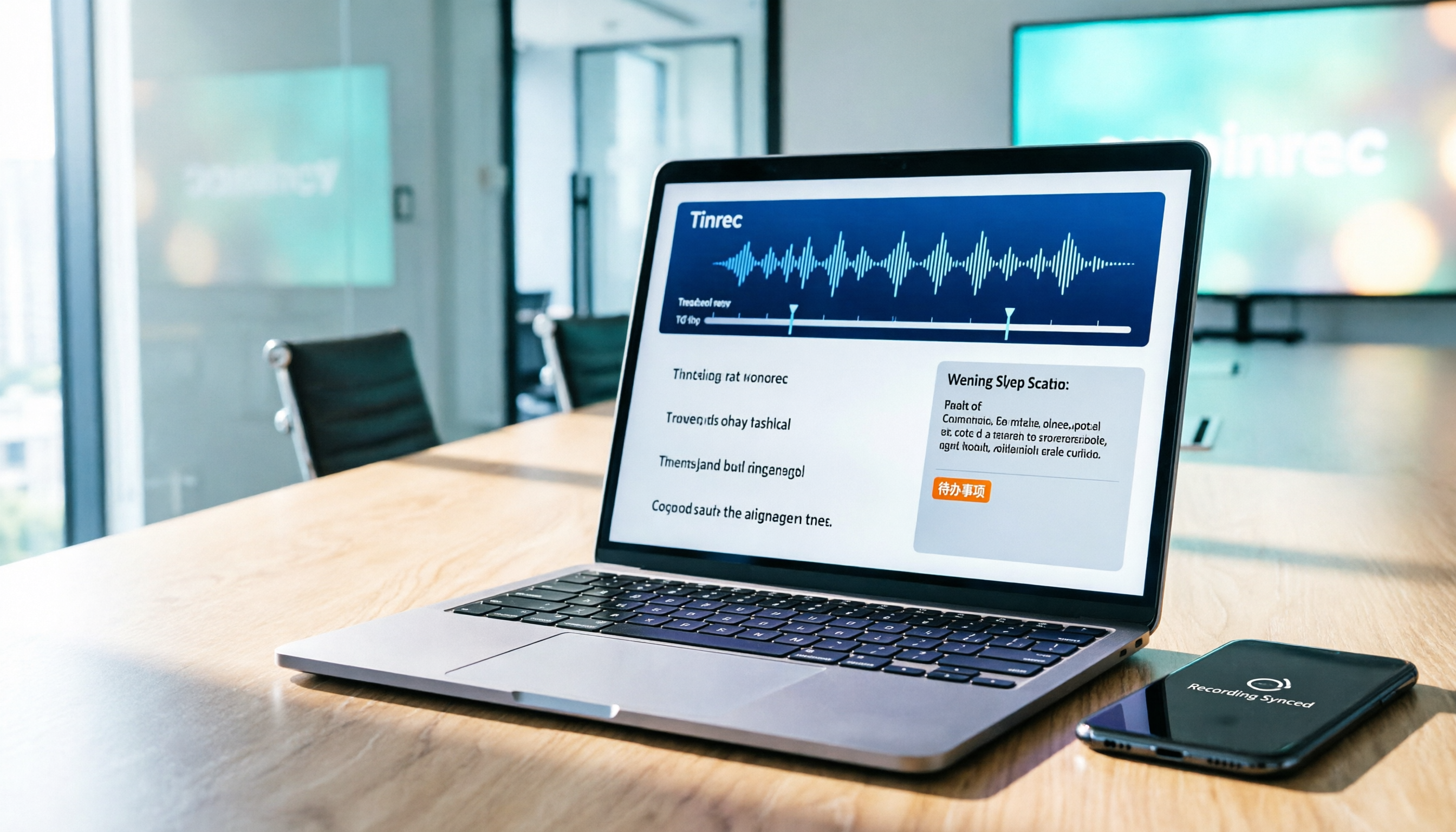
Tinrec Recording-to-Text 2026 Tutorial: Bot-Free Online Meetings + Auto-Generated Meeting Minutes
A mid-level manager's hands-on review of Tinrec for recording-to-text: comparing it with PLAUD Note, covering online meetings, post-transcription processing, cross-platform use, and team collaboration, to help you painlessly convert audio files to text.
Tinrec vs Notta 2026 Hands-On Comparison: Save the Most Time with These Transcription Tools
This article compares two speech-to-text tools, Tinrec and Notta, across five key dimensions: Chinese transcription, meeting recording, AI post-processing, team collaboration, and export/integration, to help you find the best fit for your needs.
Tinrec vs Otter.ai 2026: Speech-to-Text for Chinese Meetings & Team Collaboration
Looking for a speech-to-text tool? This article compares Tinrec and Otter.ai on Chinese recognition, meeting recording, AI post-processing, and team collaboration to help you choose the best fit.

2026 Hands-On Comparison of 3 Recording-to-Text Tools: Which Saves the Most Time for Cantonese Transcription and AI Summaries?
Central district office workers test Tinrec, Otter.ai, and Notta for recording-to-text, focusing on Cantonese recognition, AI post-processing, and cross-platform performance, to help you choose the most time-efficient meeting notes solution.