
Turn recordings into transcripts and summaries in minutes
Upload audio or video for multilingual transcription, AI notes, and action items
Faced with YouTube tutorial videos or online lectures that are often 30 minutes or longer, do you often feel the information density is too low, wanting to quickly get the key points but can only keep dragging the progress bar? Or encounter foreign language videos without English subtitles, understanding only bits and pieces?
If your goal is "efficient learning" or "quickly organizing information," simply watching is no longer enough. This article will review the needs for "converting YouTube videos to text summaries," from free web-based combo techniques to integrated AI tools, providing detailed steps and a tool comparison table.
Quick Navigation Conclusion:
- If you use it occasionally and have a limited budget: Recommend using the YouTube Transcript combined with ChatGPT technique.
- If you pursue efficiency, need to handle videos without subtitles, or need mobile operation: Recommend trying an integrated AI tool like Tinrec, which completes transcription, translation, and summarization in one go.
1. Why Do We Need "Video to Text" Tools? Three Core Pain Points
In the era of information overload, although videos are vivid, they have inherent disadvantages as "knowledge carriers." Based on user feedback and learning note scenarios (such as parenting education, investment and finance channels), the main pain points focus on the following three:
- High Time Cost: To extract 3 minutes of key information, you often have to watch 20 minutes of buildup. The traditional method of pausing and taking notes by hand is extremely inefficient.
- Language Barriers (No Subtitles): Many high-quality foreign interviews or professional tutorials (e.g., Coursera, TED, or overseas YouTubers) may not have English subtitles, making comprehension difficult.
- Difficulty in Information Retrieval: Videos cannot be searched for keywords like articles with Ctrl+F. If you later want to recall "at what minute and second the speaker mentioned a certain concept," it's often like looking for a needle in a haystack.
2. Tool Category Showdown: Free Combo Technique vs. Integrated AI Tool
The solutions on the market are mainly divided into "manually combining multiple tools" and "one-stop AI applications." Below we objectively compare the common online method "YouTube Transcript + ChatGPT" with the professional tool Tinrec.
Tool Comparison Table
| Dimension | Combo Technique (YT Transcript + ChatGPT) | Integrated AI Tool (Example: Tinrec) |
|---|---|---|
| Operation Flow | Cumbersome (Copy URL → Grab subtitles → Paste into GPT → Give instructions) | Simple (Paste URL → Auto-complete) |
| Subtitle Dependency | High (Video must have CC subtitles to grab) | Low (Has ASR voice recognition, can process videos without subtitles) |
| Mobile Support | Poor experience (needs to switch between multiple windows) | Excellent (App/Web multi-platform sync, view anytime) |
| Summary Structure | Depends on how well the prompt is written | Automatically generates structured notes, mind maps, and action items |
| Interactive Query | Needs to manually paste text into AI window | Built-in AI Chat, can directly ask questions about the content |
| Cost | Free (but may have length limits in ChatGPT) | Free tier limit (Tinrec offers 100 minutes free per month) |
Stop organizing recordings by hand
Upload audio or video and automatically get a transcript, summary, and action items
3. In-depth Analysis of Tinrec: More Than Just Transcription
After testing multiple tools, Tinrec positions itself closer to a "knowledge management assistant" rather than a simple dictation tool. For the YouTube video scenario, it solves the problems of "videos without subtitles" and "mobile operation" that the combo technique cannot handle.
Key Differentiating Features
- Independent Speech Recognition Engine: Unlike tools that rely on YouTube's built-in subtitles, Tinrec directly "listens" to the video's audio and converts it to text. This means even videos with only English audio and no subtitles at all can be accurately transcribed and translated into English.
- AI Structured Summary: It not only outputs a transcript but also automatically identifies speakers and generates a "meeting minutes" format summary, including conclusions and action items, making it suitable for turning tutorial videos into actionable checklists.
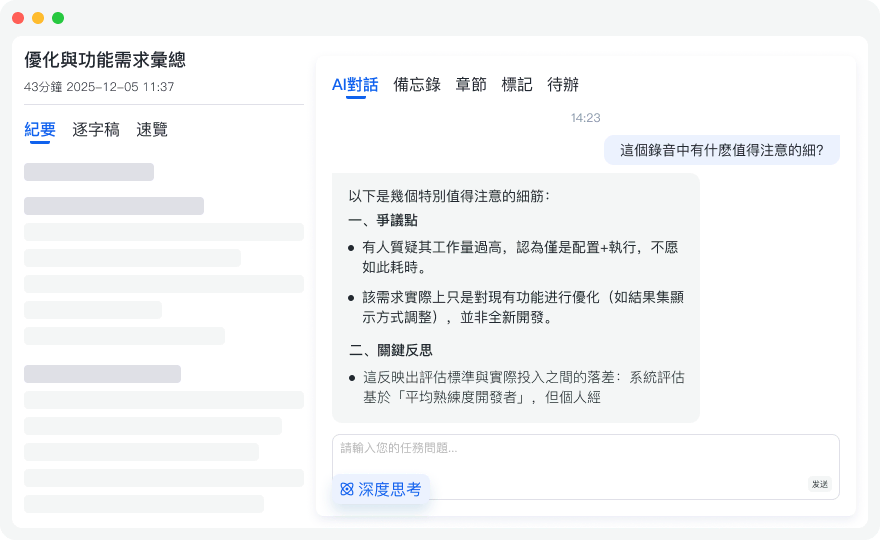
- AI Chat Query (Chat with Video): This is the biggest difference from traditional tools. You can ask about the video content like "asking a person," for example: "What are the three key Montessori teaching points mentioned in this video?" The AI will answer directly based on the recording, saving you time reading the transcript.
4. Practical Tutorial: How to Convert YouTube Videos into High-Quality Notes
Below are the steps for two mainstream methods. You can choose based on your needs.
Method A: Free Web-Based Combo Technique (Suitable for Videos with Subtitles)
This method is based on online learning note-taking experience, suitable for users who are used to working on a computer and whose videos have subtitles.
- Get Subtitles: Open
youtubetranscript.com, paste the YouTube video URL, click generate, and copy the full text. - AI Organize: Open ChatGPT (or Claude), enter the following prompt:
"Please translate the following text into English and reorganize it into key headings and paragraphs using plain language so that the average person can understand. Please use Markdown format."
- Paste Content: Paste the copied subtitles from step 1 and wait for the AI to generate notes.
Method B: Tinrec Automated Workflow (Suitable for Mobile/No Subtitles/High Efficiency)
If you want to operate on your phone or the video has no subtitles, refer to the following Tinrec workflow:
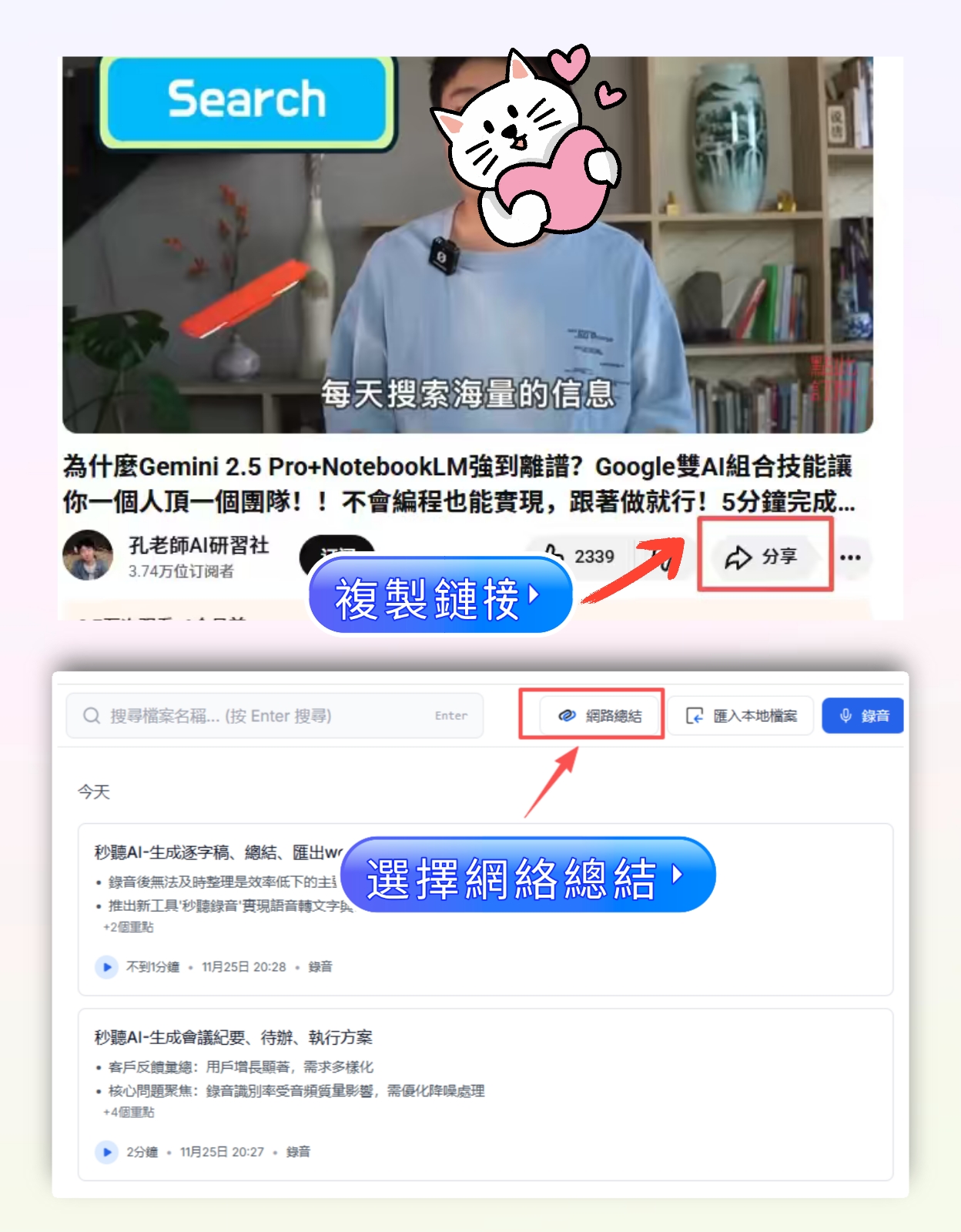
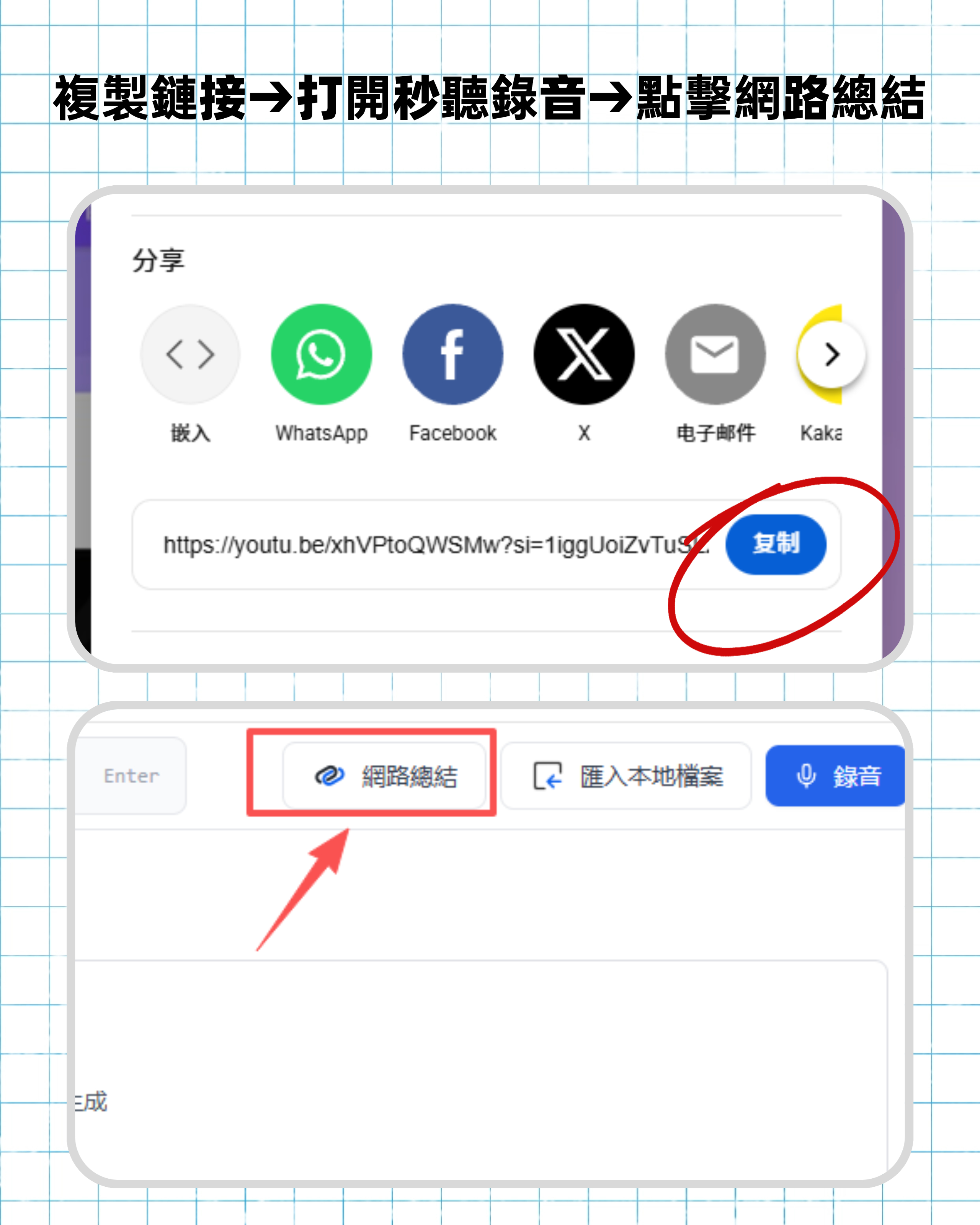
- Copy Link: In the YouTube app, tap "Share" and copy the video link.
- Paste and Parse: Open Tinrec (App or web version), select the "Online Video to Text" feature, and paste the URL.
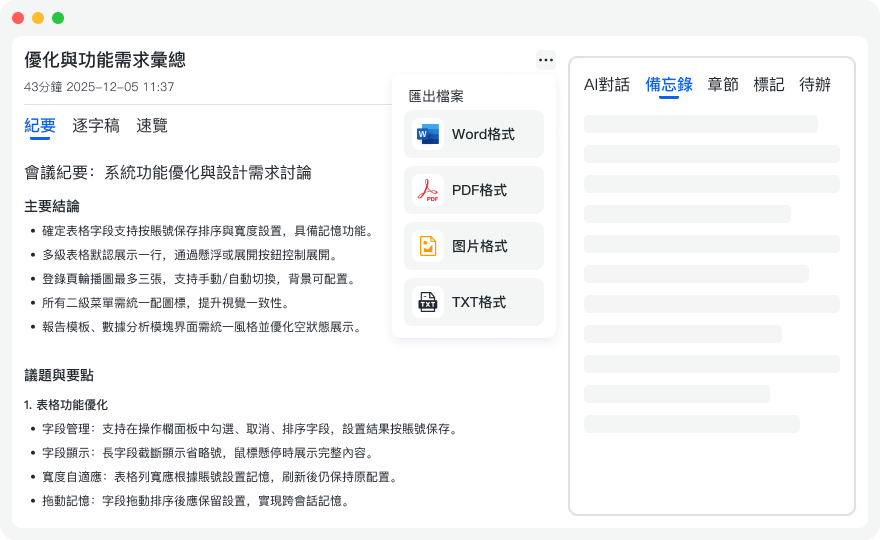
- View Summary and Transcript: The system automatically performs speech recognition, identifies speakers, and generates a structured key summary.
- Deep Interaction: If you're unclear about a point, tap "AI Chat" and ask directly: "What are the details of the second case mentioned by the speaker?" The AI will find the answer from the long video.
5. Frequently Asked Questions (FAQ)
Q1: If the YouTube video itself doesn't have CC subtitles, can these tools still be used?
- Most free web tools that rely on "grabbing subtitles" will fail. However, tools like Tinrec that have ASR (Automatic Speech Recognition) technology directly recognize the audio file, so they can generate a transcript even if the original video has no subtitles.
Q2: Is the accuracy of video-to-text high?
- It depends on the video's audio quality and the speaker's accent. Currently, mainstream AI can achieve over 95% recognition accuracy for clear English and Chinese. Tinrec supports 10 languages including Chinese, English, Japanese, Korean, Cantonese, etc., which is very friendly for multilingual learners.
Q3: Can it be operated directly on a phone?
- Method A (web combo) is inconvenient on a phone due to copy-paste. Tinrec supports iOS and Android apps, allowing you to complete all steps from link to notes directly on your phone.
Q4: Is Tinrec completely free?
- Tinrec offers 100 minutes of free recording/transcription per month, which is sufficient for occasional short video processing. If you have a lot of long videos (like classes, numerous meetings), you can consider upgrading to Basic or Pro for more hours.
Q5: Besides YouTube, does it support other audio/video formats?
- Yes. In addition to YouTube links, Tinrec also supports uploading local MP3/MP4 files or real-time recording (e.g., in-person meetings or classes), and you can enjoy the same transcription and AI summarization features.
Q6: Can the output notes be exported?
- Yes. Tinrec supports exporting transcripts and summaries to multiple formats (e.g., Word, PDF, TXT) for easy integration into Notion or other note-taking software for permanent storage.
Turn every recording into actionable outcomes
Get 60 free transcription minutes when you sign in. No credit card required.
Related Reading
You might also like
Tinrec Recording-to-Text 2026 Tutorial: Bot-Free Online Meetings + Auto-Generated Meeting Minutes
A mid-level manager's hands-on review of Tinrec for recording-to-text: comparing it with PLAUD Note, covering online meetings, post-transcription processing, cross-platform use, and team collaboration, to help you painlessly convert audio files to text.
Tinrec vs Notta 2026 Hands-On Comparison: Save the Most Time with These Transcription Tools
This article compares two speech-to-text tools, Tinrec and Notta, across five key dimensions: Chinese transcription, meeting recording, AI post-processing, team collaboration, and export/integration, to help you find the best fit for your needs.
Tinrec vs Otter.ai 2026: Speech-to-Text for Chinese Meetings & Team Collaboration
Looking for a speech-to-text tool? This article compares Tinrec and Otter.ai on Chinese recognition, meeting recording, AI post-processing, and team collaboration to help you choose the best fit.

2026 Hands-On Comparison of 3 Recording-to-Text Tools: Which Saves the Most Time for Cantonese Transcription and AI Summaries?
Central district office workers test Tinrec, Otter.ai, and Notta for recording-to-text, focusing on Cantonese recognition, AI post-processing, and cross-platform performance, to help you choose the most time-efficient meeting notes solution.
3 Best Speech-to-Text Tools in 2026: From Free Trials to Team Collaboration
A mid-level manager tested multiple speech-to-text tools and compiled the top 3 recommendations for 2026, along with 4 key factors to consider when choosing, and why Tinrec is the most practical for meeting notes and team collaboration.
Tinrec Speech-to-Text Tutorial 2026: 3 Steps to Transcribe Audio + AI Auto-Summarization
Wondering which speech-to-text tool is easy to learn? This guide uses Tinrec (秒听录音) as an example to show how to turn recordings into transcripts and key summaries in 3 steps, plus 4 criteria for choosing an easy-to-use tool—perfect for beginners.

Best Recording-to-Text Apps in 2026: We Tested 4, and This Free Version Is the Best Value
We tested 4 recording-to-text tools, and Tinrec's free version is sufficient, with the most reliable Cantonese recognition, plus AI Q&A and team spaces, so office workers no longer need to work overtime transcribing.

3 Best Voice-to-Text Apps Tested in 2026: Stop Wasting Time on Meeting Notes
A mid-level manager tests voice-to-text apps for accuracy, AI summaries, cross-platform support, and team collaboration to find the biggest time-saver.
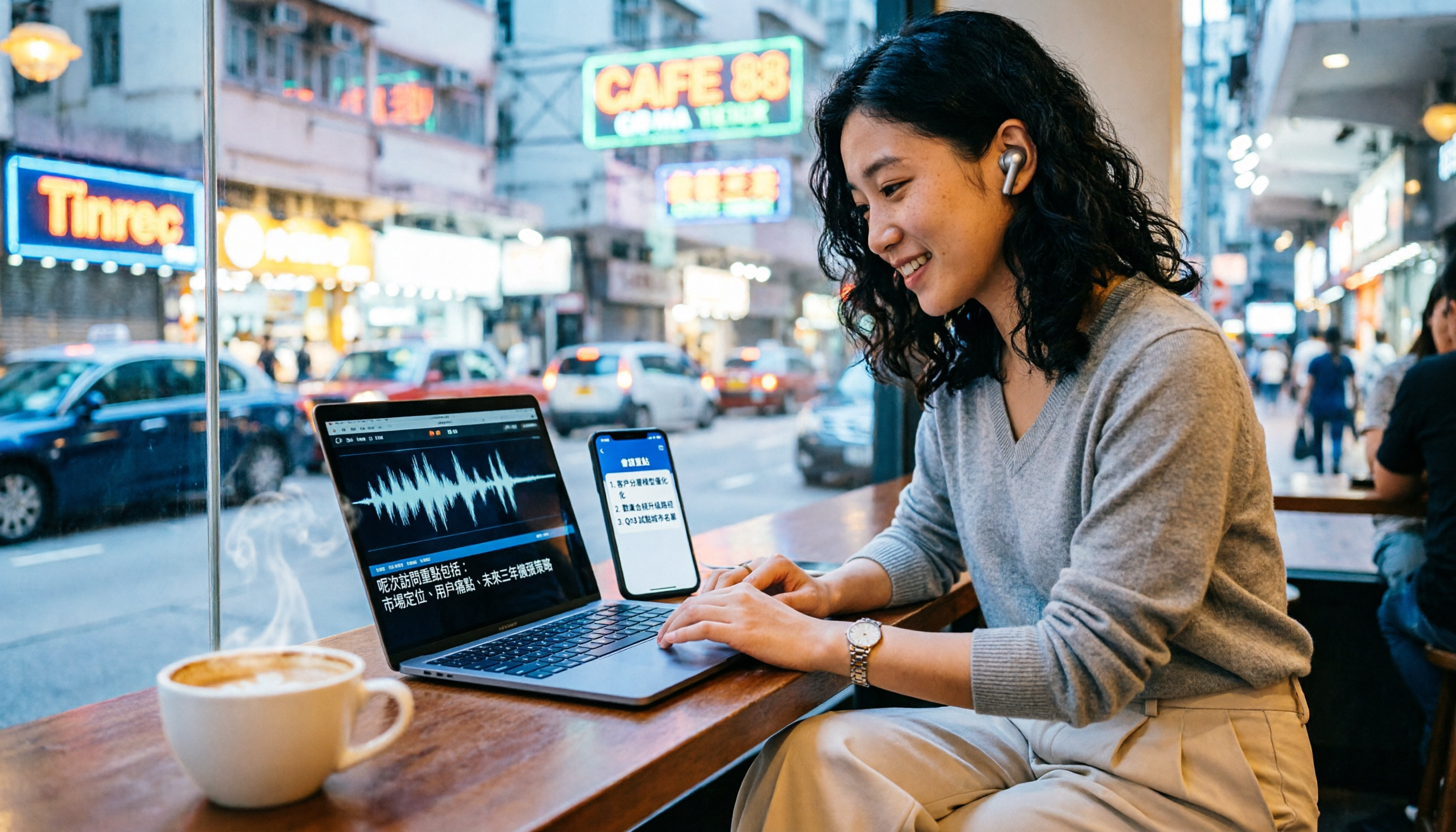
2026 Test: 4 Best Free AI Transcription Tools Compared – Which Saves You the Most Time?
We tested several free AI transcription tools for Cantonese meetings, interviews, and lectures commonly used by Hong Kong office workers. We compared free quotas, transcription accuracy, AI summarization, and cross-platform support to help you pick the most time-saving tool.