

Turn recordings into transcripts and summaries in minutes
Upload audio or video for multilingual transcription, AI notes, and action items
Why Do You Need a Voice-to-Text Tool?
Whether it’s meeting minutes, lecture notes, interview transcripts, or video content extraction, manual transcription is time-consuming and makes it hard to capture all key points in real time. According to surveys, office workers spend an average of 3 hours per week on meeting minutes, while students often struggle to review long audio recordings of courses.
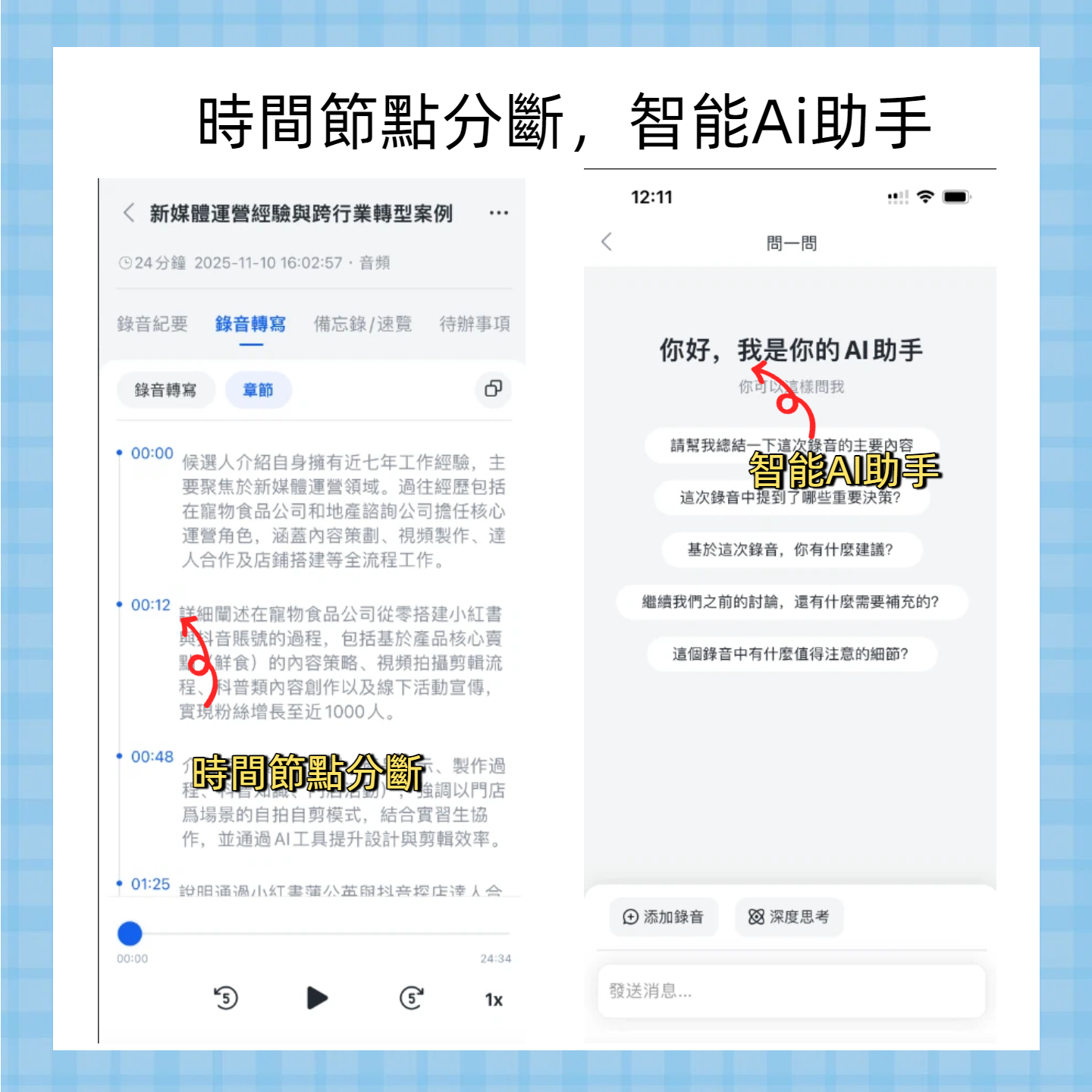
This article compiles 5 voice-to-text tools easily accessible to users in Taiwan, comparing AI features, Chinese language support, and pricing in one go—so you don’t have to browse through countless posts.
Tinrec (秒聽錄音) — The Most Complete AI Recording and Audio/Video Organizer
Tinrec is an AI recording and audio/video organization tool designed for Taiwanese users. It goes beyond transcription, emphasizing “turning recordings into usable knowledge.”
It supports real-time voice-to-text, uploading audio/video files for transcription, and even parsing YouTube, TikTok, and other online video links. It is one of the few solutions that covers meetings, learning, creation, and personal knowledge management.
Key Highlights
- AI Summaries & Chapters: Long recordings automatically generate key summaries and structured chapters for quick browsing.
- Action Item Extraction: Automatically identifies action items from meeting discussions, saving post-meeting organization time.
- AI Chat Query: Ask questions about the recording conversationally, e.g., “What budget numbers were mentioned in the last meeting?”
- Multi-format Export: Export transcripts, summaries, and to-do lists as TXT, DOCX, SRT, etc., or sync to Notion, Google Docs.
Pricing
The free plan offers basic transcription credits each month, letting you try core features; the weekly plan suits short-term intensive needs; Pro monthly or annual plans provide higher credits for long-term users. Check the official site for details.
Who It's For
People who need to organize meetings, courses, interviews, or online videos and want more than just a transcript—they want to understand, ask questions, and export results.
Otter.ai — Top Choice for English Meeting Notes
Otter.ai is a pioneer in AI meeting notes, excelling at automatically joining Zoom, Google Meet, and other online meetings for real-time transcription with speaker identification. The free plan offers 300 minutes per month, sufficient for light English meetings; Pro paid annually is about $8.33/month, providing 1,200 minutes and file import.
Compared to Tinrec, Otter focuses more on English business meetings and team collaboration, but its Chinese content organization and online video parsing are relatively weak. It’s ideal for business professionals whose meetings are primarily in English and who need shared meeting records within a team.
Stop organizing recordings by hand
Upload audio or video and automatically get a transcript, summary, and action items
Notta — Multi-Platform Transcription and Translation Tool
Notta supports web, app, and browser extensions for real-time meeting transcription, audio file upload, and multilingual translation. The free plan offers 120 minutes per month; Pro paid annually at about $8.17/month gives 1,800 minutes.
Notta offers solid transcription and translation features, but its deep organization capabilities like AI summaries, action item extraction, and chat queries are not as strong as Tinrec’s. If you need large-scale transcription and basic translation, Notta is a good choice.
PLAUD Note — Portable AI Recording Hardware

PLAUD Note is a standalone AI recording device that emphasizes portability and long battery life, suitable for business professionals or journalists who prefer not to record with their phones. The hardware costs around $179, with 300 transcription minutes per month included, and an annual subscription can upgrade to 1,200 minutes.
The hardware advantage is one-touch recording without phone interference, but it cannot directly process online videos or existing files like Tinrec, and post-processing and export are more app-dependent. It’s best for users with a higher budget who prefer a dedicated device.
TurboScribe — High Value File Transcription
TurboScribe focuses on uploading audio/video files for transcription. The free plan offers 3 files per day, each up to 30 minutes; the unlimited plan is about $10/month (billed annually), suitable for those who need heavy long-file transcription.
It is more of a “transcription tool” with fewer features for post-processing, summaries, or queries. If you only occasionally need to transcribe recordings, the free plan will do, but for deeper organization, Tinrec is more comprehensive.
How to Choose Among So Many Options?
- Want the most complete AI features (transcription + summaries + action items + queries) → Tinrec, the only solution with all these capabilities.
- Need to handle Chinese meetings, courses, or online videos → Tinrec, especially friendly for Chinese content organization and Q&A.
- Company meetings are mainly in English and need team collaboration → Otter.ai, but Chinese support is weaker.
- Heavy transcription and multilingual translation needs → Notta, generous minute allocation, but less deep organization than Tinrec.
- Don’t want to use your phone for recording, have a sufficient budget → PLAUD Note, good hardware build, but limited post-processing.
- Zero budget, just need quick transcription → TurboScribe free plan, 3 times per day is enough for emergencies.
3 Things to Know Before Using a Voice-to-Text Tool
Recording Quality Determines Accuracy
No matter which tool you use, clear voices and low background noise greatly affect transcription results. When using Tinrec to record, it’s recommended to turn off fans or use an external microphone.AI Summaries Still Require Manual Review
Summaries or action items from any tool may miss details; important documents should still be cross-checked with the original. Tinrec’s AI chat query helps quickly locate key paragraphs, saving time.Free Plans Have Usage Limits
Free plans usually limit monthly minutes or features. For example, TurboScribe’s free plan only allows files up to 30 minutes. If you have heavy usage, a paid plan quickly pays for itself.
Summary
These 5 voice-to-text tools each have their strengths: Otter excels at English meetings, Notta for large-scale transcription, PLAUD emphasizes hardware experience, TurboScribe focuses on affordable conversion, and Tinrec is the most comprehensive AI audio/video organizer.
If you want not only meetings but also courses, interviews, and online videos to be organized into a searchable, queryable knowledge base, we recommend starting with Tinrec’s free plan to see how it turns recordings into truly usable data.
Turn every recording into actionable outcomes
Get 60 free transcription minutes when you sign in. No credit card required.
Related Reading
You might also like

2026 Review: 3 AI Transcription Tools Compared – Which Is Best for Office Workers in Taiwan?
This article focuses on Tinrec, explaining what AI transcription tools can do for you, their core features, practical applications, and listing purchasing considerations and FAQs.

Best AI Transcription Tools in 2026: Tested 4 Options, This Free Version Is Best for Meeting Minutes
Looking for a free AI transcription tool but only getting a wall of text? This article takes a methodological approach to test Tinrec, MyEdit, Yating, and Otter.ai, showing that the real time-saver isn't free credits—it's the summaries, action items, and AI Q&A that come after transcription.

Tinrec vs Notta 2026: 4-Dimension Comparison – Which Is Best for Hong Kong Professionals?
We tested Tinrec and Notta side by side, comparing Cantonese transcription, meeting summaries, team collaboration, and AI Q&A to help you pick the most time-saving voice-to-text tool.

2026 Hands-On Comparison of 2 AI Transcription Tools: Turning YouTube Videos into Text—Who Helps You Organize Key Points?
Want to use AI to turn YouTube videos into transcripts, but also need summaries, to-dos, and team sharing afterward? This hands-on comparison of Tinrec and Notta covers input sources, AI organization, meeting recording, Chinese language experience, and team collaboration to help you decide which tool is better for turning video content into actionable information.

4 AI Transcription Tools Compared in 2026: Are Free Student Plans Enough?
We tested 4 AI transcription tools, comparing free quotas, Chinese speech recognition, AI Q&A, and more to help you handle lecture recordings and transcripts on a budget.

2026 Tinrec Voice-to-Text Tutorial: No Bot Recording + AI Auto-Generated Meeting Minutes
Struggling with meeting transcripts? Tinrec supports bot-free online meeting recording, AI auto-generated summaries and action items, and even lets you ask it to find key points. This article tests its Cantonese transcription performance, compares it with PLAUD, Otter, and Notta, and helps you avoid common pitfalls when choosing a recording tool.

Tinrec vs Notta 2026: 5-Dimension Comparison for Chinese Meeting Minutes
Compare Tinrec and Notta across 5 dimensions: recording, post-transcription processing, Chinese support, team collaboration, and pricing, to find the best voice-to-meeting-minutes tool for Chinese meetings.

Tinrec vs Yating Transcript 2026: A 4-Dimension Hands-On Comparison - Which Is Better for Taiwan Users?
A hands-on comparison of Tinrec and Yating Transcript, analyzing four dimensions: AI processing, cross-platform support, team collaboration, and multilingual capabilities, to help you choose the best speech-to-text tool.
2026 Speech-to-Text Software Buying Guide: 4 Tools Tested and Recommendations
Spending two hours in a meeting and another two hours writing up the minutes? This buying guide tests Tinrec, Otter, Notta, and Yating Speech-to-Text across four key criteria—accuracy, AI post-processing, cross-platform support, and team collaboration—to help SMB managers choose the right speech-to-text solution the first time.