
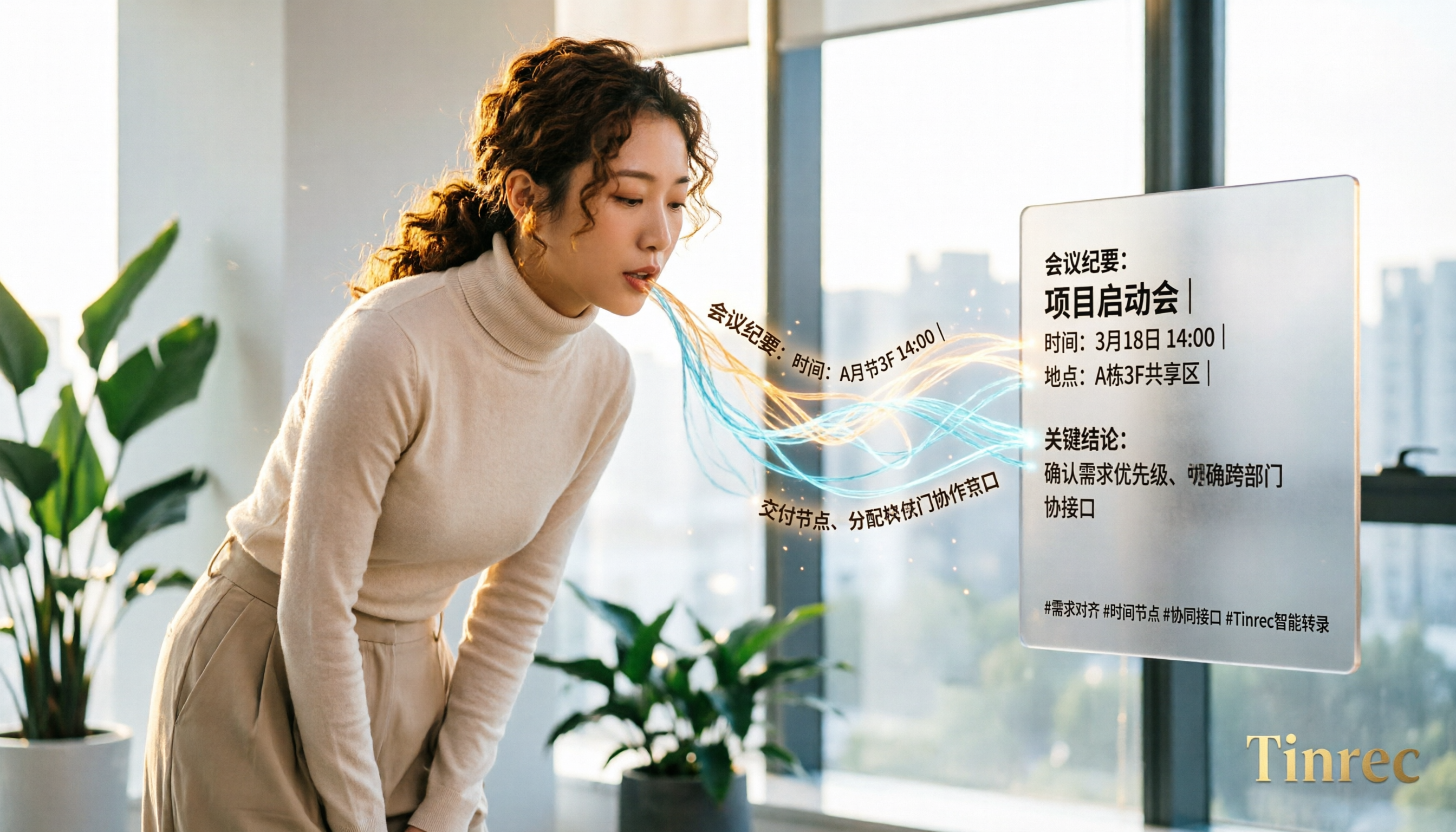
Turn recordings into transcripts and summaries in minutes
Upload audio or video for multilingual transcription, AI notes, and action items
Spending two hours in a meeting, then another two hours organizing the minutes—does that sound familiar?
What's worse, if your meeting includes a mix of Chinese and English or Cantonese discussions, most transcription tools' accuracy takes a hit. Some plans aren't cheap, yet all they give you is a transcript, leaving you to extract key points yourself.
During our procurement evaluations, the most common question we get is: "Is there a better tool than Notta for Chinese users?" This article addresses that question by testing four apps, including Tinrec, and giving you the answers.
4 Key Factors to Consider Before Choosing a Recording-to-Text App
- Chinese and Mixed Language Processing: Don't just look at advertised accuracy rates. Real meetings often mix Chinese and English, have accents, or background noise. The key is whether the tool can reliably produce usable transcripts, especially for variants like Cantonese or Taiwanese Mandarin.
- Post-Transcription Features: A transcript is just the start. You need automatic summaries, action items, and even the ability to ask AI questions like "Who mentioned the budget last time?"—that's what saves time.
- Cross-Platform and Input Variety: You might record on your iPhone today and edit on your computer tomorrow, while also wanting to summarize a YouTube video. The app must support iOS, Android, and web, and accept file and link imports.
- Free Tier and Pricing: For individuals or small teams, it's important to try the full workflow for free. Check monthly minute limits, per-upload limits, and whether the paid plan actually matches your usage frequency.
Tinrec (秒听录音) — Our Top Pick After Testing
Tinrec is an AI-powered audio/video organization tool designed for meetings, learning, and content creation. It supports iOS, Android, and web. Its standout feature is the ability to turn recordings, files, and even YouTube or Bilibili links into usable knowledge assets.
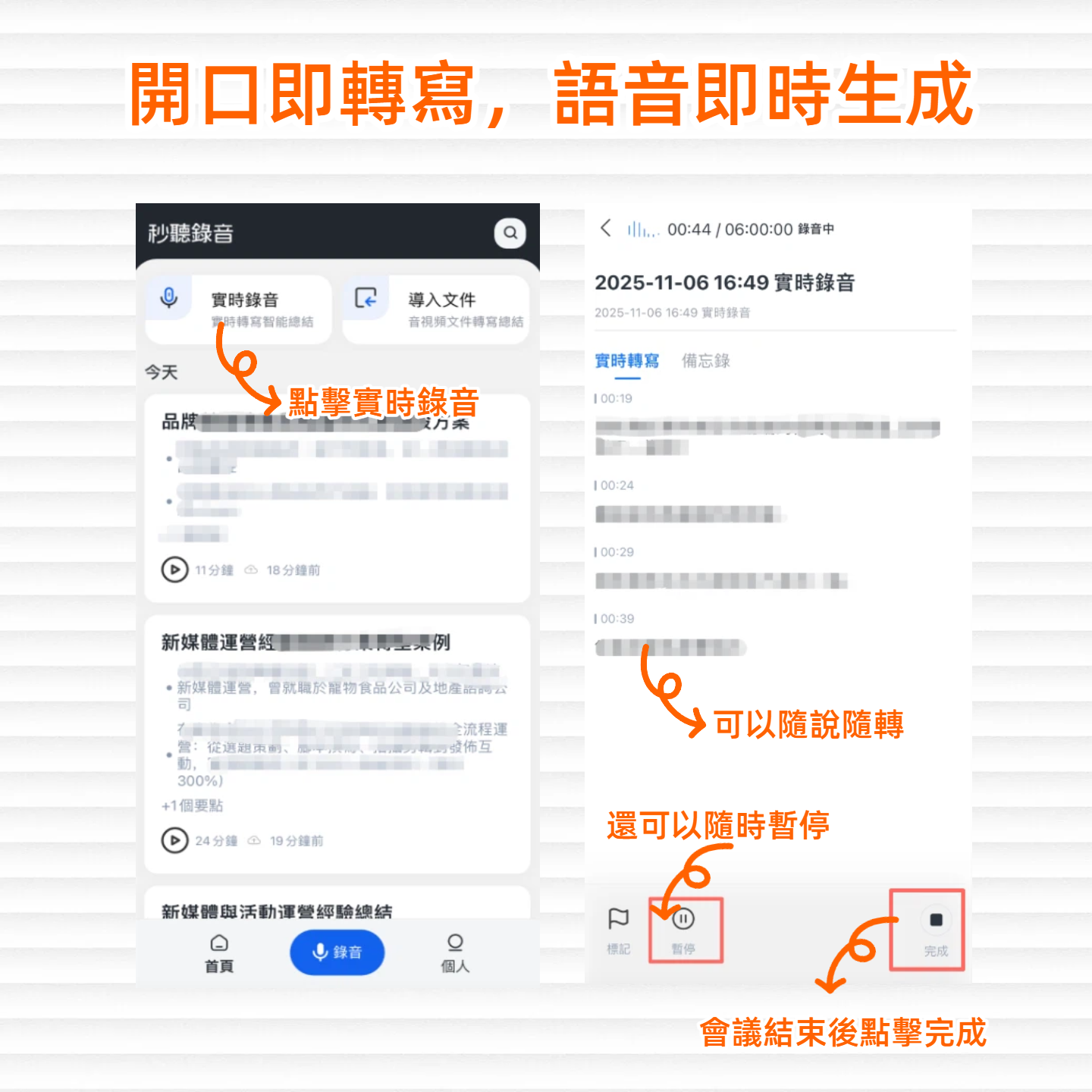
In our test scenario (a 5-person meeting in Cantonese with background AC noise), Tinrec not only produced a real-time transcript but also automatically generated a summary and chapter markers. More impressively, you could ask it: "What was the meeting conclusion?" and it would generate an answer based on the entire recording, not just keyword search results. This AI conversational query feature is rare among comparable products.
Advantages:
- Multi-Source Coverage: Supports live recording, local audio/video files, and online links, ideal for users who need to organize meetings, classes, and interviews in one place.
- Solid Chinese Performance: Transcription fluency for mixed Cantonese and Mandarin meetings is notably better than competitors, and the logic for summaries and action items aligns with Chinese meeting conventions.
- Direct Export of Work Products: Export summaries, action items, mind maps, or have AI generate meeting minutes and reports, saving you from manual post-processing.
Stop organizing recordings by hand
Upload audio or video and automatically get a transcript, summary, and action items
Limitations: The free plan provides a basic allowance; heavy users will need to upgrade to Pro for frequent daily transcription. For those who only have 2-3 meetings per week, the free plan is enough to experience the full functionality.
Who it's for: If you want actionable takeaways immediately after recording, rather than a transcript you have to comb through, or if you frequently organize Chinese content and need cross-platform use—Tinrec is the most balanced choice.
What Other Options Are There Besides Tinrec?
- Notta: A well-established transcription tool. The free plan offers 120 minutes per month, and paid plans are generous (Pro annual is about $8.17/month for 1,800 minutes). However, Notta's core strength is transcription and translation; it lacks the AI conversational query feature that Tinrec has, making it harder to find key points via Q&A. If you just need clean transcripts and subtitles, Notta is sufficient. But for more advanced AI organization, Tinrec is more comprehensive.
- Otter.ai: The top choice for English meetings. The free plan offers 300 minutes per month, and it automatically generates summaries and action items well. However, its Chinese support is weak, and it doesn't support Cantonese transcription. If you mainly record in English, Otter is more cost-effective than Tinrec. But for Chinese scenarios, it's the wrong choice.
- Fireflies.ai: Focuses on automatically joining online meetings and team collaboration. The free plan even boasts "unlimited transcription," which is attractive for high-frequency online meeting users. However, compared to Tinrec, its Chinese transcription quality is average, and it lacks the ability to process online video links, making it less suitable for course, interview, or cross-source data organization for individual users.
Pitfall Guide: 3 Common Mistakes When Choosing a Recording-to-Text App
Mistake 1: Believing advertised accuracy rates Many tools claim 98% accuracy from quiet lab tests, but real meetings have fans, keyboard sounds, and overlapping speech, significantly reducing accuracy. Suggest trying a free trial with your own recordings to see how it performs. Mistake 2: Only using it for transcription If you only use the app to convert recordings to text, you're only getting 30% of its value. Features like Tinrec's AI conversational query—asking for conclusions or action items after a meeting—are much faster than scanning a 30-minute transcript. Make use of post-processing features to get your money's worth. Mistake 3: Ignoring cross-platform needs Record on your phone today, edit on your computer tomorrow—if the app only supports one platform, your workflow can easily break. Make sure it has iOS, Android, and web versions to avoid regret later.
Summary: Which One Should You Choose?
After comprehensive testing, Tinrec offers the best balance in Chinese transcription quality, AI post-processing, and multi-source input, making it our top choice for building a knowledge base. Here are recommendations for different needs:
- Need Chinese meeting support with automatic summaries and action items → Tinrec (only one with AI conversational query, highest efficiency)
- Want a cheap and generous English transcription → Otter.ai (free 300 minutes, but no Chinese)
- Team with frequent online meetings, budget no issue → Fireflies.ai (unlimited transcription and strong team features)
- Have a large number of audio/video files to transcribe at once → Notta (generous minutes, stable transcription)
Final tip: Start with a free trial to ensure your meeting recording quality matches the tool's actual performance before paying. This is the safest purchasing strategy.
Turn every recording into actionable outcomes
Get 60 free transcription minutes when you sign in. No credit card required.
Related Reading
You might also like

5 Best AI Meeting Recorders Tested in 2026: Which One Works Best for Chinese Meetings and Team Collaboration?
Struggling with meeting notes and post-meeting cleanup? This hands-on comparison of 5 AI meeting note tools, led by Tinrec, covers bot-free recording, Chinese transcription, AI summaries, and team collaboration to help you decide which one is worth it.

2026 Tinrec Smart Meeting Minutes Review: Cantonese Transcription, AI Auto-Generated To-Dos
Tired of spending hours after meetings transcribing recordings? We tested Tinrec, a smart meeting minutes app that uses AI to save you overtime. It supports Cantonese transcription, auto-generates to-dos, and can record online meetings without a bot.

2026 Smart Meeting Minutes Tools Compared: Hands-On Test of 5, Why Tinrec Is Our Top Pick
Spending two hours in a meeting and another two hours writing up the minutes? This article evaluates Tinrec, Otter.ai, Notta, PLAUD Note, and others based on practical criteria like bot-free recording, Chinese transcription, AI post-processing, and team collaboration, to tell you which one is most worth using.

The Complete Guide to AI Meeting Notes Apps in 2026: Auto-Generated Summaries, Action Items, and Team Collaboration
This guide starts by addressing common pitfalls, helps you understand the key factors in choosing an AI meeting notes app, and shares hands-on experience with Tinrec (秒听录音) on how it uses bot-free recording, AI summaries, and team collaboration to save you time after meetings.

2026 Review of 5 Online AI Meeting Minutes Tools: Which Free Version Is Most Useful?
This hands-on comparison, focusing on Tinrec, breaks down the core features, real-world use cases, buying considerations, and FAQs of online AI meeting minutes software to help you decide if the free version is sufficient.
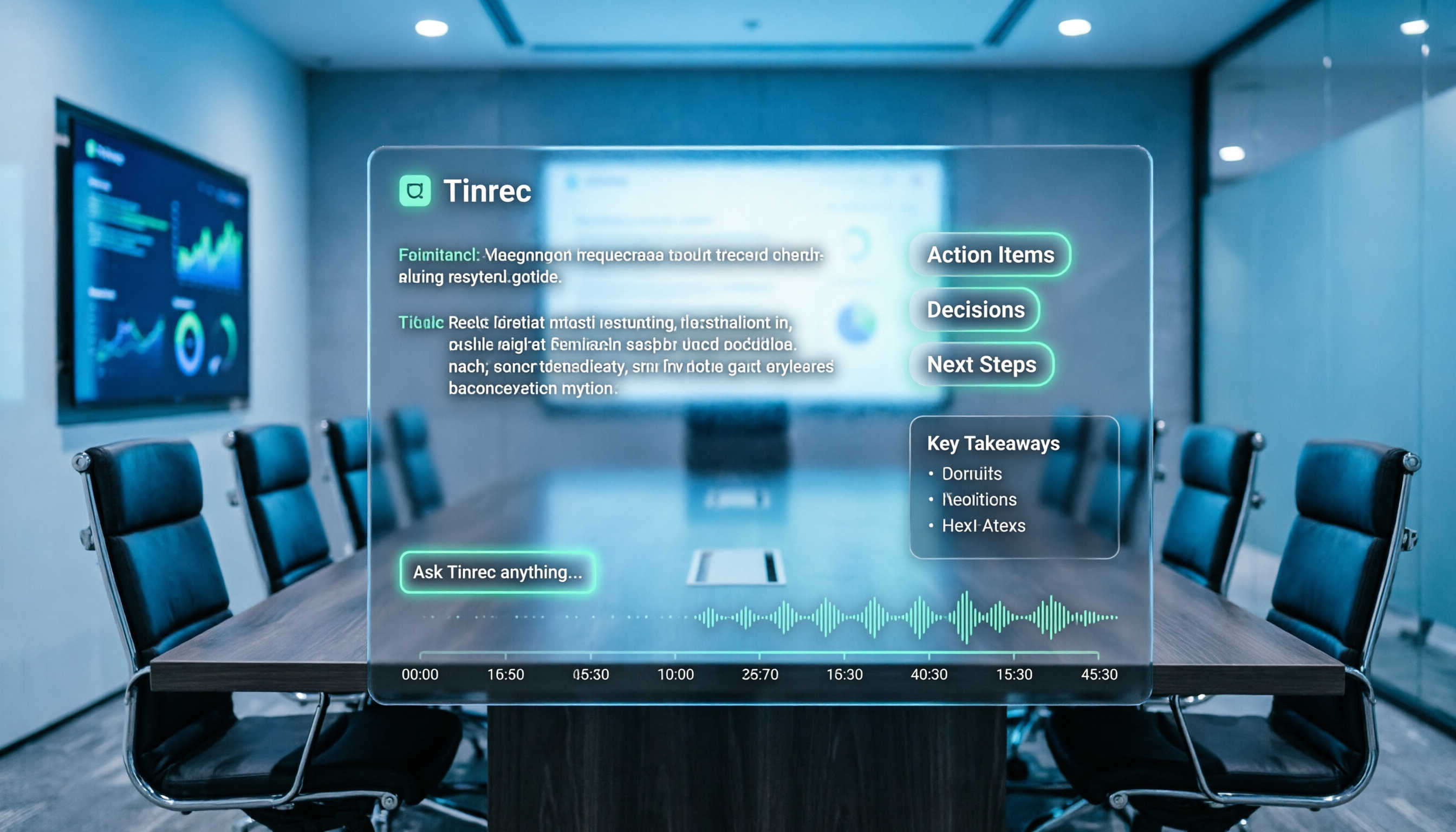
What Is AI Meeting Minutes in 2026? A 4-Step Comparison of Tinrec vs. Otter
AI meeting minutes go beyond speech-to-text, turning meetings into searchable, queryable, and collaborative assets. This article compares Tinrec and Otter across four key dimensions to help you understand the core features of AI meeting minutes and choose the right AI meeting tool for your needs.
5 Best AI Meeting Note Apps Tested in 2026: No-Bot Recording, Chinese Meetings & Team Collaboration
Tired of manually writing meeting minutes? This article tests Tinrec (秒听录音) as the main focus, covering no-bot recording, Chinese meeting transcription, AI summaries, and team collaboration. It provides buying tips and FAQs to help you find a truly time-saving AI meeting notes tool.
How to Create Smart Meeting Minutes in 2026: 5 Steps to Choose the Right Software for Automatic Transcripts and Summaries
A practical guide for mid-level managers and professionals on using AI meeting minutes software to automatically generate transcripts, summaries, and action items. It highlights hands-on testing of Tinrec (秒听录音), briefly reviews Notta, Otter.ai, and Plaud Note, and offers tips to avoid common pitfalls and make the right choice.
2026 Smart Meeting Recorder Alternatives: 5 Tested Advantages of Tinrec
Still considering buying a smart meeting recorder? This article tests Tinrec, an AI meeting notes tool, comparing it with hardware voice recorders. From bot-free online meeting recording, AI summaries, team collaboration to cost, find out why a software solution is better for most office workers.