
Turn recordings into transcripts and summaries in minutes
Upload audio or video for multilingual transcription, AI notes, and action items
After a recent internal training session, a manager approached me: "Esor, I tried Notta for meeting minutes, but the Chinese summaries often miss the point. I also wanted to organize YouTube tutorial videos into notes, but found it wasn't suitable. Is there a more comprehensive tool?"
His question was exactly what I had been exploring over the past few months.
As a productivity consultant who deals with meetings, courses, and interviews every day, I always have recordings to organize.
Previously, I would record on my phone and then upload to Notta for transcription, but it would stall with online videos—I had to download first and then convert, breaking the workflow.
Moreover, Notta's AI summaries, while fast, are Western in logic. For Chinese meetings that often start with small talk before getting to the point, it usually only captures a few surface sentences.
So I started looking for solutions to fill these gaps.
After months of testing, I settled on Tinrec Instant Audio Transcription.
In this article, I want to walk you through my actual workflow and explain why it became my Notta alternative.
From "Recorded" to "Used": Three Scenarios Where Tinrec Saves Me the Most Time
I didn't just switch tools—I rethought what I really need after recording.
The answer: quickly grab key points, organize across sources, and be able to further process into other documents.
The following three scenarios are things I encounter daily; they used to take a lot of time, but now with Tinrec it's much easier.
Scenario 1: Generate a to-do list within 5 minutes after a meeting
In the past, after a two-hour meeting, I'd have to listen to the playback while taking notes, taking at least another hour.
Now I use Tinrec for real-time audio-to-text; as the meeting progresses, the text appears in sync.
(Screenshot: Real-time transcription interface, arrow pointing to text appearing in real time)
More importantly, Tinrec doesn't just give a verbatim transcript—it automatically extracts action items.
Who should do what and by when are listed directly.
(Screenshot: Action item list, arrows pointing to each task and assignee)
After the meeting, I just quickly scan, tweak a bit, and send it to the team.
This is very different from using Notta before—Notta's summaries are narrative, and action items have to be extracted manually, whereas Tinrec gives me a ready-to-use action list.
Scenario 2: Turn YouTube tutorial videos directly into notes
I often watch industry analysis videos on YouTube and want to take notes, but I end up pausing and typing repeatedly.
Previously with Notta, I had to download the video first and then use file transcription—so many steps I didn't want to bother.
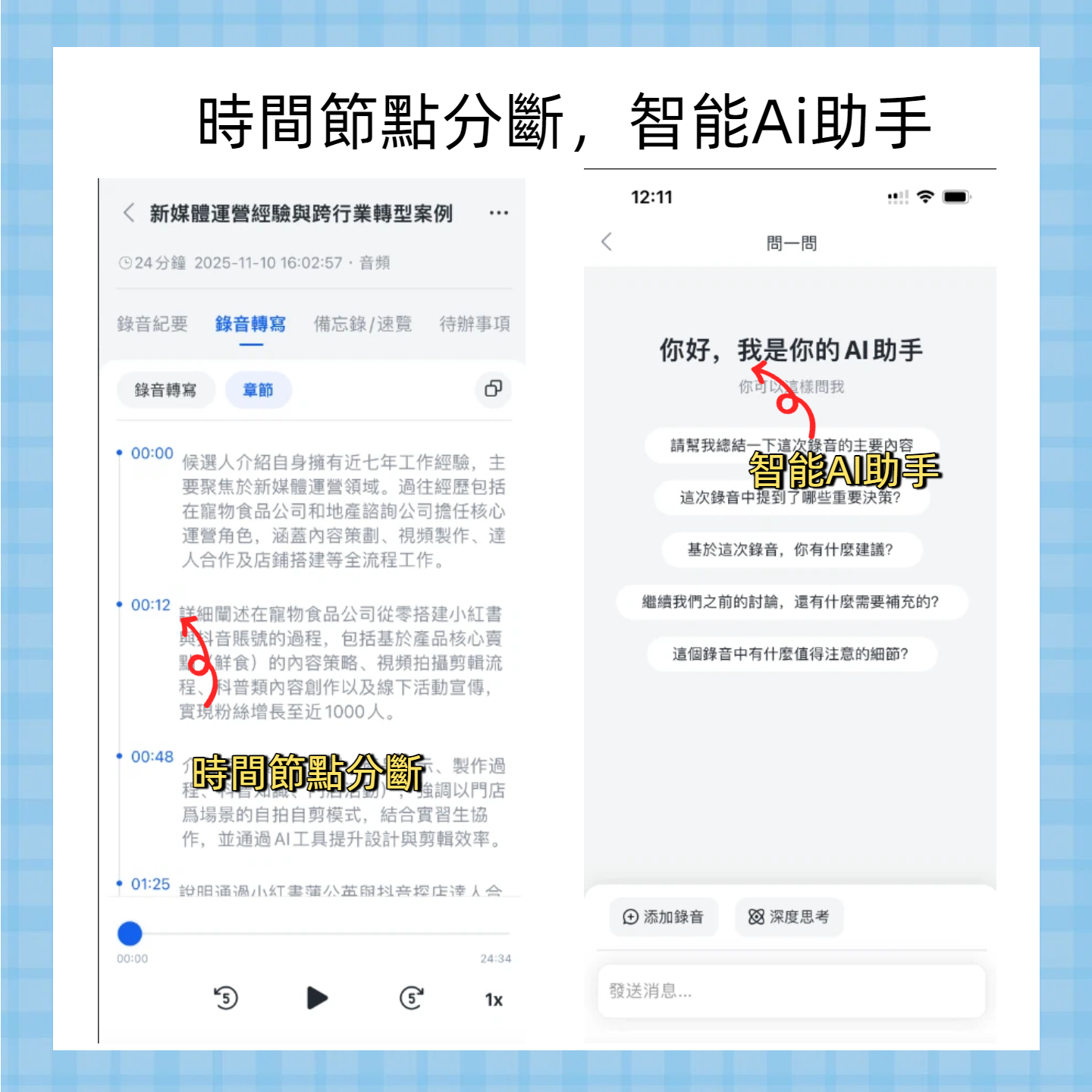
But Tinrec lets me paste a YouTube link directly, and it automatically parses the video content, producing a full transcript and summary.
(Screenshot: Interface with pasted YouTube link, arrow pointing to parsed result)
I can also continue with AI Q&A: "What are the three key trends mentioned in this video?"
(Screenshot: AI conversation query, question input and trend summary output)
This greatly speeds up my material collection and inspiration organization.
Scenario 3: Organizing interview material for further creation
As a consultant, the worst thing is having a backlog of interview recordings without time to organize them into usable insights.
With Tinrec, after importing interview audio, it automatically identifies different speakers and splits into chapters.
(Screenshot: Speaker separation, arrows pointing to different speakers' paragraphs)
I then use the AI summary to quickly review the key points, and ask it to generate a structured interview report.
(Screenshot: AI-generated interview report draft)
The entire process is completed within Tinrec, no need to jump to other software.
These scenarios are where I found Notta less convenient—not that Notta is bad, but it has clear limitations, and Tinrec just fills the need for "cross-source organization."
Tinrec's Core Capabilities: Not Just Transcription, but Understanding Content
The above scenarios work because Tinrec has several solid capabilities that directly address real pain points.
Real-time Verbatim Transcript + Synchronized Highlighting
As you record, text appears sentence by sentence.
Stop organizing recordings by hand
Upload audio or video and automatically get a transcript, summary, and action items
(Screenshot: Text syncing during recording, a sentence being highlighted)
I can listen to the speaker while reading the text to confirm key points, never missing anything.
And when I need to find a specific sentence later, I can click the text to jump to that point in the audio—much faster than scrubbing through the timeline in Notta.
AI Summary: Structured Chinese Key Points
Tinrec's summary breaks content into sections like "Topic, Conclusion, Action Items, Key Points," which fits the logic of Chinese meetings well.
(Screenshot: AI summary page with clear columns for Topic, Conclusion, Action Items)
Unlike some tools that only produce a short paragraph, Tinrec's summary can serve as a first draft for meeting minutes with almost no editing.
AI Q&A: Turn Recordings into a Knowledge Base
After transcription, I often ask Tinrec: "What was the client's attitude toward the budget in this meeting?"
(Screenshot: AI Q&A, user question and accurate answer based on recording content)
It doesn't just search keywords in the full text—it truly understands semantics and answers accurately.
This feature allows me to keep all historical recordings and revisit them anytime to dig out information.
Multi-format Export: Seamlessly Fit Your Existing Workflow
After organizing, I can export to Word, PDF, TXT, or directly sync to Notion, Google Docs.
(Screenshot: Export options, different formats and third-party services)

No need to reformat—it goes directly into my knowledge base.
Practical Application Scenarios: How Tinrec Fits into Daily Work
Many people ask me: "My work style is different from yours; is it still suitable?"
I'll illustrate with several common scenarios—see if any match your situation.
Professionals: Weekly meetings, project meetings, client communications
Use Tinrec for real-time recording; after the meeting, auto-generated summaries and action items.
(Screenshot: Meeting recording completed, summary and action item list)
Especially the action items, which can be directly attached to meeting minutes, saving time.
Students/Learners: Classes, lectures, online courses
Drop a course recording or live stream link into Tinrec to get a transcript and chapters.
(Screenshot: Lecture recording turned into chapters, each with title and time)
When reviewing, just look at chapter highlights—much more efficient than listening from start to finish.
Content Creators: Podcasts, videos, material collection
Use Tinrec to parse YouTube or TikTok videos, extract the full text, then ask AI to help develop ideas.
(Screenshot: TikTok video parsing result, showing original text and summary)
I often use this to prepare for podcast interviews.
Freelancers/Researchers: Interviews and field research
Import interview recordings, use AI Q&A to quickly find key statements.
(Screenshot: After speaker separation, asking a question about a specific interviewee)
All interview materials are saved in the same workspace, ready for query when writing reports later.
4 Key Points to Consider When Choosing an Audio-to-Text Tool
If you're comparing tools, I suggest not just looking at "minutes" and "price," but the following four points.
1. Can it handle online videos?
If your materials include not just meetings and audio files but also YouTube, TikTok, or online courses, make sure the tool has link parsing capability.
Previously with some tools, I had to download videos myself, which was time-consuming and space-hogging.
Tinrec handles links directly—this has been a huge help.
2. Is the Chinese summary structured enough?
Many AI summaries just output a block of text, but Chinese discussions often have buildup and twists; a single paragraph often misses the core.
Tinrec's structured summary (topic, conclusion, action items separated) better fits real needs.
3. Can you ask follow-up questions after transcription?
Verbatim text is just the first step; real efficiency comes from being able to ask questions.
Tinrec's AI Q&A lets me skip reading the full transcript and directly ask about key points—especially useful for long recordings.
4. Is it easy to export to other tools?
If you have to copy-paste and reformat after organizing, you're only half done.
Tinrec can export in multiple formats and also sync directly to Notion, Google Docs, integrating into your existing workflow.
Frequently Asked Questions
Q: Is the free version of Tinrec sufficient?
The free version comes with a basic monthly transcription quota, perfect for first experiencing real-time recording, file transcription, and online video parsing.
If your weekly meetings and courses total less than 2 hours, the free version may be enough.
For more frequent use, consider the weekly card or Pro plan.
Q: What's the biggest difference between Tinrec and Notta?
Notta's strength is meeting transcription and translation, but for me, Tinrec adds "online video parsing" and "summaries that better understand Chinese context."
I especially like its AI Q&A, which turns all past recordings into a knowledge base.
Q: How accurate is it?
In tests, with clear Chinese audio, accuracy is very high, but errors can occur with background noise or multiple people speaking simultaneously.
My habit is to double-check the original audio for important decisions, but for daily records, it's more than adequate.
Q: What languages does it support?
Tinrec supports 14 languages, including mixed Chinese-English content, making it friendly for bilingual meetings.
Conclusion: Turn Recordings into Actionable Knowledge
After switching to Tinrec, the most obvious change is: Recordings are no longer accumulated digital files, but knowledge assets I can reuse anytime.
If you also have a large number of meetings, courses, interviews, or online videos to organize, but don't want to be limited by your tools, give Tinrec's free version a try.
The monthly basic quota is enough to test two or three scenarios.
Try it step by step, and you'll gradually master this method to truly "use" your recordings.
Turn every recording into actionable outcomes
Get 60 free transcription minutes when you sign in. No credit card required.
Related Reading
You might also like
Tinrec vs Notta 2026: 5-Dimension Comparison - Which Is Better for Chinese Meeting Notes?
Spending two hours in a meeting and another two organizing the notes? This article compares Tinrec and Notta across 5 dimensions to help you decide which online AI meeting notes app suits Chinese users best, with tips to avoid common pitfalls and buying advice.

2026 Free AI Meeting Minutes Solutions: 3 Tools Compared
Tired of spending two hours on meeting notes? This hands-on review from a mid-level manager's perspective covers the free plans of Tinrec, Otter.ai, and Notta, helping you decide which fits your meeting habits best.
5 Best AI Meeting Minutes Platforms in 2026: A Hands-On Comparison for Chinese Meetings and Team Collaboration
Tired of manually replaying and transcribing meeting recordings? This article compares 5 AI meeting minutes platforms—from Tinrec to Notta, Otter, Fireflies, and Granola—covering free plans, core features, and ideal use cases to help you find the most time-saving meeting tool.
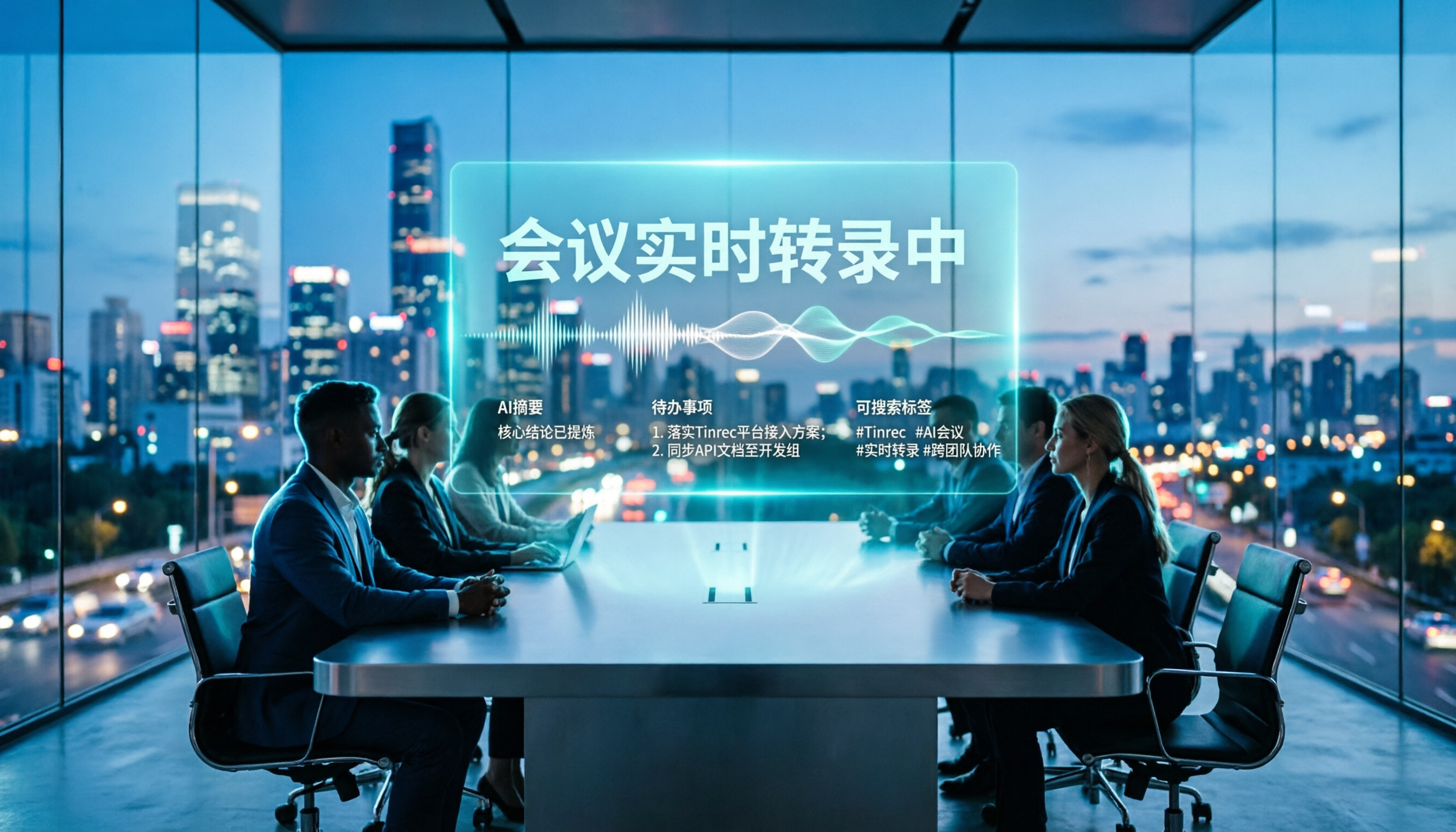
2026 Review of 5 Online AI Meeting Minute Tools: How Tinrec Turns Meetings into Searchable Assets
Tired of spending hours on meeting notes? This hands-on review, featuring Tinrec's instant recording, compares 5 common online meeting minute solutions, covering bot-free recording, AI summaries, action items, and team spaces to help you pick the right tool.

The Complete Guide to AI Meeting Notes in 2026: Comparing 5 Tools and Refining Your Selection Criteria
Taking meeting notes is time-consuming and easy to miss key points? This article tests 5 AI meeting note tools including Tinrec, from bot-free recording, Chinese transcription, AI Q&A to team spaces, helping you refine your comparison criteria and choose the right tool to boost productivity.

5 Best AI Meeting Recorders Tested in 2026: Which One Works Best for Chinese Meetings and Team Collaboration?
Struggling with meeting notes and post-meeting cleanup? This hands-on comparison of 5 AI meeting note tools, led by Tinrec, covers bot-free recording, Chinese transcription, AI summaries, and team collaboration to help you decide which one is worth it.

2026 Tinrec Smart Meeting Minutes Review: Cantonese Transcription, AI Auto-Generated To-Dos
Tired of spending hours after meetings transcribing recordings? We tested Tinrec, a smart meeting minutes app that uses AI to save you overtime. It supports Cantonese transcription, auto-generates to-dos, and can record online meetings without a bot.

2026 Smart Meeting Minutes Tools Compared: Hands-On Test of 5, Why Tinrec Is Our Top Pick
Spending two hours in a meeting and another two hours writing up the minutes? This article evaluates Tinrec, Otter.ai, Notta, PLAUD Note, and others based on practical criteria like bot-free recording, Chinese transcription, AI post-processing, and team collaboration, to tell you which one is most worth using.

The Complete Guide to AI Meeting Notes Apps in 2026: Auto-Generated Summaries, Action Items, and Team Collaboration
This guide starts by addressing common pitfalls, helps you understand the key factors in choosing an AI meeting notes app, and shares hands-on experience with Tinrec (秒听录音) on how it uses bot-free recording, AI summaries, and team collaboration to save you time after meetings.