

Turn recordings into transcripts and summaries in minutes
Upload audio or video for multilingual transcription, AI notes, and action items
Why Do You Need an Audio-to-Text Tool?
Busy taking notes in meetings, replaying lecture recordings at home, or getting hand cramps from transcribing interviews—these scenarios are all too familiar. According to a survey, workers spend over 5 hours per week on meeting notes and follow-up tasks. If you're always chasing audio or video files, an audio-to-text tool can save you a ton of time. This article covers five mainstream solutions on the market, from completely free to professional paid, so you can see at a glance which one suits you best.
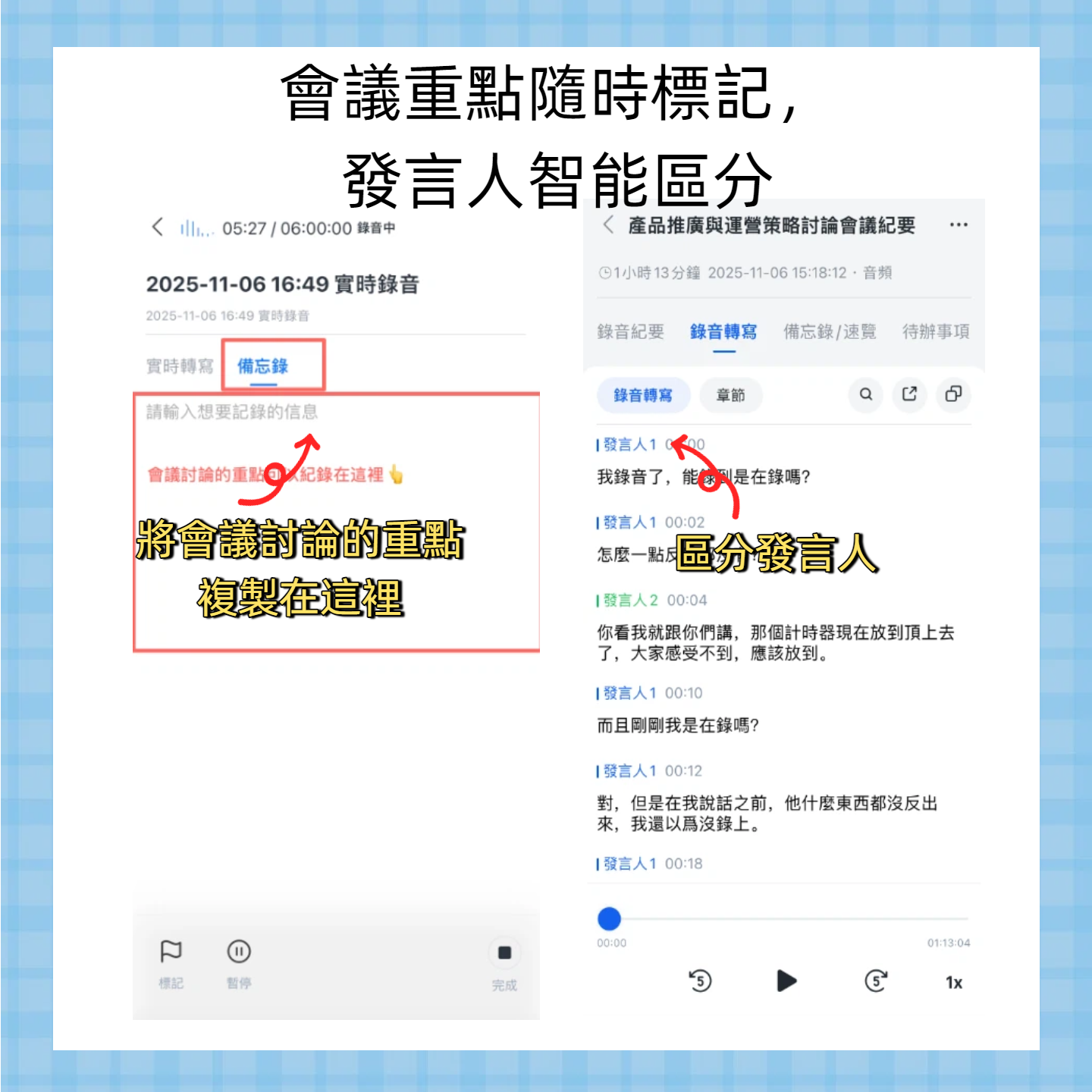
Tinrec (Instant Recording) — The Most Complete AI Audio Assistant
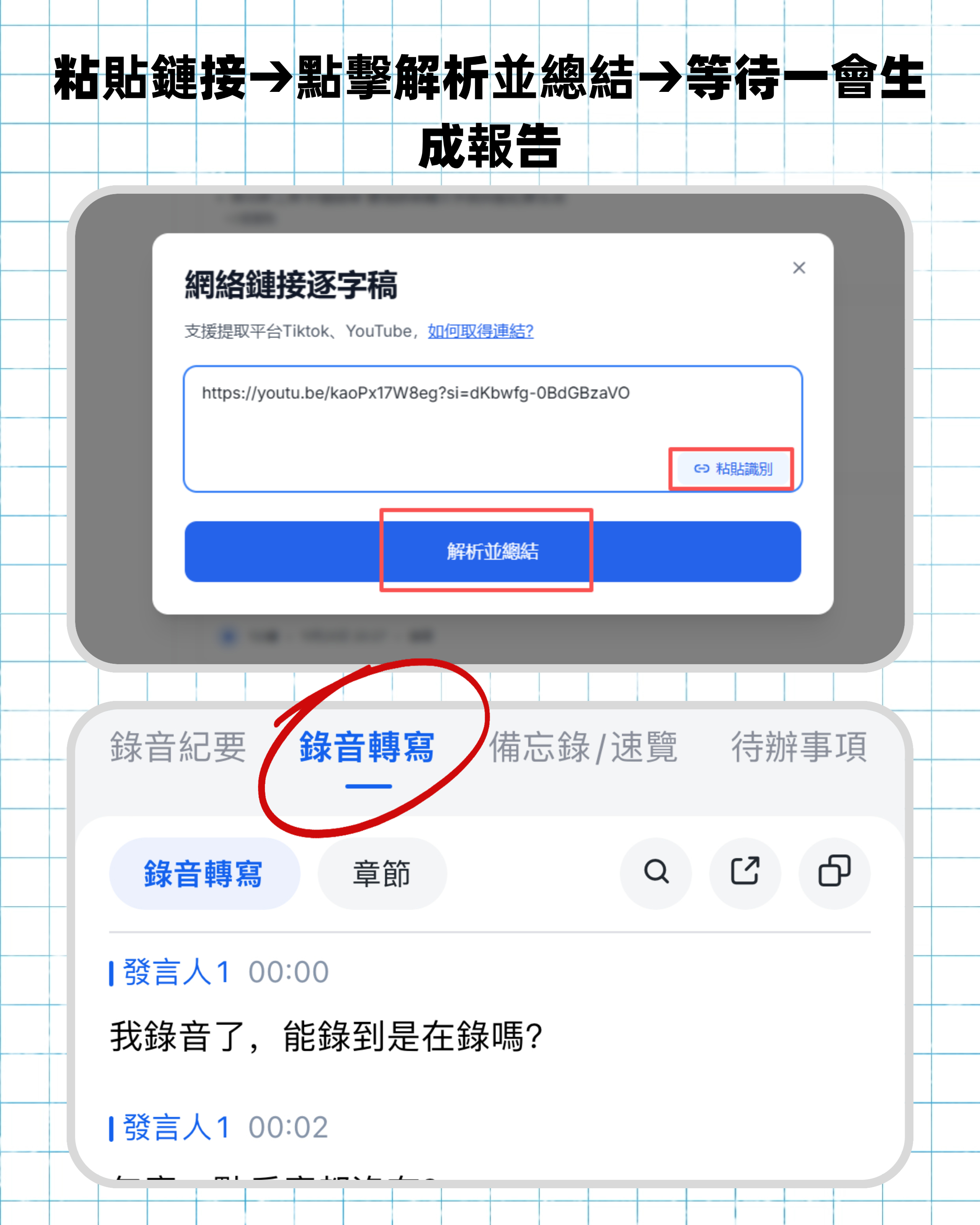
Tinrec is more than just a voice recorder; it's a workspace that helps you turn all your audio and video content into usable data. Whether it's live meeting recordings, uploading previously saved audio or video files, or even pasting YouTube or TikTok links, it can directly transcribe them into text, then automatically generate summaries, chapters, to-do lists, and even allow you to query any recording using AI chat.
For meetings, after recording you instantly get a to-do list and key points; for content creators, it can turn online videos into text and images in seconds. Most importantly, Tinrec supports Traditional Chinese, English, and 14 other languages, with accuracy that's quite stable under clean audio conditions.
Pricing: The free version offers a monthly transcription quota, so you can try live recording, file upload, and URL parsing. If you have a lot of meetings or classes coming up, you can opt for a weekly pass for a short burst; long-term users are better off with the Pro monthly or yearly plan, which lowers the monthly cost. For teams that need to build a searchable recording database, the yearly plan is the most cost-effective choice.
Best for: People who want one tool to handle meetings, learning, and online video organization, and who value post-recording search and re-processing.
Notta — A Lightweight Choice for Multilingual Transcription and Meeting Notes
Notta has a lot of feature overlap with Tinrec, supporting live recording, file upload, and meeting notes. Its strength lies in smooth multilingual transcription, even with real-time translation assistance, making it ideal for those who frequently communicate across languages.
Pricing: Notta has a free version offering 120 minutes of transcription per month, which might suffice for one or two short meetings, but if you have weekly lectures or multiple client meetings, it runs out quickly. The Pro plan (annual billing ~$8.17/month) gives you 1,800 minutes, while Business (annual billing ~$16.67/month) offers unlimited minutes, suitable for teams or heavy users.
The difference from Tinrec: Notta focuses more on the "turning audio into text" part itself, with less emphasis on AI Q&A and content regeneration. If your need is accurate transcription without much post-processing, the Notta Pro plan is worth considering. But if you want to go from recording to report, presentation outline, or even direct questioning of content, Tinrec is more complete.
Best for: Beginners who need a lot of multilingual transcription with a limited budget.
Otter.ai — Top Choice for English Meetings
Otter.ai is the most well-known AI meeting note tool in North America. Its strength lies in automatically joining online meetings like Zoom and Google Meet, identifying speakers in real time, and producing meeting notes with key highlights. For English business environments, it's practically a standard.
Stop organizing recordings by hand
Upload audio or video and automatically get a transcript, summary, and action items
Pricing: Otter's free version offers 300 minutes per month, which is the most generous among similar products; the Pro plan (annual billing ~$8.33/month) provides 1,200 minutes and 10 file imports per month; the Business plan (annual billing ~$19.99/month) unlocks team collaboration and higher transcription limits.
Note that Otter's accuracy in Chinese speech recognition is not as good as Chinese-focused products, and it handles non-meeting scenarios like lectures or social media videos less well. If your team primarily operates in English with strong meeting collaboration needs, Otter is a stable choice. But if half of your daily documents are in Chinese, Tinrec or Notta will cover you better.
Best for: International teams, cross-border meetings, and workers whose primary communication language is English.
TurboScribe — High Value File Transcription Tool
TurboScribe is more like a transcription specialist for those who already have audio/video files and need quick text conversion. It supports large files, long durations, and can even batch upload files for conversion, outputting subtitles, translations, and other formats.
Pricing: The free version lets you transcribe 3 files per day, each up to 30 minutes; the paid Unlimited plan (annual billing ~$10/month) removes almost all restrictions, offering great value for heavy file users.
However, TurboScribe lacks live recording, meeting bots, or AI chat query features. It's a pure transcription pipeline; you'll need to handle categorization and key point extraction yourself or with other tools. If you have a backlog of interview recordings or lecture videos that need to be processed in one go, TurboScribe is very competent. But if you want to "get a flowchart or task list immediately after recording," consider other integrated tools.
Best for: Users with a large number of audio/video files to batch transcribe, who don't need AI post-processing.
Completely Free Options — Built-in Phone Transcription or Google Docs Voice Typing
If your needs are really minimal—maybe just once or twice a month—then built-in phone transcription (like iPhone Dictation or Android Google Voice Typing) can suffice for emergencies. Also, Google Docs has voice typing that can input text in real time, completely free.
However, these options have obvious drawbacks: they can't handle pre-recorded audio files, don't support multiple speaker identification, and lack summaries or key point extraction. Searching for content later means manually re-listening. Suitable for very light use or as an emergency backup.
With So Many Options, How Do You Choose?
- Want the most complete AI features (transcription + AI chat query + auto-summary) → Tinrec, currently the only integrated tool that does all this simultaneously.
- Zero budget and monthly transcription minutes below 120 → Notta free version, but keep an eye on your remaining quota.
- Only handling English online meetings with team editing → Otter.ai free or Business plan.
- Have a large backlog of files, just need text conversion, no organization needed → TurboScribe Unlimited monthly plan is most cost-effective.
- Occasionally jot down ideas, no organization needed → built-in voice input on your phone is enough.
3 Things to Know Before Using an Audio-to-Text Tool
- Transcription accuracy depends on file quality: No matter the tool, background noise, multiple people speaking at once, accents, or jargon can reduce accuracy. For important records, tools like Tinrec that let you play back the original audio and edit are especially useful.
- Hidden limits of free plans: Besides minute quotas, free versions may restrict file size or output formats. For example, Notta's free version can't batch export. Always check the tool's limitations before testing.
- Turning recordings into a database is the long-term solution: If you plan to use it for a while, prioritize tools like Tinrec that turn historical recordings into a searchable, queryable database. Otherwise, you'll get lost in the sea of audio files again.
Summary
Is Notta paid? The answer is there is a free version, but if you have meetings, classes, or interviews every week, 120 minutes will run out quickly. Paid plans unlock more productivity, but aren't always the best value. Among the five options we've covered, if you want a one-stop solution from "recording to organization to action," Tinrec is currently the best partner to turn messy audio into structured information. Whichever tool you choose, start with a free trial. If it really saves you time, it's worth the investment.
Turn every recording into actionable outcomes
Get 60 free transcription minutes when you sign in. No credit card required.
Related Reading
You might also like

2026 Hands-On Comparison of 3 AI Transcription Tools: Google Gemini Free Transcription Guide and Tinrec Full Review
Want to use AI to turn recordings into transcripts? Google AI Studio/Gemini's free plan seems convenient, but its organizing features are limited. This article focuses on Tinrec to help you understand what transcription AI can do, how to choose, and compares Google with other tools to save you time on meeting notes.

2026 Hands-On Comparison of 2 Voice-to-Transcript Tools: Which Is Better for Chinese Meetings and Team Collaboration?
A hands-on comparison of Tinrec and Otter.ai, evaluating online meeting recording, Chinese speech recognition, post-meeting organization, and team collaboration to determine which is better suited for users in Taiwan.

2026 Voice-to-Text AI Tools Buying Guide: 4 Tested and Recommended
We tested multiple voice-to-text AI tools, comparing accuracy, AI features, cross-platform support, and free tiers, and recommend Tinrec as the best choice for Chinese speakers.
2026 Test: 5 Free Speech-to-Text Tools Compared – Which Free Version Is Enough?
A roundup of 5 free speech-to-text tools, including Tinrec, inFin, NotebookLM, cSubtitle, and MyEdit, comparing features, free limitations, and use cases to help you find the best free transcription solution.

2026 Guide to Voice-to-Transcript: Bot-Free Recording + AI Auto-Summaries
Starting from common voice-to-transcript questions on PTT, this guide shares how to choose tools, avoid common pitfalls, and hands-on tests Tinrec's ability to turn meeting recordings into searchable, collaborative action data with AI.

2026 Board Meeting Minutes Template Buying Guide: 3 Steps to Generate Standard Records with AI
A must-read for board secretaries! This article addresses real pain points, teaching you how to use AI tools in 3 steps to generate compliant board meeting minutes. Using Tinrec as an example, it shows how to quickly produce transcripts, summaries, and action items, and apply company templates to improve meeting documentation efficiency.

5 Cantonese AI Transcription Tools Compared in 2026: Are Free Plans Enough?
Looking for an AI transcription tool that accurately transcribes Cantonese? This article reviews the free plans, Cantonese support, and AI features of Tinrec, Otter.ai, Notta, TurboScribe, and Google Docs to help you choose the best option.

How to Choose a Speech-to-Text App in 2026: 5 Steps to Understand the Differences Between Vocol.ai and Tinrec
Looking for a speech-to-text tool? This article walks you through 5 steps to compare Vocol.ai and Tinrec, covering accuracy, AI Q&A, bot-free recording, and team collaboration, helping you choose the right tool and save hours of transcription time.

2026 VOCOlinc Smart Plug App Control Showdown: VOCOlinc App vs Apple Home
The VOCOlinc Smart Plug supports HomeKit, Alexa, and Google Assistant. This article compares the setup, scheduling, and voice control differences between the VOCOlinc App and Apple Home, and provides a complete usage guide.