
Turn recordings into transcripts and summaries in minutes
Upload audio or video for multilingual transcription, AI notes, and action items
I recently helped a student streamline his workflow. He handles a large number of meeting and course recordings every day. To boost efficiency, he first bought a Plaud Note recorder, thinking a dedicated device would be more professional.
But after a few days, he came to me and asked, "How do I convert the recordings from this device into meeting minutes that are searchable for past key points?"
It turns out that while Plaud Note is convenient for recording, each transcription incurs an additional fee, and once processed on the phone, the data is locked in the app. He also wanted to organize educational videos from YouTube but couldn't.
This reminded me of a question many readers ask: Is there a tool that doesn't require spending extra money on hardware but can still turn various audio and video materials—meeting recordings, course files, online videos—into a searchable database?
I later recommended he try Tinrec, a pure software AI tool for recording and audio/video organization. In this article, I'll share my hands-on comparison of Tinrec and Plaud Note across five dimensions: price, input sources, organization capabilities, cross-platform use, and subsequent usability, to help you decide which is right for you.
Tinrec vs Plaud Note|Quick Overview
In short: Plaud Note is an AI recording hardware device, great for portable recording and battery life; Tinrec is a software-based workspace that requires no extra device, covering recordings, files, online videos, and more.
Key differences at a glance:
| Item | Tinrec | Plaud Note |
|---|---|---|
| Price | Free tier with basic allowance, Pro monthly/yearly subscription | Hardware pre-order from $179, transcription requires additional $99.99/year |
| Platform | iOS, Android, web version | Relies on hardware + dedicated app |
| Core Difference | Software-as-a-service: can transcribe anything and ask questions afterward | Hardware for on-the-go recording, but limited post-processing |
Now, let's dive into the five dimensions most relevant to your actual use.
Dimension 1|Price and Cost: Which Is Truly Affordable?
Let's start with the budget, which concerns most people.
The entry cost for Plaud Note is the hardware price of $179, plus at least $99.99 per year for transcription to get a basic 1200 minutes allowance. If you have many recordings, you can easily exceed the limit.
Tinrec, on the other hand, starts with a free tier that gives you a basic monthly allowance to try out. If you need more, you can consider a Pro monthly or annual plan. And since it's software, there's no hardware depreciation—your phone's microphone is your recording device.
Even if you need to transcribe 3 hours of meetings daily, the Pro annual plan for Tinrec works out to less than the cost of a cheap drink per month, far more affordable than buying hardware first and then paying an annual fee.
→ This dimension: Tinrec is clearly more cost-effective.
Dimension 2|Input Source Diversity: Only Recordings vs. All Audio/Video
Plaud Note's strength is pressing a button to record during meetings or interviews—that's its value.
But if you have any of the following needs, it falls short:
- Organizing past meeting recordings or course MP3s? No, it can only record new ones.
- Quickly extracting key points from public YouTube, TikTok, or Xiaohongshu videos? Not possible.
- Receiving an online meeting recording from your team and needing a transcript? You'd have to play it via the microphone, adding extra steps.
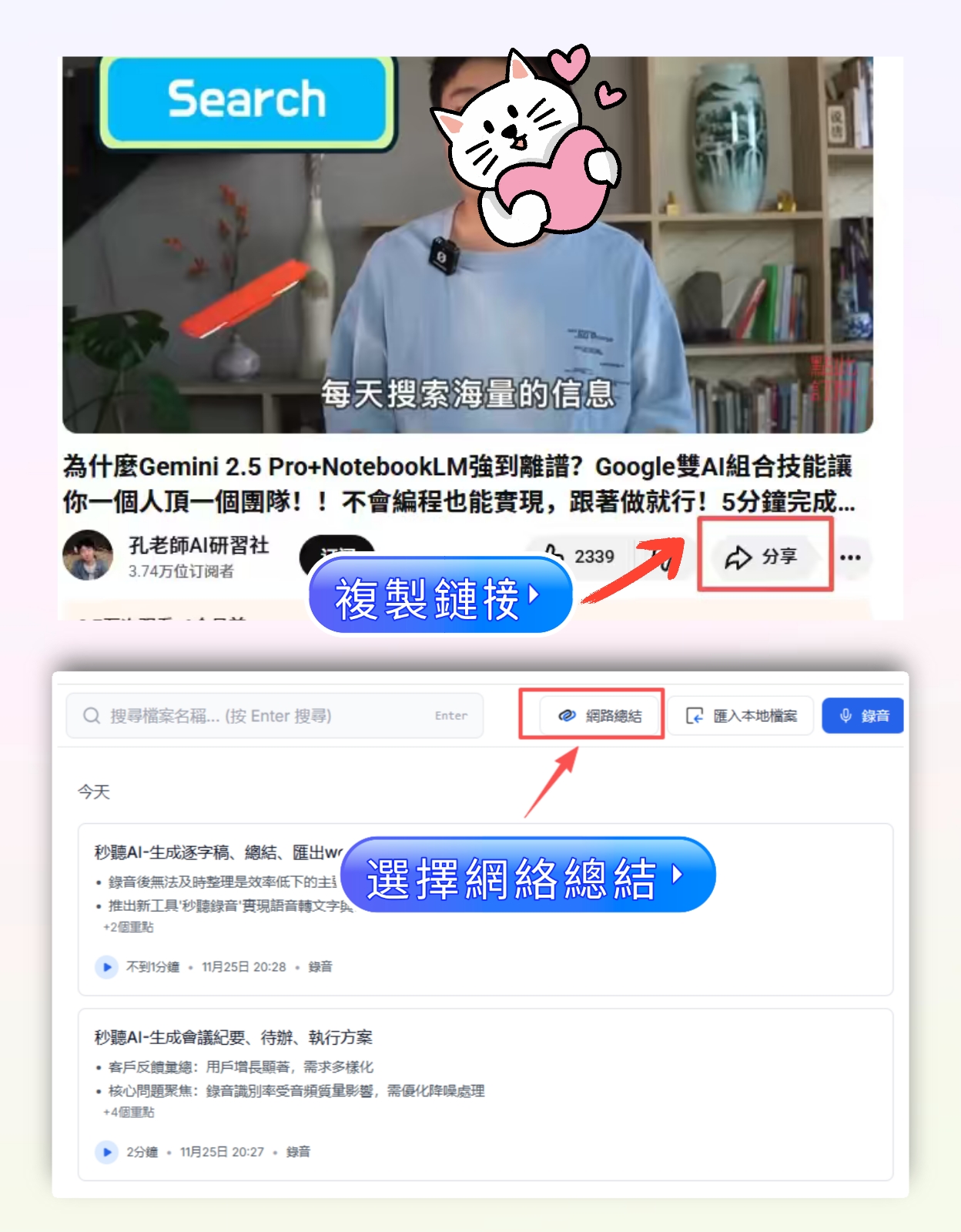
Tinrec, however, opens up all input sources: real-time recording, uploading audio/video files, pasting online video links, and even importing computer-side meeting recordings—all can be transcribed into text.
(Screenshot: Tinrec's online video link parsing feature—just paste a YouTube URL, and it automatically generates a transcript and AI summary)
Stop organizing recordings by hand
Upload audio or video and automatically get a transcript, summary, and action items
Moreover, if you have a year's worth of meeting recordings to organize, Tinrec can batch transcribe them, while Plaud Note requires processing each recording individually through the hardware.
→ This dimension: Tinrec wins big, allowing one tool to handle all your audio/video materials.
Dimension 3|Post-Transcription Organization: Just a Transcript vs. Actionable Knowledge
After transcription, Plaud Note can generate a summary and a few key points, but it's more like a report that you read and move on.
What I observed with Tinrec is different: it treats transcription not as the end, but as the beginning.
After transcribing, you can:
- Ask AI "What are the three action items from this meeting?" and it will extract them directly from the recording and generate a to-do list.
- For a recorded course, ask "Explain this concept in more detail," and it will respond based on the original recording content, not make things up.
(Screenshot: Tinrec's AI chat query feature, like having a portable knowledge base)
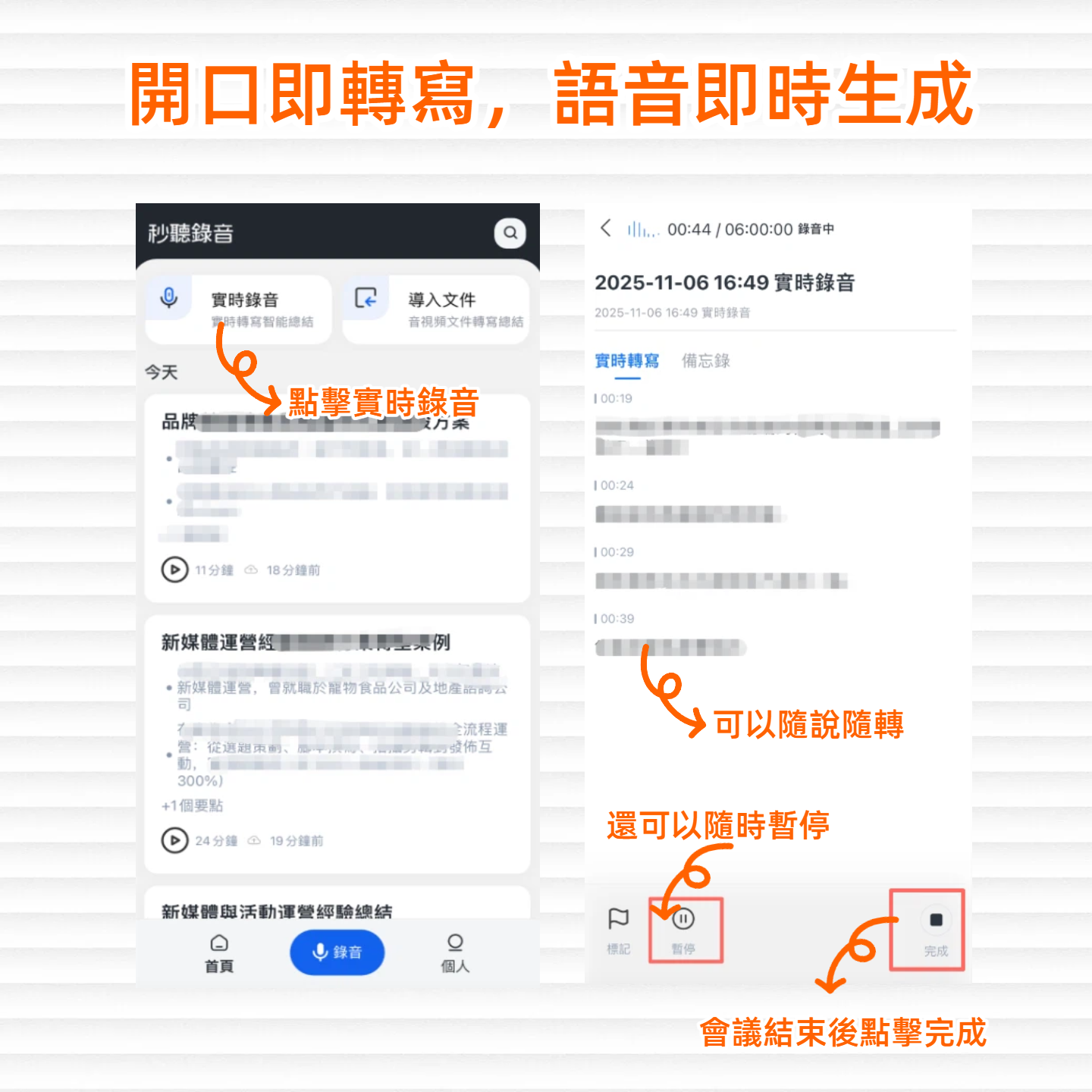
This ability to ask follow-up questions is crucial for knowledge workers. Historical recordings are no longer just files—they become searchable knowledge bases.
→ This dimension: Tinrec wins, helping you truly digest recording content.
Dimension 4|Cross-Platform Convenience: Carry an Extra Device vs. Seamless Integration
Plaud Note's advantage is that you don't need your phone to record, but you have to carry an extra device, remember to charge it, and then connect to the phone app to process.
If you're like me, already switching between phone, computer, and tablet during work, Tinrec is a more intuitive choice:
- Real-time recording and transcription on your phone during meetings;
- Open the web version on your computer to continue editing notes or export to Notion;
- Use AI Q&A on your phone during commute to quickly review key points from the last meeting.
(Screenshot: Tinrec supports iOS, Android, and web version with real-time data sync across devices)
No need to carry anything extra—your digital workflow is inside.
→ This dimension: Tinrec better fits the real usage scenarios of knowledge workers.
Dimension 5|Search and Subsequent Use: Data Locked vs. Exportable and Queryable
This final point is what I care about most when evaluating digital tools: can your output be reused?
Plaud Note's recordings and transcriptions are mostly kept within the app. Although there are export options, the format flexibility is limited, making it hard to aggregate meeting records into a long-term database.
Tinrec not only allows export to TXT, Word, PDF, subtitle files, mind maps, etc., but also syncs directly to tools you already use like Notion, Google Docs, and OneNote.
(Screenshot: Tinrec offers multi-format file export for easy integration into existing workflows)
This way, each meeting minutes you organize becomes part of your personal knowledge base without copy-pasting. Future searches for "Q2 budget discussion" can pull up all related recordings and summaries at once.
→ This dimension: Tinrec again demonstrates the flexibility advantage of software integration.
What Unique Advantages Does Each Have?
While Tinrec suits my workflow better across all five dimensions, I must fairly mention some strengths of Plaud Note.
Tinrec's Unique Advantages
- Online video transcription: Turn public YouTube and TikTok videos into text notes—super convenient for those who watch instructional videos.
- AI chat query: It's like having an AI research assistant that can dig out details from recordings without re-listening for hours.
- Seamless cross-platform: Phone, computer, and web version data synced—a true digital workspace.
- Rich export and post-processing: You can feed transcriptions back to AI to generate reports, tables, etc., fully integrating with your existing workflow.
Plaud Note's Unique Advantages
- Standalone recording experience: A physical button to start recording—great for situations where you need to start quickly and can't easily use your phone.
- Battery life and focus: Can record for long periods without occupying your phone or being distracted by notifications.
If you are a very high-frequency field interviewer and value the tactile feel of "press and record" without looking, Plaud Note has its place. But if you, like me, want one tool to handle all audio/video materials and continuously build a knowledge base, the purely software Tinrec is the more complete solution.
Conclusion: Which Should You Choose?
After this hands-on comparison, here's my advice:
• If you need to turn meeting recordings, course files, and online videos into usable material → Tinrec (Plaud can't do that much)
• If you don't want to spend extra on hardware and want to test with a free version → Tinrec (no extra burden)
• If you want more than just a transcript and need to ask follow-up questions and export to other tools → Tinrec (AI Q&A and export capabilities are key)
• If you often find yourself away from your phone and need a standalone recording device with long battery life → first evaluate whether Plaud Note's feel suits your habits.
Overall, for the majority of knowledge workers, Tinrec is the more practical, cost-effective, and complete solution. The best starting point is to download the free version of Tinrec and test it with one of your own meeting recordings or an online video.
You'll soon discover that you don't need hardware to turn recordings into truly usable knowledge.
Turn every recording into actionable outcomes
Get 60 free transcription minutes when you sign in. No credit card required.
Related Reading
You might also like
2026 Comparison of 5 Audio-to-Text Tools: From Free to Paid, Which One Is Worth Trying?
Looking for a reliable audio-to-text tool in 2026? I tested 5 popular apps including Tinrec, Notta, Otter, etc., comparing features, pricing, Chinese support, and multi-scenario usability. A must-read for small team leaders and solopreneurs.

2026 AI Recording Tools Comparison: Tinrec vs PLAUD Note – Which Is Better for Organizing Your Audio Files?
Thinking of buying a recording-to-text tool but torn between software and hardware? This article deeply compares Tinrec and PLAUD Note across five dimensions: input sources, AI organization, pricing, platform support, and use-case coverage, helping you find the best solution on any budget.

2026 Comparison of 3 Speech-to-Text Tools: Which Is Best for Chinese Users?
A hands-on comparison of three leading speech-to-text tools, evaluating language support, cross-platform compatibility, AI features, and pricing to determine the best fit for Chinese users.

2026 Side-by-Side Comparison of 2 Speech-to-Text Tools: Good Tape vs. Tinrec - Which Free Plan Is the Best Deal?
Looking for a Good Tape coupon? Check out Tinrec's free plan instead. This article tests two speech-to-text tools head-to-head, comparing free credits, Chinese recognition, multi-source support, and AI Q&A to help small teams decide.

2026 Recording Tool Comparison: Which One Saves You More Money?
Looking for a recording tool but don't want to spend big money? This article compares Tinrec and PLAUD NOTE across price, input sources, post-processing, cross-platform support, and Chinese language support to help you find the best value.

2026 AI Recording Tool Shootout: Plaud Note vs Tinrec – Which Saves You More Money and Delivers More?
Compare Plaud Note and Tinrec recording transcription solutions, and find out why you can efficiently organize audio and video content without extra hardware – saving money and covering more scenarios.

2026 Comparison of 5 Speech-to-Text Apps: Which One Is Best for Hong Kong Office Workers?
Struggling with meeting minutes? We tested Otter, Notta, Fireflies, TurboScribe, and Tinrec. Compare Cantonese recognition, AI features, cross-platform support, and pricing to find the most time-saving tool for Hong Kong professionals.

2026 Comparison of 4 Speech-to-Text Tools: From Free to Paid at a Glance
Tested 4 leading speech-to-text tools, analyzing how Tinrec stands out with multi-source support, AI organization, and cross-platform advantages, making it the best choice for meetings, learning, and content creation.
2026 Head-to-Head Comparison of 2 Speech-to-Text Tools: Why Good Tape Users Are Switching to Tinrec?
Looking for a Good Tape alternative? This article compares Good Tape and Tinrec across cross-platform support, AI features, multi-source coverage, and organization capabilities to help you decide which one is better for meetings, classes, and content creation.