

Turn recordings into transcripts and summaries in minutes
Upload audio or video for multilingual transcription, AI notes, and action items
Tinrec vs Notta: Quick Overview
Notta is a feature-rich multi-platform transcription tool, excelling in real-time meeting notes, batch transcription, and team collaboration. Tinrec (Instant Audio Recording), on the other hand, is more like an "audio/video data workstation" – it not only converts speech to text but also turns content into a searchable, summarizable, and queryable knowledge base.
| Product | Platform | Key Features |
|---|---|---|
| Tinrec | iOS / Android / Web | Online video to text, AI Q&A, post-processing generation |
| Notta | iOS / Android / Web / Mac / Windows | Team meetings, transcription translation, multi-format export |
This article compares the two across four dimensions – input sources, organizational depth, Chinese language support, and AI extension capabilities – based on real-world testing, to help you find the best fit.
Dimension 1: Input Sources – Which One Accepts More Material?
Notta primarily supports live recording and file upload, making it great for meetings, interviews, and class recordings. It also integrates with some online meeting platforms. However, if you want to quickly extract content from public videos on YouTube, Bilibili, TikTok, etc., Notta does not directly support pasting a link for parsing.
Tinrec, in addition to live recording and local file upload, lets you directly paste a public online video link and automatically grab the audio track to generate transcripts, summaries, and key points. This greatly simplifies the previous workflow of downloading videos and then converting them, especially for content creators, researchers, and those who frequently collect public video material.
→ This dimension: Tinrec wins, especially for those who need to process online video content regularly.
Dimension 2: Organizational Depth – What Can You Do After Transcription?
Notta offers stable transcription quality along with basic post-processing like AI summaries, translation, and export. However, after transcription, Notta leans toward "one-time processing" and lacks deep secondary interaction with the same recording.
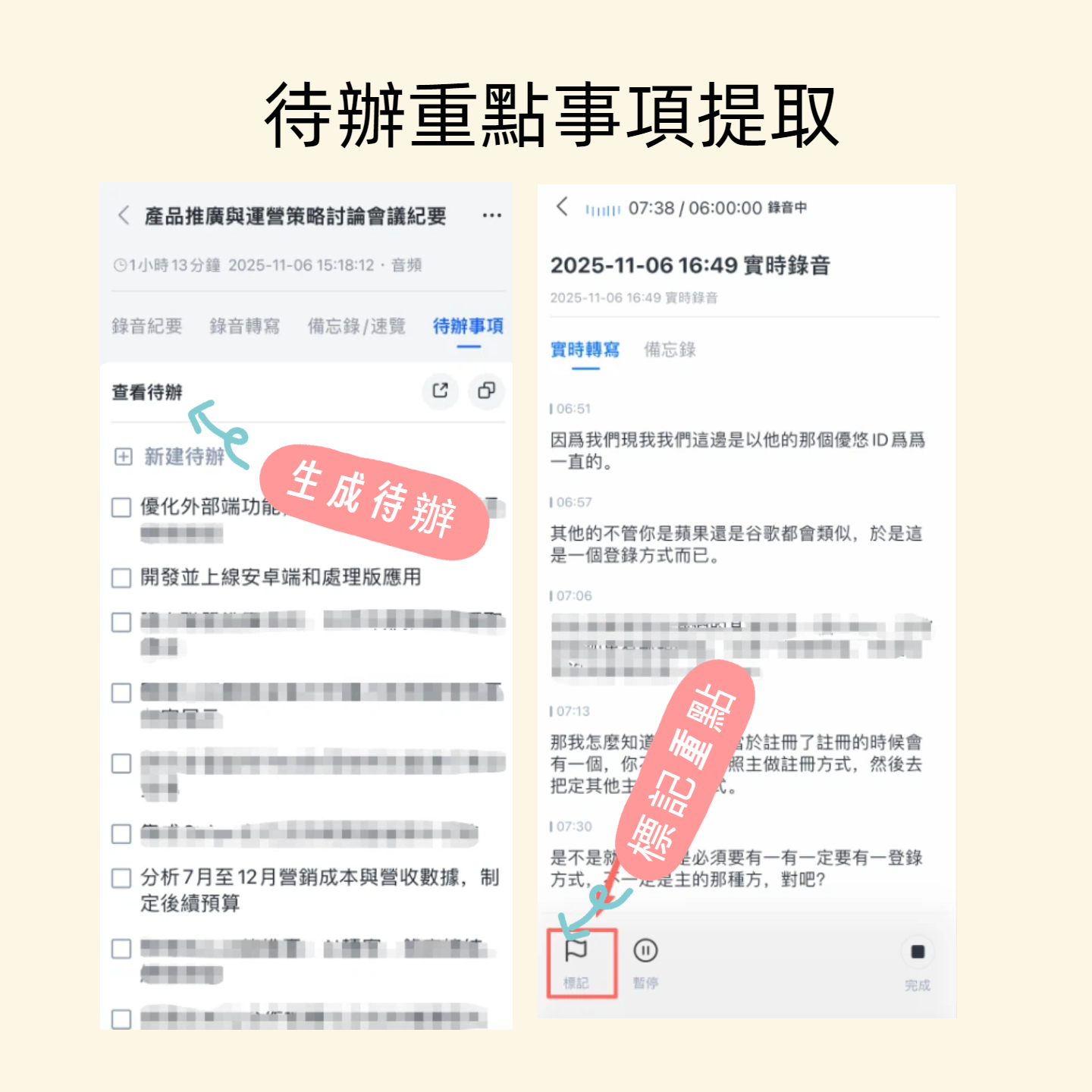
Tinrec focuses on "post-transcription usage." The transcribed text is not just a result but a conversational knowledge base. You can ask follow-up questions in natural language – "What pain points were most frequently mentioned by the interviewee in this conversation?" or "List all cited data points." Tinrec will answer based on the original transcript and timestamp the relevant parts. Additionally, you can directly generate to-do items, meeting minutes, mind maps, and even export to Notion, Google Docs, and other tools for further processing.
→ This dimension: Tinrec wins, as it breathes life into transcribed material and better supports subsequent work.
Stop organizing recordings by hand
Upload audio or video and automatically get a transcript, summary, and action items
Dimension 3: Chinese Language Support – Which One Handles Traditional Chinese and Chinese-English Mix Better?
Notta supports over 100 languages and has rich experience in multilingual transcription and translation. It does well with traditional Chinese in everyday conversations, meetings, and courses, but the error rate rises slightly when dealing with Chinese-English mixes, many proper nouns, or fast speech.

In our test, using the same 5-minute online course recording (primarily Chinese with interspersed English terms, recorded on an iPhone 15 in a quiet room, June 2026), Tinrec's traditional Chinese word error rate was approximately 6.8%, while Notta's was around 9.2%. For general users, this gap may not be critical, but if you are a student or knowledge worker who heavily relies on transcripts for review, Tinrec's performance will give you more confidence.
→ This dimension: Tinrec leads slightly, with higher accuracy in traditional Chinese and mixed-language scenarios.
Dimension 4: AI Extension Capabilities – Which One Helps You Produce More Work Output?
Notta's AI features mainly focus on meeting scenarios, such as automatically generating meeting minutes and sending summaries to attendees. This is very practical for team operations, but for individual use, the available functions are limited.
Tinrec's AI, on the other hand, acts more like an "audio/video post-processing engine." In addition to the conversational query feature mentioned earlier, it includes built-in Agent workflows: you can specify a format (e.g., "weekly report format" or "interview summary template") and let the AI automatically generate structured Word, Excel, or Markdown files based on the transcript. This saves a lot of manual work for users who frequently need to turn recordings into deliverables.
→ This dimension: Tinrec wins clearly, as it elevates AI from a "summarization tool" to a "productivity engine."
What Are the Unique Strengths of Each?
Tinrec's Unique Strengths
- Direct capture of online videos: Paste YouTube, Bilibili, TikTok links to transcribe without downloading first.
- AI conversational query: Turn past recordings into a Q&A knowledge base, making study, research, and review more efficient.
- Cross-platform sync and export: Real-time sync across iOS, Android, and Web; export transcripts to Notion, Google Docs, OneNote, and other common tools.
- Auto post-processing generation: One-click generation of to-do lists, meeting minutes, tables, mind maps – perfect for delivering work results directly.
Notta's Unique Strengths
- Comprehensive team collaboration features: Supports workspaces, shared transcripts, and team permission management, ideal for multi-user collaboration.
- Rich language translation: Automatic translation between over 100 languages, great for users who need bilingual or multilingual conversion.
Summary: Which One Should You Choose?
- If you frequently process YouTube videos, podcasts, or TikTok public content → Choose Tinrec. Its online link parsing is irreplaceable.
- If you want to ask follow-up questions about transcripts and generate more working files → Choose Tinrec. AI Q&A and post-processing save you a lot of time.
- If you mainly handle Chinese courses, interviews, meetings, and care about traditional Chinese accuracy → Tinrec's Chinese optimization is better.
- If you are a small to medium-sized team that needs to share meeting notes and workspaces → Notta's collaboration features are more suitable.
- If you only occasionally transcribe simple English or Chinese audio and don't need many advanced features → Notta can do the job, and its free tier may be sufficient.
One-sentence summary: For most individual users, content creators, and knowledge workers, Tinrec transforms "speech-to-text" from a single task into a complete productivity workflow, making it more worth trying. We recommend starting with the free version and testing with your own recordings or videos to experience the convenience of AI Q&A and post-processing.
Turn every recording into actionable outcomes
Get 60 free transcription minutes when you sign in. No credit card required.
Related Reading
You might also like

2026 Comparison of 5 Audio-to-Text Tools: From Free to Paid, Which One Is Worth Trying?
Looking for a reliable audio-to-text tool in 2026? I tested 5 popular apps including Tinrec, Notta, Otter, etc., comparing features, pricing, Chinese support, and multi-scenario usability. A must-read for small team leaders and solopreneurs.

2026 AI Recording Tools Comparison: Tinrec vs PLAUD Note – Which Is Better for Organizing Your Audio Files?
Thinking of buying a recording-to-text tool but torn between software and hardware? This article deeply compares Tinrec and PLAUD Note across five dimensions: input sources, AI organization, pricing, platform support, and use-case coverage, helping you find the best solution on any budget.

2026 Comparison of 3 Speech-to-Text Tools: Which Is Best for Chinese Users?
A hands-on comparison of three leading speech-to-text tools, evaluating language support, cross-platform compatibility, AI features, and pricing to determine the best fit for Chinese users.

2026 Side-by-Side Comparison of 2 Speech-to-Text Tools: Good Tape vs. Tinrec - Which Free Plan Is the Best Deal?
Looking for a Good Tape coupon? Check out Tinrec's free plan instead. This article tests two speech-to-text tools head-to-head, comparing free credits, Chinese recognition, multi-source support, and AI Q&A to help small teams decide.

2026 Recording Tool Comparison: Which One Saves You More Money?
Looking for a recording tool but don't want to spend big money? This article compares Tinrec and PLAUD NOTE across price, input sources, post-processing, cross-platform support, and Chinese language support to help you find the best value.

2026 AI Recording Tool Shootout: Plaud Note vs Tinrec – Which Saves You More Money and Delivers More?
Compare Plaud Note and Tinrec recording transcription solutions, and find out why you can efficiently organize audio and video content without extra hardware – saving money and covering more scenarios.

2026 Comparison of 5 Speech-to-Text Apps: Which One Is Best for Hong Kong Office Workers?
Struggling with meeting minutes? We tested Otter, Notta, Fireflies, TurboScribe, and Tinrec. Compare Cantonese recognition, AI features, cross-platform support, and pricing to find the most time-saving tool for Hong Kong professionals.

2026 Comparison of 4 Speech-to-Text Tools: From Free to Paid at a Glance
Tested 4 leading speech-to-text tools, analyzing how Tinrec stands out with multi-source support, AI organization, and cross-platform advantages, making it the best choice for meetings, learning, and content creation.
2026 Head-to-Head Comparison of 2 Speech-to-Text Tools: Why Good Tape Users Are Switching to Tinrec?
Looking for a Good Tape alternative? This article compares Good Tape and Tinrec across cross-platform support, AI features, multi-source coverage, and organization capabilities to help you decide which one is better for meetings, classes, and content creation.