

Turn recordings into transcripts and summaries in minutes
Upload audio or video for multilingual transcription, AI notes, and action items
Searching "can you save nottagen"? What You Really Need Is an AI Recording Tool Comparison
Many users who type "can you save nottagen" into Google are really asking: "Which one, Notta or Tinrec, can record, transcribe, and organize Chinese content effectively?" Don't worry, you've come to the right place. This article directly pits these two popular AI transcription tools against each other, testing them across 4 key dimensions—input sources, AI-powered organization, Chinese audio/video friendliness, and export/integration—to help you make an informed decision.
Tinrec vs Notta|Quick Overview
First, a quick positioning of both tools:
- Tinrec: An AI recording and audio/video processing workbench that goes beyond transcription—offering summaries, chapters, to-dos, AI Q&A, and even report generation.
- Notta: Focused on multi-device transcription and meeting notes, with translation, subtitles, and team plans. Efficient transcription.
| Feature | Tinrec | Notta |
|---|---|---|
| Price (Personal Use) | Free with basic quota; weekly card, Pro monthly/yearly available | Free: 120 min/month; Pro: ~$8.17/month billed annually (1,800 min/month) |
| Platforms | iOS, Android, Web | iOS, Android, Web (presumably) |
| Key Differentiators | Supports online video links, AI chat query, Agent post-processing | Unlimited plans available, ideal for team-heavy transcription |
Below is an in-depth comparison across 4 critical dimensions.
Dimension 1|Diversity of Input Sources
Notta is designed around recording and file upload. You can record directly with your phone or computer microphone, or import audio/video files for transcription. It's adequate for typical meetings and lectures. However, when it comes to public online videos, Notta currently lacks a direct "paste link and parse" feature—you must first download the video and then upload it.
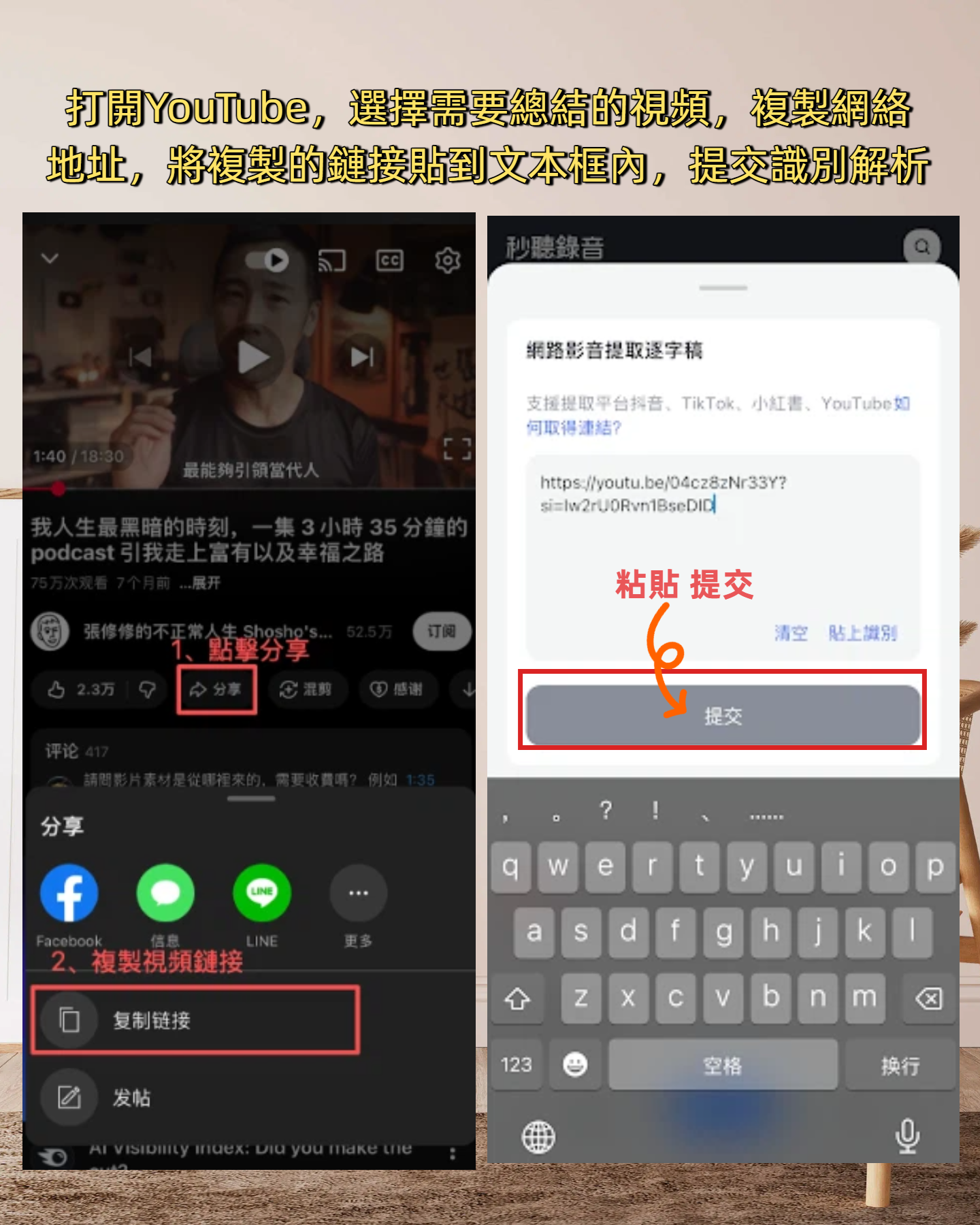
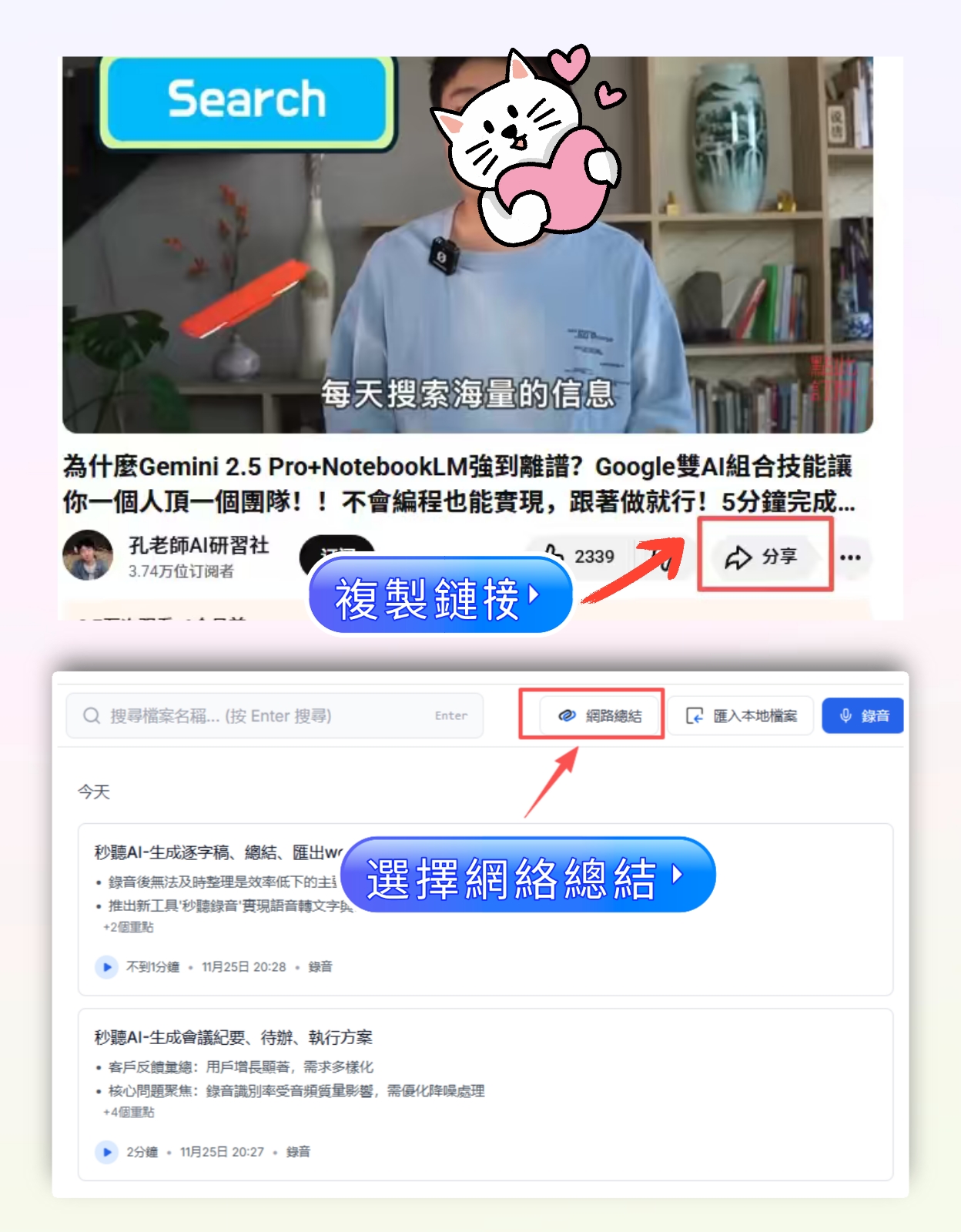
Tinrec, on the other hand, offers a wide range of sources: besides live recording and file import, it supports directly pasting public video links from YouTube, TikTok, Bilibili, and Xiaohongshu, automatically extracting audio and converting it into text and summaries. This saves a huge amount of downloading and conversion effort for people who need to organize online courses, podcasts, and interview videos.
→ This dimension: Tinrec clearly wins.
Dimension 2|AI Organization and Q&A Capabilities
After transcription, Notta provides a basic summary to quickly grasp the content. If you need translation or multilingual subtitles, Notta can generate them directly—helpful for cross-language meetings. However, if you want to ask further questions, extract action items, or dig out a specific decision from hours of recording, Notta's capabilities are currently limited.
Stop organizing recordings by hand
Upload audio or video and automatically get a transcript, summary, and action items
Tinrec's strength lies in "understanding and using" the transcription. In addition to summaries, it automatically breaks content into chapters, generates to-do lists, and has a built-in AI chat query feature—you can ask "What was the conclusion on the marketing budget discussed last time?" and Tinrec directly provides an answer with timestamps. Moreover, through Agent post-processing, it can turn a recording into a formal meeting minutes, table, or report.
→ This dimension: Tinrec clearly wins.
Dimension 3|Friendliness to Chinese Multimedia Content
Notta supports multilingual transcription, covering Chinese, Japanese, English, and Cantonese, so it's generally versatile. However, it leans more toward a "translation and subtitle" toolchain, and doesn't particularly excel in handling details common among Chinese creators—such as mixed Chinese-English speech, online video jargon, or Traditional Chinese regional terms.
Tinrec's product pages, interface, and features are clearly tailored for Chinese-language use cases, especially Traditional Chinese users. In a test using a YouTube tech review video with mixed Chinese and English, Tinrec not only produced a fluent Traditional Chinese verbatim transcript but also accurately captured product names and key specs in the AI summary. For self-media creators or students who need to organize large amounts of Chinese videos from Bilibili, Xiaohongshu, and TikTok, it's noticeably smoother.
→ This dimension: Tinrec clearly wins.
Dimension 4|Export and Workflow Integration
Notta can export transcriptions as TXT, DOCX, SRT, PDF, and other common formats, and also allows sharing via link. It's sufficient for basic archiving.
Tinrec supports the same formats (TXT, DOCX, PDF, etc.) but offers two major advantages: first, one-click export to third-party platforms like Notion, Google Docs, OneNote, and Dropbox, seamlessly integrating with your existing note-taking or collaboration system; second, the aforementioned Agent post-processing can generate structured deliverables (such as meeting minutes + to-dos + data tables) based on the recording content, saving manual organization steps.
→ This dimension: Tinrec clearly wins.
What Are Their Unique Strengths?
Tinrec's Unique Strengths
- Paste-and-parse online videos: No need to download—just paste a YouTube, TikTok, etc. link for parsing. Ideal for content creators.
- AI chat query and Agent post-processing: Turns recordings into a queryable, report-generating database, not just a transcript.
- Deep optimization for Chinese content: Recognizes and summarizes Traditional Chinese and mixed Chinese-English phrasing with a more localized touch.
- Seamless cross-platform experience: Works on phone, computer, and tablet—record on one device and continue organizing on another.
Notta's Unique Strengths
- Team unlimited plan: Business plan offers unlimited minutes, suitable for enterprise teams that frequently hold international meetings and need large-scale transcription.
- Comprehensive translation and subtitle features: Can directly generate bilingual subtitles, useful for users who need frequent translation.
Conclusion: Which One Should You Choose?
- If you need to handle a lot of online audio/video content (YouTube, TikTok, Xiaohongshu) or want AI Q&A and automated meeting minutes after transcription → Tinrec is the best choice.
- If you mainly attend international meetings, need translation and subtitles, and have a team with huge monthly usage and budget → Notta's unlimited plan is worth considering.
- If you're a personal user or small/medium team wanting to handle meetings, lectures, interviews, and video material in one go, and especially care about the Chinese experience → absolutely try Tinrec's free version first. Test it with your own recordings or videos, and you'll notice the difference.
In a nutshell: For most people who need to organize Chinese multimedia content, Tinrec is the more complete and less labor-intensive choice.
Turn every recording into actionable outcomes
Get 60 free transcription minutes when you sign in. No credit card required.
Related Reading
You might also like

5 Best Audio-to-Text Tools in 2026: Free vs. Paid Comparison for Meeting Notes
How to choose an audio-to-text tool? This article compares 5 solutions—Tinrec, Notta, Otter.ai, TurboScribe, and more—across three dimensions: input sources, post-meeting organization, and team collaboration. It includes key buying factors and 4 common pitfalls to help you see the differences from free to paid at a glance and find the best tool for organizing meeting notes.

2026 Comparison of 4 Speech-to-Text Apps: Whose Free Tier Is Enough, and Which AI Summaries Really Save Time?
An hour-long meeting recording can take three to four hours to transcribe manually. This article examines five key factors for choosing a speech-to-text app based on real-world usage, compares Tinrec, Yating Transcription, Otter.ai, and Notta on Chinese recognition, post-meeting organization, free tiers, and team collaboration, and lists four common pitfalls to help you pick the one that truly saves time.

How to Use Tinrec in 2026: Transcribe Online Meetings Without a Bot + Auto-Generate Minutes
A 47-minute meeting recording would take until 9 PM to transcribe by hand. This tutorial uses Tinrec to demonstrate a 5-step workflow for online audio-to-text: record or import, auto-transcribe, quick proofread, generate summaries and action items, and export/share. It also covers FAQs, advanced tips, and alternative tools.

How to Choose Speech-to-Text in 2026: 5 Steps to Test for Free and Avoid Pitfalls
Free speech-to-text tools seem like a bargain, but they often limit recording length, charge for exports, and struggle with mixed-language audio. This article uses 5 steps to help you test whether a tool is worth keeping within its free tier, with Tinrec as an example covering recording, transcription, AI summary, action items, and team knowledge retention. It also includes 5 key buying considerations and FAQs.

5 Best Audio-to-Text Tools in 2026: Tinrec vs Notta and Other PTT Favorites Compared
Starting from the common audio-to-text choices discussed on PTT, this comparison examines Tinrec and Notta across meeting capture, post-meeting organization, team governance, Chinese language experience, and free tiers to help readers determine which tool better fits their workflow.

4 Audio-to-Text Tools Tested in 2026: Which Is Best for iPhone Users Needing Chinese Transcription and AI Summaries?
How to choose an iPhone audio-to-text tool? Based on real meetings, interviews, and online courses, this article compares Tinrec, Apple Voice Memos, TurboScribe, and Otter.ai on Chinese recognition, post-meeting summaries, AI Q&A, team collaboration, and pricing limits. It also provides buying criteria and pitfalls to help you pick the right tool for your budget and needs.

4 Audio-to-Text Tools Tested and Compared in 2026: The Transcription Pain Points Dcard Users Discuss—Which One Actually Saves Time?
Starting from the transcription hell that Dcard users complain about most, this article compares the audio-to-text and post-meeting organization capabilities of Tinrec, Notta, Granola, and TurboScribe, and outlines selection criteria, free quotas, team collaboration, and pitfalls to avoid.

4 Best Audio-to-Text Tools in 2026: Which Chinese Transcription Tool Saves the Most Time?
Starting from common PTT requests for audio-to-text conversion, we compare Tinrec, Otter.ai, Notta, and TurboScribe on Chinese transcription, post-meeting organization, free limits, and team collaboration to help you find a practical solution that doesn't require re-listening to a two-hour recording.

Free Speech-to-Text Options in 2024: A Look at 4 Tools
Starting from PTT 2024 discussions on speech-to-text, we organize free plans and common pitfalls, comparing Tinrec, Otter.ai, Notta, and TurboScribe on free quotas, Chinese recognition, post-meeting summaries, and team collaboration to help you choose the right tool.