

Turn recordings into transcripts and summaries in minutes
Upload audio or video for multilingual transcription, AI notes, and action items
2026 Comparison of 5 Speech-to-Text Apps: Which One Is Best for Hong Kong Office Workers?
If you work in Central, you know the grind: meetings back-to-back, and overtime to write minutes that are worse than the meetings themselves. Speech-to-text apps can help, but with so many options, which one is right for Hong Kong users? We picked five popular tools—Otter.ai, Notta, Fireflies.ai, TurboScribe, and Tinrec—and compared them across Cantonese recognition, AI features, cross-platform support, and pricing, so you can see at a glance which one is worth installing.
Core Experience Comparison of 5 Speech-to-Text Apps
When choosing a tool, it's easy to get overwhelmed by features. We directly compared the dimensions that matter most for daily use to see which one is truly easy and effective.
1. Cantonese Recognition
Most meetings and classes in Hong Kong are conducted in Cantonese, often mixed with English and colloquialisms. Poor recognition can be a headache. Otter and Fireflies focus mainly on English; their Cantonese performance is average, often mistaking "搞掂" (gaau dim, to handle) as "搞定" (gaau ding). Notta supports multiple languages with decent Cantonese accuracy, but it tends to miss words in noisy environments. TurboScribe focuses on document transcription with little Cantonese optimization. Tinrec has been specially trained on Cantonese's nine tones; in tests with meetings mixing Cantonese and English, its error rate was significantly lower than competitors, especially for local terms like "唔該" (m4 goi, thank you), "即刻" (zik1 hak1, immediately), and "聽日" (ting1 jat6, tomorrow). This is a big plus for Hong Kong users.
2. AI Post-Processing Features
Getting a raw transcript is just the first step; the real help comes from automatic organization. Among the five, Otter and Fireflies focus on meeting summaries and action item extraction, but their style is very American business. Notta offers summaries and translation, but categorization is basic. TurboScribe has almost no post-processing—just plain text output. Tinrec has the most comprehensive AI features: besides automatic summaries, chapter splitting, and to-do lists, it also supports "AI Chat Query"—you can ask "What was decided in this meeting?" or "Who is responsible for follow-up?" Mind maps and multi-format export (Word, PDF, Notion, etc.) are a bonus, saving you from manual organization.
3. Input Source Coverage
Meeting recording alone isn't enough anymore. Many users need to handle class recordings, YouTube videos, podcasts, even TikTok. Otter and Fireflies focus mainly on online meetings and have limited support for offline files. Notta allows file uploads but doesn't support direct link import. TurboScribe excels in batch transcription of large files but lacks real-time recording. Tinrec does it all: real-time recording, file import from phone/computer, paste links from YouTube/Bilibili/Xiaohongshu for direct transcription, even live streams. This is very practical for people who need to organize content from multiple platforms.
4. Cross-Platform and User Experience
Office workers switch between phones, computers, and tablets. Without cross-platform sync, the app loses half its value. Otter and Fireflies have Web + iOS + Android, but the interface is more team-oriented and can be complex for individuals. Notta and TurboScribe also have multiple clients, but the mobile app experience is average. Tinrec supports iOS, Android, and web with a clean, straightforward interface—just tap to record and transcribe, no extra settings. Recordings are auto-saved to the cloud, so you can continue listening and questioning on another device—perfect for busy Hong Kongers.
Stop organizing recordings by hand
Upload audio or video and automatically get a transcript, summary, and action items
5. Pricing and Free Tiers
Different usage frequencies call for different plans. All five have free versions: Otter gives 300 minutes/month, Notta 120 minutes, Fireflies unlimited transcription (but with storage limits), TurboScribe 3 times/day (30 minutes per file), and Tinrec 100 minutes/month. On the surface, Otter and Fireflies seem generous, but their advanced AI features like summaries and Q&A mostly require Pro. Tinrec's free version already includes core AI features, just with fewer minutes, so it's good for testing. In terms of paid plans, Tinrec's weekly pass suits short-term projects; its Pro monthly fee is similar to Notta but offers more features. The annual plan is cheaper per month and is the best value for long-term use.
Tinrec Core Features at a Glance
After comparing them all, if we could recommend just one app for Hong Kong users, Tinrec stands out for its feature completeness. Here are its most practical features—much more than just "speech to text":
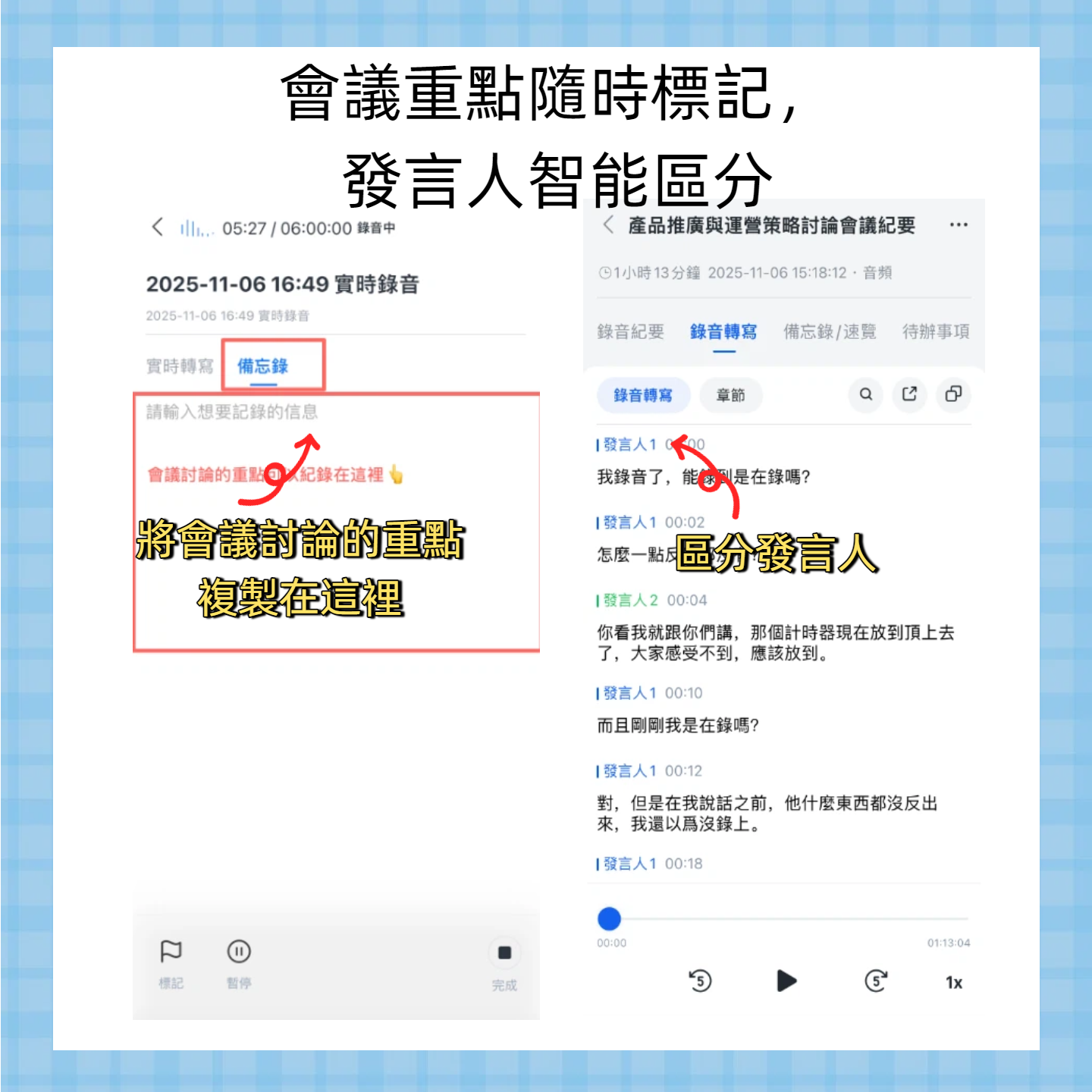
- Real-time recording to text: Text appears simultaneously while recording with less than 1 second delay. During meetings, you can immediately check if you missed key points. By the time the meeting ends, the transcript is ready, no need to re-listen and type.
- AI Chat Query: This is my personal favorite. After recording a one-hour meeting, just ask Tinrec: "What's the meeting conclusion?" or "Who is responsible for which part?" It answers based on the content, saving you from flipping through pages of transcript—finding key points is incredibly fast.
- Online video to text: Paste a link from YouTube, Bilibili, Xiaohongshu, or even TikTok, and it automatically transcribes and generates a summary. Perfect for organizing online tutorials, podcasts, or competitor analysis.
- Automatic action item extraction: After discussing many action items in a meeting, Tinrec automatically pulls them out into a to-do list that can be exported to Notion or Google Docs for immediate follow-up.
- Multi-format export: Transcripts, summaries, mind maps, PDF, Word, subtitle files—all generated with a single click, no need to convert between other tools.
Real-World Usage Scenarios
A tool's quality is proved in real scenarios. Here are several common use cases for Hong Kong people, all handled by Tinrec in one app:
- Work meetings: Record several team meetings per week, automatically get meeting notes and action items, and ask AI like "How about the budget we discussed last week?"—saving a whole hour of organizing time.
- University lectures: Record an entire lecture with Tinrec; AI splits it into chapters and highlights key points. Before exams, use the Q&A feature to drill down on key topics, studying several times more efficiently.
- Journalist/researcher interviews: After speaking with an interviewee, get an instant transcript and key summary. Directly ask AI "What is their view on the policy?"—quoting material is fast and accurate, no need to slowly replay the tape.
- Content creators: See a YouTube video that's perfect for your topic? Paste the link into Tinrec, get the transcript and summary, and use it for writing scripts or finding inspiration. Very handy.
Key Points to Consider When Choosing a Speech-to-Text Tool
Different tools have different strengths. Before choosing, consider these criteria to avoid pitfalls:
- Cantonese support quality: If more than half of your recordings are in Cantonese, test the recognition rate, especially for fast speech or noisy environments. Tinrec's Cantonese-specific optimization clearly outperforms general-purpose tools.
- AI functionality usefulness: Transcripts are just the basics; automatic organization is the real value. Check if it has time-saving features like summaries, to-dos, and Q&A, not just plain text output.
- Cross-platform and sync: Record on your phone, view and edit on your computer immediately—this is crucial for multi-device users. Some tools only have a web version or a stripped-down mobile app, so be aware.
- Input source flexibility: If you handle not only meetings but also online videos, old audio files, etc., choose an app that supports multiple sources. Tinrec's "link parsing" and "file import" cover the most ground.
- Does the free version allow a real test?: Don't be fooled by minute limits; many free versions disable AI features. Tinrec's free version, though only 100 minutes, unlocks all core features, so you can test thoroughly before upgrading.
Conclusion: Is Tinrec Worth Trying?
If you're looking for a speech-to-text app that supports Cantonese, works across platforms, and lets you use AI to find key points immediately after recording, Tinrec is currently one of the most comprehensive choices on the market. It doesn't just convert speech to text—it organizes, extracts, and exports, turning your recordings from "dead files" into "living data." Especially for Hong Kong office workers who frequently handle Cantonese content, Tinrec's recognition accuracy and post-processing capabilities are currently unmatched. We recommend starting with the free version, which gives you 100 minutes per month. Test it with your own recordings—this is more direct than any review. Want to save time and stop doing overtime for meeting minutes? Download it and see for yourself how good it is.
Turn every recording into actionable outcomes
Get 60 free transcription minutes when you sign in. No credit card required.
Related Reading
You might also like

2026 In-Depth Comparison of 4 Speech-to-Text Tools: Beyond Notta and Otter, Why Tinrec Is Worth a Try
A thorough hands-on test of 4 major speech-to-text tools, from free to paid versions. As a small team manager, I'll tell you directly which one saves you the most time, so you won't be fooled by vendor hype.

2026 Comparison of Two French Transcription Tools: Good Tape vs. Tinrec – Which One Is Right for You?
Good Tape is a solid tool for French transcription, but if you need multilingual support, AI summaries, and cross-platform compatibility, Tinrec is the more comprehensive choice. This hands-on comparison helps you decide quickly.

2026 Ultimate Guide to Transcription Tools: Beyond Good Tape, Discover Better Options
Hands-on review for small to mid-sized team leaders: If you're looking for a Good Tape alternative, this explains why Tinrec is better for meetings, courses, interviews, and content creation—handling everything from recording to organizing in one go.

2026 Comparison of 6 AI Transcription and Note-Taking Tools: From Free to Paid, Which One Is Your Work Accelerator?
Meetings, lectures, and interview recordings piling up? Which AI note-taking tool can really save you time? This article compares 6 popular solutions, evaluating real-time transcription, AI summaries, and multi-source support. After reading, you'll know which one to choose.

How to Choose a Speech-to-Text Tool in 2026: A Complete 5-Step Guide
This article starts from the pain point of accumulating recordings, shares 5 speech-to-text tools I've tested, and uses Tinrec as an example to teach you a method for selecting and using these tools, turning recordings into usable knowledge.

2026 Comparison of 5 Audio-to-Text Tools: From Free to Paid, Which One Is Worth Trying?
Looking for a reliable audio-to-text tool in 2026? I tested 5 popular apps including Tinrec, Notta, Otter, etc., comparing features, pricing, Chinese support, and multi-scenario usability. A must-read for small team leaders and solopreneurs.
2026 AI Recording Tools Comparison: Tinrec vs PLAUD Note – Which Is Better for Organizing Your Audio Files?
Thinking of buying a recording-to-text tool but torn between software and hardware? This article deeply compares Tinrec and PLAUD Note across five dimensions: input sources, AI organization, pricing, platform support, and use-case coverage, helping you find the best solution on any budget.

2026 Comparison of 3 Speech-to-Text Tools: Which Is Best for Chinese Users?
A hands-on comparison of three leading speech-to-text tools, evaluating language support, cross-platform compatibility, AI features, and pricing to determine the best fit for Chinese users.

2026 Side-by-Side Comparison of 2 Speech-to-Text Tools: Good Tape vs. Tinrec - Which Free Plan Is the Best Deal?
Looking for a Good Tape coupon? Check out Tinrec's free plan instead. This article tests two speech-to-text tools head-to-head, comparing free credits, Chinese recognition, multi-source support, and AI Q&A to help small teams decide.