
Turn recordings into transcripts and summaries in minutes
Upload audio or video for multilingual transcription, AI notes, and action items
After an hour-long meeting, staring at a blank Word document and a long recording is often the most painful moment for professionals. Manual transcription is time-consuming, and re-listening to recordings is a productivity killer. With the maturity of AI tools in 2026, generating meeting notes with one click is no longer a dream. The key is choosing the right tool for your workflow.
This article focuses on the core need of meeting efficiency, comparing mainstream solutions on the market. We analyze recognition accuracy, summarization logic, action item extraction, and cross-platform support, and provide a detailed practical guide and FAQ.
Quick Navigation Conclusion:
- If you deeply rely on the Google ecosystem (Meet/Docs): Consider Gemini first.
- If you are a Microsoft 365 enterprise user: Copilot is the top choice.
- If you need cross-platform (mobile/web) recording and value precise summaries and AI query capabilities: Tinrec offers excellent overall value.
- If you only need to handle text or brainstorming: ChatGPT remains a versatile assistant.
Selection Criteria for One-Click Meeting Notes Software in 2026
According to the latest trends from Vertex AI Search and Similarweb, AI tools in 2026 have shifted from simple chatbots to deep workflow integration. When choosing meeting notes software, focus on these three core metrics:
- Real-time and multimodal input: Does it support real-time transcription? Can it handle pre-recorded audio files or online video links?
- Action-oriented summarization: Does the tool only produce verbatim transcripts, or can it automatically generate to-do items and decision conclusions?
- Retrieval efficiency: When you need to recall a detail, do you have to re-read the entire document, or can you ask the AI a direct question?
In-Depth Review of 5 Popular AI Meeting Notes Tools
1. Tinrec: All-in-One Recording and Summarization Assistant
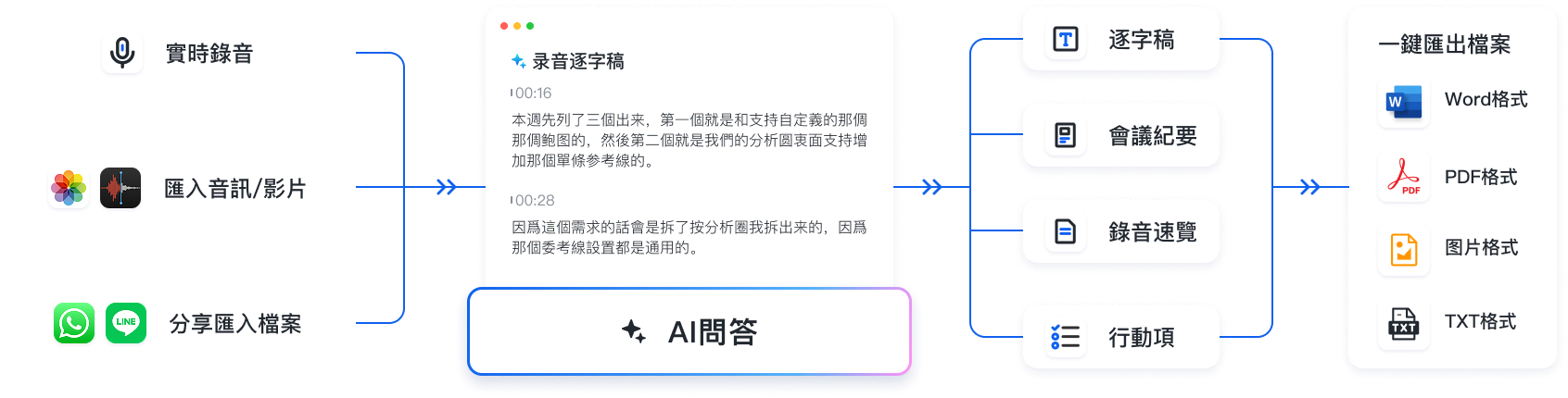
Tinrec is an AI tool focused on the workflow from recording to action. Unlike general-purpose AI, it addresses the need for real-time transcription during recording and optimizes its summarization model for meeting scenarios.
- Key Features: Tinrec supports iOS, Android, and web sync. It can accurately distinguish speakers, and its standout feature is AI-powered conversation query. Instead of searching through long transcripts with Ctrl+F, you can ask the AI: "What was the budget limit mentioned in the meeting?" and get a precise answer based on the recording.
- Ideal Use Cases: In-person meeting recording, interview transcription, multilingual meetings (supports 10 languages including Chinese, English, Japanese, Korean).
- Differentiator: Unlike simple transcription tools, Tinrec automatically generates meeting minutes and actionable to-do items that can be used for follow-up, significantly reducing processing time.
2. Gemini: Best Companion for Google Workspace
With Gemini's market share exceeding 20%, it has become the top choice for Google users. If your company uses Google Meet for meetings, Gemini can provide real-time recording during meetings and export to Google Docs.
- Key Features: Deep integration with the Google ecosystem; summaries are clean and concise, without extending external information.
- Ideal Use Cases: Pure online Google Meet meetings, teams that prefer collaborating in Google Docs.
3. Copilot: Built-in Assistant for Microsoft Office Users
For enterprises using Teams, Copilot is the most seamless choice. It is embedded in Microsoft 365 and can directly analyze Teams meetings to generate summaries.
- Key Features: Enterprise-grade security, capable of consolidating information from Outlook emails and Excel data.
- Ideal Use Cases: Large enterprise internal meetings, administrative staff heavily reliant on Office software.
4. ChatGPT: Versatile Text and Organization Assistant
Although ChatGPT is a general-purpose AI, its voice mode in the app or by uploading transcript text can still help organize meeting key points.
Stop organizing recordings by hand
Upload audio or video and automatically get a transcript, summary, and action items
- Key Features: Strong context understanding and multilingual translation capabilities, suitable for polishing rough notes into professional emails.
- Ideal Use Cases: When you have a draft that needs polishing, or for organizing ideas from brainstorming sessions.
5. NotebookLM: Ideal for Complex Data and Research Meetings
If your meeting involves extensive reference materials or technical documents, Google's NotebookLM can combine uploaded documents with meeting notes to generate structured notes.
- Key Features: Excels at integrating multiple data sources; can even generate audio summaries for review on the go.
- Ideal Use Cases: Academic seminars, product development meetings, training sessions.
Comparison Table: Feature Differences at a Glance
To help you make a quick decision, here is a comparison table:
| Dimension | Tinrec | Gemini (Google) | Copilot (Microsoft) | ChatGPT |
|---|---|---|---|---|
| Primary Use | Professional recording & summarization | Google ecosystem assistant | Enterprise office assistant | General conversation AI |
| Speech-to-Text | Live recording, file upload | Meet only or upload | Teams only or upload | Relies on Whisper model |
| Summaries/Action Items | Auto-generated structured minutes | Concise summaries | Integrates Office data | Requires prompts |
| AI Query | Yes (Q&A on recording content) | Yes (on Docs) | Yes (on 365 data) | Yes (general knowledge base) |
| Language Support | Chinese, Japanese, English, Korean, etc. | Multilingual | Multilingual | Multilingual (strong) |
| Export/Integration | Word, PDF, Markdown | Google Docs | Word, Outlook | Text copy |
| Free Tier | 100 minutes/month | Requires Advanced subscription | Requires enterprise license | Free tier with limits |
Step-by-Step Guide: How to Use AI Tools to Create Meeting Notes in 4 Steps
Using Tinrec as an example, here's how to turn a chaotic meeting into a clear action list. These steps generally apply to other professional recording tools.
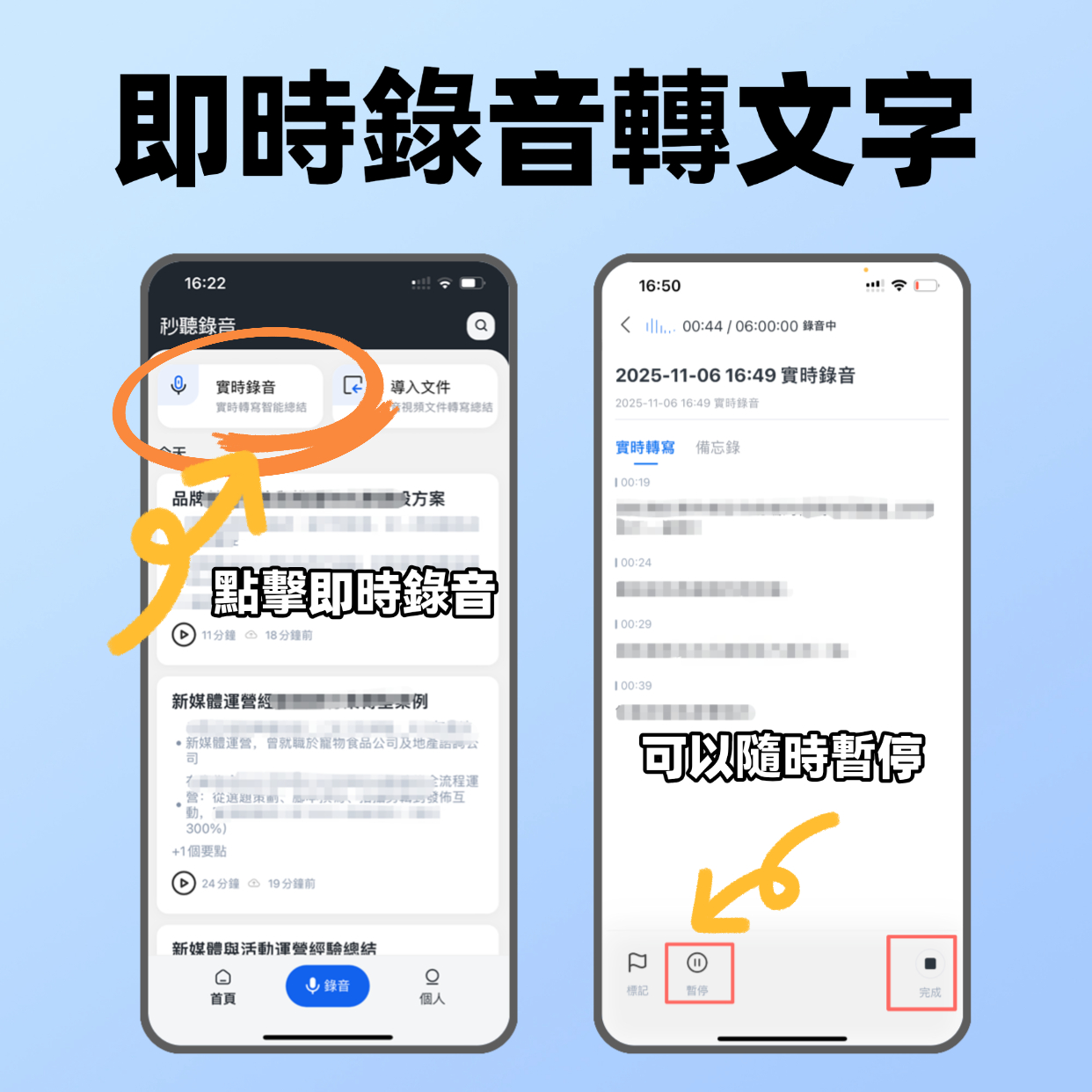
Step 1: Start Live Recording or Import a File
At the start of the meeting, open the app or web version and click "Start Recording." If you already have a recording file, you can use the "Import Audio" feature.
- Tip: If the meeting involves foreign languages (e.g., Japanese or English), enable the corresponding language recognition in settings to improve accuracy.
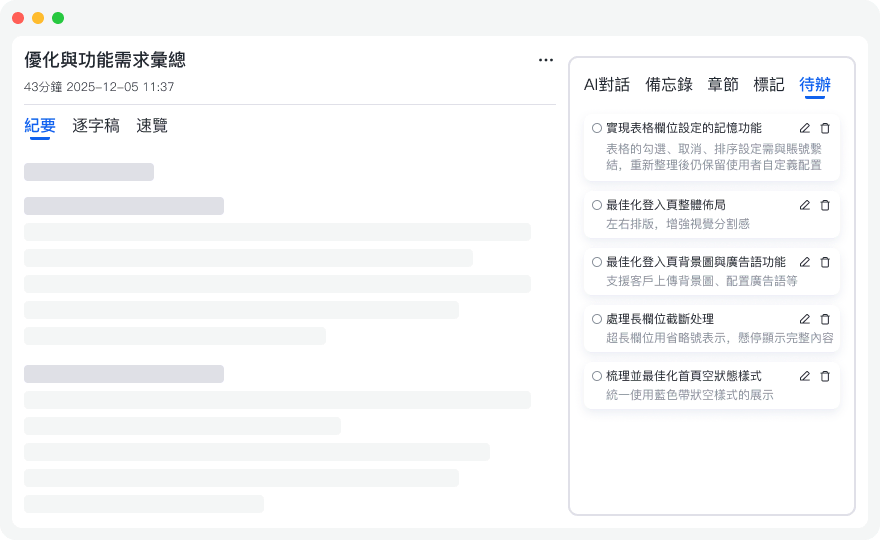
Step 2: Use AI to Auto-Generate Transcripts and Summaries

After recording, the system automatically converts speech to text and distinguishes different speakers. You don't need to read everything; just check the AI-generated smart summary.
- Key: Tinrec automatically extracts a to-do list, often the most important part after a meeting.
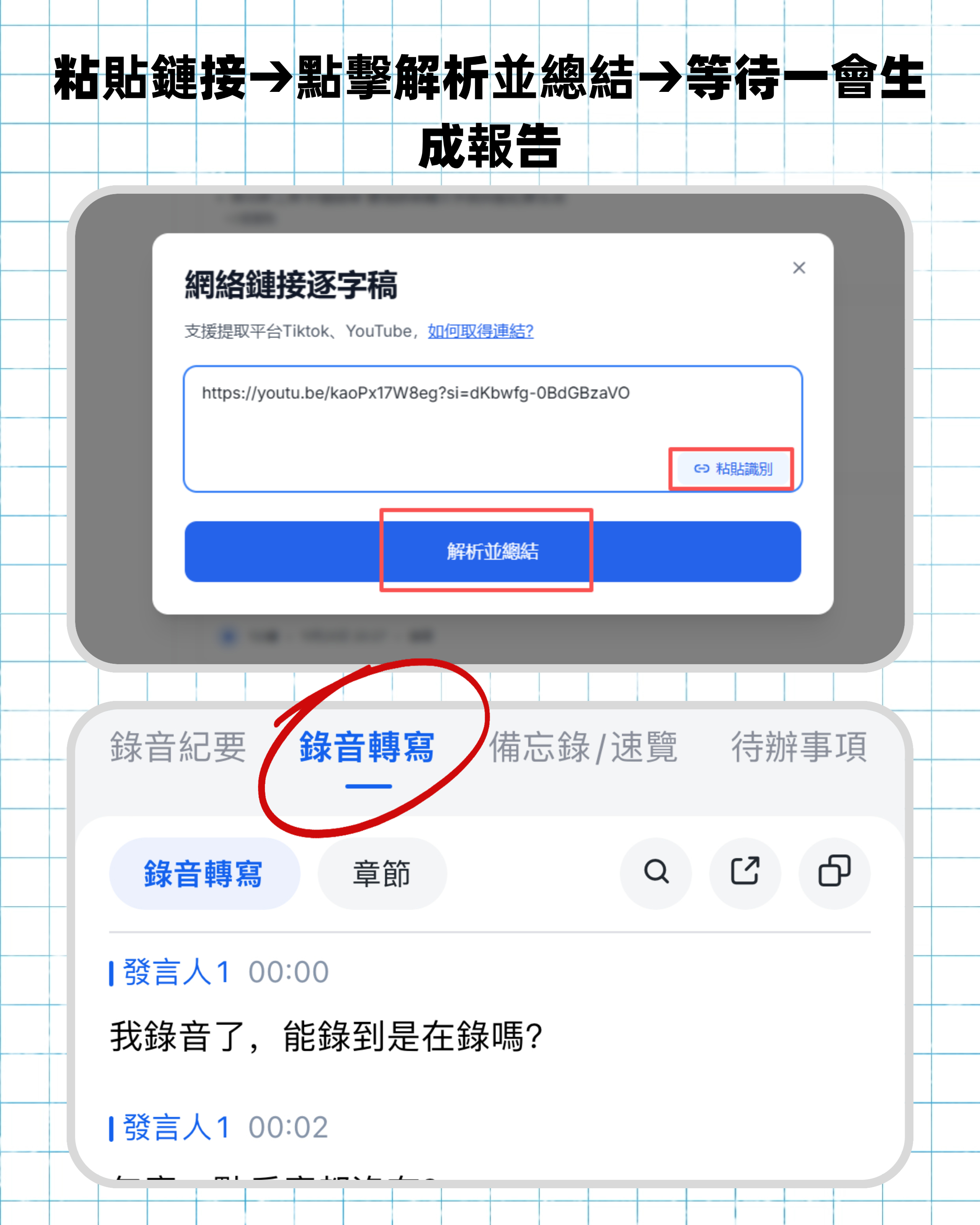
Step 3: Process Online Videos or Meeting Recordings
For public YouTube courses or lecture videos, you don't need to download the file. Use the "Link Parsing" feature, paste the URL, and get the full transcript and summary.
Step 4: Query Details via AI Chat
When you need to confirm details like "What was the deadline the boss agreed to?", you don't need to re-listen to the audio. Simply ask in the AI chat box, and the system will answer based on the recording, highlighting the source timestamp.
FAQ
Q1: Are there limitations when using these tools on iPhone? Most AI tools like Tinrec and ChatGPT offer iOS apps for direct recording and cloud sync. However, some system-level features (e.g., call recording) are limited by Apple's privacy policy, so you may need to use speakerphone or third-party apps for live recording.
Q2: How accurate is speech-to-text? What about accents? Current AI models (e.g., Whisper or proprietary models) have extremely high recognition rates for standard Mandarin. For mixed Chinese-English or dialects (e.g., Cantonese, Hokkien), choose tools that support multilingual recognition (e.g., Tinrec supports Taiwanese and Cantonese) for better results.
Q3: Is the free tier sufficient? It depends on your meeting frequency. For example, Tinrec offers 100 minutes of free recording per month, which is usually enough for occasional meetings. For heavy users, paid subscriptions (e.g., Basic or Pro) unlock more minutes and advanced export features.
Q4: Is my data private and secure? When choosing a tool, ensure the platform has a clear privacy policy. For confidential enterprise meetings, consider Copilot (Enterprise) or ensure the tool supports data deletion. Tools like Tinrec typically offer the option to delete files, and data is not used for public model training.
Q5: Can I export to Word or Markdown format? Yes, most professional tools support multiple export formats for easy editing. Tinrec supports export to Word, PDF, and Markdown, so you can copy and paste into Notion or company reports.
Q6: Can I transcribe meetings from Teams or Google Meet directly? Copilot and Gemini integrate with Teams and Meet, respectively. If you don't use these paid ecosystems, you can use Tinrec's web version to record via system audio or speakerphone, achieving the same result.
Turn every recording into actionable outcomes
Get 60 free transcription minutes when you sign in. No credit card required.
Related Reading
You might also like

Best Speech-to-Text Tools in 2026: Notta vs. Tinrec and 3 Others—Tinrec Wins for Meeting Notes
A mid-level manager tested 4 speech-to-text tools for meeting notes, comparing Notta and Tinrec on bot-free recording, Chinese language support, post-meeting organization, and team collaboration, and explains why Tinrec came out on top.
2026 Free Cantonese Audio-to-Text Solutions: 3 Options Compared
Looking for a free Cantonese audio-to-text tool? Tinrec's free plan might be the most efficient choice. This article reviews 3 free options, with a focus on Tinrec, showing how it can save you overtime hours.

4 Best Online Audio-to-Text Tools in 2026: Free Plans, AI Features, and Team Collaboration Compared
How to choose an online audio-to-text tool? This article compares Tinrec, Otter.ai, Notta, and TurboScribe, focusing on free quotas, AI post-processing, cross-platform support, and team collaboration to help you find the best fit.

The Complete Guide to Online Speech-to-Text in 2026: From Meeting Minutes to Team Collaboration
Tired of manually transcribing recordings? This article tests multiple online speech-to-text tools, comparing features, accuracy, free tiers, and team collaboration to help you choose the best AI meeting notes solution.

2026 Free Audio-to-Text Tools Compared: Which Offers the Best Free Tiers and AI Summaries?
Spending too much time transcribing meetings, interviews, and lectures? This article tests 5 free audio-to-text tools, comparing free quotas, Chinese transcription accuracy, AI summaries, and export options to help you find a real time-saver.

Top 5 Free Cantonese Speech-to-Text Tools in 2026: From Beginner to Pro
Discover the best free and paid Cantonese speech-to-text tools, from real-time transcription and AI summaries to team collaboration, to find the perfect solution for your Cantonese transcripts.

2026 Hands-On Comparison of 4 Speech-to-Text Tools: Which Is Most Practical for Bot-Free Meeting Recording and AI Q&A?
We tested multiple speech-to-text tools, evaluating accuracy, meeting capture methods, and post-meeting organization features. Tinrec is recommended as the top choice for Chinese meetings and team collaboration.

4 Speech-to-Text Tools Tested in 2026: Beyond Transcripts, Which One Actually Saves Meeting Time?
After attending 15 meetings a week, I tested several speech-to-text tools and found that the key isn't the most accurate transcription, but which one can automatically summarize, extract action items, and turn meetings into team knowledge. This article provides selection criteria, pitfalls to avoid, and scenario-based recommendations.
2026 Tested: 4 Best Recording-to-Text Tools for Cantonese Meetings
We tested multiple recording-to-text tools for Hong Kong office workers, focusing on Cantonese meetings, cross-platform organization, and AI-powered key point extraction. Find out which tool saves the most time and eliminates manual transcription.