

Turn recordings into transcripts and summaries in minutes
Upload audio or video for multilingual transcription, AI notes, and action items
Why You Need Google Meet Recording Tools
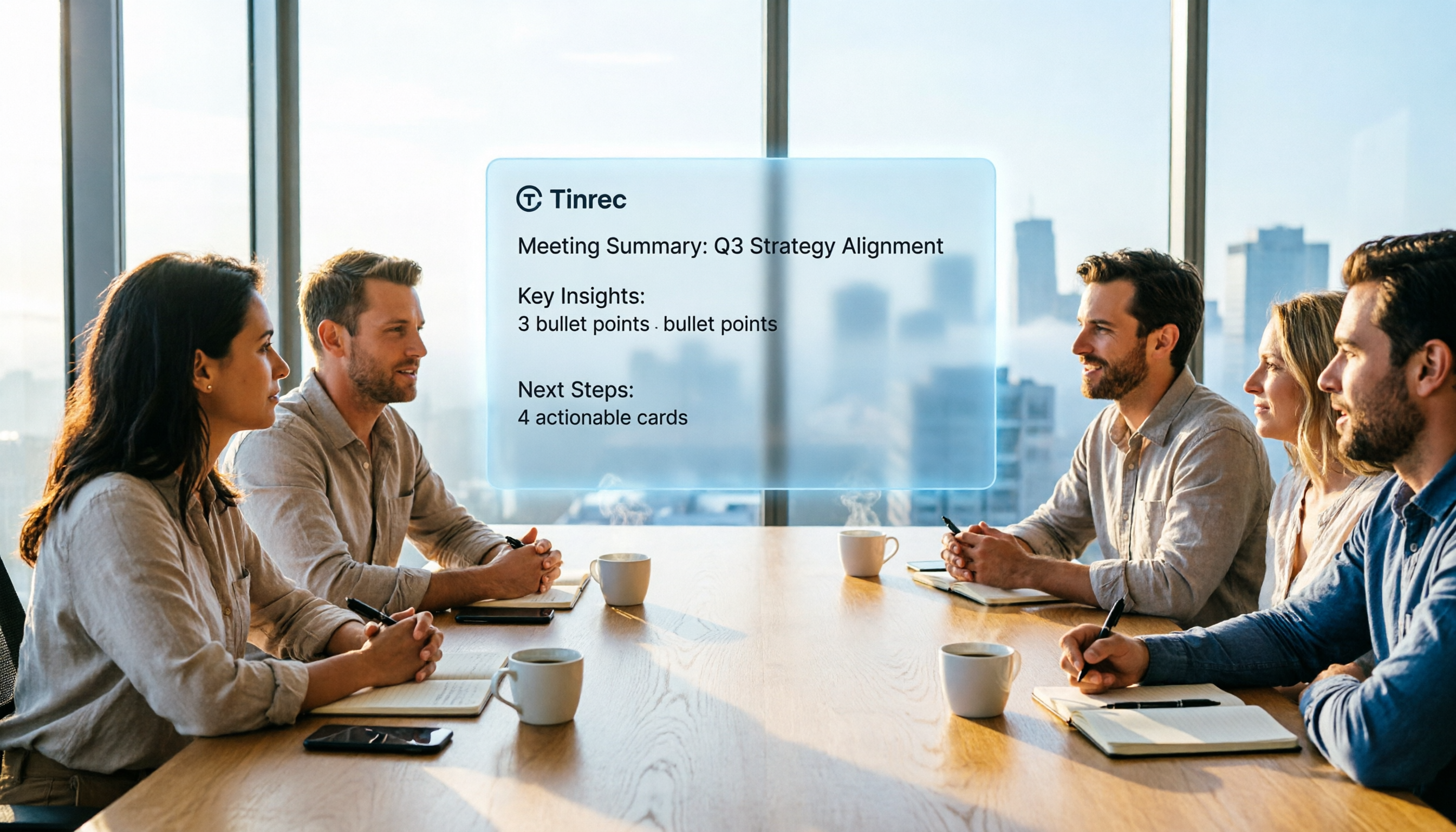
Google Meet is a popular online meeting platform for businesses and individuals, but without immediate recording and organization, important decisions and action items are easily forgotten. According to surveys, employees spend an average of 4 hours per week taking meeting notes, and AI meeting recording tools can automate this process.
This article reviews 5 AI recording and meeting note tools that work well with Google Meet, including both free and paid plans, so you can choose the best assistant based on your usage and budget.
Option 1: Tinrec – The Most Complete AI Recording Assistant
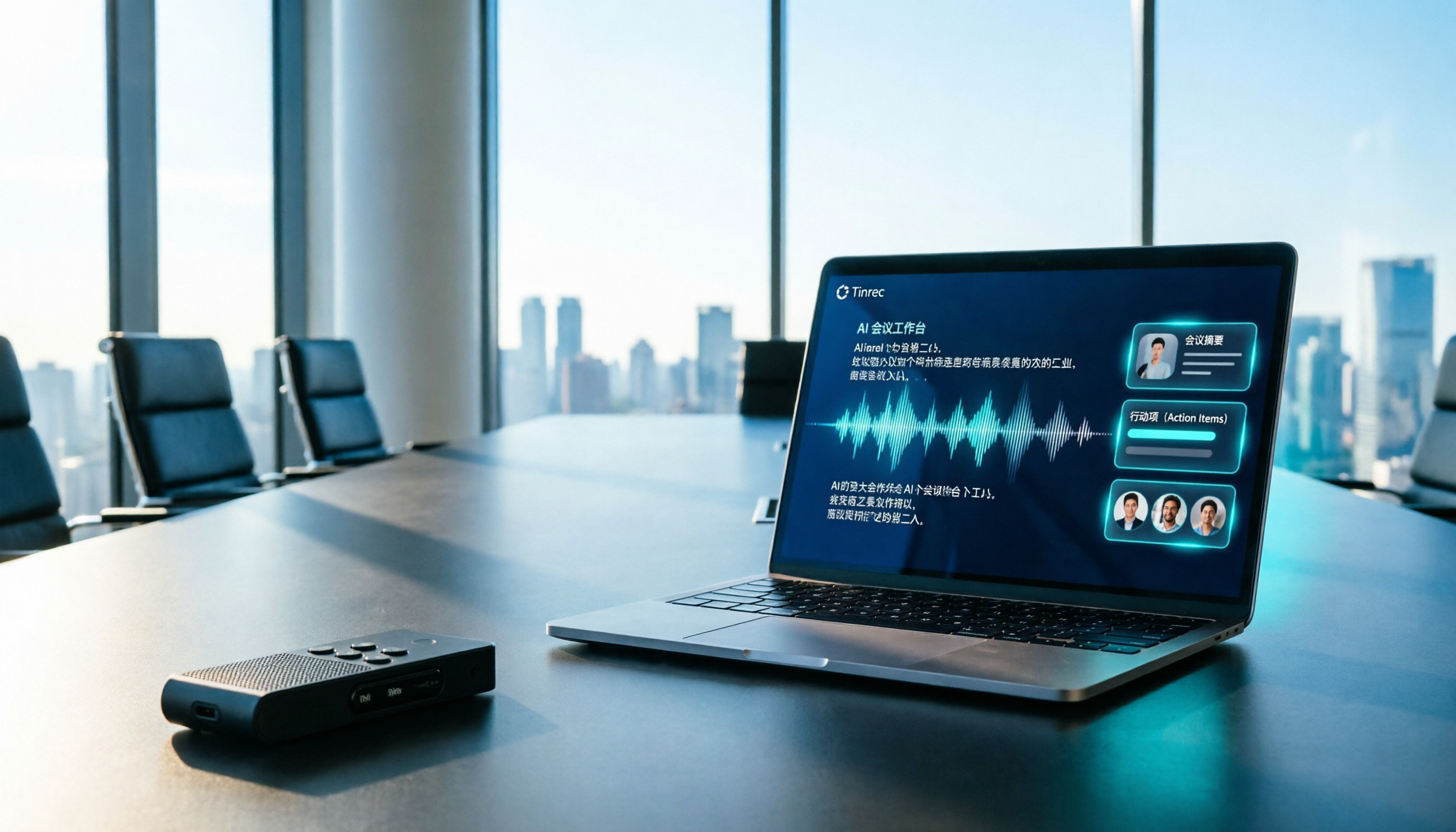
Tinrec is more than just a meeting note tool; it's a comprehensive audio and video data processing workstation. In addition to real-time transcription for online meetings like Google Meet, it can handle local audio and video files, and even analyze content from web links such as YouTube and TikTok.
Key Highlights:
- Multi-source input, not limited to meetings: You can record Google Meet meetings, upload class recordings, interview audio, or paste a YouTube video link – it transcribes into text, generates summaries, and even highlights key chapters. This is very practical for those who need to organize various audio/video materials over time.
- Powerful post-transcription processing: Unlike tools that only output verbatim transcripts, Tinrec automatically generates summaries, to-do lists, mind maps, and allows you to query the recording content like a database to quickly find key information.
- Excellent for Chinese content: If you primarily work with Chinese meetings, courses, or interviews, Tinrec's transcription and summary quality significantly outperforms English-oriented tools, avoiding common issues like mixed language or awkward sentence breaks.
Pricing:
- Free Plan: Monthly basic transcription quota, allowing you to try real-time recording, file uploads, and web link analysis.
- Weekly Pass: Suitable for short-term projects, intensive meetings, or exam cramming.
- Pro Monthly: Higher monthly transcription quota, ideal for regular use by professionals and students.
- Pro Annual: Lower monthly cost, best for users building a long-term recording library.
Best for: Professionals and learners who need to process diverse audio/video sources (meetings, courses, web videos) and want not just transcripts but also automated summaries, to-dos, and Q&A.
Option 2: Otter.ai – The Veteran AI Meeting Assistant
Otter.ai is a pioneer in AI meeting notes, excelling at automatically joining Google Meet and transcribing in real time, with speaker identification. Its free plan offers 300 minutes of transcription per month, sufficient for light users, but the free version only records 30-second meeting snippets; full features require the Pro plan.
Key Highlights: Accurate speaker recognition, great for English meetings; Pro plan at $8.33/month (approx. NT$250) provides 1,200 minutes and file import.
Best for: Users with primarily English meetings who need team collaboration and automatic meeting joining features.
Option 3: Fireflies.ai – Automated Meeting Integration Specialist
Fireflies.ai focuses on automatically joining Google Meet, Zoom, and other platforms for recording and transcription, supporting over 100 languages. The free plan offers "unlimited transcription" and AI summaries, but team storage is limited, making it suitable for heavy personal meeting recording.
Stop organizing recordings by hand
Upload audio or video and automatically get a transcript, summary, and action items
Key Highlights: Unlimited transcription is generous, but summary quality sometimes lacks conciseness; Pro plan at $10/month (approx. NT$300) adds meeting smart search and CRM integration.
Best for: Salespeople or consultants with multiple daily online meetings needing quick organization of large volumes of meeting notes.
Option 4: Notta – Flexible Multilingual Transcription
Notta positions itself similarly to Tinrec as a multi-platform transcription tool, with a strong emphasis on multilingual translation. The free plan offers 120 minutes per month, while the Pro plan at $8.17/month (approx. NT$245) provides 1,800 minutes, offering good value.
Key Highlights: Translation feature integrated directly into the transcription interface, ideal for cross-language teams; but web video analysis and AI Q&A depth are not as strong as Tinrec.
Best for: Users who frequently need cross-language transcription and translation, and rely on the mobile app.
Option 5: TurboScribe – High-Value Long File Transcription
TurboScribe focuses on cost-effectiveness, specializing in fast transcription of uploaded audio/video files, especially strong for files over 1 hour. The free plan allows 3 files per day (30 minutes each), while the paid Unlimited plan at $10/month (approx. NT$300) is nearly unlimited.
Key Highlights: Efficient batch transcription of long files, but lacks real-time meeting recording and AI Q&A; more of a pure transcription factory.
Best for: Content creators who need to transcribe large volumes of historical recordings, podcasts, or interview materials.
How to Choose Among These Options?
- Want the most complete AI processing (transcription + summary + Q&A + to-dos) and often work with Chinese content? → Tinrec is the top choice, with the most comprehensive multi-source input and post-processing capabilities.
- Have extremely frequent meetings and need unlimited transcription in an English environment? → Fireflies.ai's free unlimited transcription is very attractive.
- Limited budget but need basic transcription + translation? → Notta Pro has an affordable monthly fee and practical translation features.
- Just need bulk long-file transcription without real-time meeting features? → TurboScribe offers the best speed and value.
- Prefer English interface and prioritize team collaboration? → Otter.ai's established reputation is worth considering.
Overall, most users will find Tinrec the most suitable, as it goes beyond "meeting transcription" to turn recordings into reusable knowledge assets.
3 Things to Know Before Using Google Meet Recording Tools
- Recording quality matters most: Clear audio is the foundation of accurate transcription regardless of tool. Use an external microphone during meetings and minimize background noise.
- AI summaries are aids, not replacements: All tools may misjudge key points or miss details. Tinrec's advantage is you can always return to the original transcript and use AI Q&A to verify content.
- Privacy and consent: Inform participants before recording and comply with company policies. Tinrec encrypts data transmission and does not make your recordings public.
FAQ
Q: Can these tools directly record Google Meet system audio? A: Most tools (e.g., Otter, Fireflies) require a Chrome extension or bot to join the meeting for recording. Tinrec uses a "computer meeting recording" feature to directly input Google Meet audio, offering higher stability.
Q: Is the free plan really sufficient? A: If you only have 2-3 short meetings per month, the free plan usually suffices. For higher frequency or large file transcription, consider a paid plan.
Q: Which is more accurate for Chinese transcription, Tinrec or Otter? A: In our tests, Tinrec significantly outperforms Otter in Traditional Chinese recognition and sentence segmentation, especially in meetings mixing Chinese, English, and Taiwanese.
Q: Do these tools automatically generate meeting notes? A: Beyond transcription, Tinrec automatically generates summaries, to-do lists, and even mind maps. Otter and Fireflies also offer auto-summaries, but with more fixed formats.
Q: Can I use these tools to record privately? A: Always comply with local laws; generally, consent is required for meeting recording. These tools are for productivity and should not be misused.
Summary
When choosing a Google Meet recording tool, first decide if you just need a "verbatim transcript" or further "content organization and reuse." If you want to integrate meetings, courses, and web videos into a single knowledge management workflow, Tinrec's multi-source input and post-processing capabilities make it the most complete option on the market. Start with Tinrec's free plan to experience the "Record → Understand → Act" workflow.
Turn every recording into actionable outcomes
Get 60 free transcription minutes when you sign in. No credit card required.
Related Reading
You might also like

2026 Hands-On Comparison of 3 AI Recording Tools: Plaud Audio to Text, Why Tinrec Is Better for Teams
This article compares Plaud recording hardware with Tinrec AI meeting notes tool, explains how to handle Plaud audio files, and analyzes Tinrec's advantages in transcription, summarization, and team collaboration. It's ideal for readers seeking efficient recording and organizing solutions.

2026 AI Voice Recorder Comparison: Tinrec vs Plaud Note – Costs and Features Fully Analyzed
This article compares Tinrec and Plaud Note in terms of costs, hardware expenses, online meeting recording, historical audio organization, team collaboration, and AI post-processing capabilities to help you decide which is better for users in the U.S.

Tinrec vs Plaud Note in 2026: A 5-Dimension Comparison for Hong Kong Professionals
Thinking about buying a Plaud voice recorder? This article compares Tinrec and Plaud Note across five dimensions—cost, online meetings, post-transcription processing, team collaboration, and language support—to help you choose the best AI recording solution for Hong Kong office workers.

2026 Hands-On Test: 3 AI Recording Tools Compared—Is Tinrec's Free Plan More Practical Than Buying a Plaud Recorder?
Want to use AI recording tools to organize meetings and interviews but torn over whether to buy a Plaud recorder? This hands-on comparison tests hardware recorders, phone recording apps, and Tinrec's meeting notes tool to show which one suits office workers best.
2026 AI Recording Tool Buying Guide: PLAUD vs Tinrec Hands-On Recommendations
Still deciding between a PLAUD recorder and a software solution? This article compares hardware recording with Tinrec's AI meeting tool in real meeting, interview, and team collaboration scenarios to help you find the truly time-saving choice.

2026 Notion Alternatives: 5 Steps to Take Meeting Minutes with Tinrec
Still using Notion for meeting minutes? This article starts from real pain points, compares Tinrec and Notion for meeting notes, and provides a 5-step tutorial on how to use Tinrec to record online meetings without bots, auto-generate summaries and action items, turning meetings into searchable, collaborative team knowledge.
How to Take Meeting Minutes in 2026: 5 Steps to Replace Notion Free with Tinrec
Notion's free plan has trial limits for meeting notes. Switch to Tinrec for bot-free recording, AI summaries, to-dos, and team collaboration. Complete efficient meeting minutes in 5 steps.

What Does "Meeting Minutes" Mean? A Guide to Writing Meeting Minutes in English
Searching for "meeting minutes 中文" usually means you want to know how to say and write meeting minutes in English. This article covers the correct usage of "meeting minutes," common sections in meeting minutes, useful phrases, and introduces tools like Tinrec that can help you create meeting minutes quickly, saving you from overtime work.

Notion AI vs Tinrec in 2026: A 5-Dimension Comparison to Choose Your Meeting Notes Tool
Notion AI meeting notes may seem convenient, but limitations like the free plan, browser audio capture, and transcript retention could trip you up. This article outlines 5 common limitations of Notion AI and compares 7 meeting notes tools including Tinrec, Otter, Fireflies, Notta, TurboScribe, and Granola to help you find the best AI meeting assistant.