

Turn recordings into transcripts and summaries in minutes
Upload audio or video for multilingual transcription, AI notes, and action items
Google Meet Makes Meetings Easy, but Post-Meeting Notes Are a Headache
After every Google Meet, do you find yourself in this situation: the meeting covered many key points, but when it's time to organize notes, you either miss critical decisions or spend two hours replaying the recording.
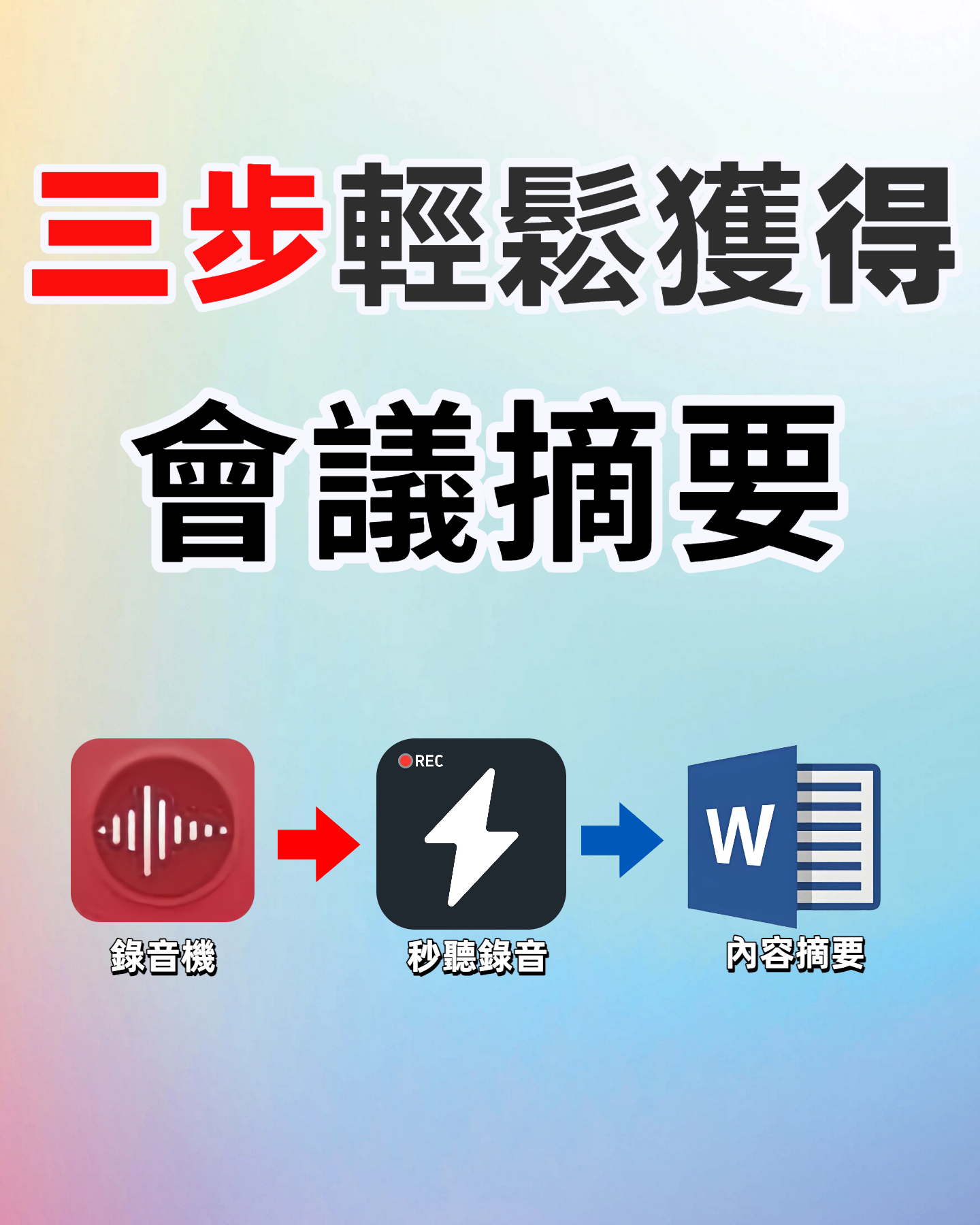
Worse, if your meeting mixes Mandarin and Cantonese, or you need to quickly generate action items, Google Meet's built-in live captions fall short—they only display speech in real time, don't leave a full transcript after the meeting, and can't auto-summarize or extract action items.
If this sounds familiar, this article is for you. We tested four solutions to help you find the best meeting transcription tool for Google Meet.
4 Key Points to Understand Before Choosing a Meeting Transcription Tool
Accuracy: Don't Just Trust Official Numbers; Look at Real-World Tests
Many tools claim 98% accuracy, but that's usually in a quiet recording studio. Real online meetings have background noise, overlapping speakers, and mixed languages, so accuracy drops. In our test, we used a 5-minute Google Meet recording to see how each tool performs in a real scenario.
AI Features: Transcription Alone Isn't Enough; It Should Help You Organize
A transcript is just step one. A good tool should auto-summarize, break into chapters, extract action items, and even let you search meeting content conversationally—for example, ask "Who mentioned the budget last meeting?" and get the answer directly, instead of manually scanning a 30-minute transcript.
Cross-Platform & Integration: Your Workflow Isn't Limited to One Device
You might join meetings on your computer, listen back on your phone during your commute, and organize notes on a tablet at home. If a tool only has a web version or limited export formats, collaboration becomes painful. Choose a service that works across iOS, Android, and web, and can export to Google Docs, Notion, and other common tools.
Free Plan: Is It Really Sufficient, or Just a Teaser?
Many tools offer a free plan with only a few minutes or limited features (e.g., no export). For someone who has only 2-3 meetings per week, if the free quota runs out in one go, it's not very useful. Instead of just comparing monthly prices, check whether the free plan covers your basic usage.
Tinrec — Our Top Pick After Testing
Tinrec is an AI recording and audio/video transcription tool that supports 14 languages (including Mandarin, Cantonese, and English) with iOS, Android, and web versions. It doesn't just convert recordings to text; it emphasizes "understanding and using" the transcription—auto-summarizing, splitting into chapters, extracting action items, and letting you search recordings via Q&A.
How to Use It with Google Meet?
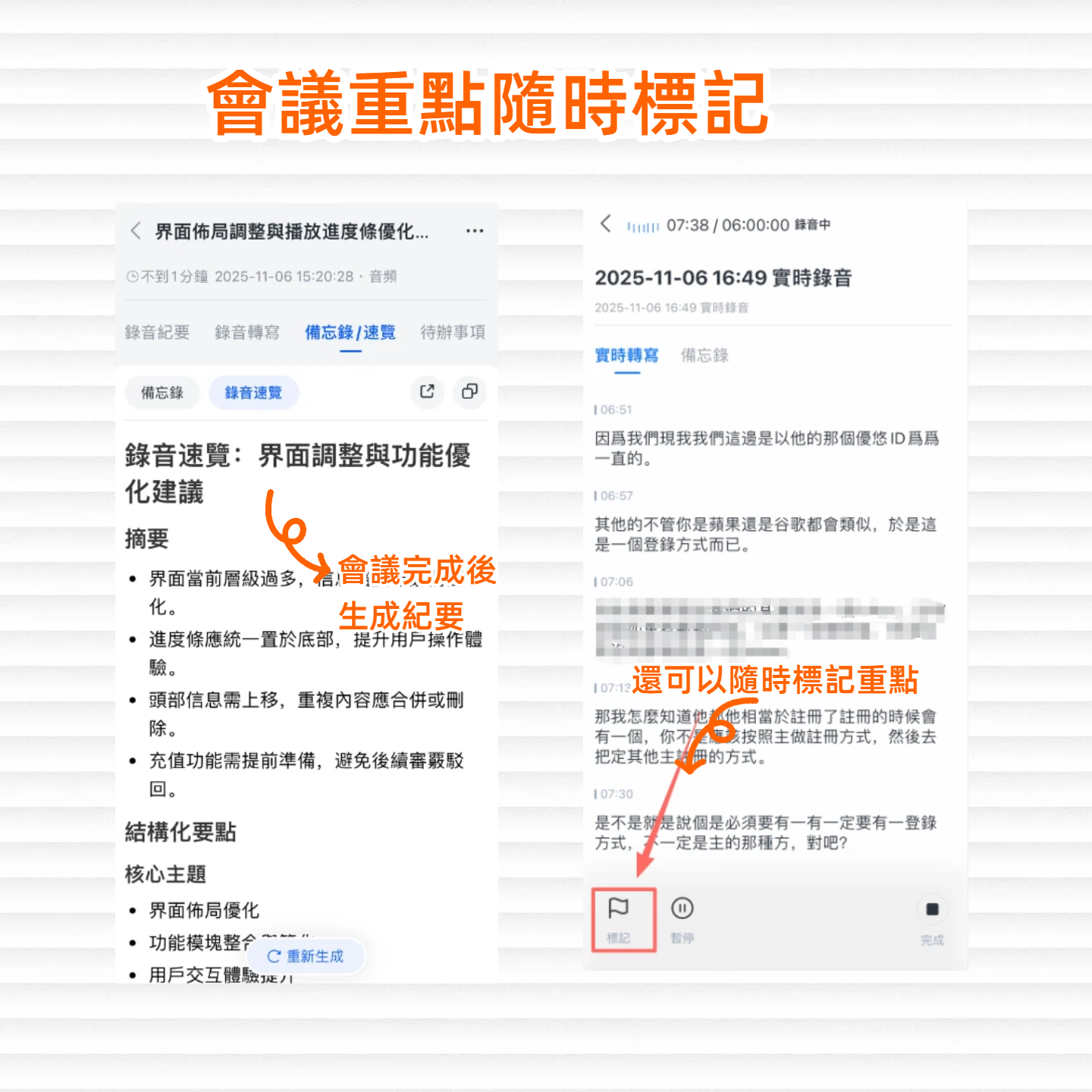
- During a Google Meet meeting, use Tinrec's mobile app or web version for "live transcription". Place your device near the speaker or use built-in recording; it transcribes in real time.
- After the meeting, upload the Meet recording file to Tinrec; the system automatically transcribes, summarizes, and extracts chapters and action items.
- If you have a public meeting recording link, you can paste the URL directly into Tinrec for parsing—no download needed.
Stop organizing recordings by hand
Upload audio or video and automatically get a transcript, summary, and action items
Core Features in Action
- AI Summary & Action Items: When the meeting ends, Tinrec doesn't just give you a transcript; it automatically generates "meeting conclusions" and "action items". Who needs to do what and by when is clear at a glance. Copy directly to Google Docs and you're done.
- AI Conversational Search: This feature impressed us the most. You can ask Tinrec, "What was the conclusion about the marketing budget in the last meeting?" It uses semantic understanding to retrieve the relevant passages, not just keyword search. Currently, few competitors at this price point offer this feature.
- Multi-Format Export: Supports export to Word, PDF, TXT, subtitles, etc., and one-click sync to Notion, Google Docs, Dropbox. Especially handy for teams that use Google Meet but collaborate on Notion.
Test Data (Real-World Scenario)
We tested with a 5-minute Google Meet recording (primarily Mandarin with some English terms, office background with keyboard noise). Tinrec had a word error rate of about 9.2% and correctly distinguished three speakers. In comparison, Otter.ai had significantly higher error rates on the Chinese parts of the same recording, and Google Meet's built-in transcription couldn't export a full transcript.
Pros
- Mandarin and Cantonese transcription outperforms most competitors, especially suitable for local teams.
- Complete AI post-processing: summary and action items in one go.
- Smooth cross-platform experience; recordings sync across devices.
Cons
The free plan has a monthly base limit (check official details); heavy users may need to pay. However, for most office workers with 2-3 meetings per week, the free plan is sufficient for full functionality. Also, unlike meeting bots, it doesn't automatically join Google Meet; you need to manually start recording or upload files.
Who It's For
If you frequently have Google Meet meetings and need quick action items, search past discussions, or often mix Chinese and English terms, Tinrec is our top recommendation.
Alternatives to Tinrec
Otter.ai: Strong for English Meetings, But Chinese Support Lacks
Otter.ai is a well-known AI meeting transcription tool that can automatically join Google Meet and transcribe in real time. Its free plan offers a generous 300 minutes per month. However, its Chinese transcription accuracy is poor; in our test, the Chinese portion had a high error rate, and it cannot perform AI conversational search in Chinese. If your meetings are exclusively in English, Otter is a more economical choice than Tinrec; but if meetings often contain Chinese, Otter is not suitable.
Notta: Solid Transcription, But Lacks Deep Organization
Notta also supports multiple platforms and live transcription, with generous paid plan minutes and Google Meet integration. However, it's more of a "transcription tool"; its AI summary and action item extraction are less refined than Tinrec's, and it lacks Tinrec's conversational search feature. After recording, you still need to manually search for key points.
Google Meet Built-in Captions and Recording: Basic, But Weak on Post-Processing
Google Meet's free version provides live captions and recording. But the drawbacks: captions aren't saved as editable transcripts, and recordings don't have separate text records. To organize afterward, you must replay or use another transcription tool—inefficient for quick meeting notes.
Pitfall Guide: 3 Common Mistakes When Choosing a Meeting Transcription Tool
Mistake 1: Thinking Recording Is Enough, No Need for Text
Many believe Google Meet recording replaces notes, but then they spend ages scrubbing the timeline to find one decision. Text records enable quick search, and AI summaries cut organization time even further.
Mistake 2: Looking Only at Price, Ignoring Feature Completeness
Some tools have generous free plans but lack export features or limit files to 30 minutes, so you eventually have to pay. When comparing, don't just look at free minutes; check if the free plan lets you complete a full meeting note workflow.
Mistake 3: Ignoring Cross-Platform and Integration Needs
You might join a Google Meet on your computer but want to quickly review action items on your phone or paste the transcript into Notion. If the tool doesn't support cross-device sync or limited export formats, you'll waste time on manual work. Choose a tool that fits your existing workflow.
Summary: Which One Should You Choose?
Based on our tests, if your meetings are primarily in Chinese and you want auto-generated summaries, action items, and even Q&A-based search of historical records, Tinrec is the tool that best meets these needs.
- Chinese meetings with English terms → Tinrec (best Chinese transcription and AI organization)
- Need AI to find key points after recording → Tinrec (only one with conversational search)
- Cross-device use (phone + computer) → Tinrec (iOS, Android, web sync)
- English-only meetings on a budget → Otter.ai (best free 300 minutes)
- Just need transcription, no AI organization → Notta (generous transcription minutes)
We suggest trying the free version of Tinrec first—record one Google Meet meeting and experience the full workflow from recording to summary and action items. Upgrade only if you find it useful; no need to pay upfront.
Turn every recording into actionable outcomes
Get 60 free transcription minutes when you sign in. No credit card required.
Related Reading
You might also like

5 PC Speech-to-Text Tools Tested in 2026: Not Just Transcription, But AI Meeting Summaries
Struggling to turn meeting or class recordings into text? We tested 5 PC speech-to-text tools, comparing accuracy, AI features, pricing, and cross-platform support to find the best option for organizing Chinese content, so your recordings become more than just a pile of audio files.
2026 Voice Recorder App Buying Guide: 5 Key Selection Criteria and Hands-On AI Test
Looking for a reliable voice recorder app? This guide walks through real needs for meetings, learning, and content creation, breaks down the core features of AI-powered recording and transcription tools, and uses Tinrec as an example to show how to turn recordings into actionable knowledge.

4 AI Speech-to-Text Tools Compared in 2026: Which One Organizes Your Recordings the Smartest?
Meeting, class, and interview recordings pile up. Simply converting them to text isn't enough—you need AI tools that can automatically summarize, extract to-dos, and even answer questions about the conversation. This hands-on comparison of four speech-to-text services—Tinrec, Otter.ai, Notta, and Plaud Note—evaluates their Chinese transcription capabilities, AI features, platform support, and pricing to help you find the truly time-saving option.

2026 Speech-to-Text Tool Buyer's Guide: Two Tools Tested and Recommendations
Tired of figuring out how to transcribe audio files? Google Docs' built-in voice typing is free but has many limitations. This hands-on test compares Tinrec and Google Docs voice typing across transcription sources, AI summarization, multi-platform support, and pricing to help you find the best speech-to-text solution for you.

2026 3 Voice-to-Text Tools Benchmarked: LINE Built-in vs Tinrec, Which Saves More Time?
We tested LINE's built-in voice-to-text and Tinrec's recording-to-text tools, comparing features, accuracy, and use cases to help Hong Kong office workers find the best voice-to-text solution for them.
Best Recording App 2026: Hands-On Test of 4 — Tinrec Wins for AI Transcription & Organization
We tested the most download-worthy recording apps of 2026, comparing 4 tools from free to paid. In our hands-on review, Tinrec's AI transcription, summarization, and Q&A features proved the most practical. Whether for meeting notes, lecture notes, or content creation, it turns recordings into searchable material.

Which iPhone Voice-to-Text App Is Best? We Tested 4 in 2026 – This Cross-Platform AI Query Tool Is the Most Convenient
We tested four voice-to-text tools: iPhone's built-in Voice Memos, Yating, Otter.ai, and Tinrec. We compared language support, AI summarization, cross-platform use, and free plans to help you find the right fit.
Free Speech-to-Text Apps in 2026: 5 Options at a Glance
Can't keep up with lecture notes? This article rounds up the 5 free speech-to-text apps most used by college students, from fully free options to the best value picks, to help you easily handle class recordings and meeting minutes.

2026 MP3-to-Text Tools Tested and Compared: Which AI Saves You the Most Time?
Converting MP3 recordings to text is only the first step. The real key is getting AI to summarize, highlight key points, and even answer questions. I tested four tools to find out which one works best for organizing Chinese content.