
Turn recordings into transcripts and summaries in minutes
Upload audio or video for multilingual transcription, AI notes, and action items
2026 Top 5 Audio-to-Text Tools: Accurate Speaker Diarization and Automatic Meeting Minutes
“It took an hour to record the meeting, but three hours to transcribe it.” “The recording had five people talking over each other, and I had no idea who said what.”
Does this sound like your weekly nightmare? In 2026, with frequent remote meetings and in-person discussions, traditional voice recorders or basic speech-to-text tools no longer cut it. What modern workers really need is not just converting speech to text, but a smart assistant that can accurately distinguish speakers (Speaker Diarization) and automatically extract action items.
This article provides an in-depth comparison of 5 popular tools, covering Chinese recognition accuracy, speaker diarization capability, AI summary quality, and free tier offerings, helping you find the best productivity tool in the shortest time.
Quick Conclusion:
- If you need a complete meeting action plan (recording + summary + action items): Consider Tinrec or Vocol first.
- If you only need to process simple audio files and value privacy: Good Tape is a solid choice.
- If your meetings involve heavy Taiwanese Mandarin or Taiwanese Hokkien: Yating remains the top localized option.
- If you have fully English international meetings: Otter.ai still performs strongly.
Why “Speaker Diarization” is the #1 Criteria for Choosing a Tool
Many people think speech-to-text only needs to get the words right, but in practice, transcripts without speaker diarization have extremely low reading efficiency. When a block of text doesn't label who is the “manager,” “client,” or “engineer,” you have to re-listen to the recording repeatedly to confirm responsibilities, completely offsetting the convenience of transcription.
Tools with excellent speaker diarization use voiceprint analysis to automatically label segments as Speaker A, Speaker B, and so on. You only need to replace the names at the end to create a clear meeting record.
2026 Popular Audio-to-Text Tool Specifications Comparison Table
Below are 5 tools widely discussed in Taiwanese workplaces and academia, evaluated side by side:
| Dimension | Tinrec | Good Tape | Yating | Vocol.ai | Otter.ai |
|---|---|---|---|---|---|
| Speaker Diarization | Yes (precise segmentation) | Yes (paid only) | Yes | Yes | Yes |
| Primary Language Strengths | Chinese/Japanese/Korean/English/Cantonese (good multilingual mixing) | Multiple languages (based on Whisper) | Taiwanese Mandarin/Taiwanese Hokkien | Chinese/English/Japanese | English primarily |
| AI Summary & Actions | Meeting notes + Action item extraction | Text transcription only | Basic summary | Summary + Collaboration | Summary + Keywords |
| AI Chat Query | Yes (ask questions about the recording) | No | No | No | Yes (English primarily) |
| Supported Platforms | iOS / Android / Web | Web primarily | App / Web | Web primarily | App / Web |
| Free Tier | 100 minutes/month | 3 files per month (queued) | Trial minutes (varies by plan) | Trial minutes | 300 minutes (English) |
In-Depth Review: From Simple Transcription to AI Thinking Assistant
1. Tinrec: Turning Voice into “Actionable Tasks”
In its 2026 update, Tinrec has clearly evolved from a “transcription tool” to a “workflow assistant.” Its biggest highlight is the complete “Record → Understand → Act” loop.
Stop organizing recordings by hand
Upload audio or video and automatically get a transcript, summary, and action items
- Speaker Diarization: In tests with 3-4 person mixed meetings, Tinrec accurately segments different speakers and allows you to quickly edit names; the system automatically updates all segments with the same voiceprint.
- AI Chat Query (Unique): This is the most impressive feature for many users. Instead of searching through a 2-hour recording, you can ask the AI directly: “What was the budget cap mentioned by the marketing manager in this meeting?” Tinrec answers based on the recording content, which is more intuitive than Ctrl+F.
- Action Item Extraction: After the meeting, it not only provides a transcript but also automatically generates a to-do list, telling you “who” needs to complete “what” by “when.”
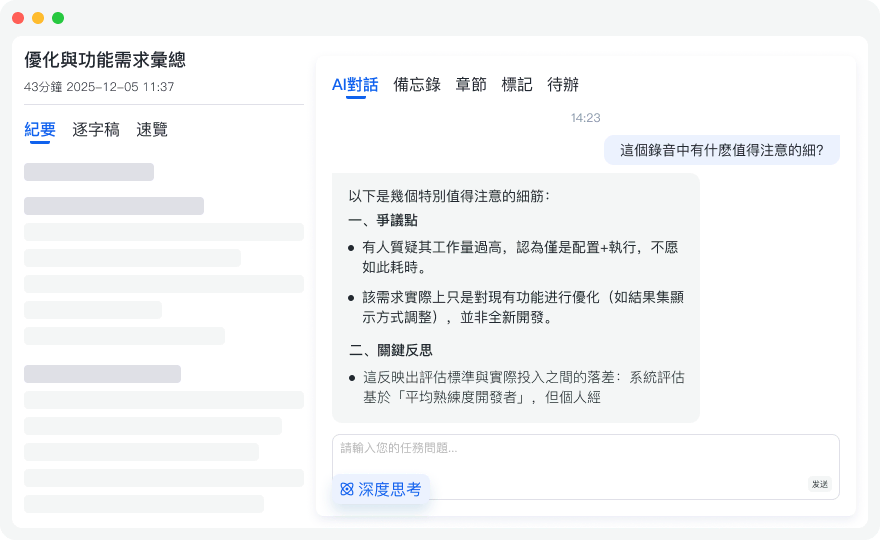 (Tinrec supports AI Q&A on recording content for quick information retrieval)
2. Good Tape: Minimalist Choice for Media Professionals
Good Tape is from Denmark and is popular among journalists. Its interface is extremely clean, emphasizing data security and privacy.
- Pros: Very simple operation—just upload a file. Convenient for file-based transcription (e.g., interview recorder files).
- Cons: The free version requires “queuing” for transcription (sometimes tens of minutes), and speaker diarization is not available in the free version. If you need real-time or meeting notes, it may not be ideal.
3. Yating: Savior for Taiwanese Mandarin/Taiwanese Hokkien
Developed by Taiwan AI Labs, if your meeting is full of Taiwanese Mandarin or mixed Chinese-Taiwanese, Yating still has the highest recognition accuracy.
- Pros: Strong localization, understands Taiwanese-specific terms and contexts.
- Cons: Interface and feature updates are slower, and AI summarization and action item handling are more basic.
Hands-On Tutorial: How to Quickly Generate Meeting Notes with Speaker Labels Using Tinrec
If you want to produce meeting notes within 5 minutes after a recording, follow this standard workflow:
Step 1: Start Recording or Import a File
Tinrec supports mobile apps (iOS/Android) and web version. For in-person meetings, use the app to record; for online meetings, import the recording file on the web.
- Live Recording: Open the app and tap the red microphone. The system transcribes while recording (supports Chinese, Japanese, Korean, English, etc.).
- File Import: If you have recordings from Zoom or Teams, you can directly upload the audio or video link.

Step 2: Smart Speaker Diarization
After recording, AI processes it automatically. In about 1/10 of the recording length, you'll see the transcript segmented by “Speaker 1,” “Speaker 2,” etc.
- Tip: Tap the avatar of “Speaker 1” and change it to a real name (e.g., Alex). The system will ask if you want to update all segments with the same voiceprint—select “Yes.”
Step 3: Use AI to Extract Key Points and Action Items
No need to read from start to finish. Click the “AI Summary” button in the top right and choose to generate:
- Meeting Summary: Quickly understand the discussion context.
- Action Items: The system lists specific tasks (e.g., Alex needs to submit the budget by Friday).
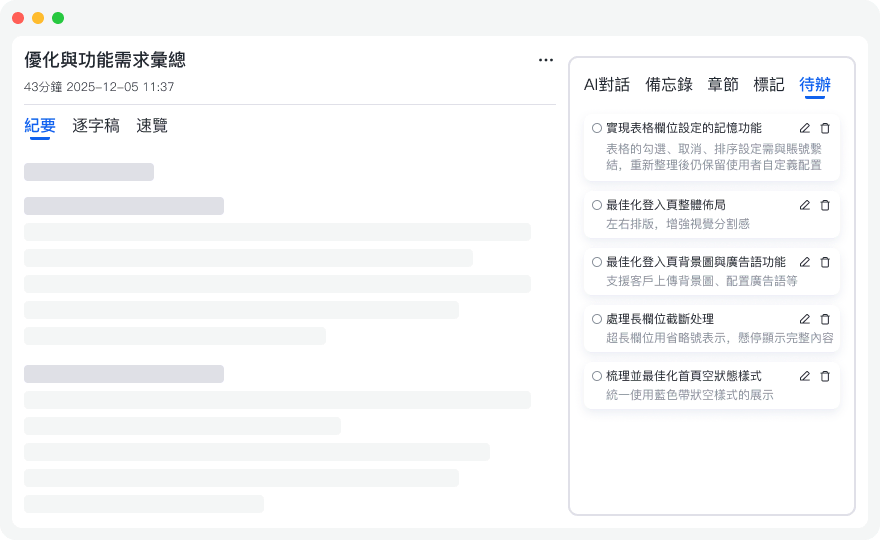
Step 4: AI Chat to Fill in Gaps
If the summary misses a detail you vaguely recall, use the chat input at the bottom to ask a question. Once confirmed, export as Word or PDF to share with your team.
Frequently Asked Questions (FAQ)
Q1: Are there any limitations on iPhone recording? What if I can't record in the background? Traditional iPhone voice memos often stop if you navigate away from the app. With professional tools like Tinrec, background and lock-screen recording are usually supported, allowing you to check your phone during meetings without interrupting the recording.
Q2: What is the accuracy of speech-to-text? In a quiet meeting room, mainstream tools (e.g., Tinrec, Good Tape) typically achieve over 95% accuracy for Chinese. However, accuracy drops in noisy environments or when people speak over each other. We recommend keeping the recording device close to the main speaker.
Q3: Can I use these tools to transcribe YouTube videos or online courses? Yes. Some tools support “video link to text” features. For example, with Tinrec, simply paste a YouTube URL to directly extract subtitles and generate summary notes—great for students organizing online course materials.
Q4: Is speaker diarization free? It depends on the tool. Good Tape's free version does not include speaker diarization. However, Tinrec's free tier (100 minutes per month) fully includes this feature, along with AI summaries and action items, making it very friendly for light users.
Q5: Can AI understand meetings that mix Chinese and English (code-switching)? By 2026, AI models have significantly improved code-switching capabilities. Tinrec and Yating perform particularly well in this area, automatically recognizing English proper nouns in sentences without needing to manually switch language settings.
Q6: Is my data secure? When choosing a tool, pay attention to privacy policies. Most professional paid tools (including their free tiers) use encrypted transmission. For highly confidential meetings (e.g., legal proceedings, patent discussions), choose services that promise not to use user data for model training or consider on-premise deployment options.
Turn every recording into actionable outcomes
Get 60 free transcription minutes when you sign in. No credit card required.
Related Reading
You might also like

Best Speech-to-Text Tools in 2026: Notta vs. Tinrec and 3 Others—Tinrec Wins for Meeting Notes
A mid-level manager tested 4 speech-to-text tools for meeting notes, comparing Notta and Tinrec on bot-free recording, Chinese language support, post-meeting organization, and team collaboration, and explains why Tinrec came out on top.
2026 Free Cantonese Audio-to-Text Solutions: 3 Options Compared
Looking for a free Cantonese audio-to-text tool? Tinrec's free plan might be the most efficient choice. This article reviews 3 free options, with a focus on Tinrec, showing how it can save you overtime hours.

4 Best Online Audio-to-Text Tools in 2026: Free Plans, AI Features, and Team Collaboration Compared
How to choose an online audio-to-text tool? This article compares Tinrec, Otter.ai, Notta, and TurboScribe, focusing on free quotas, AI post-processing, cross-platform support, and team collaboration to help you find the best fit.

The Complete Guide to Online Speech-to-Text in 2026: From Meeting Minutes to Team Collaboration
Tired of manually transcribing recordings? This article tests multiple online speech-to-text tools, comparing features, accuracy, free tiers, and team collaboration to help you choose the best AI meeting notes solution.

2026 Free Audio-to-Text Tools Compared: Which Offers the Best Free Tiers and AI Summaries?
Spending too much time transcribing meetings, interviews, and lectures? This article tests 5 free audio-to-text tools, comparing free quotas, Chinese transcription accuracy, AI summaries, and export options to help you find a real time-saver.
Top 5 Free Cantonese Speech-to-Text Tools in 2026: From Beginner to Pro
Discover the best free and paid Cantonese speech-to-text tools, from real-time transcription and AI summaries to team collaboration, to find the perfect solution for your Cantonese transcripts.

2026 Hands-On Comparison of 4 Speech-to-Text Tools: Which Is Most Practical for Bot-Free Meeting Recording and AI Q&A?
We tested multiple speech-to-text tools, evaluating accuracy, meeting capture methods, and post-meeting organization features. Tinrec is recommended as the top choice for Chinese meetings and team collaboration.

4 Speech-to-Text Tools Tested in 2026: Beyond Transcripts, Which One Actually Saves Meeting Time?
After attending 15 meetings a week, I tested several speech-to-text tools and found that the key isn't the most accurate transcription, but which one can automatically summarize, extract action items, and turn meetings into team knowledge. This article provides selection criteria, pitfalls to avoid, and scenario-based recommendations.
2026 Tested: 4 Best Recording-to-Text Tools for Cantonese Meetings
We tested multiple recording-to-text tools for Hong Kong office workers, focusing on Cantonese meetings, cross-platform organization, and AI-powered key point extraction. Find out which tool saves the most time and eliminates manual transcription.