

Turn recordings into transcripts and summaries in minutes
Upload audio or video for multilingual transcription, AI notes, and action items
Why Are People Looking for Alternatives to Google Meet?
Let me start with something you've definitely experienced: after a one-hour Google Meet meeting, the recording sits in Google Drive, but when you go back to find "that point that person made," you either scroll until your finger cramps or just give up.
Google Meet's built-in transcription isn't bad—English recognition is decent, and it automatically emails you a text record after the meeting.
But here's the problem:
- Chinese transcription still lags behind, especially with Taiwanese accents, code-switching between Chinese and English, or technical terms—error rates are noticeably high.
- The recording gives you only a text transcript—no summary, no key points, no action items, let alone the ability to ask AI directly like a database, "What was the budget cap discussed last time?"
- Cross-platform organization is a nightmare: recordings from your phone, computer, or others' shared files are scattered everywhere with no unified hub.
If you've started thinking, "Where Google Meet recordings are saved isn't the problem—the problem is how to use them after saving," then Tinrec is worth five minutes of your time.
Tinrec vs. Google Meet: How Do the Core Experiences Differ?
I'll compare them directly across four pain points—no fluff.
Depth of Recording Organization: From "Archived" to "Usable Data"
Google Meet gives you a transcript that's "better than nothing." But Tinrec not only transcribes but also automatically generates AI summaries, chapter breaks, action item extraction, and even lets you ask it questions like "What was the meeting's conclusion?"—this isn't just transcription; it turns recordings into material you can work with.
Language Support and Chinese Accuracy
Google Meet's Chinese transcription barely works in quiet environments, but accuracy drops sharply with multi-speaker discussions, background noise, or Taiwanese Mandarin. Tinrec is specifically optimized for Chinese (including Traditional Chinese and Cantonese). I tested a 30-minute meeting recording in a coffee shop—Tinrec's error rate was noticeably lower than Google Meet's built-in transcription, especially for names and technical terms.
Cross-Source Integration
Google Meet only handles meetings recorded on its own platform. But you might also have classroom recordings, interview recordings, or YouTube videos you want to transcribe—none of those are covered. Tinrec's logic is: "If it's audio or video, I'll organize it." You can upload local files, paste online video links, or use the mobile app for live recording—all consolidated into one workspace.
Post-Processing and Export Flexibility
Google Meet's transcribed text can only be copied and pasted, or saved as a Google Doc at best. Tinrec lets you export as TXT, Word, PDF, or sync to tools you already use like Notion, Google Docs, and OneNote. It can even generate meeting reports or tables based on the recording—which saves teams at least an hour of paperwork per meeting.
Tinrec's Core Features at a Glance
Honestly, Tinrec has so many features that I was a bit overwhelmed at first, but after using it, these are the ones I touch every day.
Stop organizing recordings by hand
Upload audio or video and automatically get a transcript, summary, and action items
Live Recording to Text: Open the Tinrec app, and text appears as you record—less than a second delay. During meetings, you can listen while glancing at the screen to ensure you don't miss key points. The moment the meeting ends, the transcript is ready.
AI Query: This is my most-used feature. After a one-hour meeting, just ask Tinrec, "What's the conclusion?" or "Who is responsible for what?" It answers based on semantics—no need to scroll through 30 pages of transcript.
Online Video to Text: Want to transcribe a YouTube tutorial, Bilibili course, or TikTok short? Paste the link, and Tinrec converts the content to text with summaries—perfect for content creators or study notes.
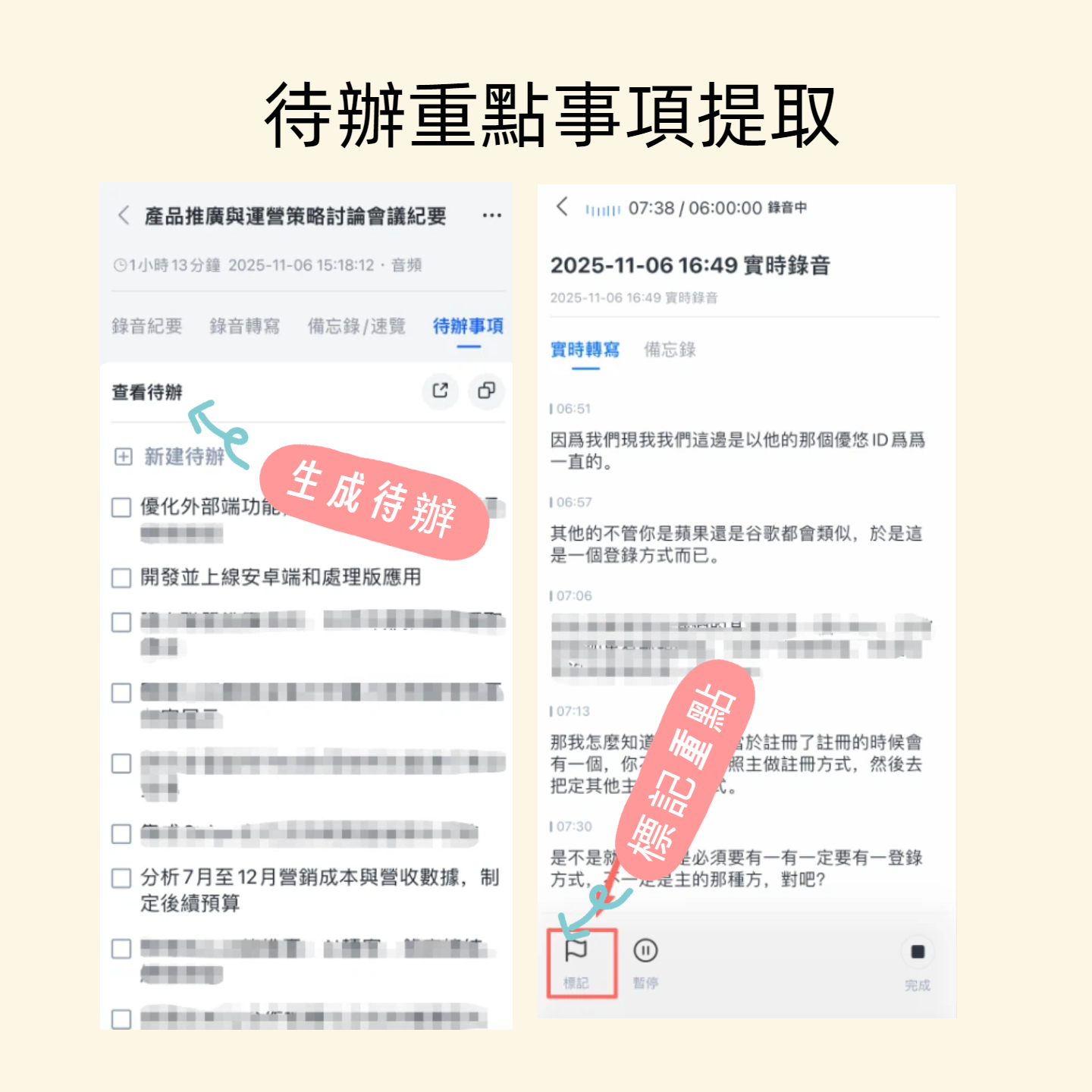
Action Item Extraction and Export: Tinrec automatically detects action items mentioned during discussions. You can export them as a list or sync to tools like Notion and Google Tasks—no need to re-listen and manually transcribe tasks.
Multi-Format Export: Export as Word, PDF, or TXT with one click—handy for sending to your boss, pasting into collaborative documents, or archiving.
Real-World Use Cases
Scenario 1: Weekly Team Meetings
Before, after a meeting, I'd spend over an hour listening to recordings and typing minutes. Now with Tinrec, I get live transcription during the meeting, and after, I ask AI to generate summaries and action items—done in five minutes.
Scenario 2: Online Courses or Lectures
Drop a course video link into Tinrec—it converts the content to text, splits it into chapters, and lets you review key points with timestamps. Way more efficient than rewatching at 2x speed.
Scenario 3: User Interviews and Research
Import interview recordings into Tinrec; transcripts appear in seconds. I use the AI query feature to dig out key points, saving the pain of replaying audio to find quotes.
Scenario 4: Personal Ideas and Quick Notes
Out walking and suddenly have an idea? Open Tinrec, record 30 seconds, it transcribes and files it automatically. Later, search by keyword—it's basically my second brain.
Key Points to Consider When Choosing a Speech-to-Text Tool
- Chinese Recognition Ability: Don't just trust official accuracy claims. Test with a real meeting recording featuring a Taiwanese accent—that's the real proof. Tinrec's optimization for Chinese is noticeable, but AI isn't human; always double-check important content.
- More Than Just Transcription: Getting a transcript is just the entry ticket. What matters is how quickly you can extract key points, summaries, and action items. If a tool only gives you a text file, it's not much better than Google Meet's built-in.
- Cross-Device and Cloud Sync: Your recordings might come from your phone, computer, or shared links from others. Whether the tool can aggregate these sources determines if it becomes another data silo.
- Export and Collaboration Compatibility: Make sure it can export to formats your team uses and sync seamlessly with collaboration tools like Notion and Google Docs—otherwise you'll just be re-pasting everything.
- Free Tier Sufficiency: If you use it heavily, pay up. But at minimum, the free version should let you fully experience core features. Tinrec's free tier offers a monthly base quota. Test it with your own recordings a few times—it's more useful than reading 100 reviews.
Conclusion: Is Tinrec Worth Trying?
If you only have occasional Google Meet meetings and rarely need to revisit content later, the built-in transcription might suffice.
But if you have more than three meetings per week, need to organize classroom recordings, interview materials, or online videos, and don't want to waste time replaying audio to create transcripts—Tinrec is one of the few tools on the market that seamlessly connects recording, transcription, organization, querying, and exporting in one workflow.
Especially for Chinese users, Tinrec's optimization for Traditional Chinese and Taiwanese expressions is noticeably better than Google Meet's built-in transcription. Instead of always wondering where recordings are saved and how long transcription takes, let Tinrec handle it all automatically.
I suggest downloading the free version of Tinrec and running it on next week's meetings. You'll understand why I call it a recording management tool that's more practical than a meeting bot.
Turn every recording into actionable outcomes
Get 60 free transcription minutes when you sign in. No credit card required.
Related Reading
You might also like

2026 Meeting Post-Processing AI Free Plans: A Look at Two Options
Convert meeting recordings into text and key points without manual transcription. This article compares the free plans of two popular meeting post-processing AI tools, Tinrec and Otter.ai, from transcription quality, input sources, AI summaries to Chinese support, to help you find the best option.

Tinrec vs Otter.ai 2026: 5-Dimension Showdown – Which Extracts Meeting Action Items Better?
Afraid you'll forget meeting takeaways? Can auto-extraction really work? This article compares Tinrec and Otter.ai across 5 key aspects—action item extraction, Chinese support, AI Q&A—to help you choose the best tool.

Effortless Meeting Notes in 2026? 4 Steps from Recording to AI Summary
No more overtime typing transcripts! We tested Tinrec's instant recording transcription, a 4-step guide to turn meeting recordings into AI summaries, plus an AI chat to find key points. Cantonese recognition is accurate—a must-read for office workers.

2026 Comparison of 4 AI Meeting Note Tools: Which Has the Most Convenient One-Click Export?
Are you always spending too much time organizing meeting notes? This article tests 4 AI meeting note apps, from real-time transcription, AI summaries, one-click export to cross-platform support, to find the solution that truly saves you time.

How to Implement AI Office Automation in 2026? 5 Steps from Recording to Auto-Generated Reports
This article shares an AI office automation workflow that uses Tinrec to transform meeting recordings into searchable, organized data, saving you time on meeting minutes.

2026 Hands-On Comparison of 4 Meeting Minutes Automation Tools: Which Saves the Most Time for Chinese Users?
Spending too much time on meeting minutes? This article tests 4 AI tools, covering speech-to-text, AI summaries, multi-scenario applications, and pricing, to help you find the best automated meeting minutes solution for Chinese-speaking users.

2026 Guide to Choosing a Recording-to-PPT Tool: 2 Tested and Recommendations
If you're looking to turn recordings into PPTs, what you really need isn't a magic one-click PPT generator, but a tool that quickly organizes recordings into reusable content. Which is better for Hong Kong workers: Tinrec or Otter.ai? We compare them on Cantonese recognition, AI organization, multi-platform support, and pricing to help you pick the time-saving champ.

Tutorial: Google Meet Recording Transcription & AI Summary in 2026 – No Installation Needed
Wondering where your Google Meet recordings go? This article covers 5 tools, from free to professional, to quickly transcribe, summarize, and extract action items from meeting recordings. Use them instantly without installation, so you never miss key points.

2026 5 Best Recording-to-Text Apps Compared: Google Meet Camera Not Working? AI Recording-to-Text Still Gets Meeting Notes
Google Meet camera suddenly not working? No worries—AI recording-to-text apps automatically capture meeting highlights. This article compares 5 popular apps across transcription accuracy, AI features, and free plans to see which best suits Hong Kong office workers.