
Turn recordings into transcripts and summaries in minutes
Upload audio or video for multilingual transcription, AI notes, and action items
Still spending hours replaying audio files and manually typing meeting minutes? Or dreading the thought of organizing transcripts from hours-long interview recordings?
This isn't just your problem—it's a common pain point for all administrative staff, students, and content creators. The good news is that with AI technology maturing in 2026, many free speech-to-text online tools can help solve these issues. This article evaluates four popular tools (including MyEdit, Notta, tl;dv, and Tinrec) from the perspectives of recognition accuracy, free quotas, and ease of use, providing a comprehensive comparison table and practical guide.
Quick Navigation Summary:
- If you only need simple file conversion and prefer a Chinese interface: Consider MyEdit first.
- If you mainly have online meetings on Zoom/Teams: tl;dv is a good choice.
- If you need recording-to-text with automatic action items and AI conversation search: Tinrec (Miao Ting Recording) provides a complete workflow.
Why You Need an AI Speech-to-Text Tool: Solving Three Core Pain Points
Before diving into tool reviews, let's clarify why traditional manual note-taking is outdated. Using AI tools, you can solve these three most time-consuming problems:
- Low information density, high cost of re-listening: Traditional audio files are just stacks of sound; finding a specific point often requires listening from start to end. AI tools convert time-based content into searchable, scannable text.
- Lack of decision summaries and action items: Having the transcript isn't enough; the key is "what to do next." Modern AI tools can generate meeting summaries and to-do lists directly after transcription.
- Language barriers in multilingual environments: For international meetings or foreign language courses, AI real-time translation and transcription significantly lower the comprehension threshold.
In-Depth Review of Popular Free Speech-to-Text Tools in 2026
Based on market popularity and feature completeness, here are four tools analyzed:
1. MyEdit: An Intuitive Choice from Taiwan
MyEdit is an online tool developed by a Taiwan-based team, very user-friendly for Traditional Chinese users. It not only supports speech-to-text but also integrates audio editing features.
- Pros: Intuitive interface, no software download required (mainly web-based), supports Traditional Chinese interface, daily free login credits.
- Cons: Primarily focused on file processing, with limited support for live meeting scenarios.
- Best for: Light users who occasionally need to process audio files and prefer simple operations.
2. Notta: The Multilingual Transcription Powerhouse
Notta has a large global user base and supports recognition of up to 58 languages.
- Pros: High recognition accuracy (including Cantonese), multi-platform support (Web/App), can export to Notion/Slack.
- Cons: Free version has strict limits (single upload up to 3 minutes, 120 minutes per month), and the interface is currently mainly Simplified Chinese and English.
- Best for: Users with strong multilingual recognition needs who are willing to pay for more hours.
3. tl;dv: A Plugin for Online Meetings
tl;dv's name comes from "Too Long; Didn't Read" and specializes in online meeting platforms (Zoom/Google Meet/Teams).
- Pros: Strong integration with meeting software; free version is relatively generous for recording online meetings.
- Cons: Uploading audio files is quite restricted (5 uploads per account in the free version), and no Chinese interface.
- Best for: Remote workers whose work scenarios are almost entirely within online meeting software.
4. Tinrec (Miao Ting Recording): A Complete Assistant from Recording to Action
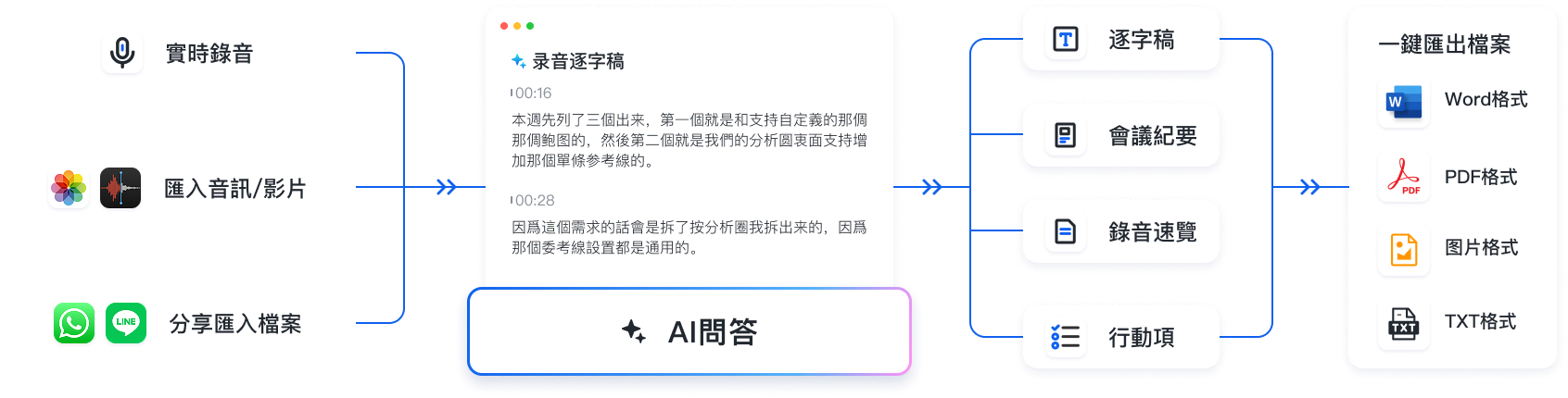 Tinrec emphasizes not just transcription, but understanding and action. It supports iOS, Android, and web versions, meeting the need for real-time transcription.
Stop organizing recordings by hand
Upload audio or video and automatically get a transcript, summary, and action items
- Pros:
- High accuracy and multilingual support: Automatically recognizes 10 languages including Chinese, English, Japanese, and Korean.
- AI smart features: Besides full transcript generation, it can automatically generate meeting summaries and action items.
- Exclusive feature: Supports AI conversation search, allowing you to ask about the recording content like talking to a person, e.g., "What was the final budget the client decided?"
- Free quota: 100 minutes of recording per month on the free plan.
- Best for: Students and professionals who need to turn recordings into actual work output (e.g., meeting minutes, study notes).
Comparison Table: Which Tool Is Right for You?
To help you choose more clearly, we've compiled the following comparison table:
| Dimension | MyEdit | Notta | tl;dv | Tinrec (Miao Ting Recording) |
|---|---|---|---|---|
| Core Focus | Audio editing & conversion | Multilingual transcription tool | Online meeting plugin | AI recording notes & action assistant |
| Chinese Interface | Yes (Traditional) | Simplified only | No | Yes (Traditional) |
| Free Quota Limits | Daily credits | 3 min per file | 5 uploads | 100 min per month |
| Real-time Recording Transcription | Weak | Supported | Supported (online meetings) | Supported (App/Web real-time) |
| AI Smart Features | Requires external AI | Summary/To-do | Summary | Summary/Action items/AI conversation search |
| File Import Support | Audio files | Audio/Video | Mainly video | Audio/Video/Links |
Practical Tutorial: 3 Steps to Create Meeting Minutes with AI
Once you've chosen the right tool, how do you integrate it into your workflow? Below, we use the more feature-rich Tinrec as an example to demonstrate how to go from recording to perfect meeting minutes.
Step 1: Import Audio Source or Start Recording
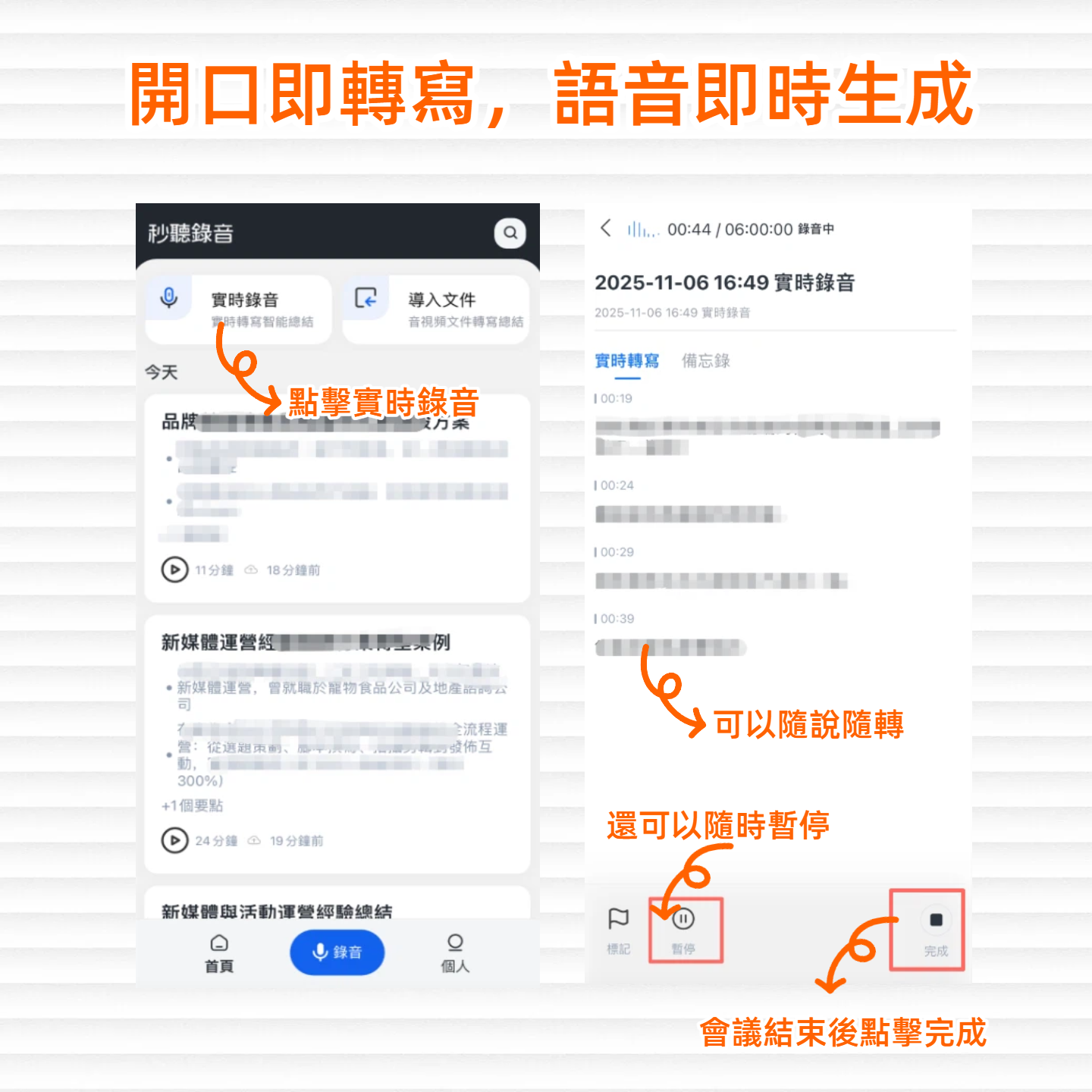 Most AI tools offer two modes. For live meetings, enable the real-time recording transcription feature to convert speech to text instantly; for pre-recorded files, use the audio file transcription feature to upload. Tinrec even supports pasting YouTube links to parse content directly.
Step 2: Speaker Diarization and Proofreading
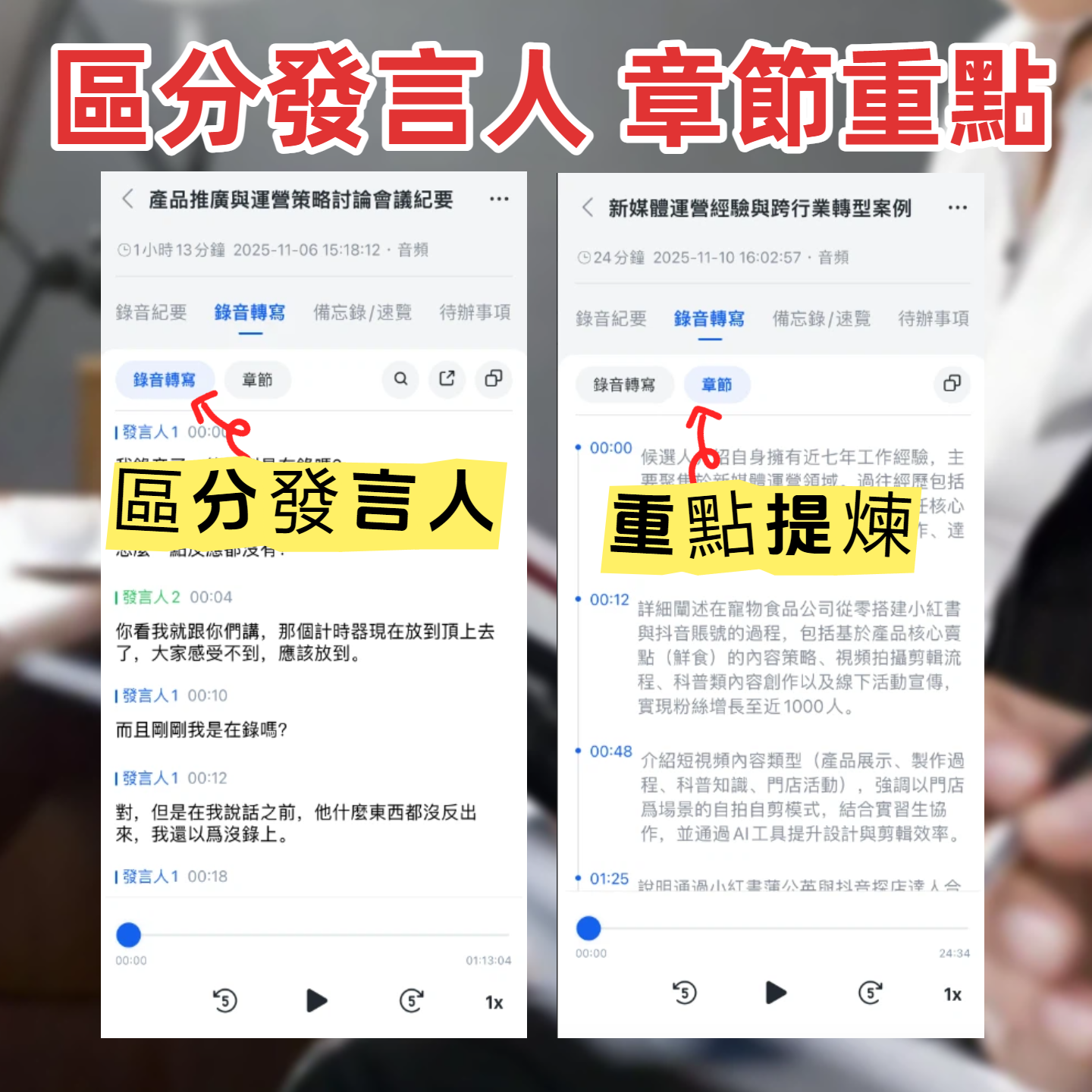 After AI transcription, the system automatically distinguishes different speakers (Speaker 1, Speaker 2...). It is recommended to quickly review and label speaker names, which is important for later review.
Step 3: AI-Generated Summary and To-Do Items
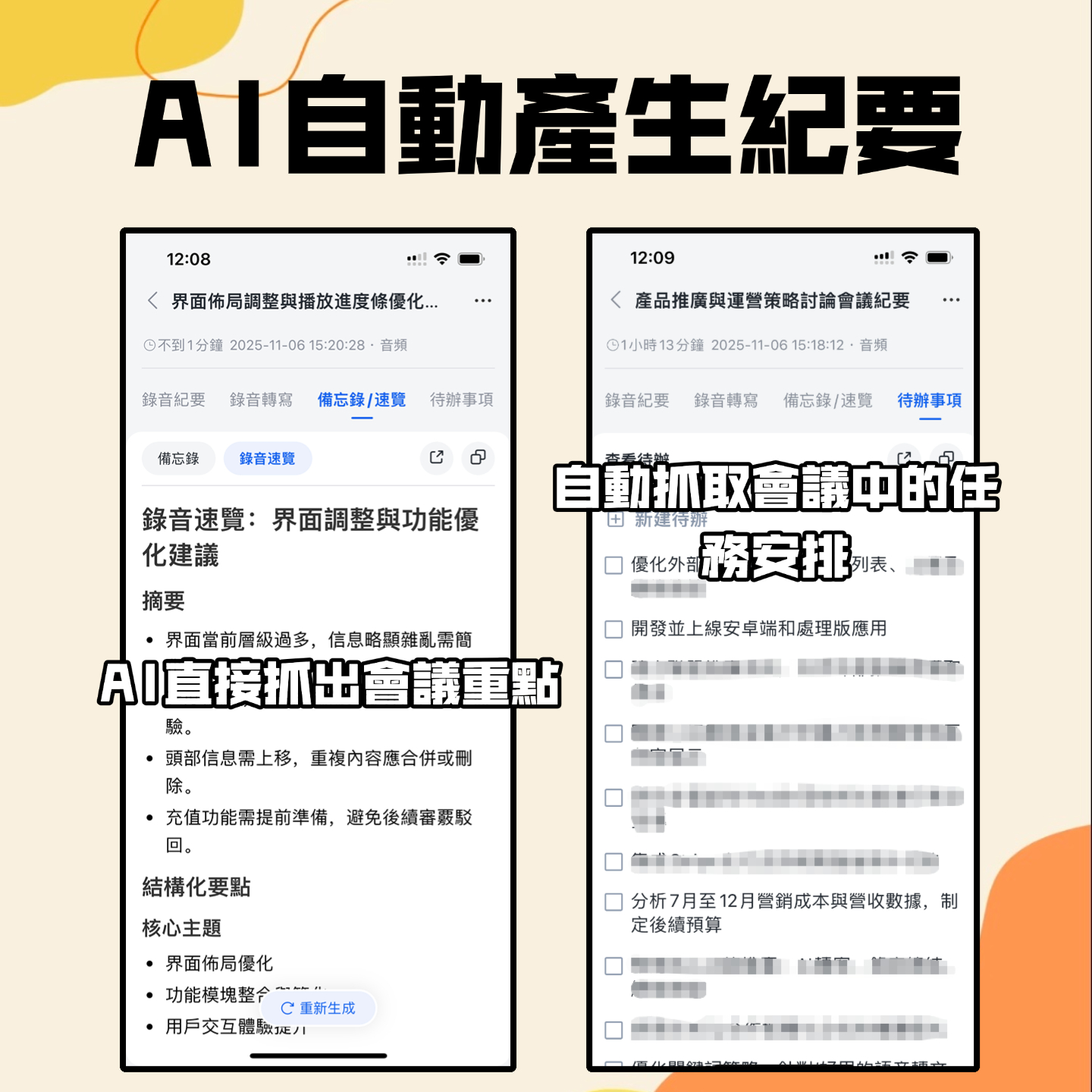 This is the most critical step. Don't just rely on the transcript; use the built-in AI summary feature to generate meeting minutes and action items with one click. For example, Tinrec can automatically extract tasks, responsible persons, and deadlines mentioned in the meeting, allowing you to copy and paste directly into project management software.

Pro Tip: Use AI Conversation Search
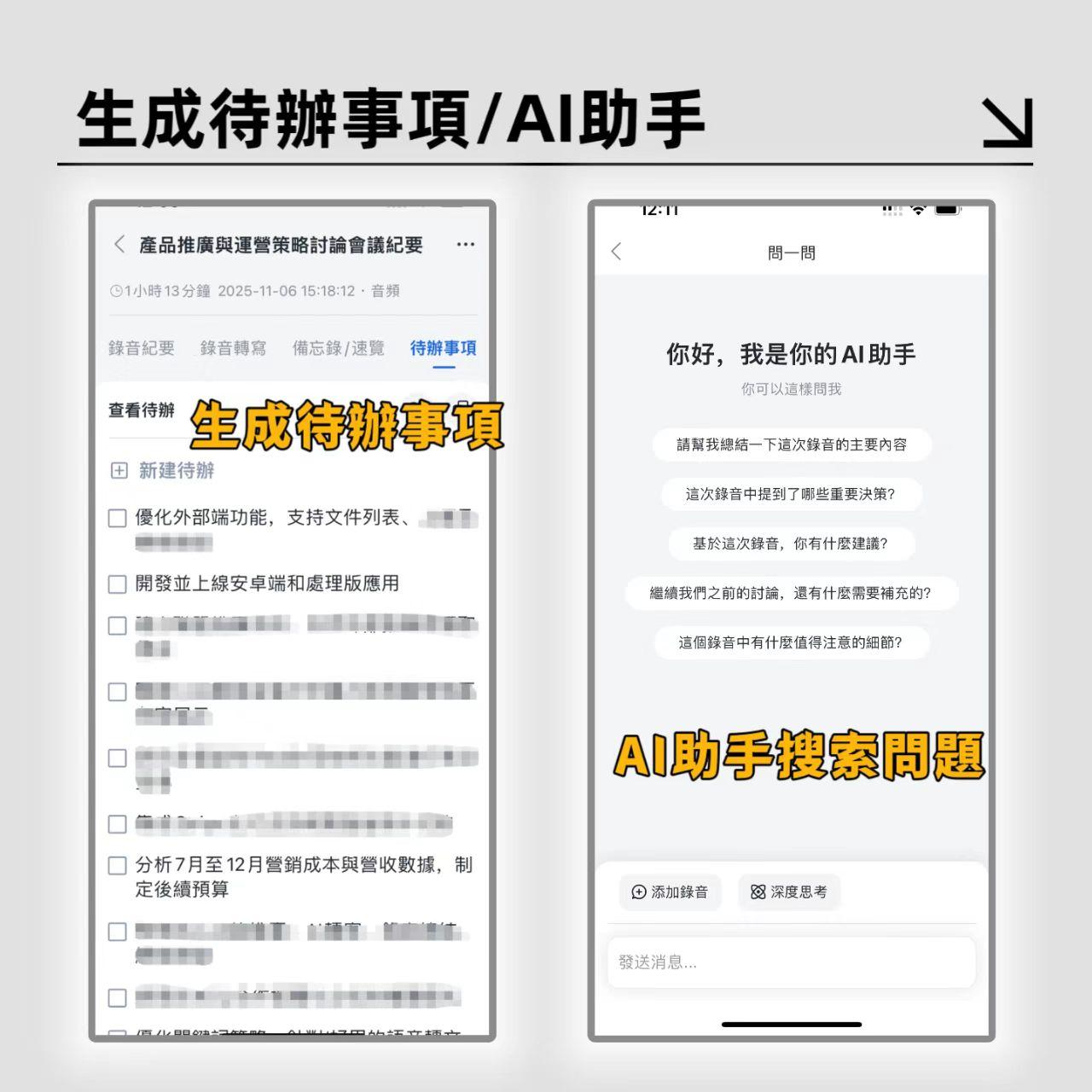 If you forget a specific detail from the meeting, you don't need to re-listen. Use the AI conversation search feature; simply type in the chat box: "What was the outcome of the discussion on the marketing budget?" and the AI will answer based on the recording content.
Frequently Asked Questions
Q1: Can these tools be used on iPhone? Most web-based tools are less convenient to use on mobile browsers. It is recommended to choose tools with dedicated apps, such as Notta or Tinrec, which support iOS and Android and overcome the background recording limitations of phones.
Q2: Can Google Meet or Teams meetings be directly transcribed? tl;dv is a plugin specifically designed for this. For Tinrec and Notta, you can achieve real-time transcription through side recording or system audio recording combined with web features.
Q3: Is the accuracy of the free version high? Currently, mainstream tools (such as MyEdit, Tinrec) typically achieve over 90% Chinese recognition accuracy, especially for clear meeting recordings. However, accuracy may drop slightly in noisy environments or when multiple people speak simultaneously.
Q4: Can I upload video files and convert them to text? Yes. MyEdit, Notta, and Tinrec all support video formats (e.g., MP4). Tinrec goes further by allowing you to paste YouTube or podcast links for direct transcription.
Q5: Is it safe to upload data to these platforms? When choosing a tool, be sure to review its privacy policy. Enterprise users concerned about data leaks should avoid completely public free conversion websites and opt for account-based services with encryption protection.
Q6: What if the audio file is too long? Free versions usually have time limits (e.g., Notta's 3-minute single file limit). If your meetings often exceed 1 hour, consider splitting the file into segments for upload, or choose a tool like Tinrec that offers a longer monthly free quota (100 minutes).
By leveraging these latest 2026 AI tools, turning voice into productivity is no longer a challenge. Whether you choose MyEdit's simplicity or Tinrec's deep AI integration, you can free yourself from tedious typing work.
Turn every recording into actionable outcomes
Get 60 free transcription minutes when you sign in. No credit card required.
Related Reading
You might also like

2026 Comparison of 4 Speech-to-Text Apps: Which Free Plan Suits Hong Kong Office Workers Best?
Tired of meetings and typing up recordings afterward? This article tests Tinrec's free plan and breaks down how to choose a speech-to-text app without getting scammed, helping you save overtime hours.

2026 iPhone Voice-to-Text: Free Built-in Features vs Tinrec Premium Choice
Want to transcribe iPhone recordings for free? Is the built-in Voice Memos app enough? Our tests show free options fall short in noisy environments, Cantonese recognition, and post-processing. This article compares iOS built-in features, free apps, and Tinrec to help you find the best solution.
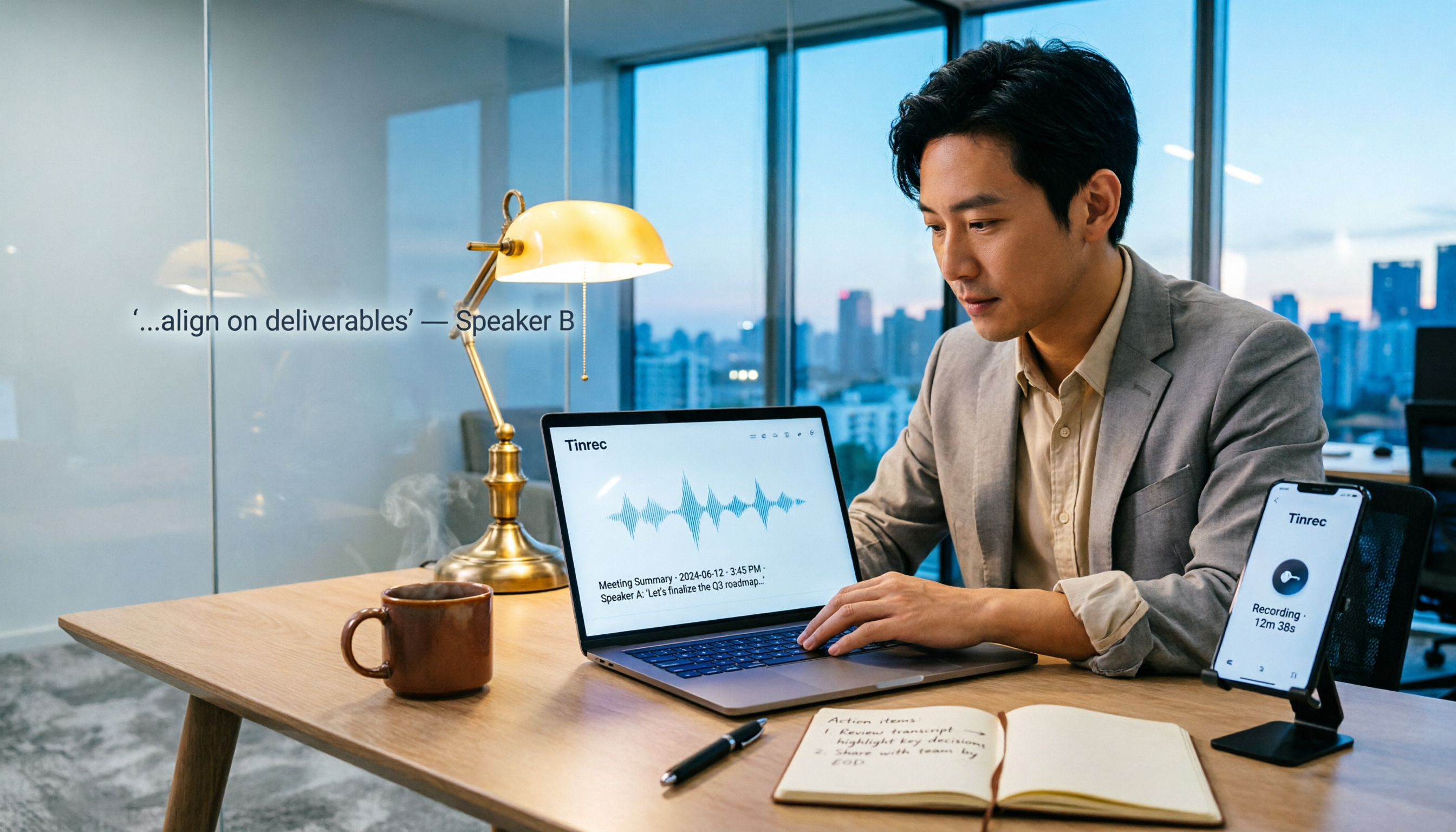
2026 Speech-to-Text Tool Review: Is Tinrec's Free Plan Really Enough?
A mid-level manager tests online speech-to-text tools, from free quotas to transcription accuracy and post-meeting organization, to tell you whether Tinrec's free plan is sufficient and when you should upgrade.

4 Best Online Speech-to-Text Tools in 2026: Free Plans and AI Features Compared
This article tests four online speech-to-text tools—Tinrec, Otter.ai, Notta, and Granola—and provides buying advice based on free allowances, bot-free meeting recording, AI Q&A, and team collaboration features.

2026 iPhone Voice-to-Text App Tutorial: Tinrec 3-Step Automatic Transcription + AI Summary
A student's hands-on review of Tinrec, an iPhone voice-to-text app that automatically generates transcripts, AI summaries, and to-do lists for classes, meetings, and interviews. The free version is enough to get started, saving more time than built-in features.

Best Speech-to-Text Tools in 2026: Notta vs. Tinrec and 3 Others—Tinrec Wins for Meeting Notes
A mid-level manager tested 4 speech-to-text tools for meeting notes, comparing Notta and Tinrec on bot-free recording, Chinese language support, post-meeting organization, and team collaboration, and explains why Tinrec came out on top.

2026 Free Cantonese Audio-to-Text Solutions: 3 Options Compared
Looking for a free Cantonese audio-to-text tool? Tinrec's free plan might be the most efficient choice. This article reviews 3 free options, with a focus on Tinrec, showing how it can save you overtime hours.

4 Best Online Audio-to-Text Tools in 2026: Free Plans, AI Features, and Team Collaboration Compared
How to choose an online audio-to-text tool? This article compares Tinrec, Otter.ai, Notta, and TurboScribe, focusing on free quotas, AI post-processing, cross-platform support, and team collaboration to help you find the best fit.

The Complete Guide to Online Speech-to-Text in 2026: From Meeting Minutes to Team Collaboration
Tired of manually transcribing recordings? This article tests multiple online speech-to-text tools, comparing features, accuracy, free tiers, and team collaboration to help you choose the best AI meeting notes solution.