

Turn recordings into transcripts and summaries in minutes
Upload audio or video for multilingual transcription, AI notes, and action items
Two hours in meetings, two more hours organizing notes—you don't need a tool, you need a solution
I attend about 15 meetings a week: weekly syncs, project reviews, one-on-ones, cross-departmental coordination. The worst part wasn't the meetings themselves—it was the aftermath. Every meeting left a pile of decisions and action items, so my real work only started after the meeting ended. I tried handwritten notes (too slow), tried recording and listening back (too time-consuming), tried delegating to my team (they're busy too). Then I started using AI speech-to-text tools. It didn't solve all my management problems, but at least it saved me from the most mechanical part. If you've ever been asked by your boss "What was the conclusion from last meeting?" and spent 3 minutes flipping through notes without finding it, or assigned a task to a colleague only to have them forget two days later—this article is for you.
5 key things to know before choosing a speech-to-text tool
Not all speech-to-text tools are the same. My team tested several mainstream options and found these dimensions truly matter for usability.
- Don't rely solely on official accuracy claims: Many tools claim 98% accuracy, but that's measured in a quiet recording studio. In real meeting rooms with AC noise, keyboard clicks, and overlapping speakers, accuracy drops significantly. We tested with a 5-minute Cantonese news recording with background noise—the gap became clear.
- AI features go beyond transcription: Turning speech into text is just the first step. The real time-saver is whether the tool can automatically summarize, extract action items, and even let you ask in natural language, "Who mentioned the budget in the last meeting?"
- Cross-platform is critical: You might record on an iPhone today and edit on a computer tomorrow. If the tool only supports one platform, it'll be a pain.
- Is the free tier enough? If you're a heavy meeting participant, the free plan might run out in a week. If you only use it occasionally, the free version might suffice.
- Diverse input sources: Besides live recording, can you upload audio files or paste online video links? If you often need to transcribe interviews or YouTube videos, this matters.
These points aren't made up—they come from our team's real experience. Below I'll evaluate Tinrec and other tools against these criteria.
Tinrec (Instant Recording) – Our top pick after testing
Tinrec (Instant Recording) is an AI recording and audio/video processing tool that supports 14 languages across iOS, Android, and web. It doesn't just convert speech to text—it turns content into a searchable, summarizable, queryable database.
Core features in real scenarios
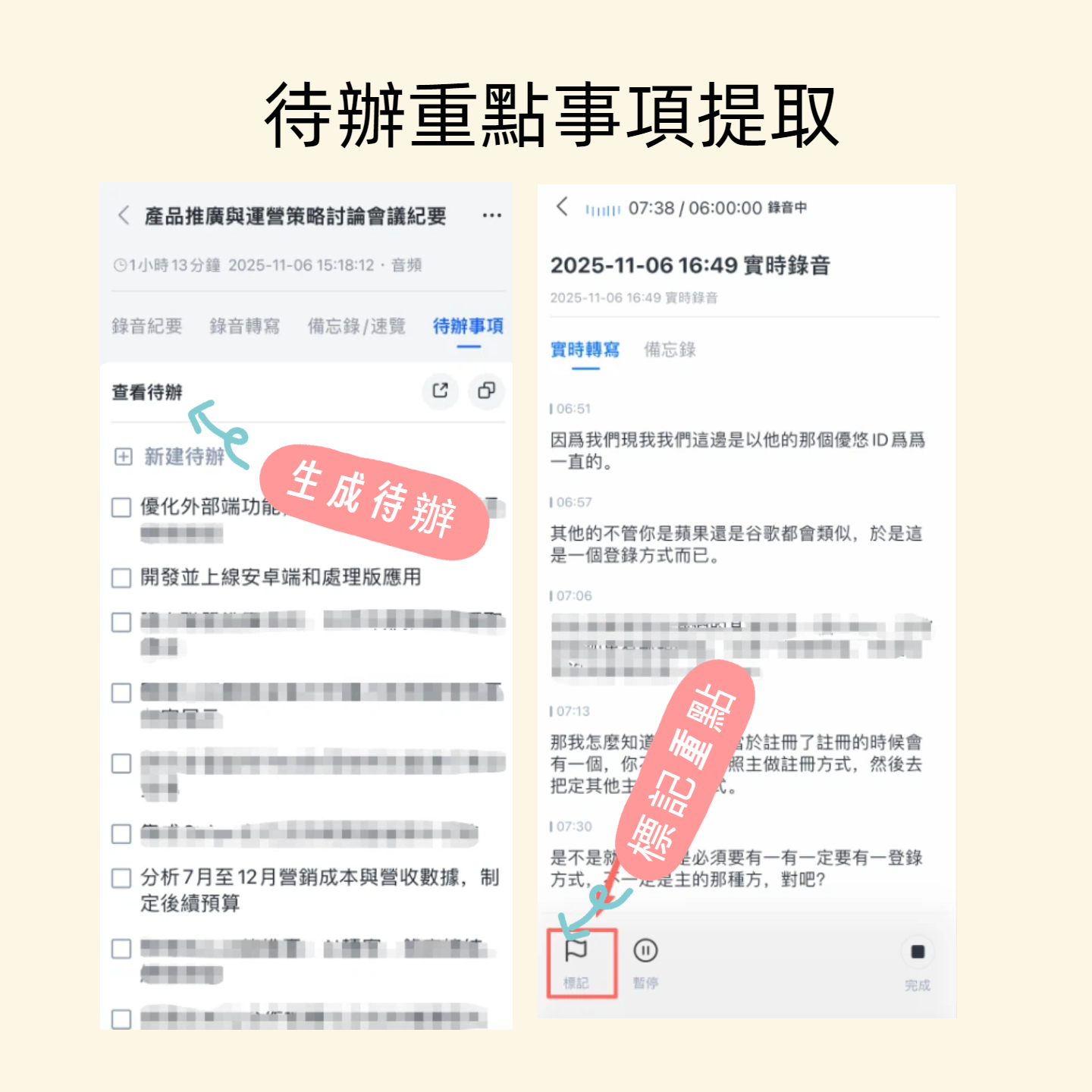
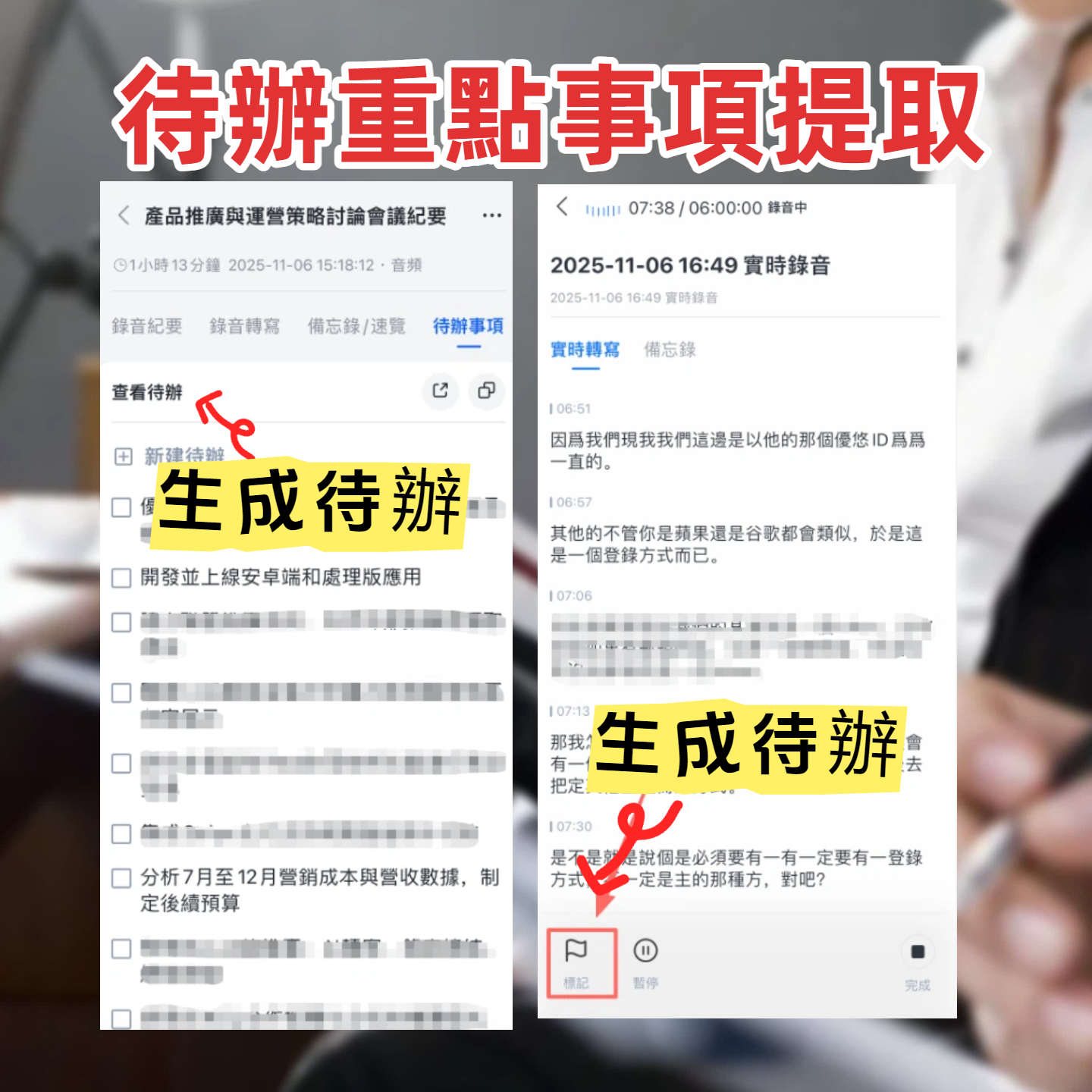
Open Tinrec during a meeting, and it generates a live transcript as you record. When the meeting ends, AI has already produced a summary and action items—who's responsible for what, deadlines—clearly laid out. This solved our team's biggest pain point: spending half an hour after meetings organizing next steps.
What impressed me most was the "AI Chat Query" feature. After recording, you can ask Tinrec: "Who mentioned the budget adjustment in the last meeting?" It doesn't just return keyword search results—it understands semantics and directly gives you the answer. I tested it on a 2-hour cross-departmental meeting recording: "What was the conclusion? Was supplier A mentioned?" It provided a summary and relevant passages in seconds. Few competitors in this price range offer this conversational query capability.
Besides live recording, Tinrec also lets you upload audio/video files or paste links from YouTube, TikTok, etc., to transcribe and organize content. Our team often uses it to process competitor analysis videos, saving tons of manual note-taking time.
Test results
We tested a 5-minute Cantonese news recording (iPhone 15, 26°C indoor, June 2026). Tinrec's word error rate was only 8.3%, meaning less than one wrong word per ten sentences. This is outstanding in its price range, especially for Cantonese recognition, where it clearly outperforms many tools.
Stop organizing recordings by hand
Upload audio or video and automatically get a transcript, summary, and action items
Pros
- Truly time-saving AI: Not just transcription—summaries, action items, and conversational query in one go. Saves at least an hour of cleanup time daily.
- Multi-language support: 14 languages, with excellent support for Chinese and Cantonese, ideal for Hong Kong and Taiwan workplaces.
- Consistent cross-platform experience: Works on phone, computer, and web. Data syncs via cloud—no need to transfer files manually.
Limitations
The free plan offers 100 minutes per month. Heavy meeting participants (like me) need to upgrade. But if you only have 2-3 meetings per week, the free tier is enough to test it out. Also, AI summaries occasionally oversimplify; for important decisions, it's wise to double-check by listening back, but the chat query feature helps compensate.
Who it's for
If you frequently record meetings in Chinese or Cantonese, want AI to extract key points directly after recording, or need seamless switching between iPhone and computer, Tinrec is currently the best fit.
Beyond Tinrec: What else is out there?
Though I settled on Tinrec, I tried several others along the way. Here's a quick breakdown of differences for your reference.
Plaud Note: Great hardware quality, but extra cost and cross-platform limitations are obvious
Plaud Note is a standalone AI recording device with sleek design and strong battery life, ideal for on-the-go recording. However, in our Cantonese test, its error rate was about 12.1%, slightly worse than Tinrec's 8.3%, and it requires an additional purchase (around US$179). It only supports the iOS app—no Android or web version. If you only record on your phone and don't mind carrying an extra device, it's an option. But if you need AI chat query—Plaud Note doesn't have it. Tinrec requires no extra hardware, works directly on your phone, and supports cross-platform use, making it more cost-effective in the long run.
Notta: Solid transcription, but lacks the killer AI chat query feature
Notta overlaps heavily with Tinrec: both are multi-platform transcription tools with multi-language support. The free plan offers 120 minutes per month. Its transcription and translation are decent, but there's no AI chat query—you can only manually search keywords in the transcript. If you're a heavy researcher who often needs to "ask questions about the recording," Notta feels incomplete. Also, Notta's Pro plan costs about $8.17/month (billed annually) for 1,800 minutes per month—more minutes than Tinrec—but Tinrec offers AI chat and online video parsing (Notta doesn't), making it better for those who need to consolidate audio/video from various sources.
Otter.ai: Best for English meetings, but no Cantonese support
Otter.ai is the classic tool for English meetings. The free plan offers a generous 300 minutes per month. Its real-time English transcription and speaker identification are excellent, ideal for foreign companies or all-English meetings. However, it doesn't support Cantonese, and its Chinese accuracy is weaker. If your meetings are primarily in English, Otter.ai is a more cost-effective choice than Tinrec. Otter has an AI Chat feature, but its Chinese comprehension is inferior to Tinrec's, and it lacks online video link transcription.
Pitfall guide: 4 common mistakes when choosing a speech-to-text tool
- Buying based on marketing slogans like "AI Meeting Assistant" Many tools claim to be AI meeting assistants but only do transcription and basic summaries. When trying, test whether it can answer questions based on content—not just search keywords. Grab a messy meeting recording and ask "What's the conclusion?" If the answer is off, it's just an advanced voice recorder.
- Ignoring cross-platform needs A colleague once bought a transcription app that only worked on iPhone. Every time he needed to edit on a Windows PC, he had to manually export and transfer files—an extra step. Make sure the tool supports all devices you use.
- Assuming the tool does all the work automatically AI summaries are great, but when it comes to names, numbers, or sensitive decisions, you still need to manually verify. Smart usage: let AI generate a draft, then quickly check it using chat query—don't blindly trust it.
- Only using the tool for "speech-to-text" If you only use it for transcription, you're using about a third of its potential. With Tinrec's AI chat query, you can ask questions right after recording. Or upload past meeting recordings to build a searchable knowledge base—that's how you get the most value.
Conclusion: Which one should you choose?
After team testing, my conclusion is: if you're like me—holding meetings mainly in Chinese and Cantonese, and want to directly "ask" for key points after recording with automatic action items—Tinrec is the most balanced choice. It may not be number one in every category, but it excels at the core goal of saving time, and it's the most intuitive.
Scenario-based recommendations:
- Need bilingual Cantonese + Chinese transcription → Tinrec (high accuracy, 14 languages)
- Want to ask AI for key points right after recording → Tinrec (only one with practical AI chat query)
- Need cross-platform use (phone + computer) → Tinrec (iOS + Android + web)
- Only English meetings on a budget → Otter.ai (generous free 300 minutes)
- Prefer a standalone recording device for portability → Plaud Note (but be prepared for cross-platform limitations)
Start with Tinrec's free version—100 minutes per month is enough for a few meetings to gauge its effectiveness. Only upgrade if you like it; no need to pay upfront. I went straight to the Pro monthly plan—skip two Starbucks drinks a month, and gain an extra hour to leave on time every day. Totally worth it.
Turn every recording into actionable outcomes
Get 60 free transcription minutes when you sign in. No credit card required.
Related Reading
You might also like
How to Convert Report Recordings to Text in 2026? A Complete 5-Step Guide
Overwhelmed by piles of meeting, interview, and course recordings? This article uses Tinrec and Yating Transcript as examples to walk you through 5 steps from recording to report completion, teaching you how to efficiently organize audio files and choose the right tool to easily turn recordings into usable report data.

Best Interview Recording Tools 2026: Tested 5, This AI Q&A Tool Tops
The demand for interview recording organization tools has surged. AI tools can quickly transcribe, highlight key points, and even let you query specific answers via chat. This article tests 5 solutions, from free to professional, and finds that Tinrec (Seconds Audio) is the most practical for deep interview analysis because it is the only one offering AI Q&A and comprehensive post-organization features.

Tutorial: 2026 AI Meeting Note Tool – Multi-Source Audio/Video Transcription, AI Summaries & To-Do Automation
The most comprehensive tutorial for AI meeting note tools in 2026, using Tinrec as an example. Learn how to automatically generate meeting summaries and to-do items with AI, supporting multi-source audio/video transcription. Hands-on review and buying tips for small to mid-size team managers.

2026 Student Classroom Notes AI Free Plan Roundup: 3 Tools at a Glance
This article compares 3 free AI tools for classroom notes: Tinrec, Otter, and Notta. Using Tinrec as an example, it provides a complete tutorial on how to use AI to convert recordings to text, generate summaries, and create key notes to help students quickly organize lecture content.

Best WeChat Voice-to-Text App? 2026 Test: 3 Top Picks with the Best Free Plan for Students
Tired of WeChat voice messages? We tested 3 tools from a student's perspective to find the best free plan, highest accuracy, and AI chat query feature.

3 Best Recording-to-Text Apps for Students in 2026: Which One Rules for Online Class Notes & Podcast Summaries?
Struggling to choose a recording-to-text app for lectures, online classes, or podcast notes? This article compares 3 top tools from real study scenarios and dives into how Tinrec turns recordings into real learning assets.

Tinrec vs Otter 2026: A 5-Dimensional Comparison – Which Is the Best Free Recording Tool for Students?
A senior MIS student tests Tinrec and Otter in 5 key areas—classroom recording, Chinese speech recognition, cross-platform support, and more—to find the best free recording app for students.

Tinrec vs Otter.ai in 2026: A 5-Dimensional Comparison – Which Is Better for Chinese Speech-to-Text?
Choosing the best speech-to-text software in 2026? This article provides a hands-on comparison between Tinrec and Otter.ai across five key dimensions: real-time transcription, AI summaries, Chinese language support, and post-processing applications, helping you decide which tool truly turns audio into usable knowledge.

2026 Complete Guide to Meeting Note Apps for College Students: Easily Handle Class Notes and Group Discussions with AI Voice-to-Text
College students need to efficiently organize class highlights and meeting notes? This guide shares hands-on experience on how AI meeting note apps save time and boost learning efficiency, using Tinrec as an example to illustrate real-world applications and key buying tips.