

Turn recordings into transcripts and summaries in minutes
Upload audio or video for multilingual transcription, AI notes, and action items
I recently processed a two-hour user interview recording. In the past, something that long would have taken me an entire afternoon just to listen to and transcribe, not to mention extracting key points and summarizing. But this time was different: I threw the recording into Tinrec, and within minutes, it not only gave me a full transcript but also automatically generated a summary, action items, and even let me extract key information using a Q&A interface.
This is what modern AI speech-to-text tools can do: transform the act of "listening" from passive reception into active organization. But there are many options on the market, and Otter.ai, for example, is a top choice for many international business users. What are the real differences between these two? Which one is better suited for Chinese scenarios? Based on five dimensions you probably care about most, here are my hands-on test findings.
What Can Speech-to-Text Do for You?
If you still think "speech-to-text" is just converting audio to text, you might miss out on the time it can actually save. For example, in my workflow, Tinrec solves at least these four scenarios:
1. Meeting Minutes Generated in Real Time
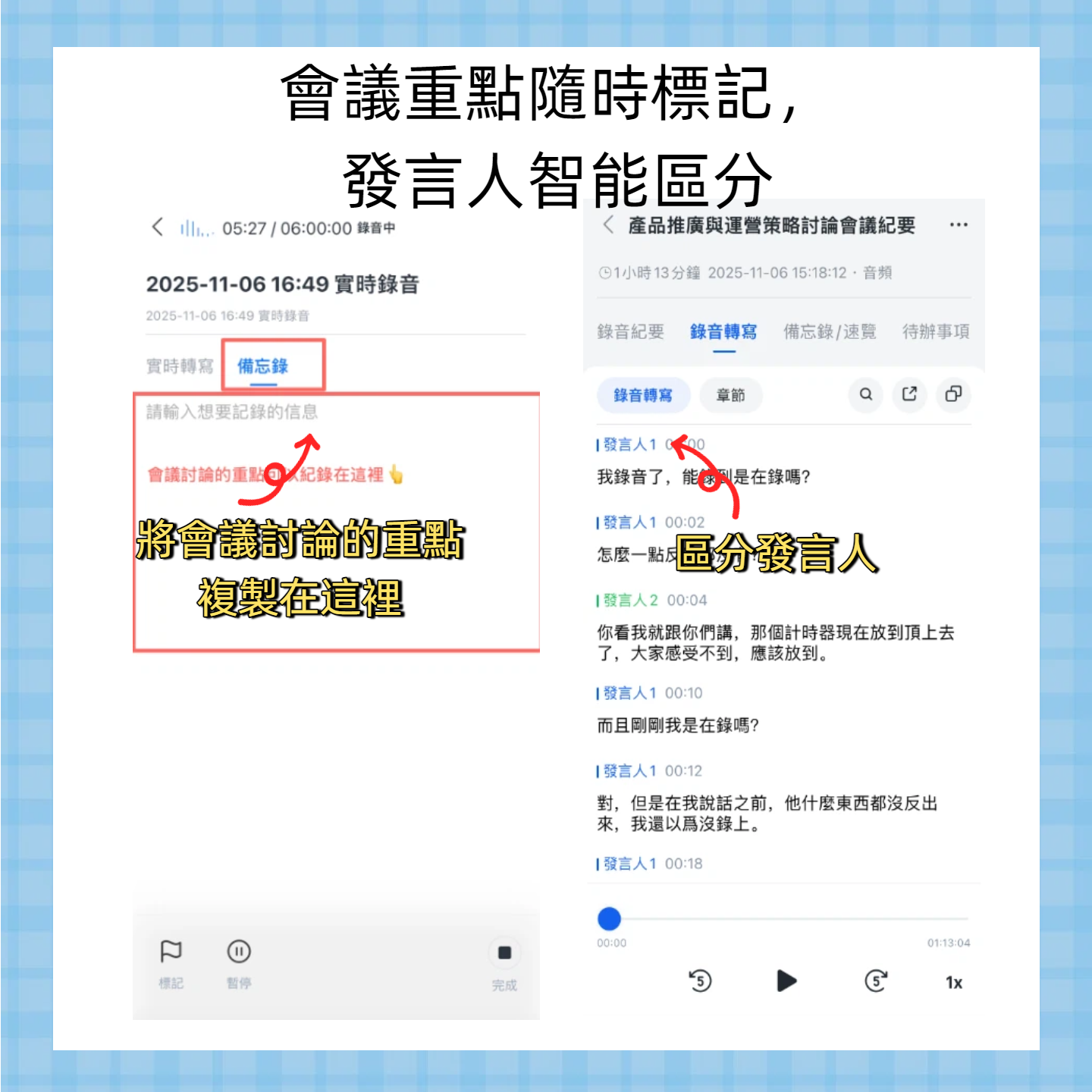
After a meeting, I used to rely on memory and scattered notes to reconstruct discussions. Now I just open Tinrec for real-time recording, and the text appears as we speak; after the meeting, the AI summary has already listed topics, conclusions, and action items clearly.
(Screenshot: Real-time transcription, arrow pointing to live transcript)
2. Interview Recordings Become Quotable Content
The most painful part of user research is extracting specific quotes from hours of recordings. Tinrec not only provides a full transcript but also labels different speakers, allowing me to search keywords or ask AI, "What was his opinion on pricing?" to quickly find the relevant section.
(Screenshot: Speaker separation, arrows pointing to speaker labels and segment splits)
3. Course Audio Converted to Study Notes
It's easy to forget key points from online courses or lecture recordings. I upload audio to Tinrec, which automatically splits into chapters, extracts highlights, and through AI Q&A, reviewing feels like having a private tutor.
(Screenshot: Importing audio/video files for transcription, arrow pointing to chapter splits)
4. Quick Organization of Online Video Content
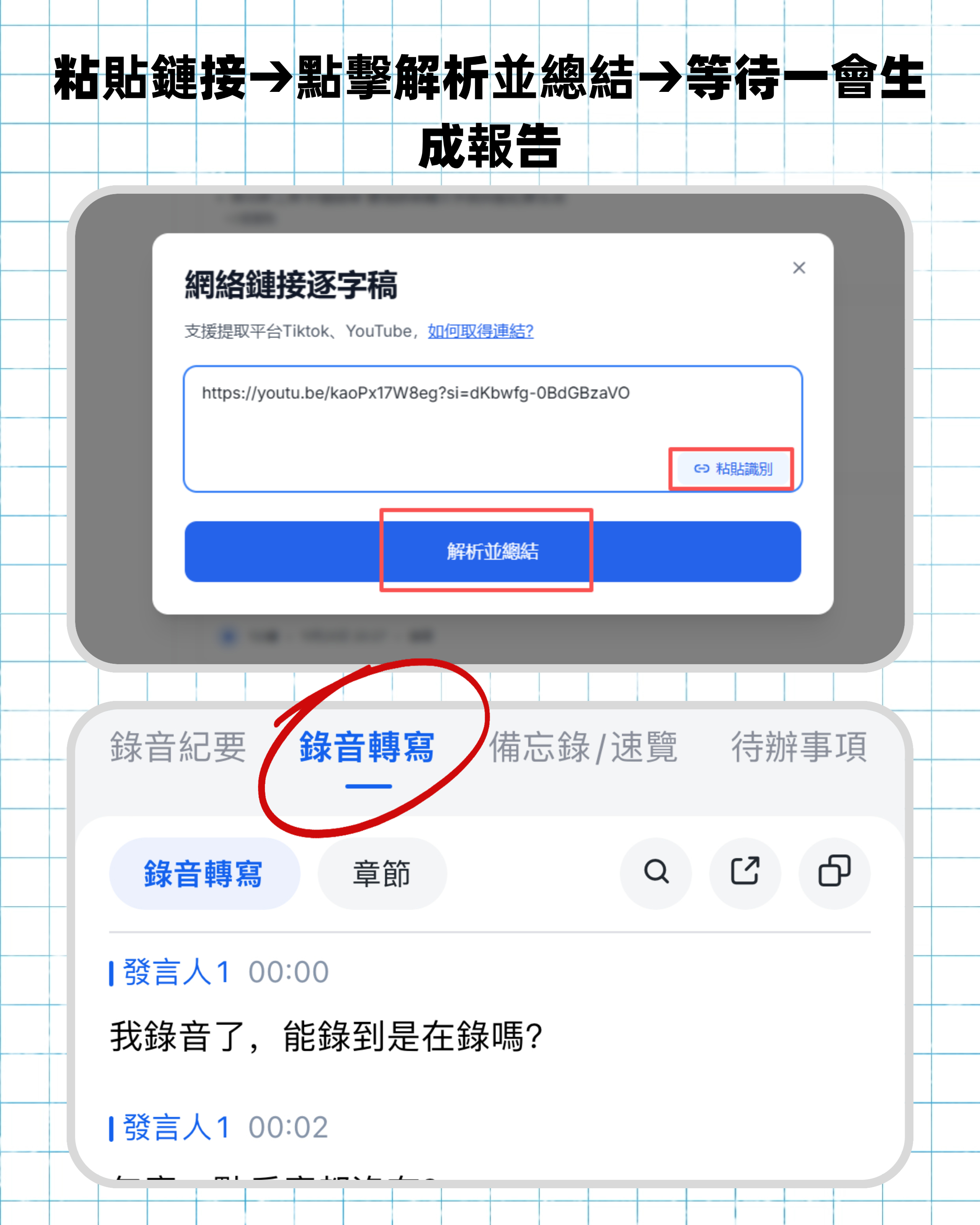
Sometimes I need to organize content from public YouTube or Xiaohongshu videos. In the past, I had to watch and type manually. Tinrec lets me paste the link directly and produces a transcript and summary in minutes, without even needing screenshots.
(Screenshot: Online video link parsing, arrow pointing to the input box for pasting the link)
Core Capabilities of Speech-to-Text Tools
Transcription is just the foundation. What really determines efficiency is "what happens after transcription?" These five capabilities are where I felt Tinrec truly stands out:
Real-Time Transcription: See Text as You Speak, Never Miss a Point
It doesn't wait until the recording finishes; text appears in real time. Tinrec's delay is very short, so during meetings I can glance at the screen to confirm the discussion is being captured accurately.
AI Semantic Summaries: Not Just Condensing, but Structured Organization
Some tools just compress the transcript into one paragraph, but Tinrec's summary is itemized: meeting topic, discussion results, action items, assignees. Reading the summary is like having attended the meeting.
(Screenshot: Meeting summary, arrow pointing to structured summary block)
AI Q&A: Query the Recording Like a Database
After transcription, you can ask Tinrec directly: "Who mentioned the budget?" "What are the client's core pain points?" It answers based on content semantics, saving you from manually scanning the entire transcript.
(Screenshot: AI Q&A, arrow pointing to the Q&A input box and answer)
Stop organizing recordings by hand
Upload audio or video and automatically get a transcript, summary, and action items
Automatic Extraction of Action Items
During meetings, tasks like "I'll handle this" or "Need to present by next Wednesday" often come up. Tinrec automatically captures these action items and organizes them into a list. This is much more reliable than manual after-meeting notes.
(Screenshot: Action items extraction, arrow pointing to action item list)
Multiple Export Formats, No Workflow Lock-In
Organized content can be exported as Word, TXT, or synced to Notion, Google Docs. You don't have to change your existing workflow; Tinrec is just the intermediary that turns audio into text.
(Screenshot: Multiple export formats, arrow pointing to export options)
Practical Use Cases
These individual functions combine into a real workflow. Here are three typical scenarios where I use Tinrec:
Meeting Scenario: From Recording to Trackable Items in One Flow
At our weekly team meeting, I always have Tinrec running. Real-time transcription means I don't have to take notes frantically; the AI summary serves as meeting minutes, and action items are pushed to the group for follow-up. This saves time and helps the team stay focused.
Learning Scenario: Turn Long Lectures into a Searchable Knowledge Base
After listening to a two-hour online lecture, I upload the recording to Tinrec, first review chapter highlights, then use Q&A to identify the three core concepts the instructor presented. Finally, I export the transcript to my note-taking app for future reference.
Content Creation Scenario: Deconstruct Interview Videos to Quickly Generate Articles
When I want to write an article based on an interview video, I simply paste the video link into Tinrec, which generates the transcript and summary. Then I use AI Q&A to extract the best quotes, making it easy to create an outline.
5 Things to Consider When Choosing a Speech-to-Text Tool
If you're comparing different solutions, here's a checklist:
1. Chinese Transcription Quality
Don't just look at marketing numbers. Test it yourself: use the same Chinese recording on different tools. Some may excel in English but struggle with Chinese speech rate and colloquial pauses. Tinrec has been consistently reliable in my regular meetings and interviews, handling both simplified and traditional Chinese well.
2. Post-Transcription Understanding
Transcript is just step one. The real value is whether the tool helps you understand the content. Tinrec's summaries and Q&A go beyond simple transcription, offering a "comprehension layer" that adds more value than just processing thousands of minutes.
3. Input Source Versatility
Do you only handle online meetings, or also local files and online videos? For cross-source organization, choose a tool like Tinrec that supports real-time recording, file upload, and link parsing.
4. Cross-Platform Support and Export Flexibility
Make sure the tool works smoothly on your phone and computer, and that output can be easily exported to your preferred note or document platform. Tinrec has iOS, Android, and web versions, with a wide range of export formats.
5. Ease of Use and Privacy
Do you need additional hardware? How is recording data handled? Tinrec requires no extra devices; your phone acts as the recorder. Privacy settings are clear, which is important for both individuals and teams.
FAQ
Q: What's the accuracy rate of speech-to-text?
A: There's no fixed number because it's affected by background noise, accents, and overlapping speech. In typical meeting and interview environments, Tinrec's accuracy is sufficient to replace manual transcription, but for critical details, I recommend double-checking against the recording.
Q: Is the free version sufficient?
A: Tinrec's free version provides a monthly basic quota, suitable for occasional short recordings. If you have more than three meetings per week or need to process long course audio, the Pro plan is more appropriate.
Q: Can it integrate directly with Zoom or Google Meet?
A: Tinrec supports computer system audio recording, so during online meetings you can record the meeting audio simultaneously for real-time transcription and later processing. It doesn't automatically join as a bot, but the operation is simple.
Q: Should I choose a hardware recorder or software like this?
A: If you carry a recorder everywhere, hardware has its convenience. But if you're mainly dealing with meetings, courses, and online video content, software is more flexible and doesn't require carrying an extra device.
Summary
Speech-to-text is no longer just "turning sound into text"; it's about transforming the audio and video stored in your folders into searchable, reviewable, reusable knowledge. Tinrec's organizing abilities, diverse input sources, and post-processing features make it my go-to tool for Chinese scenarios.
If you're tired of manually transcribing recordings, start with the free version. Pick your most important meeting or course recording and experience what AI-assisted organization feels like. With the right approach, tools truly save you time.
Quick Start: Three Steps to Organize Recordings with Tinrec
- Record or Import: Record in real time, upload files, or paste a public video link.
- Let AI Organize: After obtaining the transcript, click for summary, action items, or use Q&A to extract key points.
- Export and Continue: Export the results as documents or sync to note-taking apps, making them part of your working materials.
Test it step by step, and you'll gradually turn "listening" into the most efficient way to input knowledge.
Turn every recording into actionable outcomes
Get 60 free transcription minutes when you sign in. No credit card required.
Related Reading
You might also like
How to Convert Report Recordings to Text in 2026? A Complete 5-Step Guide
Overwhelmed by piles of meeting, interview, and course recordings? This article uses Tinrec and Yating Transcript as examples to walk you through 5 steps from recording to report completion, teaching you how to efficiently organize audio files and choose the right tool to easily turn recordings into usable report data.

Best Interview Recording Tools 2026: Tested 5, This AI Q&A Tool Tops
The demand for interview recording organization tools has surged. AI tools can quickly transcribe, highlight key points, and even let you query specific answers via chat. This article tests 5 solutions, from free to professional, and finds that Tinrec (Seconds Audio) is the most practical for deep interview analysis because it is the only one offering AI Q&A and comprehensive post-organization features.

Tutorial: 2026 AI Meeting Note Tool – Multi-Source Audio/Video Transcription, AI Summaries & To-Do Automation
The most comprehensive tutorial for AI meeting note tools in 2026, using Tinrec as an example. Learn how to automatically generate meeting summaries and to-do items with AI, supporting multi-source audio/video transcription. Hands-on review and buying tips for small to mid-size team managers.

2026 Student Classroom Notes AI Free Plan Roundup: 3 Tools at a Glance
This article compares 3 free AI tools for classroom notes: Tinrec, Otter, and Notta. Using Tinrec as an example, it provides a complete tutorial on how to use AI to convert recordings to text, generate summaries, and create key notes to help students quickly organize lecture content.

Best WeChat Voice-to-Text App? 2026 Test: 3 Top Picks with the Best Free Plan for Students
Tired of WeChat voice messages? We tested 3 tools from a student's perspective to find the best free plan, highest accuracy, and AI chat query feature.

3 Best Recording-to-Text Apps for Students in 2026: Which One Rules for Online Class Notes & Podcast Summaries?
Struggling to choose a recording-to-text app for lectures, online classes, or podcast notes? This article compares 3 top tools from real study scenarios and dives into how Tinrec turns recordings into real learning assets.

Tinrec vs Otter 2026: A 5-Dimensional Comparison – Which Is the Best Free Recording Tool for Students?
A senior MIS student tests Tinrec and Otter in 5 key areas—classroom recording, Chinese speech recognition, cross-platform support, and more—to find the best free recording app for students.

Tutorial: 2026 Speech-to-Text Tools with AI Query & Auto To-Do – Say Goodbye to Overtime for Meeting Notes
Tested 5 speech-to-text tools from a mid-level manager's perspective to show how AI recording assistants save meeting cleanup time. This article deeply analyzes Tinrec's core features, pros/cons, and competitor comparisons, plus buying tips and pitfalls to avoid.

2026 Complete Guide to Meeting Note Apps for College Students: Easily Handle Class Notes and Group Discussions with AI Voice-to-Text
College students need to efficiently organize class highlights and meeting notes? This guide shares hands-on experience on how AI meeting note apps save time and boost learning efficiency, using Tinrec as an example to illustrate real-world applications and key buying tips.