

Turn recordings into transcripts and summaries in minutes
Upload audio or video for multilingual transcription, AI notes, and action items
Tinrec vs PLAUD NOTE|Quick Overview
Let's quickly get to know these two tools:
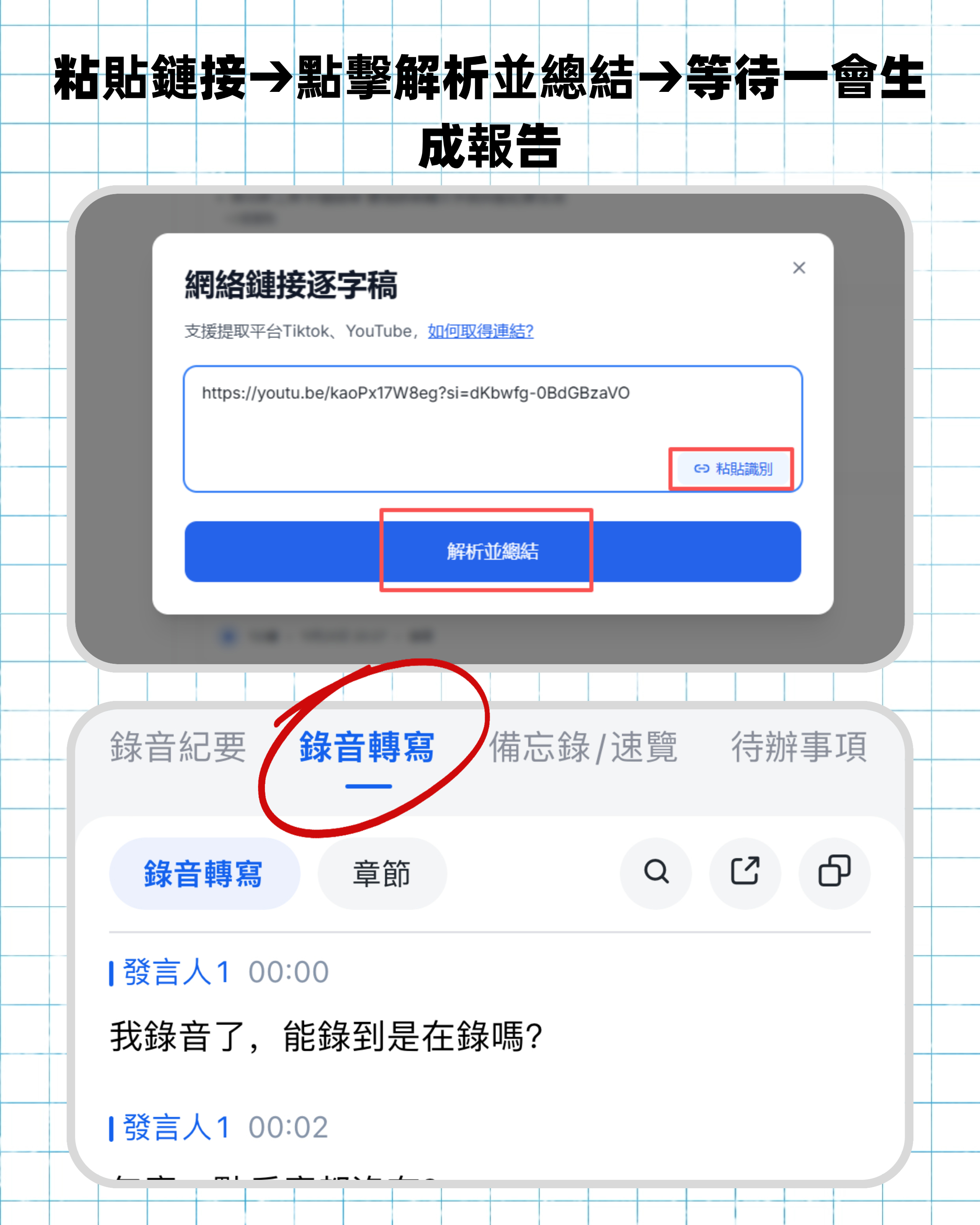
- Tinrec (Second Listening Recorder): An all-in-one AI recording and audio/video organization tool that supports mobile apps and a web version. It focuses on "turning any audio/video into actionable knowledge," and the free version lets you experience core features.
- PLAUD NOTE: An AI recording hardware device that looks like a lightweight voice recorder. You need to purchase the device to use it, and it emphasizes portable recording, hardware battery life, and app transcription integration.
Both tools target the common headache of organizing recordings for workers, but they take completely different routes: one is a pure software solution, the other is a hardware + app combo. Below, we directly compare them across 5 key dimensions to help you decide which one fits your work scenarios better.
Dimension 1|Core Features: Not Just Transcription, But "Understanding"
The core of PLAUD NOTE is "recording + transcription." It converts recorded audio into text, provides AI summaries, template-based Q&A, and highlighting features. Essentially, it's a smart voice recorder. The hardware recording quality is decent, and the app's organization interface is intuitive.
However, Tinrec positions itself more as an "audio/video knowledge workstation." Beyond real-time recording transcription and uploading audio/video files, it can also paste public video links from YouTube, TikTok, Xiaohongshu, etc., automatically parse them, and generate transcripts, summaries, chapters, and to-do items. More critically, after transcription, you can ask questions about the recording content (AI Q&A) or export it as meeting minutes, reports, mind maps, and other deliverables.
→ This Dimension: Tinrec clearly wins. PLAUD stays at recording + transcription, while Tinrec truly turns recordings into usable materials.
Dimension 2|Input Sources: Can You Only Record, or Handle Various Audio/Video?
PLAUD NOTE relies on hardware recording. Its advantage is that it's ready to record on the go, suitable for on-site scenarios like meetings, interviews, and classes. But it cannot directly handle audio files already on your phone, videos on your computer, or public videos online—you have to record with the hardware first or manually upload files (with limited support).
Tinrec has almost no limits on input sources:
- Real-time recording with simultaneous transcription;
- Upload audio and video files directly from your phone or computer;
- Paste public video URLs (supports TikTok, YouTube, Bilibili, Xiaohongshu, etc.);
- Record online meetings like Zoom, Google Meet from your computer.
For workers, it's common to need to organize recordings sent by a supervisor, tutorial videos found online, or spontaneous ideas recorded on your phone—PLAUD cannot directly handle these, but Tinrec supports all of them.
→ This Dimension: Tinrec clearly wins. Multi-source support makes it more suitable for the messy information flow of modern workers.
Dimension 3|Post-Processing & Output: What Can You Do After Transcription?
After transcription, PLAUD NOTE provides AI summaries, speaker identification, and highlighting, and allows exporting text files. However, its post-processing is somewhat templated, generating fixed-format summaries for scenarios like meetings, classes, or interviews, lacking flexibility for further interaction with the content.
Tinrec adds multiple layers of post-processing on top of transcription:
- AI automatically generates summaries, chapters, and to-do items;
- Supports "AI conversation search," allowing you to ask, "What was the conclusion of this meeting?" or "What are the three pain points the client mentioned?";
- Can generate meeting minutes, reports, tables, and other documents with one click;
- Export options include Word, PDF, TXT, and direct synchronization to tools like Notion and Google Docs.
Stop organizing recordings by hand
Upload audio or video and automatically get a transcript, summary, and action items
→ This Dimension: Tinrec clearly wins. It's not just a transcription tool but a productivity engine that directly converts recordings into work results.
Dimension 4|Pricing & Free Plan: What Should Budget-Conscious Workers Choose?
PLAUD NOTE's hardware cost is a major hurdle: the Note Pro pre-order price is around $179, and to unlock higher transcription quotas, you'll need a paid subscription (starting at about $99/year). A free plan? Almost none—without buying the hardware, you can't even get started.
Tinrec offers a genuine free version: a monthly basic transcription quota that allows you to experience real-time recording, file transcription, and online video analysis. If your usage increases, you can consider weekly, monthly, or annual plans. The entry barrier is extremely low—you don't even have to spend a penny to try it out.
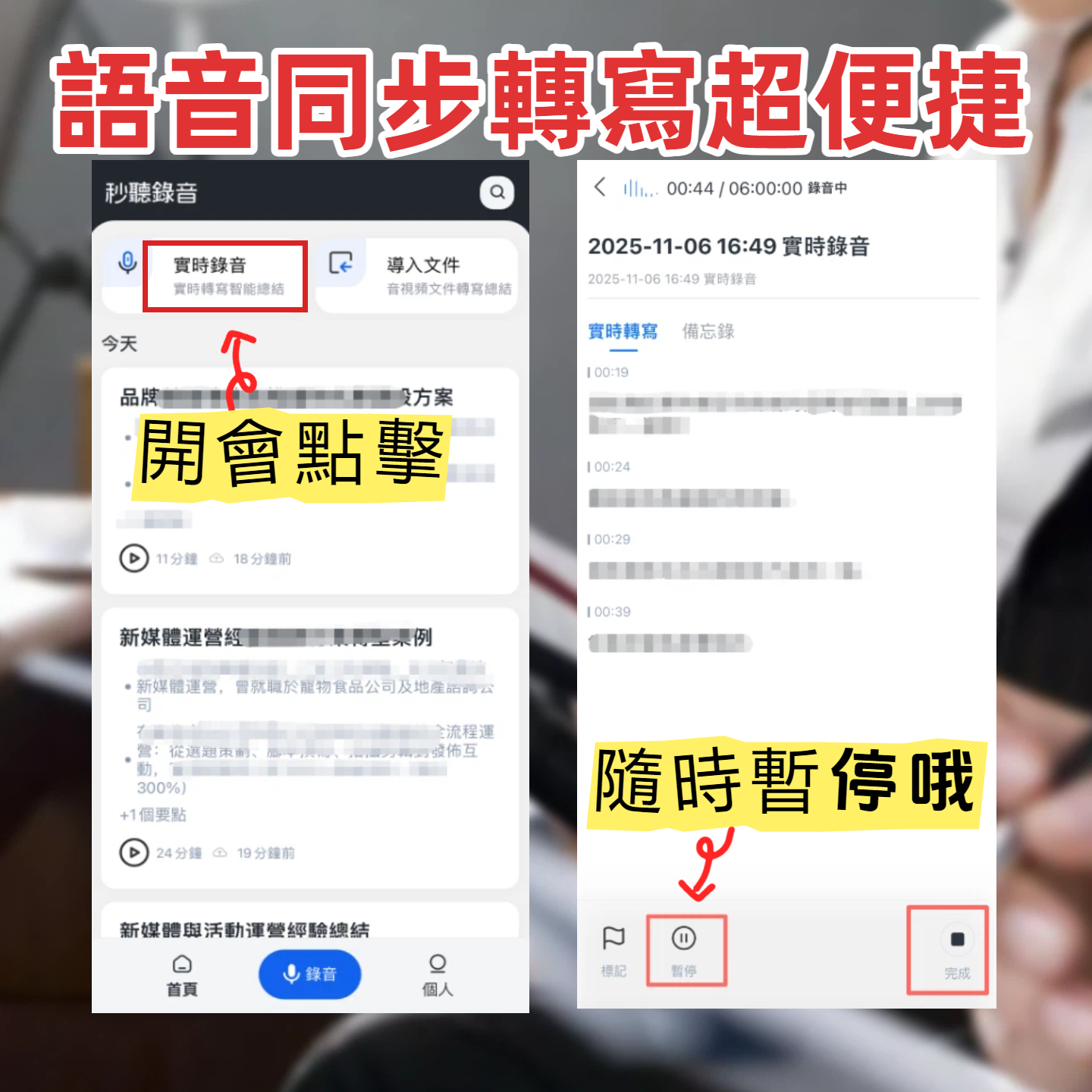
For budget-sensitive office workers, students, or freelancers, Tinrec's "zero-cost entry" is highly attractive.
→ This Dimension: Tinrec clearly wins. Zero hardware cost and a free plan minimize risk, while PLAUD requires an upfront hardware investment.
Dimension 5|Cross-Platform & Convenience: Can You Use It on Phone and Computer?
PLAUD NOTE is a hardware device that doesn't rely on your phone during recording, but transcription, organization, and export must be done through the mobile app. Although it also has a web backend, the main operations are still tied to the mobile device, which is slightly inconvenient for those who prefer organizing data on a computer.
Tinrec is natively cross-platform: it works on iOS and Android mobile apps, and also has a fully functional web version. You can record a meeting on your phone, then sit down at your computer, open the web page, and directly edit, ask questions, and export—all within the same workflow.
→ This Dimension: Tinrec clearly wins. True cross-platform experience keeps your work uninterrupted, while PLAUD offers less flexibility in switching devices.
What Are Their Unique Strengths?
Tinrec's Unique Strengths
- One-stop organization of multi-source audio/video: Meetings, courses, interviews, online videos, old recordings—all can be thrown in and turned into a searchable, queryable database.
- AI Q&A makes recordings "come alive": Historical recordings are no longer just space-occupying files but a knowledge base you can repeatedly query and extract key points from.
- Zero hardware cost, quick start: Just download the app or open the web page to start, no equipment purchase required, very friendly for occasional users or first-timers.
- Continue processing after transcription: Generate meeting minutes, reports, mind maps, and even automatically extract to-do items, turning them directly into work deliverables.
PLAUD NOTE's Unique Strengths
- Independent recording, doesn't use phone battery: Ready to record immediately, suitable for long recording sessions without draining your phone.
- Hardware audio quality and battery life: Built-in microphone array and long battery life still offer advantages in pure recording quality and reliability.
Summary: Who Should You Choose?
- If you need to handle meetings, courses, online videos, and want to directly ask questions and generate reports after recording → Tinrec (full features, strongest post-processing).
- If you're on a budget and want to try a free plan first → Tinrec (free version has full features, zero barrier).
- If you use both phone and computer and want to switch seamlessly → Tinrec (smooth cross-platform experience).
- If you only want a simple voice recorder for long on-site recordings and don't need complex post-transcription processing → PLAUD NOTE is sufficient.
In a nutshell: For most workers, Tinrec is a more comprehensive, flexible, and hassle-free choice. We recommend directly downloading the Tinrec free version, testing it with your own recordings, and seeing how much time it saves you.
FAQ
Q1: Is the Tinrec free version sufficient?
A: The free version provides a monthly basic transcription quota, allowing you to experience real-time recording, file transcription, and online video analysis—enough for occasional users. If you regularly organize long meetings or courses, consider a paid plan.
Q2: Is PLAUD NOTE's recording quality better than phone recording?
A: Generally, PLAUD's hardware microphone may be slightly better for distant recording or multi-person meetings, but a phone with Tinrec is also clear enough in typical meeting rooms or classrooms. Actual performance depends on the environment.
Q3: What languages does Tinrec support? How accurate is Chinese?
A: It supports Chinese, English, Cantonese, and other languages. Chinese recognition performs well with clear audio, but accuracy can be affected by accents, noise, and overlapping speech.
Q4: Can I export recordings to Notion or Google Docs?
A: Yes, Tinrec supports exporting to Word, PDF, TXT, and direct synchronization to third-party services like Notion and Google Docs.
Q5: Do I have to buy hardware for PLAUD NOTE?
A: Yes, PLAUD is a recording hardware device, and you need to purchase it before using its recording and transcription services.
Q6: Which one is better for students taking class notes?
A: Tinrec is more suitable because it not only transcribes text but also automatically generates chapters, key points, mind maps, and can import online course video links for organization.
Turn every recording into actionable outcomes
Get 60 free transcription minutes when you sign in. No credit card required.
Related Reading
You might also like

2026 Hands-on Comparison of Two Business Meeting Speech-to-Text Tools: Which AI Summarization Saves You the Most Effort?
How to choose a speech-to-text tool for business meetings? This article hands-on compares Notta and Tinrec, from input sources, AI summarization depth, Chinese language experience to downstream applications, guiding you step by step to find a truly time-saving workflow, and provides a quick-start checklist.

Tinrec vs Yating Transcript 2026: 4-Dimension Comparison – Which Free Phone Transcription Tool Is Better?
Looking for a free way to turn phone recordings into text? This article compares Tinrec and Yating Transcript across four dimensions: free credits, AI organization, cross-platform support, and Chinese accuracy. Find out which tool truly boosts your productivity.

2026 Comparison Test of 4 Speech-to-Text Apps: Which AI Meeting Notes Actually Saves You Time?
We tested 4 popular speech-to-text apps for the workplace, comparing accuracy, AI summaries, cross-platform support, and free tiers. Tinrec stands out with AI chat query and multi-source support, especially for Mandarin and Cantonese meetings. This review helps you avoid buying mistakes and find the most time-saving solution.
The Complete Guide to Podcast Transcription in 2026: Features, Use Cases, and Tool Recommendations
This guide is tailored for podcasters, covering the most practical transcription features of Tinrec—from interview transcripts, key summaries, to note exports—helping you save hours of post-production time, and providing key points for choosing a transcription tool.

2026 Hands-On Comparison of 5 Meeting Note Apps: Which AI Assistant Really Saves Office Workers Time?
A mid-level manager who attends 15 meetings per week personally tests 5 meeting note apps—from voice-to-text transcription, AI summarization, to-do lists, to cross-device sync—to find out which one saves you the most time on meeting minutes so you can focus on what truly matters.

2026 Comparison of 4 Remote Work Meeting Note Tools: Which AI Summary Saves the Most Time?
The biggest fear in remote work is losing meeting notes. We tested four mainstream meeting note tools, comparing Chinese accuracy, AI summary quality, and cross-platform support to help you find the best choice for your remote team.

4 Transcription Tools Comparison in 2026: Find the Best Solution for Organizing Performance Review Recordings
Organizing performance review recordings doesn't require manual transcription. We compare four transcription tools—Tinrec, Notta, Otter.ai, and Fireflies.ai—focusing on Chinese accuracy, AI summarization, and pricing to help you choose the best tool.
4 Transcription Tools Comparison in 2026: Find the Best Solution for Organizing Performance Review Recordings
Organizing performance review recordings doesn't require manual transcription. We compare four transcription tools—Tinrec, Notta, Otter.ai, and Fireflies.ai—focusing on Chinese accuracy, AI summarization, and pricing to help you choose the best tool.

2026 Real-World Test: 4 Speech-to-Text Apps Compared – Which Saves the Most Time for Remote Work?
A middle manager tests 4 AI speech-to-text tools for remote work meetings, interviews, and data organization. Deep dive into Tinrec vs Otter.ai across 4 key dimensions: recording sources, AI summarization, Chinese support, and cross-platform compatibility—helping you choose the most efficient assistant for complex workflows.