

Turn recordings into transcripts and summaries in minutes
Upload audio or video for multilingual transcription, AI notes, and action items
Have you ever had this experience? Recorded a two-hour meeting but don't want to listen to it again; recorded a whole semester of lectures but can't find the key points before exams. Many people's first thought is to buy a voice recorder, but can it really solve these problems? Honestly, a simple voice recorder only helps you "record" – the subsequent organization is still on you. So this article aims to show you that besides traditional voice recorders and built-in phone recording, there are now AI transcription tools like Tinrec that can do much more than just record.
Why Are People Looking for Alternatives to Voice Recorders?
Traditional voice recorders excel at portable recording and simple operation, which is indeed friendly for seniors or tech novices. However, most users quickly realize that recording is just the first step – the subsequent listening, transcribing, and summarizing often take longer than the meeting itself. Plus, phone recording quality is already decent nowadays, so many people start thinking: instead of spending money on a single-function recorder, isn't there a smarter way? If you have similar struggles, it might be time to get to know AI recording tools like Tinrec.
Tinrec vs. Voice Recorder: What's Different in Core Experience?
Input Sources: More Than Just Live Recording
A voice recorder can only capture ambient sound; it's useless for online meetings, web videos, or past audio files. In addition to live recording, Tinrec can import audio/video files, parse public video links like YouTube, and even record computer meetings. If you often need to organize audio content from various sources, this difference is significant.
Transcription and Organization: From "Recorded" to "Understandable"
This is the key difference. A voice recorder is just hardware – it gives you an audio file. Tinrec transcribes voice to text in real time and automatically generates summaries, chapters, action items, and even lets you query the recording conversationally – like "What was the conclusion of this meeting?" or "Who is responsible for which tasks?" In short, a voice recorder records; Tinrec helps you understand.
Cross-Platform Use: No Need for an Extra Device
Though compact, a voice recorder is still one more gadget to carry. Tinrec offers iOS, Android, and web versions, usable on phones and computers with real-time sync. When you need to check past meeting records, you won't have to dig through drawers for that recorder. For those always on their phones, it means one less device to charge, transfer files from, and store.
Pricing: Hardware vs. Subscription – Which Is More Cost-Effective?
A mid-range voice recorder starts at about NT$2,000-3,000 and does nothing but record. Tinrec has a free tier with monthly basic transcription credits, so you can try live transcription and file import. For heavier use, Pro monthly or yearly plans cost little per month, and you get every update – unlike hardware that may become obsolete in a couple of years.
Chinese Content Experience: Something Voice Recorders Can't Do at All
A voice recorder doesn't care about language; Tinrec is specially optimized for Chinese (including Traditional Chinese) recognition and organization. Whether it's meetings with code-switching or a one-hour lecture, the transcripts and summaries maintain good readability. Of course, actual accuracy depends on the recording environment, but compared to manual replay and note-taking, the efficiency improvement is incomparable.
Stop organizing recordings by hand
Upload audio or video and automatically get a transcript, summary, and action items
Overview of Tinrec's Core Features
We've compared a lot; now let's see what Tinrec can do for you.
Real-Time Transcription: Transcribes as you record with less than a second delay. During meetings, text appears in real time; by the time the meeting ends, the transcript is ready – no need to listen again.
Audio/Video File Transcription: Upload course recordings or interview files stored on your phone, and Tinrec converts them to text, complete with summaries and highlights.
Online Video Link Parsing: Paste a YouTube, TikTok, or other public video URL, and Tinrec transcribes the audio and generates a summary. This is especially handy for organizing tutorial videos or international conference content.
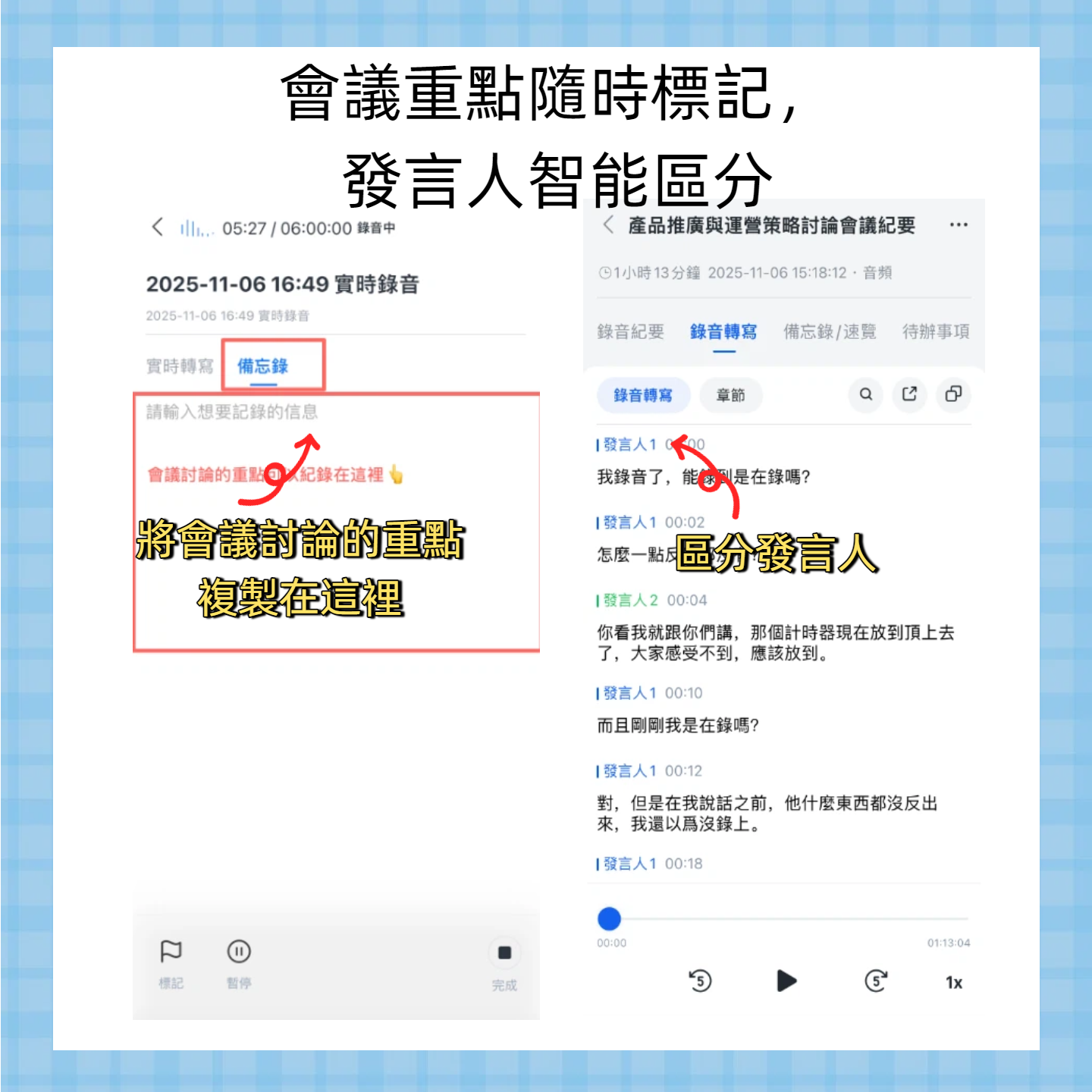
AI Summaries and Chapters: A two-hour meeting or lecture is automatically split into chapters with labels, so you can grasp the entire structure in three seconds.
AI Conversational Query: This is my personal favorite. After recording, ask Tinrec – "What's the conclusion?", "What are the action items?", "What data was mentioned?" – it finds answers from the recording without you having to search through dozens of pages of transcript.
Action Item Extraction and Export: Tinrec extracts action items from meetings into a to-do list, which can be exported as text or synced to other note apps, ready for your workflow.
Practical Use Cases
Meeting Minutes: Whether in-person or online, start recording with Tinrec. Immediately after, you get meeting minutes with summaries and action items, saving the effort of rotating note-taking.
Class Learning: Lecture content is instantly transcribed into notes. For review, you can read the transcript or use AI to quickly find where a concept was mentioned – far more efficient than replaying with a recorder.
Interviews and Research: For user interviews or expert talks, previously you had to replay in segments, transcribe, and mark highlights. Now, Tinrec automatically does transcription and summarization, letting you jump straight to analysis.
Personal Notes and Ideas: When an idea strikes, record a quick note; Tinrec transcribes and stores it. Later you can search by keyword – no more lost ideas.
Key Points to Consider When Choosing a Transcription Tool
1. What Is Your Main Use Case? If you only occasionally record personal memos, built-in phone recording might suffice. But if you frequently organize meetings, lectures, or interviews, an AI-powered tool saves time. Tinrec excels in these scenarios.
2. Do You Need More Than Just Transcription? Transcription is just the first step; whether it can auto-summarize, split chapters, extract action items, or even answer questions is key to efficiency. Most recorders and simple transcription apps still can't do this.
3. Cross-Device and Sync Convenience With a recorder, you have to transfer files to a computer, sometimes with proprietary software. Using a cloud-synced tool means the recording is available on your computer right after you record on your phone, and data won't be lost when you change devices. Tinrec's three-way sync solves this.
4. Chinese Recognition and Mixed-Language Handling Taiwan users often have conversations with code-switching or Hokkien terms. The tool's language model optimization for these scenarios makes a big difference. Tinrec has put significant effort here; after a few tests, I find it more than adequate for regular meetings and courses.
5. Long-Term Cost and Flexibility Hardware depreciates; software has monthly fees. If you use it only a few times a year, try the free version first. But if you have weekly meetings or courses, the cost of a subscription (like one or two coffees a month) is very reasonable compared to the time spent transcribing manually.
Conclusion: Is Tinrec Worth Trying?
If you need more than just "recording" – you want to quickly understand the content, find key points, and turn that data into actionable material – then Tinrec is one of the few options on the market that meets all these needs. It's not just an alternative to voice recorders; it's a tool that transforms audio content into truly usable knowledge.
I recommend downloading the free version of Tinrec and testing it with your own meeting or lecture. See the quality of the transcript and summary, and whether the AI Q&A helps you. After all, everyone's habits differ – a few minutes of trial will give you a better feel than any review.
Turn every recording into actionable outcomes
Get 60 free transcription minutes when you sign in. No credit card required.
Related Reading
You might also like

2026 Free Hokkien Speech Recognition Solutions: 1 App Tested Perfect for Hong Kong Users
Looking for a free Hokkien speech recognition app? Tested Tinrec for instant transcription, real-time text conversion, AI summaries, and task management. Free 100 minutes per month. Essential for Hong Kong professionals in cross-strait meetings and learning Taiwanese.

2026 Tinrec vs Traditional Voice Recorder: A 5-Dimension Comparison – Which Should Professionals Choose?
A guide for professionals comparing recording tools across 5 dimensions: recording convenience, transcription speed, organization capabilities, and more. Compares Tinrec with traditional voice recorders, provides real-world scenarios, and highlights key purchase considerations to help you make the best decision.

Tinrec vs Plaud Note 2026: 5-Dimensional Comparison for High-Capacity Recording
A mid-level manager's real-world test compares AI recording software Tinrec and voice recorder Plaud Note in high-capacity recording scenarios. Analyzed from five dimensions: recording quality, transcription accuracy, organization efficiency, cross-platform, and cost, to help you find the best high-capacity recording solution for professionals.

2026 Cantonese Translation Free Plan Roundup: 1 Tool to See at a Glance
Student-tested! A complete breakdown of Tinrec’s free Cantonese translation features, suitable for lectures, watching Cantonese YouTube videos, and understanding Hong Kong coworkers. Includes 100 minutes of free credit to save note-taking time without spending a dime.

2026 Cantonese Speech to Text Complete Guide: Free Tools, Features & Tested Picks
A mid-level manager tests multiple Cantonese-to-text tools, from free quotas, Cantonese recognition accuracy, AI organization, to cross-platform support, helping you find the best free solutions for meetings, interviews, and learning.

Which Voice Recorder Offers the Best Value? 2026 Real-World Test of 3 Solutions – Skip the Recorder and Use Tinrec for Even Better Deals
A real-world comparison of traditional voice recorders, AI recording hardware, and the Tinrec app reveals that Tinrec, which requires no extra equipment, offers the best value with AI-powered summarization features – a must-have for professionals.

2026 Voice Recorder Buying Guide: 2 Products Tested and Recommendations
Still hesitating between buying a traditional voice recorder or just using an app? This article takes you through a complete hands-on comparison of PLAUD Note and Tinrec Instant Recording, covering core positioning, recording sources, transcription, AI features, and pricing. You'll see why software solutions are actually more suitable for most people's meeting, learning, and creative needs.
2026 Voice Recorder vs Tinrec: 5-Dimension Showdown – Which is Smarter for Mobile Recording?
Which is better for your needs: a voice recorder or a recording app? This article compares traditional voice recorders with AI-powered recording app Tinrec across five dimensions—features, cost, convenience, organization ability, and scalability—to help you quickly decide which tool truly boosts your recording and note-taking efficiency.
How to Choose a Voice Recorder in 2026: A 5-Step Complete Comparison Guide from Hardware to Software
With many voice recorder brands and features, the key isn't just hardware or software—it's your use case. This article uses five steps to compare PLAUD Note and Tinrec across input sources, organization capabilities, cost, Chinese language experience, and long-term expenses, helping you find the best recording solution for your needs.