
Turn recordings into transcripts and summaries in minutes
Upload audio or video for multilingual transcription, AI notes, and action items
What Can AI Recording Apps Like Tinrec Do for You?
Traditional voice recorders have a simple task: press record, save the audio file, and that's it. Later, if you need to find an important conversation, you might have to listen from start to finish.
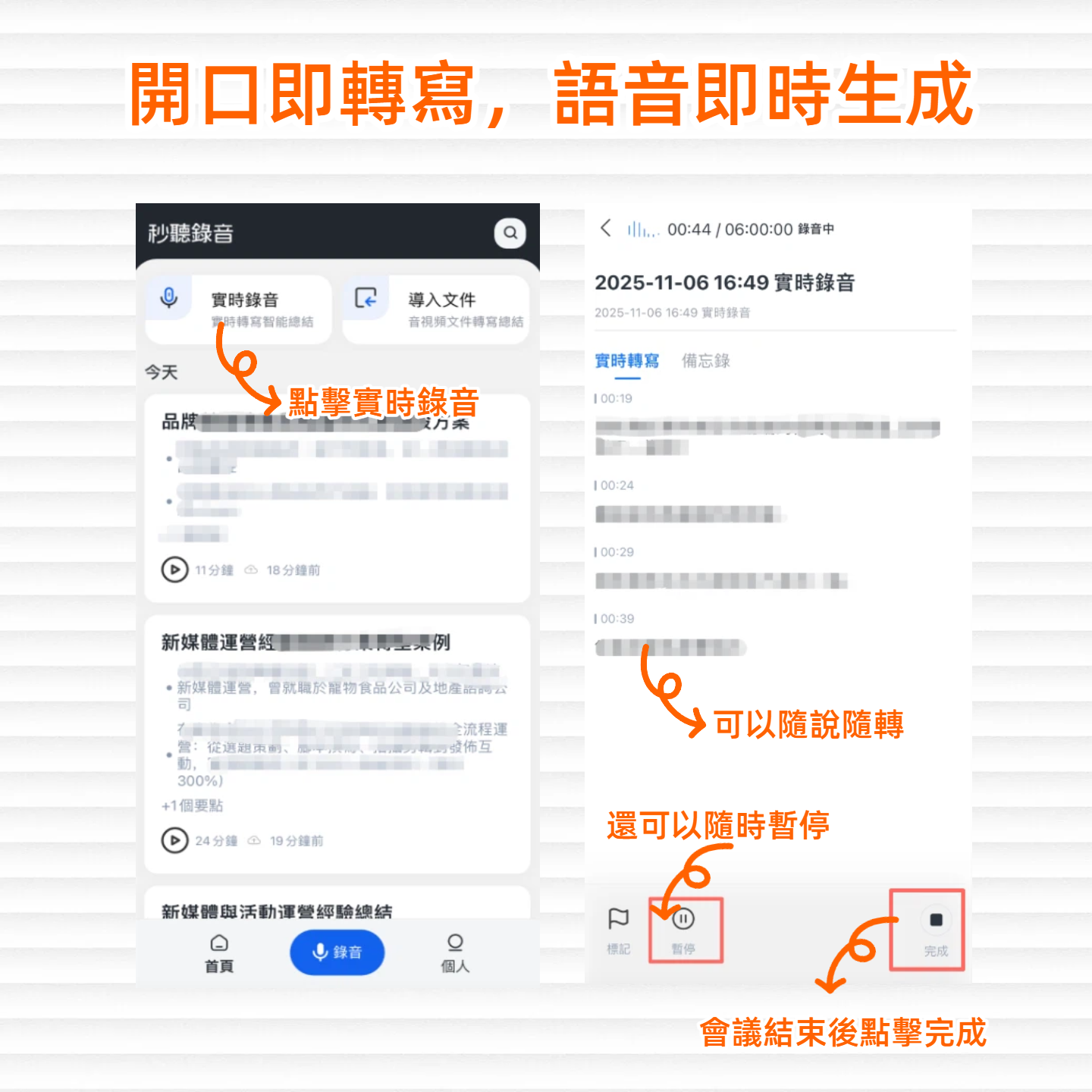
But with AI recording apps like Tinrec, recording is just the first step. It can also:
- Auto-generate transcripts: Get a complete text record within minutes of recording—no more manual transcription.
- AI summaries and action items: Right after a meeting, get a summary and even a list of who needs to do what.
- Ask questions about your recording: Want to find "the budget number the client mentioned"? Just type your question to the AI, and it finds it—much faster than re-listening to an hour of audio.
Voice recorders can hardly do any of this. You'd still need to transfer files to a computer, open software, and then figure out how to organize. Tinrec lets you complete the entire process on your phone.
Tinrec's Core Capabilities: Not Just Recording, but Understanding
Voice recorders are basically just for recording, maybe with some noise reduction. Tinrec includes "organizing" and "understanding" as well.
Real-time Speech-to-Text
Transcribes as you record, with less than a second of delay. During meetings, you can glance at the screen to make sure you didn't miss anything important. With a voice recorder, you can only replay later.
AI Semantic Summarization
Not just condensing the transcript into a paragraph—it structures the content: meeting topic, conclusions, action items, responsibilities, all listed separately. Traditional recorders can't do this at all.
AI Conversational Query
After recording, you can ask Tinrec questions like "What did the client say about pricing in the meeting?" It answers based on the semantic content. Imagine doing that with a voice recorder—you'd have to listen to the entire meeting to find the answer.
Multi-source Input
Tinrec can not only record but also upload local audio files, paste YouTube video links, and even parse public videos from TikTok, Bilibili, and others. Voice recorders can only capture live audio; handling other files requires separate tools.
Multi-format Export
Transcriptions can be exported as Word, PDF, subtitle files, and synced to Notion or Google Docs. Voice recorder? You usually have to organize manually.
Real-World Use Cases
Scenario 1: Meeting Notes
With a voice recorder: After the meeting, transfer the file to your computer, open a player, listen slowly, and type notes. A two-hour meeting might take an extra hour to organize.
With Tinrec: Real-time transcription during the meeting, and after it ends, the AI summary is ready, including action items. A quick review and your meeting notes are done.
Stop organizing recordings by hand
Upload audio or video and automatically get a transcript, summary, and action items
Scenario 2: Lecture Recording
With a voice recorder: Record the entire class, listen again at home, struggle to find key points, and rely on memory to skip around.
With Tinrec: Transcribes while recording. After class, use the AI query to ask "Which pages did the teacher mention as exam focus?" The answer appears instantly, doubling your study efficiency.
Scenario 3: Interview Transcription
With a voice recorder: After the interview, manual transcription takes hours, and you might miss some sentences due to unclear audio.
With Tinrec: Upload the interview file, get a transcript in minutes, ask the AI for a summary, and directly extract quotable quotes.
Scenario 4: Content Creation
With a voice recorder: Record a podcast or video narration, then repeatedly listen to organize into a script or article.
With Tinrec: Paste a video link, get the transcript and summary instantly, turning it into blog post or social media content.
4 Things to Consider When Choosing a Recording Tool
If you're debating between a voice recorder and an app, evaluate these four points.
1. Auto-Organization Ability
After recording, do you want a "to-be-organized" file or one that's already organized for you? Tinrec automatically provides summaries, action items, and chapters after transcription, saving tons of post-processing time. Voice recorders just record; you organize yourself.
2. Convenience of Use
Voice recorders need to be carried, and you might forget them or they may run out of battery. Tinrec lives in your phone—something you already carry. Open the app and start recording without needing an extra device. Plus, real-time transcription lets you verify content on the spot.
3. Scalability and Cross-Scenario Use
Voice recorders can only handle live recordings. To organize old audio files on your computer or online videos, you need additional tools. Tinrec handles recording, file transcription, and online video parsing in one app, covering more use cases.
4. Long-Term Cost
A decent voice recorder can be quite expensive, and transcription or summary features may require extra fees—or may not exist at all. Tinrec offers a free plan with basic monthly credits, and paid plans start with a weekly pass for short-term needs. Pro monthly or annual plans suit heavy users. No need to spend on hardware upfront.
Frequently Asked Questions
Q: Isn't voice recorder audio quality better?
A: Not necessarily. Most modern phones have decent microphones, and apps like Tinrec use noise reduction and voice enhancement to achieve sufficient transcription accuracy in typical meeting or classroom environments. Unless you're recording in extremely noisy settings, a phone app is often enough.
Q: Does recording with an app drain battery?
A: Tinrec processes real-time transcription in the cloud, so the phone only handles recording and data transmission, consuming power similar to a regular recording app. If you're worried about long meetings, a power bank solves the problem.
Q: Is a voice recorder more private?
A: It depends on your habits. With a recorder, the file is stored on the device. If you lose it, the content could be exposed. Tinrec uses cloud storage with encrypted transmission and has privacy protection mechanisms. Both have risks, but apps usually offer more granular access control.
Q: I'm not tech-savvy—isn't a voice recorder simpler?
A: Actually, Tinrec's interface is very intuitive. Open the app, press record, and you're off—just like a voice recorder. But after recording, Tinrec automatically organizes the content, reducing downstream hassle.
Q: Is the free plan enough?
A: The free plan offers basic monthly transcription credits. If you only record meetings or classes occasionally, you can experience the core features for free. Upgrade only when you need more transcription—no long-term commitment required.
Summary
The gap between voice recorders and AI recording apps is no longer just "hardware vs. software." Modern recording tools need to do more than just store audio—they must quickly turn recordings into actionable information. Tinrec's real-time transcription, AI summarization, multi-source input, and cross-platform export far exceed what traditional voice recorders can offer. If you're still on the fence, try Tinrec's free plan first—without spending a dime, you can experience the efficiency of AI-assisted recording.
Turn every recording into actionable outcomes
Get 60 free transcription minutes when you sign in. No credit card required.
Related Reading
You might also like

2026 Tinrec vs Plaud Note: Dialect Speech-to-Text Test – Which Is More Accurate for You?
2026 dialect speech-to-text tool comparison: real-world test of Tinrec vs Plaud Note on Cantonese recognition, cross-platform support, AI Q&A, and more, to help you choose the best AI solution for transcribing meetings, lectures, and interviews.

2026 Comparison of Two Speech-to-Text Tools: A Shanghai Dialect User's Perspective
Meeting minutes in Shanghai dialect always garbled? Hands-on test of Tinrec vs Otter.ai, comparing input sources, Chinese support, AI features, and pricing to help you choose the best tool for multi-source audio/video organization.

2026 Comparison of 5 Speech-to-Text Tools: Shanghai Dialect Recognition Solutions at a Glance
This article compares 5 Chinese-capable speech-to-text tools, including Tinrec, Notta, Otter.ai and others, and provides selection tips and practical techniques for Shanghai dialect recognition scenarios.

Top 5 Speech-to-Text Tools in 2026: Which One Excels at Recognizing the Northeastern Chinese Dialect?
Can you easily convert Northeastern Chinese dialect to text? This article compares several speech-to-text tools on the market for their performance in recognizing the Northeastern Chinese dialect, covering free and paid options, so you can quickly see which one suits you best.

Tutorial: Tinrec Hokkien Voice-to-Text in 2026 – Supports Hokkien Recognition and Auto-Generated Transcripts
Want to convert Hokkien recordings to text? Tinrec supports Hokkien recognition, letting you transcribe live recordings, uploaded audio files, or video links, and it can also auto-summarize and extract tasks. This complete guide shows you how to handle Hokkien transcription on your phone or computer.

2026 Free Hokkien Speech Recognition Solutions: 1 App Tested Perfect for Hong Kong Users
Looking for a free Hokkien speech recognition app? Tested Tinrec for instant transcription, real-time text conversion, AI summaries, and task management. Free 100 minutes per month. Essential for Hong Kong professionals in cross-strait meetings and learning Taiwanese.

2026 Tinrec vs Traditional Voice Recorder: A 5-Dimension Comparison – Which Should Professionals Choose?
A guide for professionals comparing recording tools across 5 dimensions: recording convenience, transcription speed, organization capabilities, and more. Compares Tinrec with traditional voice recorders, provides real-world scenarios, and highlights key purchase considerations to help you make the best decision.

Tinrec vs Plaud Note 2026: 5-Dimensional Comparison for High-Capacity Recording
A mid-level manager's real-world test compares AI recording software Tinrec and voice recorder Plaud Note in high-capacity recording scenarios. Analyzed from five dimensions: recording quality, transcription accuracy, organization efficiency, cross-platform, and cost, to help you find the best high-capacity recording solution for professionals.

2026 Cantonese Translation Free Plan Roundup: 1 Tool to See at a Glance
Student-tested! A complete breakdown of Tinrec’s free Cantonese translation features, suitable for lectures, watching Cantonese YouTube videos, and understanding Hong Kong coworkers. Includes 100 minutes of free credit to save note-taking time without spending a dime.