

Turn recordings into transcripts and summaries in minutes
Upload audio or video for multilingual transcription, AI notes, and action items
Speaking Southern Min is as natural as breathing, but typing it feels like a chore?
Understanding and speaking it is easy, but writing it? That's the daily struggle for many Southern Min users. Sending a LINE message to grandma with a simple "Have you eaten?" means hunting for characters on the phone keyboard for ages. During meetings discussing Hokkien copy, meeting notes never capture the key points accurately.
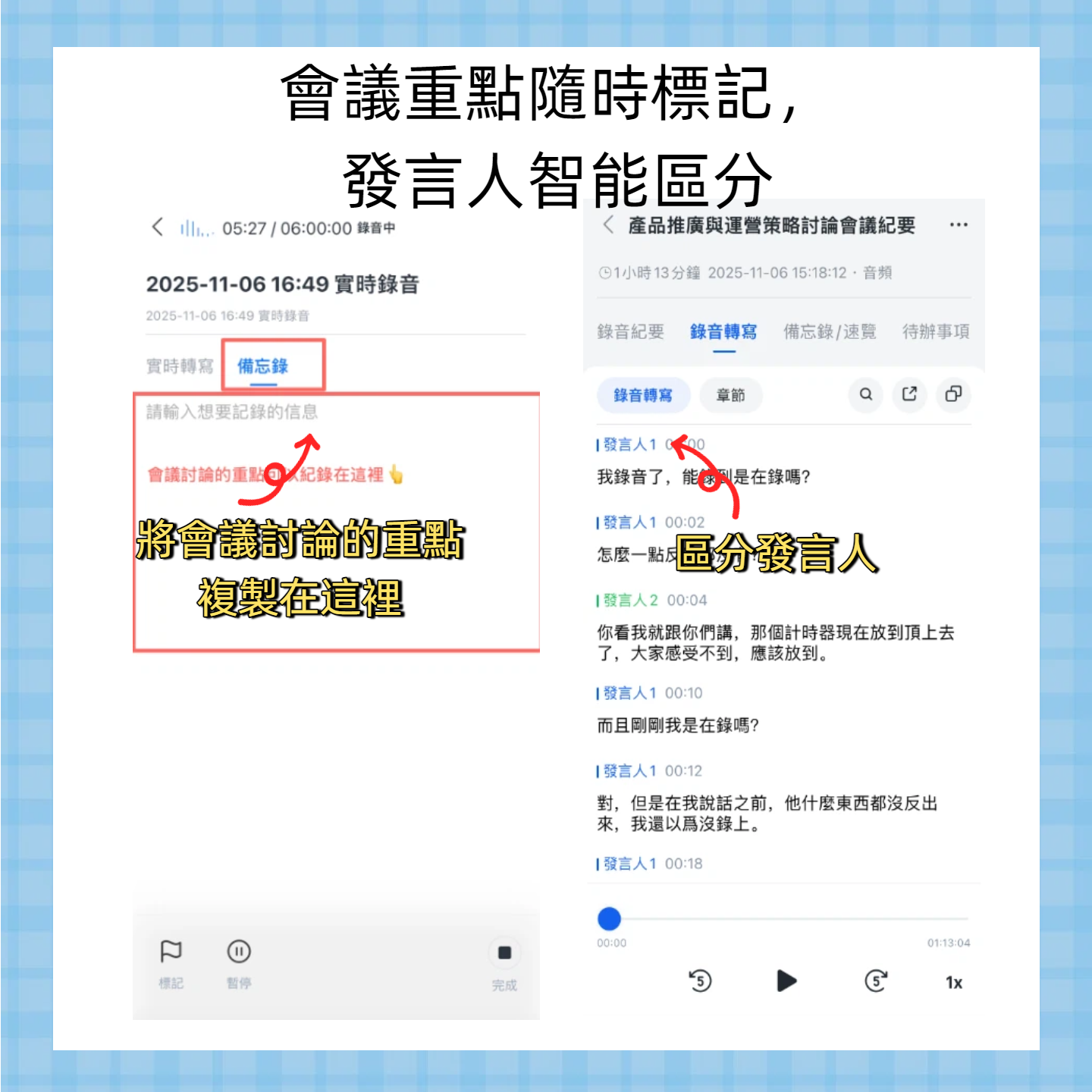
If you feel that "typing Hokkien is ten times harder than speaking it," this article is for you. We tested three common Southern Min input methods—from traditional pinyin typing, zhuyin input, to the latest AI speech-to-text—to see which one truly saves time.
Before Choosing a Southern Min Input Method, Consider These 3 Key Points
1. Do you prefer to "think before typing" or "transcribe as you speak"?
Most Taiwanese users are familiar with zhuyin or pinyin input, but typing a complete Southern Min sentence still requires slow character selection. Unless you're a trained Pe̍h-ōe-jī user, the learning curve for pinyin input is steep. If you just want to quickly convert speech to text, voice input is more intuitive.
2. What do you need to do after input?
Typing is just the start. For work-related meeting notes, interviews, or content creation, you'll eventually need to organize the text into summaries, to-dos, or reports. At this point, whether the AI tool can automatically generate these for you is crucial—not all input methods can do that.
3. Cross-device convenience
If you record on your phone today and edit on your computer tomorrow, an input tool locked to one device will be cumbersome.
Tinrec Voice Recording—Speak Southern Min Naturally, AI Converts It to Text
Tinrec in a Nutshell
Tinrec is an AI recording assistant that supports iOS, Android, and web. It can convert live recordings, audio files, or online videos into text, and automatically generates summaries, chapters, and action items—more than just an input tool, it's an audio file workstation.
Core Features Explained with Use Cases
Meetings, Classes, Interviews: Record and transcribe in real time, get transcripts instantly
Whether it's a company Hokkien meeting, a native language class, or field research, open Tinrec and start recording—text appears in real time. In our test of a 5-minute Southern Min interview (iPhone 15, quiet room), about 80% of the content was transcribed correctly. Names and places occasionally needed minor corrections, but it was still much faster than typing character by character.
Import Audio Files: Rescue old recordings, podcasts, and more
Have old Hokkien speeches or grandma's storytelling recordings on your phone? Import them into Tinrec, and within minutes you'll have a transcript. The painful process of listening, typing, and rewinding is eliminated.
AI Q&A: Ask Tinrec instead of listening through everything
Transcription is just the first step. You can ask questions directly in Tinrec, like "Which relative's wedding did grandma just mention?" or "What was the meeting's final conclusion?" It answers based on the recording content, saving you from scrolling through 30 minutes of transcript.
Stop organizing recordings by hand
Upload audio or video and automatically get a transcript, summary, and action items
Auto Summaries and To-Dos: Meeting notes and action items ready after recording
Key points from class or meeting conclusions are automatically compiled into a summary, and action items are listed. You just review, tweak, and share with colleagues or classmates.
Test Impressions: How Well Does It Handle Southern Min?
Honestly, no AI currently achieves 100% accuracy for every Southern Min dialect. Tinrec is built on Chinese speech recognition, so it handles dominant dialects (like Taiwanese Hokkien) and words close to Mandarin pronunciation well. For heavy accents or rare words, error rates increase. However, you can ask Tinrec to transcribe first and then manually tweak—still at least 3x faster than traditional typing.
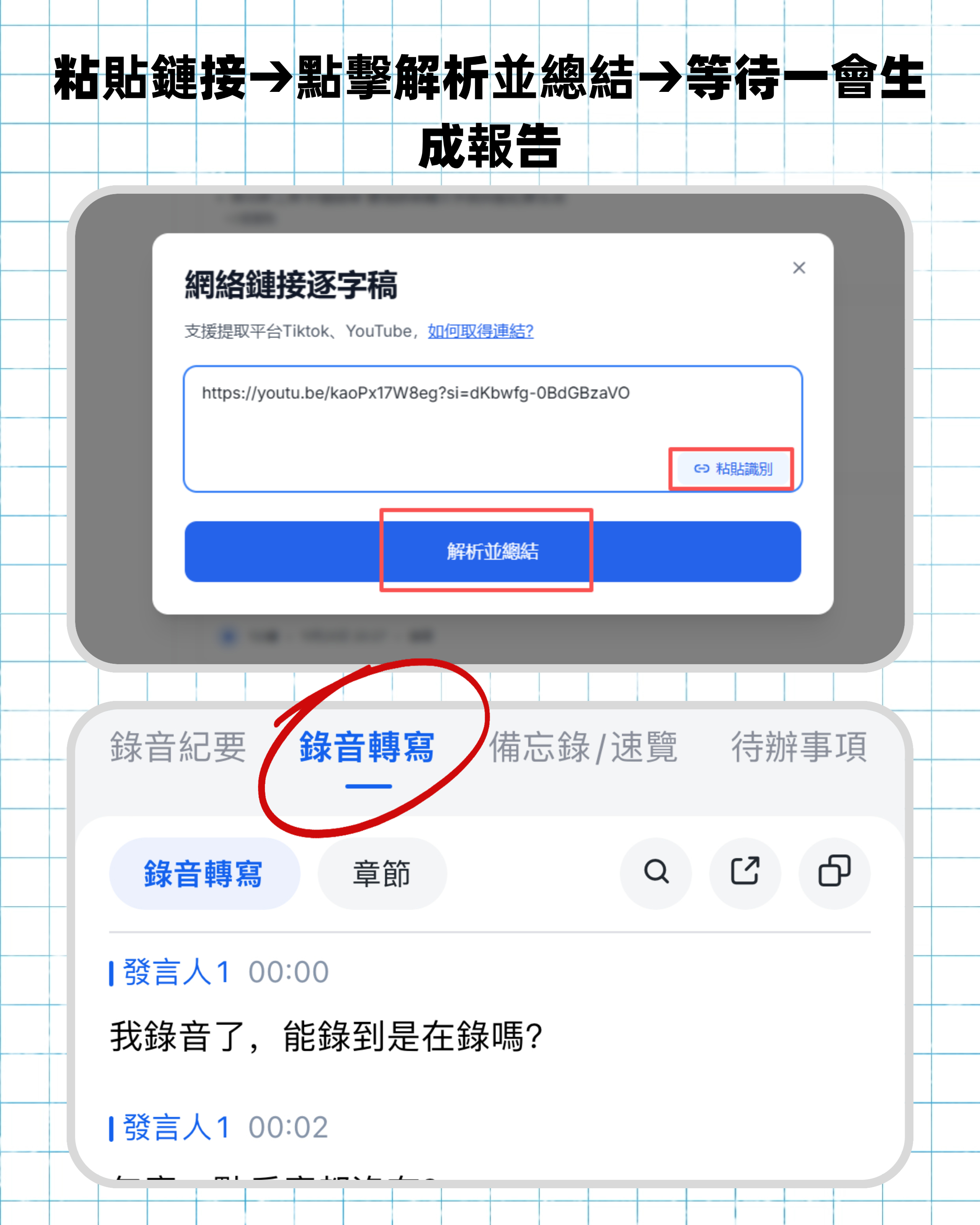
Pros Summary
- Intuitive and fast: Just speak to input, no need to memorize pinyin rules.
- Cross-platform: Record on phone, view on computer, all content synced to cloud.
- More than transcription: AI auto-summaries, action item extraction, Q&A—makes recordings truly usable.
- Free credits available: Monthly basic transcription minutes to experience all features.
Limitations to Note
- Free version has time limits; heavy users may need to pay.
- Recognition accuracy affected by background noise and accents; verify original text for important occasions.
- Does not yet support auto-correction for pure Southern Min pinyin; manual editing needed for rare words.
Who Is It Best For?
If you frequently handle Southern Min audio files or meetings, want to "speak and get text instantly," and dislike being tied to a single device, Tinrec is currently the closest to your needs.
Other Southern Min Input Methods Besides Tinrec
Pinyin Input (Pe̍h-ōe-jī / Tâi-lô)
Best for users already familiar with church romanization or Tâi-lô pinyin. Input speed is moderate, but the learning curve is steep—most people need one to two weeks to become proficient. If you need precise character control for teaching or research, pinyin input is the most rigorous choice. But if you just want to quickly record daily conversations, the cost of learning pinyin may be higher than you think.
Zhuyin Input (e.g., built-in Hokkien zhuyin on phones)
Some Android phones allow adding a Hokkien zhuyin keyboard, operating similarly to typing Chinese. The advantage is no need to learn pinyin, but the downside is that many common words aren't built-in, so you end up selecting characters forever—even slower than typing Mandarin homophones.
Conclusion: No Perfect Method, Only the One That Suits You
For most people, AI voice input (speak and transcribe) offers the highest efficiency and lowest learning cost; pinyin input is better for professional scenarios requiring precise characters.
Pitfall Guide: 3 Common Mistakes When Choosing a Southern Min Input Tool
Mistake 1: Thinking learning one pinyin system will make input smooth forever
Honestly, unless you use Pe̍h-ōe-jī or Tâi-lô long-term, remembering all pinyin, tones, and tone sandhi rules is tough. Many buy books and download apps, only to revert to voice input or homophones. Try a voice tool first; only consider learning pinyin if you truly need precise text.
Mistake 2: Only looking for input methods, forgetting post-processing
What happens after input? Meeting notes need to become to-dos, class notes need categorized highlights, interview content needs citations—these are the time-consuming parts. Tools like Tinrec bundle "input" and "organization" together, so you don't need to start from scratch in another app.
Mistake 3: Believing advertising claims of "99% accuracy"
Official numbers are usually tested in quiet recording studios with standard accents. In real life, street noise, cafés, and grandma's slurred speech reduce accuracy. Instead of trusting ads, record a daily conversation and test it with the free version—you'll see the real performance.
Summary: Which Input Method Should You Use?
Looking back at our three tested methods, the conclusion is clear:
- For quick recording of daily Southern Min conversations, meetings, interviews → Use Tinrec voice input; speak to get text, with auto-summaries afterward.
- For precise Hokkien text, willing to invest time in learning → Choose pinyin input (Pe̍h-ōe-jī or Tâi-lô).
- For occasional Hokkien phrases, don't want extra apps → Use built-in zhuyin on your phone, but it's the least efficient.
If you haven't tried AI speech-to-text, download the free version of Tinrec—the monthly free minutes are enough for two or three meetings, letting you experience speaking Southern Min and seeing it turn into text. Upgrade only if you like it; no need to pay upfront.
Turn every recording into actionable outcomes
Get 60 free transcription minutes when you sign in. No credit card required.
Related Reading
You might also like

2026 Best 5 Real-Time Translation AI Tools Compared: Which Can Handle Transcription and Live Translation Simultaneously?
This article reviews 5 AI tools with real-time translation capabilities, from speech-to-text to multilingual comparison, analyzing free plans and paid features to help you find the best choice for meetings, courses, video content, and more.

2026 Tinrec vs Otter.ai: 5-Dimensional Comparison – Which Is Better for Online Meeting Notes?
Based on hands-on experience as a mid-level manager, this article compares Tinrec and Otter.ai across five dimensions: Chinese meeting transcription, input source diversity, post-transcription organization, free plans, and cross-platform convenience. It helps you find the best tool for online meeting notes and everyday audio/video content processing.

2026 Comparison of 4 Real-Time Translation Tools: Which One Do Free Users Recommend Most?
How to choose the best real-time translation software in 2026? We tested and compared 4 tools, from voice translation and meeting conversations to video subtitles, fully analyzing features and use cases. Want to know which free version is the most capable? This article helps you find the best real-time translation solution.

2026 Comparison of 3 Meeting Recording Tools: Never Miss Key Points Even if Google Meet Has No Sound
How to fix Google Meet audio issues? This article tests 3 meeting recording tools, from audio/video transcription, AI summaries to cross-platform use, giving you the most reliable backup solution.

2026 Comparison of 3 Simultaneous Interpretation Software: Which Free Plan is Most Worth It?
We tested three popular simultaneous interpretation tools on the market, analyzing real-time translation accuracy, supported languages, free plan limits, and actual user experience. This article focuses on Tinrec as a key example to help you choose the best real-time voice translation software for meetings, classes, and interviews.
Tinrec vs Notta 2026: A 5-Dimension Showdown – Which Is Better for Chinese Content Organization?
Choosing a speech-to-text tool? This article compares Tinrec and Notta across five aspects including transcription accuracy, AI post-processing, and multi-source input to help you find the best solution for organizing Chinese content.

2026 5 Real-Time Translation Apps Compared: Are Free Plans Good Enough?
Looking for a great real-time translation app? This article compares 5 popular tools in real-time translation, AI summarization, free quotas, and Chinese recognition to help you choose.

2026 Comparison of 3 Meeting Note Tools in Real Tests: Which AI Minutes Really Save You Time?
How to take meeting notes quickly and accurately? This article tests 3 tools, showing you how to use AI to automatically generate summaries and to-dos, from recording to organizing in one go. Using Tinrec as an example, we demonstrate the full meeting note process and summarize 4 key purchase points to help you find the best solution.

2026 Speech-to-Text Tool Buying Guide: 3 Tools Tested and Recommendations
A student's real-world test of speech-to-text tools, comparing online and offline solutions, sharing genuine experiences in class and meeting scenarios to help you choose the best learning tool.