

Turn recordings into transcripts and summaries in minutes
Upload audio or video for multilingual transcription, AI notes, and action items
I recently wanted to transcribe recordings from a few offline meetings into text, but I didn’t have a professional voice recorder—just my laptop and phone.
So I started looking into tools that can directly convert audio to text on a computer, and even help with further organization afterward.
The first tool that came to mind was Otter.ai. It’s well-known abroad and many people use it for English meeting notes. But after actually trying it, I found that its handling of Chinese content—and the fact that I needed not just transcription but also usable organized output—wasn’t as smooth as I’d hoped.
Then I went back to Tinrec and realized that the different positioning of these tools can significantly affect your workflow.
In this article, I’ll use my hands-on experience to compare the real-world differences between Tinrec and Otter.ai for desktop audio-to-text.
(Screenshot here: Tinrec desktop web main interface, arrows pointing to "Start Recording" and "Import File" buttons)
Tinrec vs Otter.ai|Quick Overview
To put it in one sentence: Otter.ai is an AI note-taking tool designed for English online meetings, while Tinrec is more of a complete workstation for organizing Chinese audio and video content.
| Otter.ai | Tinrec | |
|---|---|---|
| Price (Entry) | Free plan: 300 minutes/month | Free plan: basic monthly transcription quota |
| Desktop | Web version | Web version, Windows / Mac |
| Core Strength | Real-time English meeting transcription, collaboration | Chinese multi-source audio organization, AI post-processing |
This article compares the two across the following five dimensions:
- Chinese speech recognition and organization
- Supported audio/video source diversity
- AI post-processing and conversational search
- Desktop operation smoothness
- Pricing plans and free quotas
Dimension 1|Chinese Speech Recognition and Organization
Otter.ai’s speech model is clearly optimized for English. Although it supports Chinese, in our tests, when encountering mixed Chinese-English or Taiwanese accents, the error rate increased significantly; in meetings with multiple people talking at once, sentence segmentation and recognition quality became unstable.
Tinrec, from its product page to feature design, is more tailored for Traditional Chinese users, deliberately enhancing recognition for Chinese meetings, lectures, and interviews. When I used the same 15-minute Chinese meeting recording (laptop built-in microphone, mild background noise), Tinrec required almost no manual correction for names and terms, while Otter had quite a few misrecognitions.
→ This dimension: Tinrec clearly wins.
Dimension 2|Supported Audio/Video Source Diversity
Otter.ai mainly handles two types of content: live online meeting recordings and uploaded audio files. It does not directly parse online video links, so if you want to transcribe public videos from YouTube or other platforms, you must first download them as files and then upload.
Stop organizing recordings by hand
Upload audio or video and automatically get a transcript, summary, and action items
Tinrec directly supports "paste a public video link" to transcribe, currently covering YouTube, TikTok, Bilibili, and other platforms. This is very convenient for content creators and learners. Plus, it also handles live recordings and local audio/video files, giving it a much wider range of input sources.
→ This dimension: Tinrec clearly wins.
(Screenshot here: Tinrec interface for pasting a web video link to transcribe, arrow pointing to the link input field)
Dimension 3|AI Post-Processing and Conversational Search

Both tools offer AI summaries and Q&A. Otter.ai’s AI Chat lets you ask questions about meeting content and automatically generates meeting summaries and action items. However, these features also suffer in Chinese from the basic recognition quality; if the original transcription has errors, the summaries and Q&A accuracy drop.
In addition to summaries, chapters, and task extraction, Tinrec also has a special "AI Conversational Search" that lets you repeatedly query historical recordings like a database. Its task extraction and key point marking follow Chinese expression logic, generating more directly usable to-do lists.
→ This dimension: Tie (basic AI features exist in both, but Tinrec is more practical for Chinese scenarios).
Dimension 4|Desktop Operation Smoothness
Otter.ai’s web interface is clean, centered around "meetings," with intuitive recording buttons and calendar integration. However, if you just want to quickly import an audio file or paste a video link, it requires extra steps, and some advanced features are less smooth on the web version than on mobile.
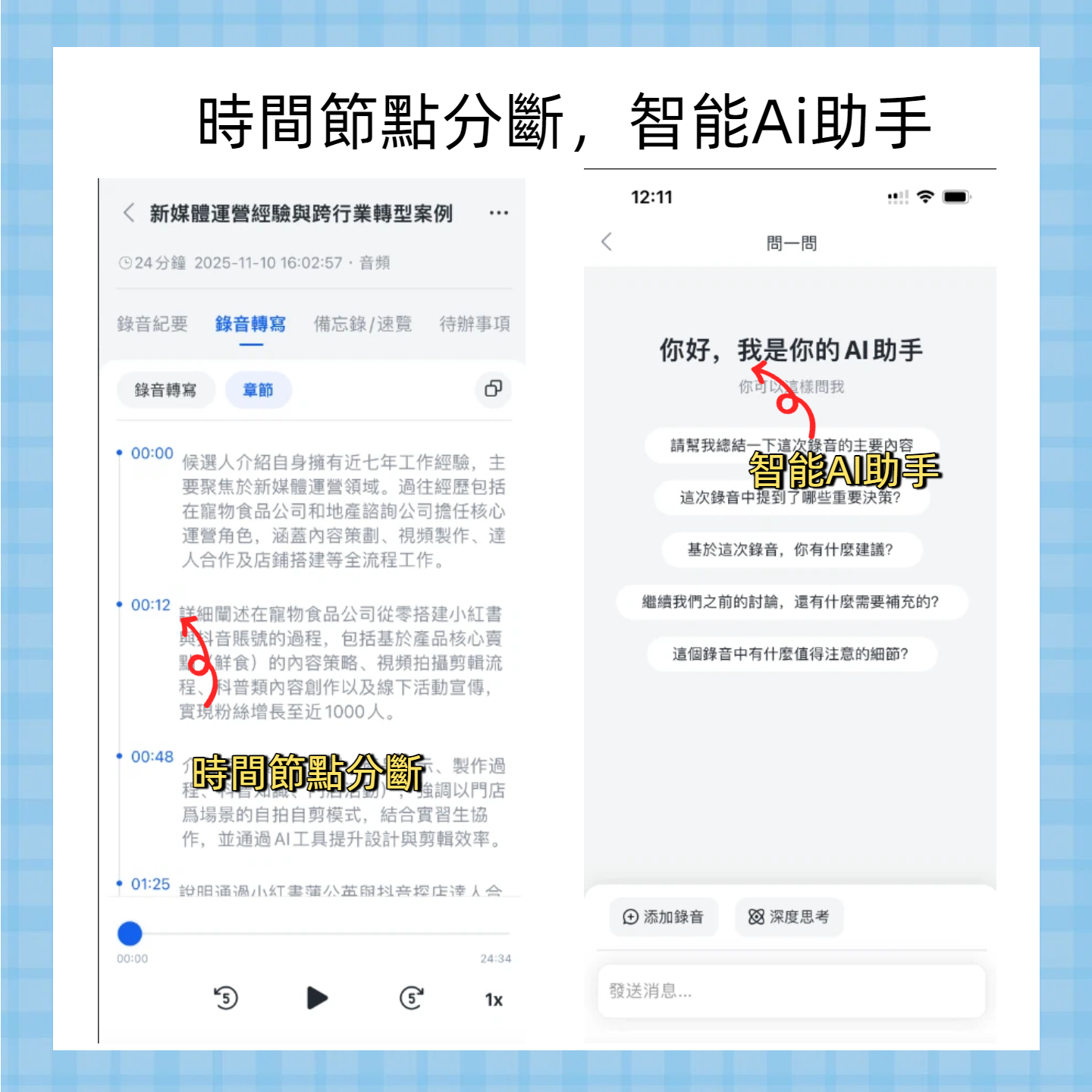
Tinrec’s desktop version feels more like an "audio/video organization hub": a list of all recordings on the left, and the transcript and AI organization panel on the right. Whether starting a new recording, importing a file, or pasting a video link, everything can be done on the same screen with almost no learning curve.
→ This dimension: Tinrec slightly wins (better for users who frequently organize content from different sources).
(Screenshot here: Tinrec desktop side-by-side view of transcript and AI summary, arrow pointing to the summary block)
Dimension 5|Pricing Plans and Free Quotas
Otter.ai’s free plan offers 300 minutes of transcription per month, sufficient for light users. If you exceed that, the Pro plan is about US$8.33/month (annual, 1200 minutes). However, advanced features like bulk imports and team collaboration are locked behind the higher-priced Business plan.
Tinrec’s free plan also provides monthly basic quota, and paid plans range from weekly to annual cards, offering more flexibility. For users who only need intensive use during a project and don’t want a long-term subscription, the weekly card is a cost-effective choice.
→ This dimension: Tie (Otter has more free minutes, Tinrec has more flexible plans).
Unique Advantages of Each?
Tinrec’s Unique Advantages
- Optimized for Traditional Chinese, more stable recognition for mixed Chinese-English and conversational speech.
- Supports pasting links from YouTube, TikTok, etc., to transcribe directly, saving download steps.
- Beyond transcription, offers repeated AI Q&A, automatic to-do lists, and meeting minutes.
- Cross-platform (iOS, Android, Web), all recordings synced, a true workstation experience.
Otter.ai’s Unique Advantages
- Mature English meeting ecosystem with deep integrations with Zoom and Google Meet, automatically joining meetings.
- Team collaboration features well-suited for cross-border English meeting scenarios.
Summary: Which Should You Choose?
- If you primarily deal with Chinese meetings, lectures, interviews, or online videos, and want to further organize transcripts into summaries and to-dos → Tinrec is the more complete choice.
- If you need a tool that can automatically join online English meetings, transcribe in real time, and share with a team → Otter.ai remains a good option.
- If you use both languages but focus on turning audio/video into a searchable, reusable knowledge base → Tinrec’s input sources and Chinese post-processing will save you effort.
In a nutshell: For most Traditional Chinese users, Tinrec provides a solution that better fits the real workflow for desktop audio-to-text. I suggest downloading the free version of Tinrec and testing it with your own recordings.
Turn every recording into actionable outcomes
Get 60 free transcription minutes when you sign in. No credit card required.
Related Reading
You might also like

3 Zoom Meeting Recording Tools Compared in 2026: Can You Record Without Host Permission?
Can you record a Zoom meeting? Yes, but the free version and participant permissions come with significant limits. This article compares three tools for recording Zoom meetings—Zoom built-in, Otter.ai, and Tinrec—testing which one works best when you don't have host permission, need Chinese transcription, and want post-meeting organization.
2026 Zoom Video Conferencing Comparison: Free Plan, Built-in Recording, and Tinrec — Which Should You Choose?
Want to learn how to use Zoom for video meetings without manually organizing notes afterward? This article compares Zoom's built-in features with Tinrec's meeting documentation workflow across 5 dimensions—from joining a meeting, muting and raising your hand, recording and transcription, to team collaboration—to help you pick the most effortless approach.
4 Zoom Meeting Recorder Clients Compared for 2026: Which One Actually Saves You Post-Meeting Cleanup Time?
The pain starts after the Zoom meeting ends. This article tackles common misconceptions and compares four recording tools that work with Zoom—Tinrec, Granola, Otter.ai, and Notta—explaining the real differences in bot-free recording, post-meeting summaries, and AI Q&A, plus buying tips and pitfalls to avoid.
4 Free Online Meeting Tools Compared for 2026: Time Limits and Restrictions Explained
How long can you actually meet on Zoom's free plan? Starting from a real student group project scenario, this article compares the time and participant limits of free online meeting tools like Zoom, Google Meet, and LINE, and shares how to use Tinrec to capture transcripts, summaries, and action items after the meeting.
Zoom Meeting Notes in 2026: Built-in Recording vs Cloud Recording vs Tinrec — A Hands-On Comparison
Zoom has built-in meeting notes and recording features, but how do you organize, search, and collaborate after the meeting? This article compares Zoom's built-in recording with Tinrec across 5 dimensions to help you decide which Zoom meeting notes method fits your workflow.
What Is Vocal Fry? 3-Minute Breakdown of the Creaky Voice Phenomenon, Celebrity Examples, and Perception Debates
Vocal fry, also known as creaky voice or glottal fry, is the lowest vocal register. This article explains in 3 minutes what vocal fry is: from the actual vocal mechanism in the throat, the low-frequency characteristic of vocal folds vibrating 20 to 50 times per second, to celebrity examples like Kim Kardashian, social perception research, and 3 common misconceptions—all in one go.
What Does Vocal Cord Mean in Chinese? 5 Steps to Choose the Right Speech-to-Text Tool in 2026
The Chinese translation of "vocal cord" is "聲帶" (shēngdài), but most people actually need to turn spoken words into usable text. This article first explains 5 key points for choosing a speech-to-text tool, then compares Tinrec, Notta, TurboScribe, and Otter.ai with hands-on testing, and finally gives clear purchase recommendations.
What Is Vocal Fry? Definition, 3 Practical Uses & Examples (2026 Guide)
What does vocal fry mean? This student-friendly guide explains the often-misunderstood vocal register: from the Cambridge Dictionary definition and vocal cord vibration to three practical uses in speech emphasis and singing, plus the answer to the big debate—is it a bad habit or a useful tool?
Vocal Cord Palsy: Symptoms, Causes, and Treatment (2026 Guide)
This article explains vocal cord palsy in plain English, covering common symptoms, possible causes, how it's diagnosed, and when to see a doctor, so you can quickly grasp the key information.