

Turn recordings into transcripts and summaries in minutes
Upload audio or video for multilingual transcription, AI notes, and action items
Over the past six months, I dug out old recordings from online courses I’d taken and wanted to turn them into study notes.
The number of files was staggering: over 30 hours of course recordings.
Listening to them one by one? Impossible.
Manually typing transcripts? Way too time-consuming.
I realized firsthand: speech-to-text tools have gone from "nice to have" to "essential for productivity."
(Image: Importing a local audio file for transcription)
But with so many tools out there, how do you choose?
During this time, I tested several mainstream tools.
In the end, I found the key isn't "who has the most features," but "who can turn your recordings into actionable knowledge."
This article uses Tinrec 秒听录音—the one I use most often—as the core example to share a complete methodology for handling recordings.
What Can Speech-to-Text Tools Do for You?
Many people think speech-to-text is just "turning sound into text."
But in my workflow, I've found its use cases are far richer than expected.
Scenario 1: Meeting ends, meeting notes ready in 5 minutes
Before, after a two-hour meeting, you'd spend another hour crafting notes from memory or recording.
With an AI speech-to-text tool, everything changes.
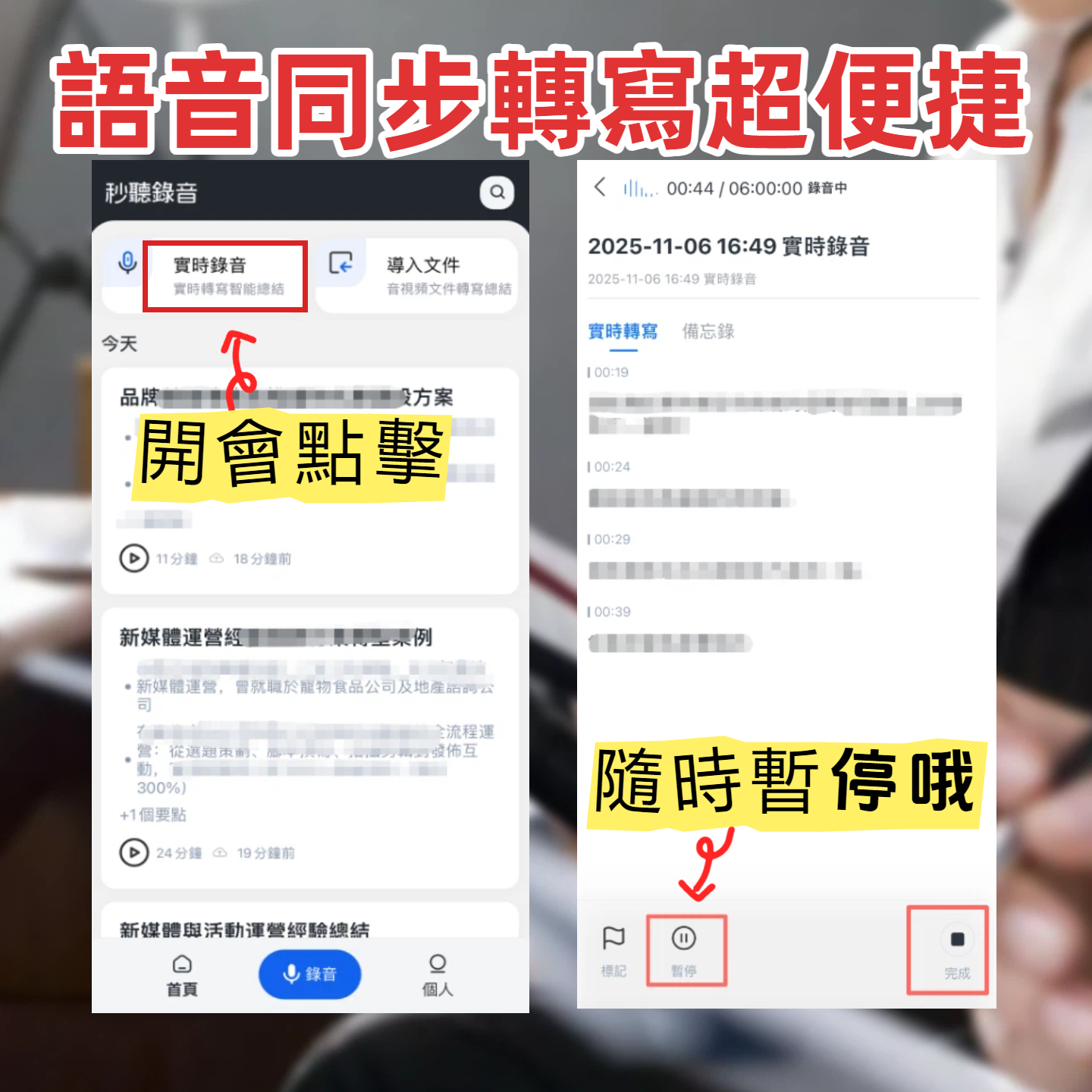
With Tinrec, while the meeting is happening, it starts real-time transcription.
As soon as the meeting ends, summaries, conclusions, and action items are auto-generated.
Who's responsible for what and deadlines are crystal clear.
(Image: Tinrec auto-generated summary and action items after a meeting)
You just quickly review and send to the team.
Scenario 2: Online course recordings turn into review notes automatically
In the online courses I take, instructors talk fast, and handwritten notes can't keep up.
Now, I open Tinrec during class, and when the session ends, I get a structured note with chapters and key points.
I no longer need to re-listen; I just search keywords or ask Tinrec: "What are the three main takeaways from this lesson?"
It gives me the answer based on the recording.
Scenario 3: Expert interviews—quick transcripts and key insight summaries
If you interview clients or experts, verbatim transcripts are the foundation for analysis.
Before, I'd pay someone to transcribe and wait one or two weeks.
Now, after the interview, Tinrec transcribes instantly and auto-labels different speakers.
I can even ask Tinrec: "What are the interviewee's core views on market trends?"
It extracts key opinions from the transcript for quick quoting.
Scenario 4: Online videos—directly turn into text assets
Not just audio, but also public online videos.
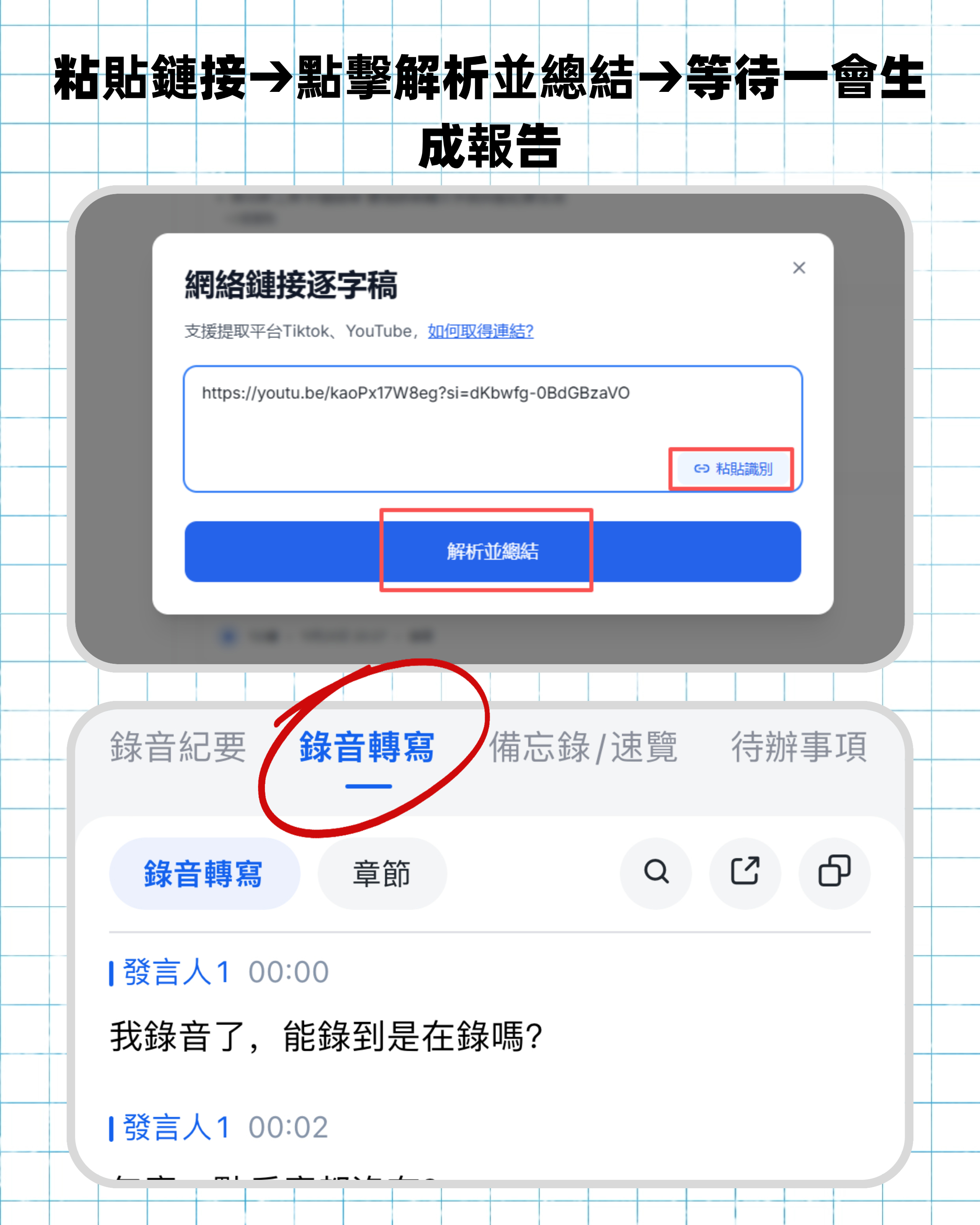
I often paste a YouTube or Xiaohongshu video link into Tinrec, and it extracts audio, outputs text, and provides a summary.
For content creators, this is incredibly convenient—quickly scan competitors' video highlights or gather material for inspiration.
(Image: Tinrec with a YouTube link, generating summary and transcript)
Core Capabilities of Speech-to-Text Tools
From these scenarios, I've identified a few truly critical capabilities.
These determine whether a tool is just a "transcription machine" or a "knowledge companion."
I'll again use Tinrec as an example.
Real-time transcription—words appear as you speak
Tinrec's real-time transcription has very low latency—words appear almost as you talk.
This is especially useful in meetings or classes: you can watch the text to confirm you haven't missed key points, and use it as live notes.
(Image: Real-time recording with text appearing almost instantly)
Multi-source input—not limited to phone recording
Tinrec supports not only live phone recording but also:
- Importing local audio or video files.
- Pasting links to online videos (YouTube, TikTok, Xiaohongshu).
- Recording online meetings from your computer (Zoom, Google Meet, Teams).
This makes it a unified hub for audio and video processing.
AI summary and chapter splitting—turn long recordings into structured content
Transcribed text can easily run tens of thousands of words. Who has time to read it all?
Tinrec auto-generates a summary and splits the long recording into chapters, each with a title and key points.
It's like browsing a book's table of contents—jump to the section you want.
Action item extraction—from discussion to action
In meetings or discussions, "who does what" often comes up.
Tinrec can automatically extract action items from the recording, listing tasks, assignees, and context.
This connects recorded content directly to next steps, instead of piling up in a folder.
(Image: Tinrec automatically extracted action items with clear assignees)
AI Q&A—query your recordings like a database
This is one of my favorite features.
After transcription, you can ask Tinrec questions in natural language, such as:
- "Who mentioned the Q3 budget in the meeting?"
- "What specific complaints did the client have about our product?"
- "What three market strategies were covered in this lesson?"
Stop organizing recordings by hand
Upload audio or video and automatically get a transcript, summary, and action items
Tinrec understands semantics and answers directly, with timestamps from the original text.
(Image: AI Q&A—just ask and get answers)
Multi-format export and follow-up use
After processing, Tinrec lets you export as TXT, Word, PDF, or SRT subtitle files.
Or, via integrations, sync directly to Notion, Google Docs, OneNote, etc.
This way, your recordings seamlessly fit into your existing workflow.
Practical Use Cases
Now, let me demonstrate how Tinrec fits into daily workflows with a few specific scenarios.
Scenario 1: Project progress meeting
Weekly project meetings cover a lot of ground.
My process:
- At the start of the meeting, open the Tinrec mobile app or web version and begin recording.
- During the meeting, I can manually mark "important moments" for later review.
- When the meeting ends, tap stop. Tinrec starts processing.
- Within 30 seconds, the summary and action items are ready.
- I quickly review and screenshot the action items to share with the team group chat.
What used to take 30 minutes of post-meeting cleanup is now done in under 1 minute.
Scenario 2: Self-studying an online course
I took a 2-hour data analysis class.
During class, I focused on listening and only jotted down a few keywords.
After class, I opened Tinrec to view the auto-generated chapter notes.
For unclear parts, I used AI Q&A: "Explain the steps of hypothesis testing."
Tinrec pulled the steps from the instructor's explanation.
Then I exported the entire note to Notion and integrated it with my learning database.
Scenario 3: User interview research
Conducting user interviews—1 hour each, 5 participants.
Before the interview, I set up an "Interview Records" folder in Tinrec.
During the interview, I recorded the entire session.
After the interview, I had an instant transcript with automatic speaker labels (interviewer/interviewee).
I used AI Q&A to ask across all interviews: "How do these 5 users feel about the new feature?"
Tinrec scanned all related recordings and gave me a consolidated summary.
This drastically shortened the time from interview to insight report.
(Image: Different speakers color-coded for clarity)
Scenario 4: Content creation material gathering
I was planning an article about "remote work."
I collected several relevant YouTube talk videos.
I pasted links into Tinrec and got text summaries.
After a quick skim, I noted key arguments and used AI Q&A to extract memorable quotes: "What was the most impactful sentence from the speaker in this talk?"
This helped me quickly build the article's argument structure.
4 Things to Look for When Choosing a Speech-to-Text Tool
There are many tools on the market, but based on my experience, you can evaluate them across these four dimensions.
1. Accuracy and language support
Transcription accuracy is fundamental, but don't just rely on official numbers.
Test it yourself in scenarios with multiple speakers or background noise.
Tinrec's Chinese transcription quality is stable, especially in clear Chinese meetings or classes, with low error rates.
It also explicitly supports Traditional Chinese (Taiwan), which is important for local users.
Some tools only support Simplified Chinese, and their transcription of Taiwanese expressions can be off.
2. Diversity of input sources
Your recordings come from more than just your phone.
You may have old audio files, online videos, or online meetings.
When choosing, make sure the tool supports these input methods.
Tinrec is very comprehensive here: live recording, file import, link parsing, and computer meeting recording—it covers almost all sources.
This way you don't have to switch tools for different scenarios.
3. AI post-processing capabilities
Transcription is just the first step.
I value how much "organization" a tool provides after transcription.
Tinrec doesn't just produce a transcript—it offers summaries, chapters, action items, AI Q&A, mind maps, and more.
These aren't gimmicks; they genuinely save time.
For example, AI Q&A lets you skip scanning the full text and go straight to the key points.
4. Cross-platform support and export flexibility
You'll record on your phone but edit on your computer.
So a good tool must work across platforms and allow seamless exports.
Tinrec has iOS and Android apps and a web version, accessible anytime, anywhere.
It offers multiple export formats and can sync directly to my primary note-taking apps (like Notion), so my data isn't scattered.
(Image: Multiple export formats supported for smooth follow-up work)
Frequently Asked Questions
Q1: Is the free version sufficient?
Tinrec's free plan provides a monthly base transcription quota, suitable for light use or those who want to try it first.
If you only have one or two meetings or classes per week, the free version is plenty.
But if, like me, you use it frequently or handle long recordings, consider a paid plan.
Q2: What languages are supported?
Tinrec supports multiple languages, with special optimization for Chinese (including Traditional).
It also supports English, Japanese, and other languages, and can even correctly recognize mixed Chinese-English content.
Q3: How long can recordings be?
Paid plans support longer recordings; check the specific plan details.
I've transcribed a 3-hour course recording without issues.
Q4: Is my data safe? Will my recordings be used to train AI?
Tinrec prioritizes user privacy; all recordings and data transfers are encrypted.
Check the official privacy policy to ensure it meets your security requirements.
Q5: What's the difference from my phone's built-in voice memo app?
The built-in app only records; Tinrec takes it further with transcription, summaries, action items, and searchable Q&A.
It's the difference between "capturing" and "acting."
Conclusion: Turn Your Recordings into Knowledge Assets
After using these tools extensively, my deep realization is:
Speech-to-text tools aren't about typing less—they're about rethinking what "recording" means.
Before, recording was just for "evidence" or "in case I forget."
Now, with tools like Tinrec, every recording can become a structured, searchable, reusable knowledge asset.
If you also want to break free from manual organization, start with these steps:
- Download Tinrec and sign up for a free account.
- Next meeting or class, test it by recording with your phone.
- Afterward, review the auto-generated summary and action items.
- Try using AI Q&A to ask a question about the recording.
- Once comfortable, start importing old recordings or video links to organize your knowledge base.
- Set up exports so results automatically sync to your note-taking tool.
Test it step by step, and you'll gradually master this method.
Turn your backlog of recordings into resources that truly help you.
Turn every recording into actionable outcomes
Get 60 free transcription minutes when you sign in. No credit card required.
Related Reading
You might also like
2026 Speech-to-Text Tool Buying Guide: Tinrec vs Plaud Note Hands-On Review and Recommendations
A senior MIS student tested both apps for a semester, comparing Tinrec and Plaud Note on price, cross-platform support, AI features, and more to help you decide which is best for students.

Complete Guide to Speech-to-Text Open Platforms in 2026: Features, Tool Selection, and Usage Tutorial
Want to know what a speech-to-text open platform can do for you? This complete guide covers core features, practical scenarios, and key purchasing points, using Tinrec as an example to demonstrate how to turn audio files from meetings, classes, interviews, etc., into immediately usable text.

A 2025 Comparison of 5 Speech-to-Text Tools: From Free to Paid
A curated selection of 5 major types of speech-to-text tools in 2025, from AI meeting bots to multi-source organization platforms, comparing features, pricing, and use cases. Using Tinrec as an example, this article provides a complete tutorial and FAQ.

2026 Comparison of 3 Speech-to-Text Input Methods: Real-time Transcription and Organization, This One Saves the Most Time
Looking for a speech-to-text input method? Our team tested 3 tools and found that Tinrec's instant transcription not only converts speech to text in real time but also automatically organizes key points and to-do items. It's great for meetings, classes, and interviews, offering excellent value.

2026 Speech-to-Text Tool Buying Guide: 3 Major Types Tested and Selection Tips
Wondering if speech-to-text tools are effective? This article tests 3 major types, uses Tinrec as an example, and shares buying tips, FAQs, and real-world use cases to help you find the best solution.

The Complete 2026 Guide to Transcription: Features, Use Cases, and How to Choose the Right Tool
A comprehensive comparison of the latest speech-to-text tools in 2026, from free options to professional AI transcription assistants. Dive deep into the features, pricing, and ideal use cases of Tinrec, Notta, Otter.ai, and more to find the perfect voice-to-text solution for you.

2026 Tinrec vs Otter.ai: 5-Dimension Showdown, Which Free Voice-to-Text App Suits You Best?
Compare Tinrec and Otter.ai across five dimensions: accuracy, Chinese language support, free tier, post-processing capabilities, and multi-scenario adaptability, to help you choose the best free voice-to-text tool.

Tinrec vs Notta 2026: 4-Dimension Comparison for Students – Best Alternative for Speech-to-Text
A senior student's semester-long comparison of Tinrec and Notta across free quotas, AI summarization, Chinese language support, and study scenarios to help you pick the best value speech-to-text tool.
Top 3 Speech-to-Text Solutions of 2026 Compared: Which Free Option Lasts the Longest?
Looking for a free speech-to-text app? Worried about time limits or minute caps? We tested three major types of solutions on the market to find out which free transcription lasts the longest, plus an AI organizing feature showdown. After reading, you'll know how to save time and avoid overtime!