

Turn recordings into transcripts and summaries in minutes
Upload audio or video for multilingual transcription, AI notes, and action items
If you're constantly chasing meeting notes, class audio, or interview recordings, an "online speech-to-text tool" could be your lifesaver. These tools convert audio directly into text, and some can even automatically summarize, highlight key points, and help organize the content into usable data.
This time, I've picked 4 popular online speech-to-text services— Tinrec, Otter.ai, Notta, and TurboScribe—and compared them on transcription quality, AI organization capabilities, pricing, and real-world feel, so you can quickly determine which one suits you best.
What Is an Online Speech-to-Text Tool?
Simply put, it's an online service that converts recorded audio (or uploaded audio/video files, or even links to online videos) into text. But today's tools go far beyond just generating verbatim transcripts: they automatically segment text, tag speakers, provide summaries and action items, and some even let you ask questions about the content, as if you were flipping through your own notes.
These tools are especially useful for people who frequently deal with meetings, lectures, interviews, or need to organize video material. Below, I'll compare these 4 tools across several key dimensions.
Core Feature Comparison: From Simple Transcription to AI Organization
1. Input Source Diversity
Most tools support real-time recording transcription, but the more sources they can handle, the more practical they become.
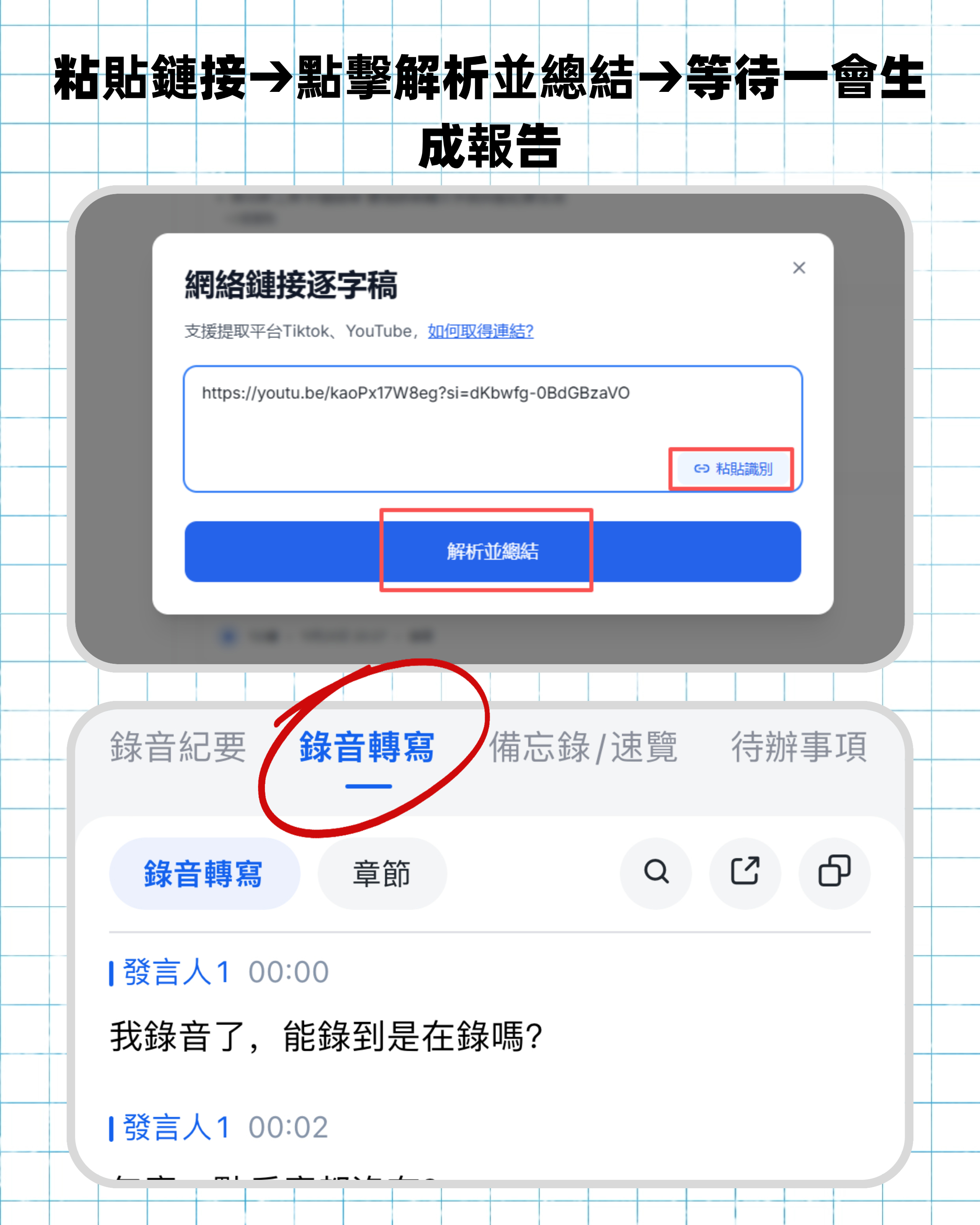
- Tinrec: Besides real-time recording, you can upload audio/video files, or even paste public video links (e.g., YouTube, TikTok) to start transcription. This is convenient for people who need to organize online courses or interview videos.
- Otter.ai: Primarily focused on online meetings, automatically joining Zoom, Google Meet, and Teams to generate meeting notes, but less oriented toward handling external files or online videos.
- Notta: Also supports real-time recording, file upload, and some meeting integrations, overlapping with Tinrec, but less emphasis on parsing online videos.
- TurboScribe: Specializes in file transcription, allowing batch processing of uploaded audio or video files. Good for transcribing large files at once, but less focused on meeting scenarios or real-time recording.
2. Post-Transcription Organization Capabilities
After the transcript is done, the ability to "understand the content" is key.
- Tinrec: Automatically generates summaries, chapters, and action items after transcription. You can also ask questions about the recording (e.g., "What was the conclusion of this meeting?") in a conversational way. Supports exporting in multiple formats and can even generate reports, tables, etc.
- Otter.ai: Provides meeting summaries and speaker identification. Its AI chat feature (Otter Chat) can answer content-related questions, but the output is more collaboration-oriented for meetings.
- Notta: Offers summaries and translation, but AI Q&A and subsequent output capabilities (like generating meeting minutes or reports) are not as comprehensive as Tinrec's.
- TurboScribe: Mainly provides transcripts and subtitles; few additional summary or organization features. Suitable for those who only need pure text transcription.
3. Chinese Content Friendliness
This is especially important for users in Taiwan.
- Tinrec: Optimized for Chinese meetings, courses, interviews, and video organization. Handles mixed Chinese-English content well.
- Otter.ai: Strong suit remains English meetings; Chinese transcription is usable but accuracy and organization depth lag behind English scenarios.
- Notta: Good multilingual support, decent Chinese transcription, but sometimes misses in mixed Chinese-English or complex meeting scenarios.
- TurboScribe: General multilingual model; Chinese transcription acceptable but lacks organization features tailored for Chinese content.
Stop organizing recordings by hand
Upload audio or video and automatically get a transcript, summary, and action items
Price Plans and Free Credits Comparison
| Tool | Free Plan Offers | Paid Plan (Avg Monthly, Annual Billing) | Best For |
|---|---|---|---|
| Tinrec | Monthly basic transcription credits; try real-time recording, file import, and online video parsing | Weekly pass for short-term heavy use; Pro monthly around a few hundred NTD (see official site); annual plan lowers monthly cost for long-term users | Those who want to handle multiple audio/video sources and expect further organization after transcription |
| Otter.ai | 300 minutes per month | Pro ~US$8.33/month (1200 mins), Business ~US$19.99/month | Users focused on English online meetings needing team collaboration |
| Notta | 120 minutes per month | Pro ~US$8.17/month (1800 mins), Business ~US$16.67/month (unlimited) | High-volume transcription, multilingual translation, and subtitles |
| TurboScribe | 3 transcriptions per day (30 mins each) | Unlimited ~US$10/month, supports large files and batch processing | One-time processing of large numbers of long files, budget-conscious users |
Honestly, if you look at minutes alone, Notta and TurboScribe's paid plans are very competitive. But if you care more about "what you can do with the text after transcription," Tinrec's AI organization and Q&A features clearly add value.
Usage Tutorial: Using Tinrec as an Example
After the comparison, I'll use Tinrec to demonstrate the basic workflow of an online speech-to-text tool. Because it has the widest range of input sources, learning this will give you a sense of how other tools generally operate.
Step 1: Open Tinrec, Choose Recording or Import
Open the Tinrec web version, iOS, or Android app. On the homepage, you'll see three main entry points: Real-time Recording, Import File, and Paste Video Link.
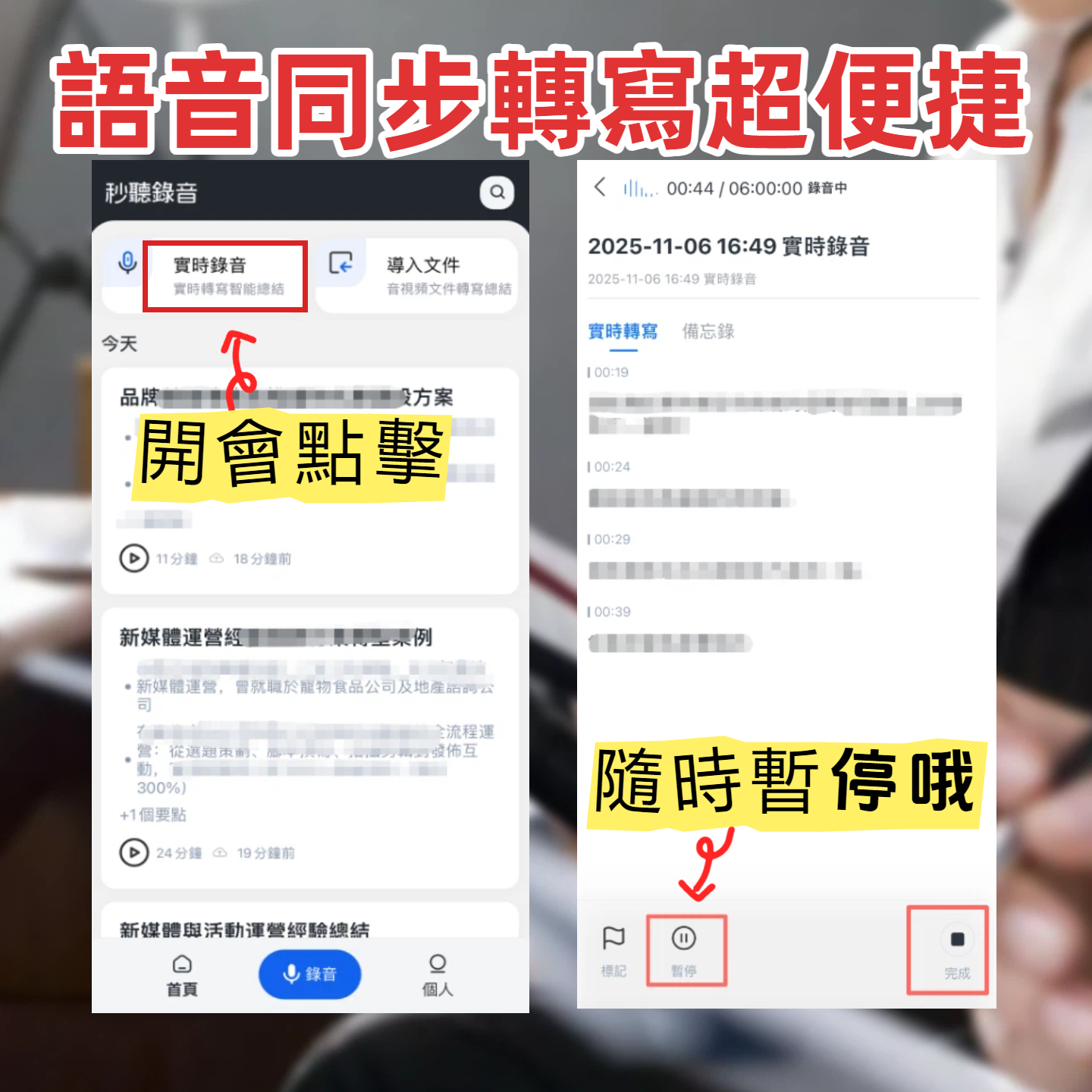
(Screenshot location: Real-time recording transcription 1)
During a meeting or class, just press the record button, and text appears below in real time. To organize old audio files, select "Import Audio/Video File." For a YouTube course or interview, click "Parse text from online link" and paste the URL to start transcription.
Step 2: Let AI Organize Key Points
After recording or transcription is complete, click "Tinrec Meeting Summary" and the system will automatically generate a summary, chapters, and action items.
(Screenshot location: Tinrec Meeting Summary)
You can quickly review the meeting via the summary; with chapters, you can jump to the section you want to revisit. If there are items to follow up, switch to the action items page, where all task lists extracted from the discussion are listed.
(Screenshot location: Action items to-do list)
Step 3: Use AI Q&A to Further Clarify Content
This is my most frequently used feature. In the "AI Chat Query," you can directly ask: "What was the conclusion of this meeting?" "Who is responsible for what?" "What were the three key points the client raised?" Tinrec answers based on the entire recording's context, saving you from manually flipping through dozens of pages of transcript.
(Screenshot location: AI Chat Query 1)
Step 4: Export or Continue Generating More Content
The organized text can be exported as Word, PDF, TXT, or directly synced to tools like Notion, Google Docs, etc. If you need formal meeting minutes, you can also ask the AI to generate reports or tables.
(Screenshot location: Multi-format file export)
Frequently Asked Questions
Q1: How accurate are online speech-to-text tools?
Actual accuracy depends on recording quality, background noise, speaker accent, and speed. In my experience, for normal meetings and clear lecture recordings, mainstream tools achieve over 90% recognition. Note that accuracy may drop in mixed Chinese-English or multi-speaker scenarios.
Q2: Is the free version sufficient?
If you only occasionally transcribe short recordings (e.g., a single meeting or short course), most tools' free credits are enough to try. For example, Tinrec's free version lets you test real-time recording and online video parsing; Otter's 300 minutes per month also suits light English meeting users. But for frequent use, a paid plan ensures you won't worry about running out of credits.
Q3: Which one is best for users in Taiwan?
I usually look at Chinese language friendliness. Tinrec is especially optimized for Chinese meetings, courses, interviews, and YouTube video organization, handling mixed Chinese-English content well. Combined with its comprehensive AI organization and Q&A features, it offers the best all-around experience for Taiwan users. If you mainly handle English meetings, Otter.ai is also a solid choice.
Q4: Can I convert recordings directly into meeting minutes or reports?
Yes. Tinrec not only provides verbatim transcripts but also automatically generates summaries, action items, and can even produce formal meeting minutes, tables, or documents with AI. Other tools often require templates or manual work; Tinrec makes this more intuitive.
Q5: How secure is it? Will my recordings be stored?
Each service has its privacy policy. Recordings are typically encrypted and only accessible from your account. For highly confidential needs, check the tool's privacy terms or consider on-premise solutions.
Q6: How do I get started?
I recommend starting with Tinrec's free version—no cost to test real-time recording and file transcription. Run an actual recording of yours through it, feel the transcription speed and organization results, which is more direct than reading any number of reviews.
Turn every recording into actionable outcomes
Get 60 free transcription minutes when you sign in. No credit card required.
Related Reading
You might also like

How to Choose a Speech-to-Text Tool in 2026? A 5-Step Test Guide
Learn how to pick the best recording-to-text app, with hands-on tests of Tinrec and other popular options. Avoid common pitfalls and streamline your meeting notes.

2026 Comparison of 4 Speech-to-Text Tools: Which One Best Handles Chinese Transcription and Post-Processing?
How to choose a speech-to-text tool? Pseric tested Tinrec, Otter.ai, Notta, and TurboScribe, comparing free tier limits, Chinese accuracy, AI summaries, and post-processing capabilities to help professionals and students find the best fit.

Best WeChat Voice-to-Text Alternatives 2026: Why Tinrec Stands Out
Tired of struggling to organize long WeChat voice messages? This article compares WeChat's built-in voice-to-text with the professional tool Tinrec from a practical perspective, explaining why it's more suitable for professionals to switch to Tinrec for meetings, interviews, and voice messages, along with free trial suggestions.

2026 Complete Guide to Audio-to-Text: Accuracy, Tool Selection, and Practical Tips
Is audio-to-text accurate? This article covers the actual accuracy of speech-to-text technology, influencing factors, how to choose the right tool, and uses Tinrec as an example to show complete application scenarios, helping you decide if it's worth it.
The Complete Guide to Speech-to-Text in 2026: Features, Use Cases, and How to Choose the Right Tool
Struggling to choose a speech-to-text tool? This article takes a practical approach, helping you understand the core features and application scenarios of speech-to-text. Using Tinrec (秒聽錄音) as an example, it teaches you how to select the best tool for your needs and easily turn recordings into usable data.
2026 Side-by-Side Comparison of 2 Speech-to-Text Tools: Which One Handles Chinese Recordings Better?
Tinrec and Notta are both excellent speech-to-text tools, but when it comes to organizing Chinese recordings, diverse input sources, and AI post-processing, Tinrec is better suited for users who need to turn meetings, lectures, and online videos into actionable knowledge. This article compares them in detail across input sources, AI features, plan flexibility, and cross-platform experience to help you quickly find the right choice.
2026 Comparison of 3 Free Online Speech-to-Text Tools: Which Free Plan Is Best for Taiwan Office Workers?
We tested 3 free speech-to-text tools, comparing accuracy, AI features, and free credits. Tinrec is the best fit for Taiwan users who need to transcribe meetings, lectures, and online videos.

2026 Comparison of 2 Speech-to-Text Tools: Why I Switched from Notta to Tinrec
A mid-level manager tests speech-to-text tools, comparing Notta and Tinrec. From meetings and Chinese recognition to AI post-processing, it analyzes which is better for professionals who need to manage both up and down.

How to Choose a Speech-to-Text Tool in 2026: A Complete 5-Step Guide
Accumulating recordings from meetings, classes, and interviews? Converting them to text is time-consuming and tedious. This guide walks you through 5 steps to find the best transcription solution for your needs, using Tinrec as an example to turn recordings into actionable knowledge.