

Turn recordings into transcripts and summaries in minutes
Upload audio or video for multilingual transcription, AI notes, and action items
I have about 15 meetings a week—weekly meetings, project status meetings, one-on-ones, cross-departmental coordination. What I used to dread most wasn’t the meetings themselves, but what came after. Because every meeting left a pile of decisions and action items to sort out, meaning my work only started once the meeting ended. Handwritten notes were too slow, and listening back to recordings took too much time—until I started using AI transcription tools to offload the most mechanical part.
This article offers a hands-on comparison of 5 Google Meet alternatives from the perspective of a mid-level manager. They don’t just let you hold meetings; more importantly, they help turn meeting content into searchable, summarizable, and trackable data.
Why Do You Need a Google Meet Alternative?
Google Meet itself is a stable video conferencing platform, but its post-meeting organization features are virtually zero. After a meeting, you still have to write meeting notes, organize action items, and track decisions—these nagging tasks are the real time sinks. Based on my experience, for a one-hour meeting, manually summarizing the key points takes at least 30 minutes, which means an extra 2–3 hours per day. A truly effective alternative isn’t just about hosting meetings; it must also help you with the "post-meeting homework."
The following 5 tools all excel in post-meeting organization. Here are the real-world findings.
Option 1|Tinrec – The Most Complete AI Transcription Assistant
Tinrec is currently my team’s go-to tool. It not only transcribes meeting recordings to text but also does an excellent job of processing the transcription afterward.
Key Highlights:
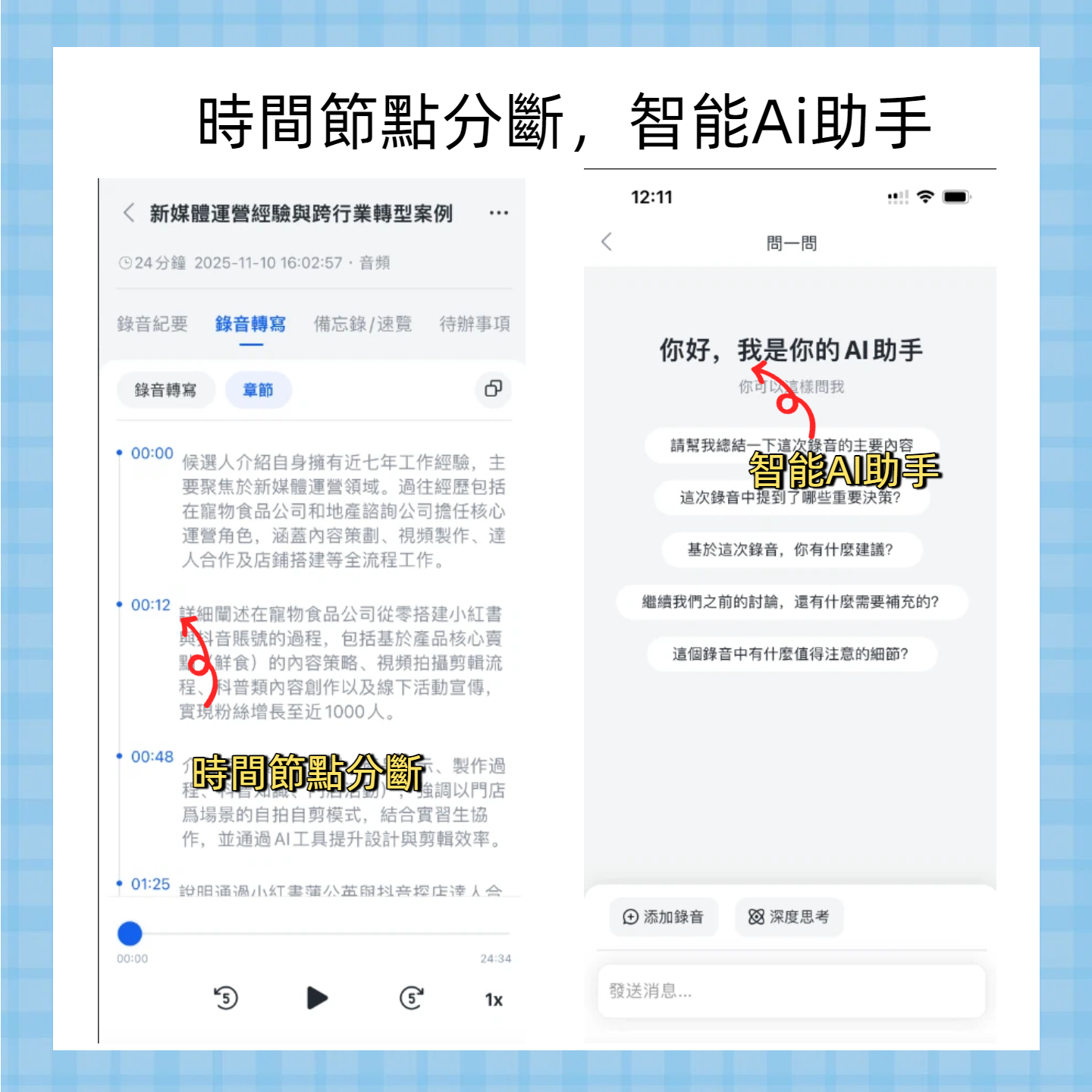
- Real-time transcription + AI summary: Record directly from your computer during Google Meet, and get a structured summary with chapter breaks within 1 minute after the meeting. No more flipping through notes when reporting to your boss.
- AI conversation query: You can ask questions about the recording content directly, such as "What was the budget number discussed in last Friday’s meeting?" It pulls answers from the recording, like having a recording data manager for your team.
- Automatic action item extraction: Action items mentioned in the meeting are automatically extracted, saving you the time of listing them one by one. Particularly useful for cross-departmental follow-ups.
- Supports multiple input sources: Besides real-time recording, you can upload local audio files, paste YouTube or Xiaohongshu links, or even process online courses and interview recordings all in one place.
Pricing:
- Free plan: Basic monthly transcription quota to try core features.
- Pro monthly: For regular meeting users, more transcription minutes.
- Pro yearly: Most cost-effective in the long run, ideal for building a recording archive.
Best for: People who need to quickly generate reusable data from various audio/video sources like meetings, courses, and interviews; especially mid-level managers who don’t want to switch between tools.
Option 2|Otter.ai – Veteran Choice for Online Meetings
Otter.ai is the pioneer of AI meeting notes, excelling in real-time transcription and speaker identification. Its interface is intuitive, best suited for English-only meeting scenarios.
Key Highlights:
Stop organizing recordings by hand
Upload audio or video and automatically get a transcript, summary, and action items
- Automatically joins Zoom, Google Meet, and other platforms, producing timestamped transcripts after meetings.
- Provides AI summaries and keyword search for quick review of key points.
Pricing: Free plan: 300 minutes/month; Pro: $8.33/month billed annually for 1,200 minutes.
Best for: Teams that primarily hold English online meetings and need simple meeting notes. However, its support for Chinese and classroom recordings is weaker.
Option 3|Fireflies.ai – Integration-Focused Meeting Assistant
Fireflies.ai also focuses on meeting scenarios but emphasizes team collaboration and CRM integration, making it ideal for sales teams that need to feed meeting notes directly into Salesforce.
Key Highlights:
- Supports transcription in 100+ languages and generates SMART action items after meetings.
- Can search across meetings, syncs with Slack, Notion, and other tools.
Pricing: Free plan includes basic transcription and AI summaries; Pro: $10/month per user billed annually.

Best for: Sales or project teams that need meeting notes auto-pushed into workflows. However, the Chinese interface and summary quality still have room for improvement.
Option 4|Notta – Multi-Platform Transcription Swiss Army Knife
Notta’s positioning is similar to Tinrec—a multi-device transcription tool, especially well-regarded for Japanese and Korean transcription.
Key Highlights:
- Supports real-time recording, file uploads, and online meeting transcription.
- Offers bilingual comparison and translation features, suitable for international meetings.
Pricing: Free plan: 120 minutes/month; Pro: $8.17/month billed annually for 1,800 minutes.
Best for: Users needing multilingual transcription and translation. However, its AI conversation query and post-processing features are not as comprehensive as Tinrec’s.
Option 5|TurboScribe – Long-File Transcription Expert
TurboScribe is more like a high-efficiency transcription factory, capable of processing a 3-hour video upload quickly. It’s suited for those with high-volume long-file transcription needs.
Key Highlights:
- Handles single files up to 10 hours, supports subtitle and translation output.
- Batch upload with fast processing.
Pricing: Free plan: 3 transcriptions per day, up to 30 minutes per file; Unlimited: $10/month billed annually.
Best for: Mainly processing large volumes of historical audio files or video subtitles. Lacks real-time meeting recording and AI Q&A features.
With So Many Options, How Do You Choose?
- Want the most complete AI features (transcription + AI conversation query + auto minutes)? → Tinrec, the only tool covering all these features at once.
- Need to handle Chinese meetings and online courses, and want to ask questions from recordings? → Tinrec, most reliable for mixed Chinese-English scenarios.
- Focus on team collaboration with mostly English meetings? → Otter.ai or Fireflies.ai team plans.
- Zero budget, just need simple transcripts? → TurboScribe free plan works in a pinch, but limited.
- Occasional need for multilingual translation and subtitles? → Notta’s bilingual comparison is very practical.
3 Things to Know Before Using Post-Meeting Organization Tools
- Recording quality determines transcription accuracy: Even top AI struggles with background noise or overlapping speech. Tinrec’s built-in noise reduction and chapter splitting help significantly, but I still recommend checking the original transcript for important decisions.
- AI summaries assist, not replace: Auto-summaries are great for quick reviews but can’t fully capture tone or subtext. My habit is to skim the summary and then glance at the transcript to ensure no misinterpretation.
- Build a "process right after recording" habit: No matter how good the tool, stacking 100 unprocessed recordings won’t help. Tinrec’s action item extraction and AI Q&A help you digest content on the spot, avoiding post-meeting procrastination.
Conclusion
Google Meet lets you hold meetings, but it won’t help you with post-meeting work. What really saves you 1–2 hours a day is a tool like Tinrec that turns recordings into actionable knowledge. Among the options my team tested, Tinrec stands out as the best choice for mid-level managers because it offers real-time transcription, AI Q&A, action item extraction, and cross-source processing. If you’re tired of staying up late writing meeting notes after meetings, start with the free plan and let AI give you your time back.
Turn every recording into actionable outcomes
Get 60 free transcription minutes when you sign in. No credit card required.
Related Reading
You might also like

Tinrec vs Otter.ai 2026: 5-Dimension Comparison for Chinese Meetings and Team Collaboration
Tinrec and Otter.ai are both AI meeting transcription tools, but they differ significantly for Chinese-speaking users, bot-free recording, and team data governance. This article compares them across 5 key dimensions to help you decide which is better for your meeting scenarios.

2026 Test: 3 Online File Conversion Apps Compared - Is Tinrec's Cantonese Transcription + AI Summary the Biggest Time-Saver?
We tested three online file conversion tools. Tinrec records Zoom and Meet without a meeting bot, and its Cantonese transcription and AI summaries are the most practical. Includes a guide to avoid common pitfalls.

2026 Hands-On Comparison of 4 AI Meeting Recorders: Top Choice for Chinese Meetings and Team Collaboration?
We tested AI meeting recorders including Tinrec, Otter.ai, Notta, and Fireflies, evaluating bot-free recording, Chinese transcription, AI summaries, action item extraction, and team spaces to find the best meeting collaboration solution for users in Taiwan.

2026 Review of 5 Vocal AI Tools: Tinrec Best for Hong Kong Professionals to Save Time in Meetings
When choosing a Vocal AI tool, don't just look at transcription accuracy—the real time-saver is the subsequent organization and follow-up. We tested several voice AI tools and found that Tinrec is particularly suitable for Hong Kong office workers in meeting minutes, AI summaries, action item extraction, and team collaboration.

2026 Vocol Free Trial Review: Is 200 Minutes of AI Speech-to-Text Enough?
Vocol.ai offers a free trial with 200 minutes of speech-to-text and AI summaries. This article tests the registration process, uploading audio files, generating transcripts and highlights, and reviews the free plan, paid credits, and FAQs to help you decide if it's worth using.

5 Best AI Meeting Recorders Tested in 2026: Why Tinrec Is the Top Choice for Chinese Meetings
We tested Otter, Fireflies, Notta, Granola, and Tinrec, comparing bot-free recording, Chinese transcription, team collaboration, and pricing to help you decide which is worth using.

2026 Vocal AI Remover Guide: Free Online Vocal Separation & Karaoke Track Maker
This article tests multiple online AI vocal removal tools, comparing free plans, track separation quality, and usage limits, to help you quickly remove vocals from songs, create karaoke tracks, or extract acapellas.
2026 Hands-On Comparison of 3 Vocal Air Plugins: Is the Free Fresh Air Worth Installing?
Want brighter vocals without the harshness? This hands-on test covers Slate Digital Fresh Air and 2 other vocal air plugins, from dynamic high-frequency processing principles to usage tutorials and free plan limitations, helping you find airy vocals without the harshness.
Vocol.ai Promo Codes Guide: How to Get 300 V-points and 25% Off
A practical guide to Vocol.ai's known promo codes and offers, including the 25% off code FLSHV and the VIP referral 300 V-points, with redemption instructions and important notes.