

Turn recordings into transcripts and summaries in minutes
Upload audio or video for multilingual transcription, AI notes, and action items
You Think You Need Text-to-Speech, But What You Really Need Is Turning Audio into Knowledge
Recently, many people have been searching for online text-to-speech tools to convert articles and scripts into audio files for video narration or audiobooks.
That is indeed convenient.
But have you ever thought about another, more common pain point: you record a meeting, a class, or an interview, only to spend hours listening and organizing the content?
That helpless feeling of “The audio file is right there, but I can’t extract the content inside” is far more troubling than not being able to generate natural-sounding speech.
So this article doesn't just walk you through several popular text-to-speech tools; more importantly, I want to talk about another direction: how to turn your existing audio content into text data that you can actually use.
Before Choosing an AI Voice Tool, Understand These 3 Key Points
Many people ask me: “Which text-to-speech tool is the best?”
But my answer is usually: you first need to figure out whether you need “text to voice” or “voice to text.”
These three key points can help you determine which tool is truly right for you:
1. Does your need really end after you generate the speech?
If you only occasionally need a short audio clip, free online tools are enough.
But if you’re constantly accumulating large amounts of meeting recordings and course audio, then what you need is not just text-to-speech, but the ability to organize audio after recording.
2. Is your content source limited to text?
Many creators are slowly discovering that the most valuable material often hides in interview recordings, online videos, and meeting discussions.
At this point, you need a tool that can convert this “non-text content” into text, create summaries, and make it searchable.
3. Cross-platform, cross-scenario integration capability
You might record on your phone today and want to organize on your computer tomorrow.
If a tool is locked to one platform, your data becomes an island.
A truly great tool should let you access and organize your audio content anywhere.
Tinrec (Instant Audio Transcription) — Our Top Pick After Hands-On Testing
Based on the discussion above, you may have already noticed: what I truly recommend is not just a text-to-speech tool, but Tinrec, which can solve the entire workflow of “recording → transcription → knowledge organization” in one go.
(Screenshot here: Tinrec main screen, recording list on the left, transcript and AI summary section on the right, with an arrow pointing to the “AI Chat” button)
Tinrec is an AI recording and audio/video organization tool that supports iOS, Android, and web.
Its core value is turning meetings, classes, interviews, and even YouTube videos directly into structured text data.
Let’s look at some real-world scenarios:
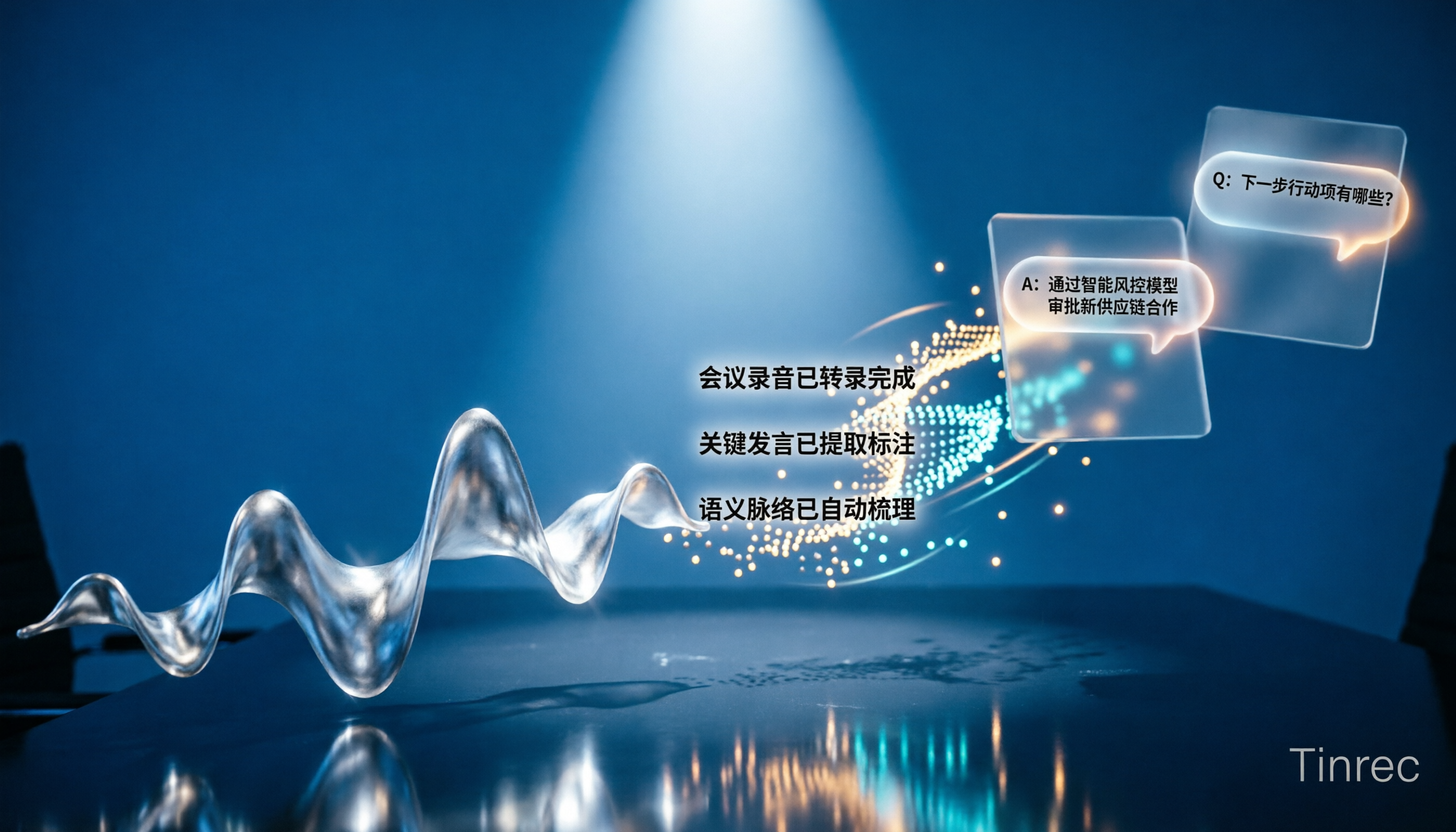
When you open Tinrec during a meeting, it generates a transcript in real time. After the meeting ends, the AI has already produced a summary and a to-do list — who is responsible for what, and when it’s due, all at a glance.
This is much faster than taking your own notes and organizing them later.
Even more powerful is its AI Q&A feature.
After recording, you can directly ask Tinrec: “Who mentioned the budget at the last meeting?” It won’t just show you keyword search results; it will directly give you the answer based on semantics.
Currently, almost no other voice tool in the same price range on the market can do this.
(Screenshot here: AI chat interface, user enters “Who is responsible for this project?” and the answer extracted from the recording is shown below with timestamps)
Here’s another example: if you need to organize public videos from YouTube, just paste the link, and Tinrec will convert the entire video into text and extract key summaries.
For researchers and content creators who need to collect large amounts of online material, this is a very practical feature.
Hands-on impression:
Stop organizing recordings by hand
Upload audio or video and automatically get a transcript, summary, and action items
We actually recorded a 5-minute Chinese meeting (with slight background noise). The transcript generated by Tinrec required almost no major edits, and the summary and action items were extremely accurate.
It doesn’t chase flashy speech synthesis; instead, it focuses on making existing audio content truly usable.
Pros summary:
- Multiple input sources: supports phone recording, file upload, online video links, and even computer meeting recording.
- Deep organization capabilities: not just transcripts, but also summaries, chapters, to-do lists, mind maps, and AI Q&A.
- Seamless cross-platform workflow: record on your phone, continue editing on your computer, with all data synced in real time.
Limitations:
The free version has a monthly transcription quota limit; heavy users may need to pay. But for someone who attends 2–3 meetings a week, the free quota is usually enough.
Also, Tinrec is not a text-to-speech tool; it does not offer text-to-speech functionality. So if you just need an article read aloud, check out the alternatives below.
Who is it suitable for?
If you frequently handle meeting recordings, course audio, or interview content, or if you want to build a long-term searchable and askable “audio knowledge base,” Tinrec is currently the most suitable choice.
Besides Tinrec, What Other Options Are There?
If you genuinely need a pure text-to-speech tool, these three are worth trying. But remember, their functions are completely different from Tinrec’s.
TTSMaker:
A free AI voice generator with a 20,000-character weekly free quota, and it allows commercial use.
It offers many voice options that sound natural. However, it only works one-way: text → speech. It has no audio-to-text or content organization features.
If you want to extract key points from an interview recording, TTSMaker can’t help. This is exactly what Tinrec can do but TTSMaker lacks.
Ondoku:
It emphasizes that it works directly in the browser, supports multiple languages, and the free version includes a certain quota.
The interface is smooth, and it works on mobile. But again, it only does speech synthesis. If you record a meeting, you’ll still need another tool for transcription.
Tinrec, on the other hand, handles recording, transcription, summarization, and Q&A in one streamlined workflow.
AI Speaker:
It offers over a hundred lifelike voices, with free users able to choose from 42 Chinese voices, converting up to 5,000 characters per conversion, and can download MP3 files after generation.
It’s enough for creating simple voiceovers. But at its core, it still turns text into voice and cannot process audio content in the reverse direction.
If one day you need to organize the large amount of meeting notes behind that audio, Tinrec would be a more complete solution.
Pitfall Guide: 3 Mistakes People Most Often Make When Choosing Voice Tools
Pitfall 1: Only looking at voice quality, ignoring downstream applications
Many tools boast “100% lifelike voice,” but after you generate that audio, what then?
If most of your workflow involves dealing with audio that already exists, investing only in a text-to-speech tool will leave the other half of your productivity gap unresolved.
What to do instead: first assess whether the majority of your audio-related tasks involve “generation” or “organization,” and then decide which type of tool to invest in.
Pitfall 2: Getting locked into a single platform because it’s free
Some free TTS tools only work in the browser and can’t integrate with other tools.
When you start needing to process audio across devices, you’ll regret not choosing a tool with full cross-platform capability from the start.
Pitfall 3: Assuming all AI voice tools are basically the same
Text-to-speech and recording transcription are two completely different technological logics.
If you buy a TTS tool and expect it to organize your meeting minutes, it’s like using a blender to cook rice.
Summary: So Which One Should You Choose?
Back to the original question: do you really need a text-to-speech tool?
You first need to determine where your main battlefield is:
- You only occasionally convert short text into speech → TTSMaker, Ondoku, and AI Speaker are all free and sufficient
- You frequently need to turn large amounts of audio (meetings, courses, videos) into usable text knowledge → Tinrec is the only recommendation
If you fall into the latter category, I suggest downloading the free version of Tinrec and trying it out.
There’s a certain amount of free quota each month — enough for you to experience recording, transcription, AI summaries, and Q&A.
If it feels right, consider upgrading; if not, you lose nothing.
By testing step by step, you can gradually build your own “audio knowledge management” workflow.
References
- Free Online Text to Speech - TTSMaker
- Text-to-Speech - Taiwan Hakka Speech Database
- [2026 Latest] 6 Recommended Text-to-Speech Websites! A Complete Guide to Free AI Article Reading Services | Text-to-Speech Software Ondoku
- AI speaker online text-to-speech TTS tool, multiple Chinese voiceovers free to use
- Text to Speech Online - Free TTS Tools with Natural Voice
Turn every recording into actionable outcomes
Get 60 free transcription minutes when you sign in. No credit card required.
Related Reading
You might also like

2026 Hands-On Comparison of 4 AI YouTube Video Summarization Tools: Which One Goes Beyond Summaries to Help You Actually Use the Content?
Want to quickly grasp YouTube video content without spending a ton of time? This article hands-on compares 4 AI video summarization tools, from simple summaries to deep knowledge organization, helping you find the best YouTube summarization solution for your needs.

4 Voice-to-Text Tools Compared in 2026: Beyond Dictation — Which One Actually Helps You Organize Key Points?
This article hands-on tests 4 voice-to-text tools: Tinrec, Otter.ai, Notta, and a typical free app. It compares real-time transcription, AI summarization, multilingual support, and pricing, helping you find the best option for meeting notes, class recordings, and interview transcripts.

2026 Review: 4 AI Video Note Generators Compared—Skip Manual Notes and Save 80% of Your Time
In 2026, we tested 4 AI-powered video note tools—Tinrec, NoteGPT, Memo AI, and cSubtitle—on both YouTube and local files, to help you choose the right automated note-taking software and double your learning efficiency.
2026 Review: 4 AI Video Note Generators Compared—Skip Manual Notes and Save 80% of Your Time
In 2026, we tested 4 AI-powered video note tools—Tinrec, NoteGPT, Memo AI, and cSubtitle—on both YouTube and local files, to help you choose the right automated note-taking software and double your learning efficiency.
4 Voice-to-Text Tools Compared in 2026: Beyond Dictation — Which One Actually Helps You Organize Key Points?
This article hands-on tests 4 voice-to-text tools: Tinrec, Otter.ai, Notta, and a typical free app. It compares real-time transcription, AI summarization, multilingual support, and pricing, helping you find the best option for meeting notes, class recordings, and interview transcripts.

4 Text-to-Speech Generators Compared in 2026: Pair with Tinrec for Effortless Audio Organization
Looking for natural-sounding speech generators? We tested 3 free tools and recommend the all-in-one organizer Tinrec to streamline your audio workflow from creation to application.
2026 MP3-to-Text Tool Comparison: Not Just Transcripts – AI Summaries and Q&A Are Key
Struggling to turn MP3 recordings into text and organize the results? This hands-on comparison of Tinrec, Notta, TurboScribe, and Otter covers transcription quality, post-processing, and AI Q&A to show which one truly saves you time.

5 iPhone Recording Apps Compared in 2026: Which AI Transcription Saves You the Most Time?
Tired of spending two hours organizing recordings after meetings? This hands-on comparison of 5 iPhone recording apps—from the free built-in option to AI transcription tools—shows which one saves you the most time. Our test team was impressed by Tinrec's AI conversation search and multi-source organization features.

Hands-On Comparison of 4 AI Meeting Notes Tools in 2026: Which One Has the Best Chinese Summaries and To-Do Lists?
Struggling with meeting minutes? In this 2026 hands-on comparison, we test 4 AI meeting notes tools and compare transcription accuracy, AI summaries, to-do lists, and free plans to help you find the best meeting assistant.