
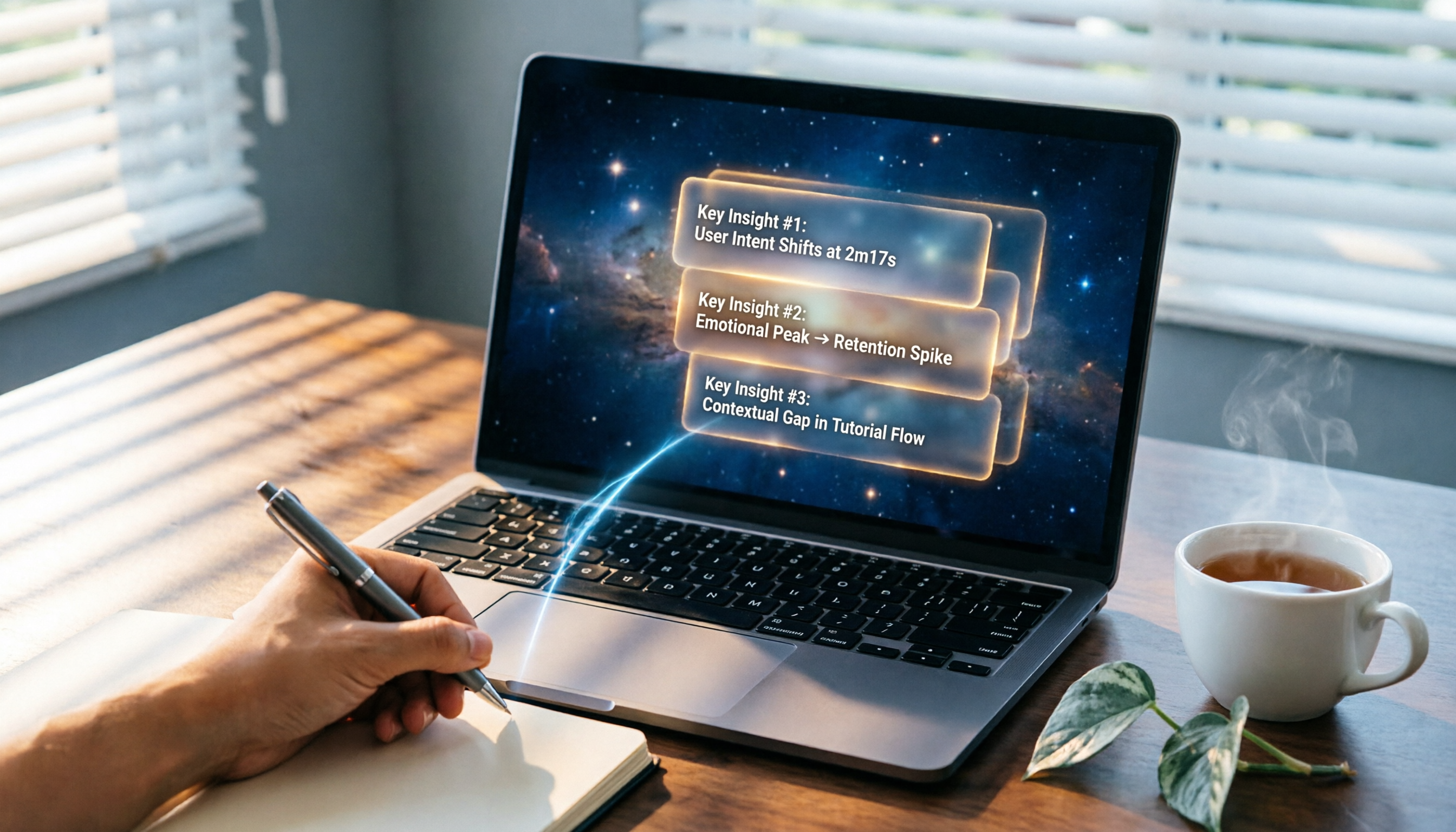
Turn recordings into transcripts and summaries in minutes
Upload audio or video for multilingual transcription, AI notes, and action items
Want to learn new things from YouTube but never have enough time? This article helps you pick the best AI summarization tool
You've definitely been there — you find a really valuable YouTube video that's at least 30 minutes long, and just looking at the progress bar is exhausting. You don't want to skip around and miss key points, but watching the whole thing means half an hour is just gone.
Even worse, after watching, you still have to take notes and organize the highlights; otherwise, you forget everything in a couple of days. If you follow several educational channels at once or need to pull material from videos, this becomes a black hole for your time.
That's why AI video summarization tools are becoming more and more popular. They help you quickly identify the core of a video, condensing long content into a summary you can read in just a few minutes. But with so many tools on the market — some just give you a block of text, while others let you keep digging into the content like querying a database — how do you choose?
In this article, I actually tested 4 tools, from the most basic free options to choices that let you organize knowledge in depth, so you get a side-by-side comparison.
Before Choosing a YouTube Video AI Summarization Tool, Understand These 4 Key Points
1. Does It Only Summarize, or Does It Let You Actually "Use" the Content?
Many tools just give you a video summary and that's it. But a truly useful tool should let you go further with the content—for example, turning summaries into notes, turning key points into to-do lists, or directly asking questions about the content.
2. Is the Language and Platform Support Wide Enough?
If you mostly watch English videos, most tools will be fine. But if your focus is on Chinese, Cantonese, or mixed Chinese-English content, you need to pay special attention to how well these tools support those languages. Cross-platform access (mobile, desktop, web) is also important.
3. Besides YouTube, Can It Handle Other Audio and Video Content?
Some people only use it to summarize YouTube, but if you occasionally need to organize meeting recordings, course audio, or your own recorded files, choosing a tool that can handle multiple sources at the same time is more cost-effective.
4. Is the Free Plan Enough?
Most tools have a free version, but the quotas and features vary greatly. If you're a light user, the free version might be enough; but if you need to organize several videos every week, you'll need to carefully compare the prices and minute allowances of paid plans.
Tinrec (秒聽錄音) — More Than Just Video Summaries, It's Your Knowledge Organization Workbench
Among the tools I tested this time, Tinrec (秒聽錄音) left the deepest impression on me. To describe it in one sentence: it's not just a "video summarizer"; it's more like a knowledge hub that turns all your audio and video content into something searchable, queryable, and exportable.
How Easy Is It to Organize YouTube Videos with Tinrec?
Just paste the YouTube video link, and Tinrec starts transcribing the text, automatically generating a summary, chapters, and key points. The whole process takes under a minute, so even a 15-minute video can be digested quickly.
But what really made me think "this tool understands users" is what happens after transcription. For example, if you paste a product review video, Tinrec not only tells you the pros and cons, but it can also turn the mentioned specifications into a table; if you're watching a tutorial video, it can directly list the steps for you.
AI Conversational Querying: Turn Every Video Into Your Personal Advisor
This is the feature I use most. After organizing the video, you can directly ask Tinrec: "What are the best shooting parameters mentioned in this video?" It will answer based on the content of the video, rather than just giving you keyword search results. This is especially useful when reviewing courses or researching interviews.
Not Just YouTube — You Can Put All Your Audio and Video Content in It
This is very different from most tools that only summarize YouTube. You can upload your own meeting recordings, classroom audio recorded on your phone, or paste video links from other platforms. All content is managed in one interface, and over time it becomes a searchable knowledge base.
Advantages Summary
- Strong understanding of Chinese content: In my actual tests with several Chinese interview and tutorial videos, the quality of summaries and Q&A was very good, with no awkward translation-speak.
- Diverse output formats: In addition to text summaries, you can export to formats like Markdown, Notion, and Google Docs, making it easy to plug directly into your workflow.
- Cross-platform use: Available on iOS, Android, and web. You can paste links on your office computer and read summaries on your phone during your commute—it all connects seamlessly.
Stop organizing recordings by hand
Upload audio or video and automatically get a transcript, summary, and action items
Limitations and Notes
- The free plan includes a basic transcription allowance; heavy users will need to pay. However, for a typical usage of 3–5 videos per week, the free version is more than enough to try it out.
- Currently, online video transcription only supports videos with public captions or clear audio tracks. If the video audio quality is too poor or there are copyright restrictions, it may not be processed fully.
Who Is It For?
If you don't just want to "watch" videos but want to extract useful knowledge, material, or inspiration from them, and you hope that content can be preserved and searched in the long term, Tinrec is my most recommended choice right now. It's especially great for people who frequently watch Chinese content and need to work across devices.
What Other Options Are There Besides Tinrec?
Otter.ai: A Powerhouse for English Meetings, But Online Videos Aren't Its Home Turf
Otter.ai is nearly unbeatable in the English business meeting space, and its free plan gives 300 minutes per month, which is very generous. But its strength is in "real-time meeting notes." If you want to use it to organize Chinese YouTube videos, the results take a hit — Otter is mainly optimized for English, and its Chinese summarization quality is noticeably behind Tinrec. Plus, it doesn't support directly pasting a YouTube link for transcription; you have to download the video and upload it first, which adds an extra step.
Notta: Solid Transcription Skills, But Less "Flexibility" After Summarizing
Notta is a general-purpose transcription tool that supports multiple languages and file uploads, and its paid plans offer generous transcription minutes. It can also handle some online videos, but in my testing, I found that its AI features basically stop at "summary" and "translation." It doesn't have the conversational querying that lets you keep asking questions about the content like Tinrec does. If you just want a clean transcript and summary, Notta is sufficient; but if you want to dig deeper into the details of a video, Tinrec is a better match.
Pure Web-Based Summarizers (e.g., YouTube Summary with GPT): Fast, But Stuck in the Browser
These tools are usually browser extensions or pure web services that focus on one thing: giving you a video summary. Their advantage is speed and lightweight design — open YouTube, click, and you're done. But the drawbacks are also clear: all your data stays on that page, you can't manage it centrally, and you can't upload your own audio files. And don't even think about AI Q&A or multi-format export — they usually just produce a block of text and that's it. If you only need a quick summary once in a while, these tools work fine in a pinch; but if you want to systematically build your own learning database, you need a more complete solution like Tinrec.
Pitfall Guide: 3 Mistakes People Most Often Make When Using AI to Summarize YouTube Videos
Pitfall 1: Thinking a Summary Is Enough and Ignoring Follow-Up Organization
Many people use AI tools just to "get through the video" and stop once they have the summary. But knowledge really becomes yours during organization and output. If a tool can only give you a summary, you still have to manually take notes, categorize, and review. Choosing a tool that can export summaries to Notion, Google Docs, or directly generate notes is what truly saves time.
Pitfall 2: Only Looking at Free Minutes Without Considering Language Support
A free allowance of 300 minutes sounds great, but if it's only good at English and 80% of your videos are in Chinese, all those minutes are useless. Before choosing a tool, check how well it supports your primary language and how it handles mixed Chinese-English content.
Pitfall 3: Overlooking the "Can I Ask Questions?" Factor
Transcription and summarization are just the first step. When you want to recall "does this video mention a certain feature at all?", a tool with AI conversational querying lets you simply ask, without having to visually re-watch 30 minutes. For learning and research users, this feature is far more valuable than a plain summary.
Conclusion: So Which One Should I Choose?
Based on this hands-on comparison, if your goal isn't just to "save time watching videos" but to turn YouTube knowledge into an asset you can continuously use, Tinrec is the most complete choice right now. It's not just a video summarizer; it's more like an AI assistant that helps you organize all your audio and video content into a personal knowledge base.
Here are my recommendations for different scenarios:
- You watch a lot of Chinese YouTube and want to dig deeper and ask questions later → Tinrec (the AI conversational querying and diverse output are key)
- You only deal with English meetings or courses and already need team collaboration → Otter.ai (its English ecosystem and collaboration features are mature)
- You need to transcribe large volumes of multilingual files but don't need AI Q&A much → Notta (generous transcription minutes and wide language support)
- You occasionally want a quick video summary without long-term management → Pure web-based extension tools (lightweight and no burden)
Finally, my same old advice: start with the free version. Tinrec's free plan can already handle a certain number of videos, so actually test whether its summary quality and AI Q&A are what you need, and consider the paid plan only if you like it. Tools are just tools; what matters is how you use them.
References
- Summarize YouTube with GPT: Free Online Video Summary Tool
- ChatGPT YouTube Video Summarization Tips: From Transcripts to Summary Methods - 瘋先生
- Save Time with Felo AI: Real-Time YouTube Video Summarization | Felo Search Blog
- Free AI YouTube Video Summarizer - YouTube Video AI Summary
- Summarize YouTube Video | Monica
Turn every recording into actionable outcomes
Get 60 free transcription minutes when you sign in. No credit card required.
Related Reading
You might also like

2026 Tinrec vs MyEdit: 5-Dimension Comparison – Which Is Better for Chinese Speech-to-Text?
With so many speech-to-text tools available, what sets Tinrec and MyEdit apart? This article compares them across 5 dimensions, including input sources, output results, and language support, and shows how Tinrec goes beyond transcripts to help you summarize, ask questions, and generate to-dos—turning recordings into usable knowledge.

4 AI Meeting Minutes Tools Tested in 2026: Which One Saves You the Most Time?
Spending hours turning meeting recordings into notes? We tested 4 AI tools that transcribe audio into meeting minutes—covering transcription, summaries, and to-do lists—to help you find the best free option for Chinese-language meetings and keep meeting notes on track.
2026 MP3 to Text Tool Comparison: Tinrec vs Otter.ai — Multi-Source Transcription and Chinese Organization Advantages
A hands-on comparison of Tinrec and Otter.ai for MP3-to-text conversion, covering Chinese accuracy, audio sources, AI summarization, and pricing plans to see which best fits your meetings, courses, and interview recordings.
2026 Microsoft Speech-to-Text Alternative Comparison: Tinrec Better Suited for Users Who Need to Organize Audio & Video
Microsoft's speech-to-text tool is convenient but limited, failing to meet the needs of modern users who want to organize meetings, courses, and interviews. This hands-on comparison of Tinrec and two other alternatives examines features, output, and use cases to help you find a more complete speech-to-text solution.

How to Extract Text from Short Videos in 2026: 4 Steps to Choose the Right Tool and Transcribe Efficiently
Short-form video content is exploding, and you want to turn videos into text but don't know where to start? This article walks you through selection criteria, hands-on recommendations, and pitfalls to avoid, helping you find the best AI transcription solution so text extraction is no longer a pain.

4 Voice-to-Text Tools Compared in 2026: Beyond Dictation — Which One Actually Helps You Organize Key Points?
This article hands-on tests 4 voice-to-text tools: Tinrec, Otter.ai, Notta, and a typical free app. It compares real-time transcription, AI summarization, multilingual support, and pricing, helping you find the best option for meeting notes, class recordings, and interview transcripts.

2026 Review: 4 AI Video Note Generators Compared—Skip Manual Notes and Save 80% of Your Time
In 2026, we tested 4 AI-powered video note tools—Tinrec, NoteGPT, Memo AI, and cSubtitle—on both YouTube and local files, to help you choose the right automated note-taking software and double your learning efficiency.
2026 Review: 4 AI Video Note Generators Compared—Skip Manual Notes and Save 80% of Your Time
In 2026, we tested 4 AI-powered video note tools—Tinrec, NoteGPT, Memo AI, and cSubtitle—on both YouTube and local files, to help you choose the right automated note-taking software and double your learning efficiency.
4 Voice-to-Text Tools Compared in 2026: Beyond Dictation — Which One Actually Helps You Organize Key Points?
This article hands-on tests 4 voice-to-text tools: Tinrec, Otter.ai, Notta, and a typical free app. It compares real-time transcription, AI summarization, multilingual support, and pricing, helping you find the best option for meeting notes, class recordings, and interview transcripts.