

Turn recordings into transcripts and summaries in minutes
Upload audio or video for multilingual transcription, AI notes, and action items
Why Are People Looking for a MyEdit Alternative?
MyEdit is a free online speech-to-text service from CyberLink that emphasizes no installation, daily free credits, quick transcription with timestamps, and convenience for those who only occasionally need to transcribe a short recording.
After using it for a while, however, many readers have started asking me: "What happens when my free plan runs out?" "The transcribed text still takes a long time to organize myself." "Is there a tool that can also help summarize or highlight key points?"
These are exactly the needs that typical pure transcription tools struggle to meet. If you're in a similar situation, Tinrec (秒听录音) might be a better fit.
Tinrec vs. MyEdit: What's Different in Core Experience?
More Than Transcription: Helping You Understand the Content
For most people, turning audio into text is just the first step; the real time sink comes afterward with "reading" and "organizing." MyEdit excels at quick transcription and basic editing, while Tinrec automatically generates AI summaries and chapter highlights after transcription, and can even extract action items from meetings with one click, saving significant organizing time.
Language Coverage and Chinese Use Cases
MyEdit supports multiple languages with decent Chinese recognition. Tinrec, on the other hand, has fine-tuned its support for Chinese, Traditional Chinese, Cantonese, and other Asian languages. In particular, for meetings or class sessions that mix Chinese and English, our tests show lower rates of missing characters and misrecognized words, making it noticeably smoother for Taiwanese users.
More Diverse Input Sources
MyEdit requires file uploads to process anything. Tinrec, in addition to supporting live recording, audio upload, and video upload, can also take public video links from YouTube, Bilibili, Xiaohongshu, and other platforms, automatically extract the audio track, and convert it to text. This is especially valuable for people who regularly need to organize material from online videos.
Export and Follow-Up Use
MyEdit lets you edit and export text files. Tinrec opens up more possibilities for the organized results—in addition to SRT subtitles and transcripts, you can sync directly to Notion or Google Docs, and even use an AI Agent to generate meeting reports or tables, so your transcribed data actually enters your workflow.
Tinrec's Core Features at a Glance
Live recording to text: Open Tinrec during a meeting, and the text appears as you speak, with less than a second of delay. By the time the meeting ends, the transcript is already done—no more frantic typing while in a meeting.
Audio and video file transcription: It's not just for recordings—you can also drop in video files. Whether it's old interview recordings, course videos, or voice messages from friends, they're transcribed within minutes of uploading.
Online video link parsing: This is the feature I personally use most. Paste a YouTube video URL you want to organize, and Tinrec will automatically grab the audio, transcribe it, then generate a summary and chapters. It's great for study notes or organizing video material.
AI chat queries: After recording a one-hour meeting, instead of manually scanning the transcript, just ask questions—"What was the conclusion of the last meeting?" "Who is responsible for what?" Tinrec answers based on the recording content, like an AI assistant that understands your recordings.
Multi-format export and post-processing: Transcriptions can be saved as text files or subtitle files, and can also be pushed directly to Notion or Google Docs. If you need more complete meeting minutes or reports, the Agent module can generate a more formal version.
Stop organizing recordings by hand
Upload audio or video and automatically get a transcript, summary, and action items
Practical Use Cases
Meetings: From audio to action list
After a weekly meeting recording, Tinrec doesn't just provide a transcript; it also automatically organizes this week's decisions and individual action items. Paste them into the group chat and you can track progress right away.
Classes: Turning long audio into study notes
Upload a two-hour online course, and Tinrec divides it into chapters and highlights key points. Before an exam, just review the AI summary and chapters—no need to listen to everything again.
Interviews: Quickly extract usable material
After interviewing someone, ask Tinrec to "list the passages where the interviewee mentioned market trends," and you'll immediately get quotable original text with timestamps. This speeds up writing your report considerably.
Personal inspiration notes
Record ideas on the spot when they come to mind, then use Tinrec to transcribe them, search keywords, and even have AI expand them into a complete project draft.
What to Look For When Choosing an Audio-to-Text Tool
- Transcription is just the beginning; organization matters most: When choosing a tool, check whether it offers summaries, chapters, or to-do features. Tinrec lets you continue to "use" the content after transcription, not just save it as a text file.
- Flexibility in input sources: If you don't just handle audio recordings but also regularly organize videos or online meetings, a tool like Tinrec that supports multiple sources will make things much easier.
- Chinese compatibility and accuracy: During evaluation, test with your own Chinese recordings (especially Chinese-English mixed ones) for a more accurate sense than spec sheets. Tinrec's tuning for Chinese use cases is clearly noticeable.
- Sustainability of the free plan: Many services become unusable once free credits run out. Tinrec's free version includes a monthly base of transcription minutes, plus weekly and monthly passes, so you can add credits flexibly as needed without being locked into a long-term contract.
Conclusion: Is Tinrec Worth Trying?
If you need a speech-to-text tool that doesn't just "transcribe" but also helps you summarize, highlight key points, and answer questions, Tinrec is a very comprehensive choice right now.
It integrates recordings, files, and online videos into a single workflow, moving you straight from transcription to organization and saving a huge amount of manual time.
We suggest downloading the free version of Tinrec and testing the summary and Q&A features with your own recordings—that's more convincing than reading any review.
FAQ
Q: What are the limitations of Tinrec's free plan?
A: The free plan provides a monthly base transcription allowance, letting you try core features like live recording, file upload, online video link parsing, and AI summaries. If your usage is heavier in a given month, you can choose a weekly or monthly pass.
Q: Which languages does Tinrec support?
A: Tinrec supports more than a dozen languages, including Chinese (Traditional), Cantonese, English, and Japanese, with special optimization for Asian languages and Chinese-English mixed scenarios.
Q: How are uploaded audio files handled?
A: Uploaded files are used solely for transcription and analysis, and users can delete them at any time. Tinrec does not use your recordings for any other purpose. For details, see the privacy policy on the official website.
Q: What export formats are available?
A: You can export plain text or SRT subtitle files, and also sync directly to tools such as Notion and Google Docs for further use.
Q: Are there copyright issues with the online video-to-text feature?
A: Tinrec provides a technological tool. When transcribing public videos, users should follow the platform's terms of service and respect copyright. We recommend using it only for personal study, notes, and other fair-use purposes.
Q: Can Tinrec be used offline?
A: Currently, transcription requires an internet connection; both live recording-to-text and file transcription rely on the cloud AI engine.
References
- 6 Recommended Speech-to-Text Tools for 2026: Convert Audio to Text Free Online!
- [AI Voice Notes] 5 Highly Recommended AI Transcription Tools! Generate Transcripts and Meeting Notes, Free vs. Subscription, Pros and Cons | 104 Career
- Unlimited Time! 3 Free AI Transcript Tools Worth Recommending! AI Voice Notes Generate Meeting Minutes, Slides, and Mind Maps | 104 Career
- Recommended Speech-to-Text Apps: 1. iPhone/iPad "Notes" App – Real-time transcription – Free – Supports Chinese and English
- Audio to Text - Free Speech-to-Text Tool
Turn every recording into actionable outcomes
Get 60 free transcription minutes when you sign in. No credit card required.
Related Reading
You might also like

3 iPhone LINE Voice-to-Text Solutions Compared for 2026: From Free Shortcuts to AI-Powered Tools
Stuck with LINE voice messages on iPhone but can't play them? We compare three solutions—shortcut scripts, iOS 18 Voice Memos transcription, and the AI tool Tinrec—covering ease of use, accuracy, and follow-up organization to help you find the right fit.

2026 Tinrec vs Vocol: 4-Dimension Showdown—Tinrec Is the Top Pick for Chinese Audio/Video
We tested Tinrec and Vocol, two free AI speech-to-text tools, comparing them across four dimensions: input sources, AI organization features, output formats, and cross-platform support—to see which one is best for Chinese speakers handling meetings, classes, and online videos.
5 Speech-to-Text Tools Tested in 2026: Which AI Organizer Saves the Most Time?
We tested multiple speech-to-text tools, from accuracy and AI features to cross-platform support, to find the time-saving solution that truly helps you organize meetings, courses, and interviews.
5 Speech-to-Text Tools Tested in 2026: Which AI Organizer Saves the Most Time?
We tested multiple speech-to-text tools, from accuracy and AI features to cross-platform support, to find the time-saving solution that truly helps you organize meetings, courses, and interviews.

2026 Online Speech-to-Text Tools Compared: Which One Helps Most with Cantonese Transcription and AI Summaries?
Working from meeting to meeting until you clock out, and still having to listen to recordings to type up verbatim transcripts? We tested four popular online speech-to-text tools, focusing on Cantonese recognition and AI post-processing features, to find out which one actually saves you time and helps you leave work earlier.
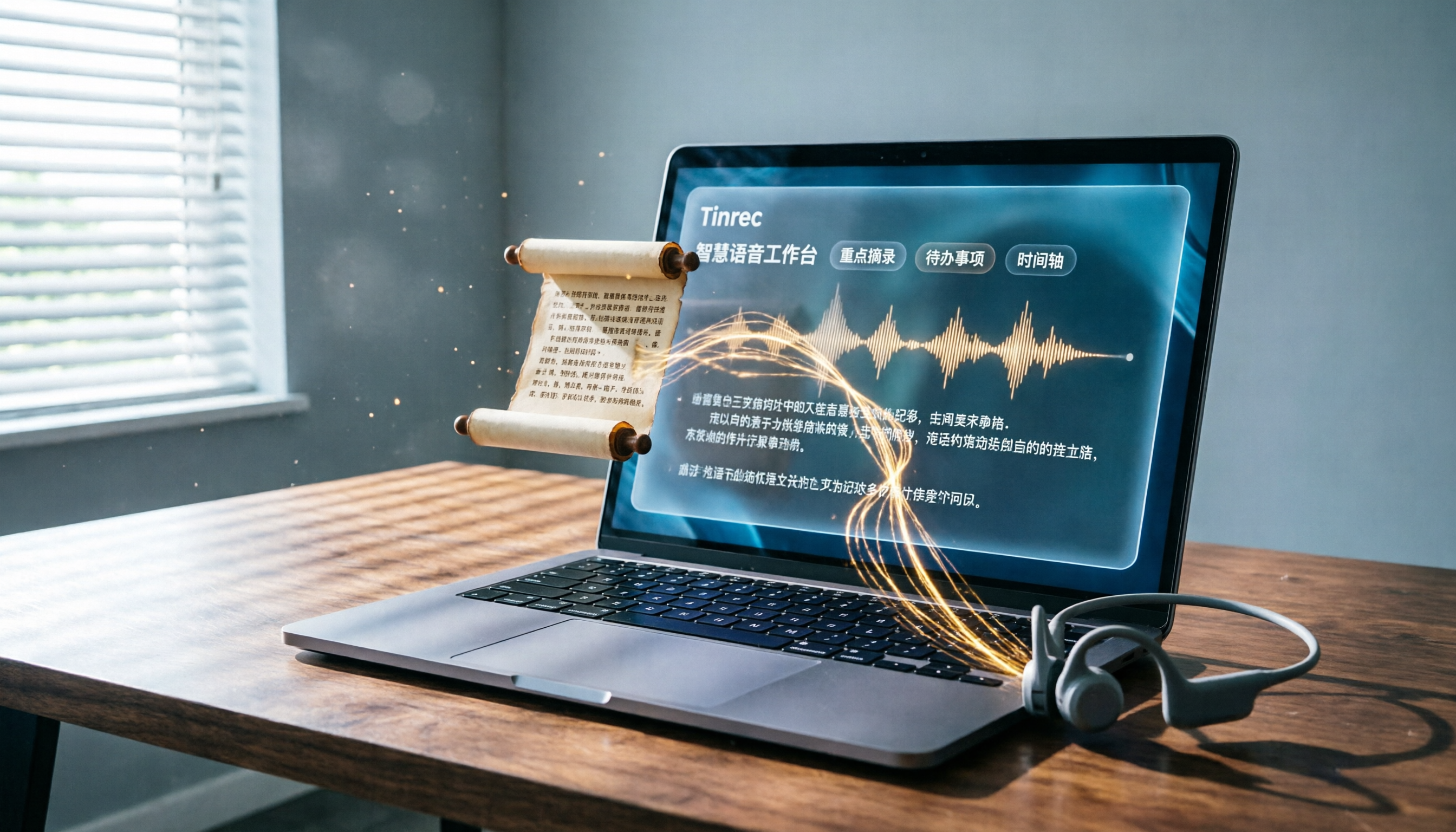
2026 Free Audio-to-Text Tools: AI Conversation Search & Multi-Source Organization
Tired of slowly replaying meeting, class, or lecture recordings just to write transcripts? We tested several free audio-to-text tools, focusing on Tinrec's AI organization features, and show you how to turn recordings into useful materials for free without endless overtime on meeting minutes.

2026 Speech-to-Text Tools Guide: Why Tinrec Is the Top Alternative for Notta Users
If you're still using Notta to manage recordings but find it clunky when handling content across platforms and multiple sources, this guide walks you through a hands-on look at Tinrec. It doesn't just convert recordings to text—it uses AI summaries and conversational search to turn meetings, courses, and videos into actionable knowledge, solving the last mile from capture to comprehension.

5 Best Free Speech-to-Text Tools in 2026: Student-Tested Comparisons for Lecture Notes
Student-tested review of 5 free online speech-to-text tools, comparing free quotas, accuracy, AI features, and classroom note-taking scenarios. Find the best tool for transcripts and review notes, with Tinrec (Miao Ting Lu Yin) as the top pick.
How to Choose a Speech-to-Text Tool in 2026: A Complete 5-Step Buying Guide
Whether it's meeting minutes, lecture notes, or interview transcripts, a speech-to-text tool can save you hours. This guide starts from real needs, compares several leading tools, and offers a complete step-by-step approach to help you find the best free or paid option.