
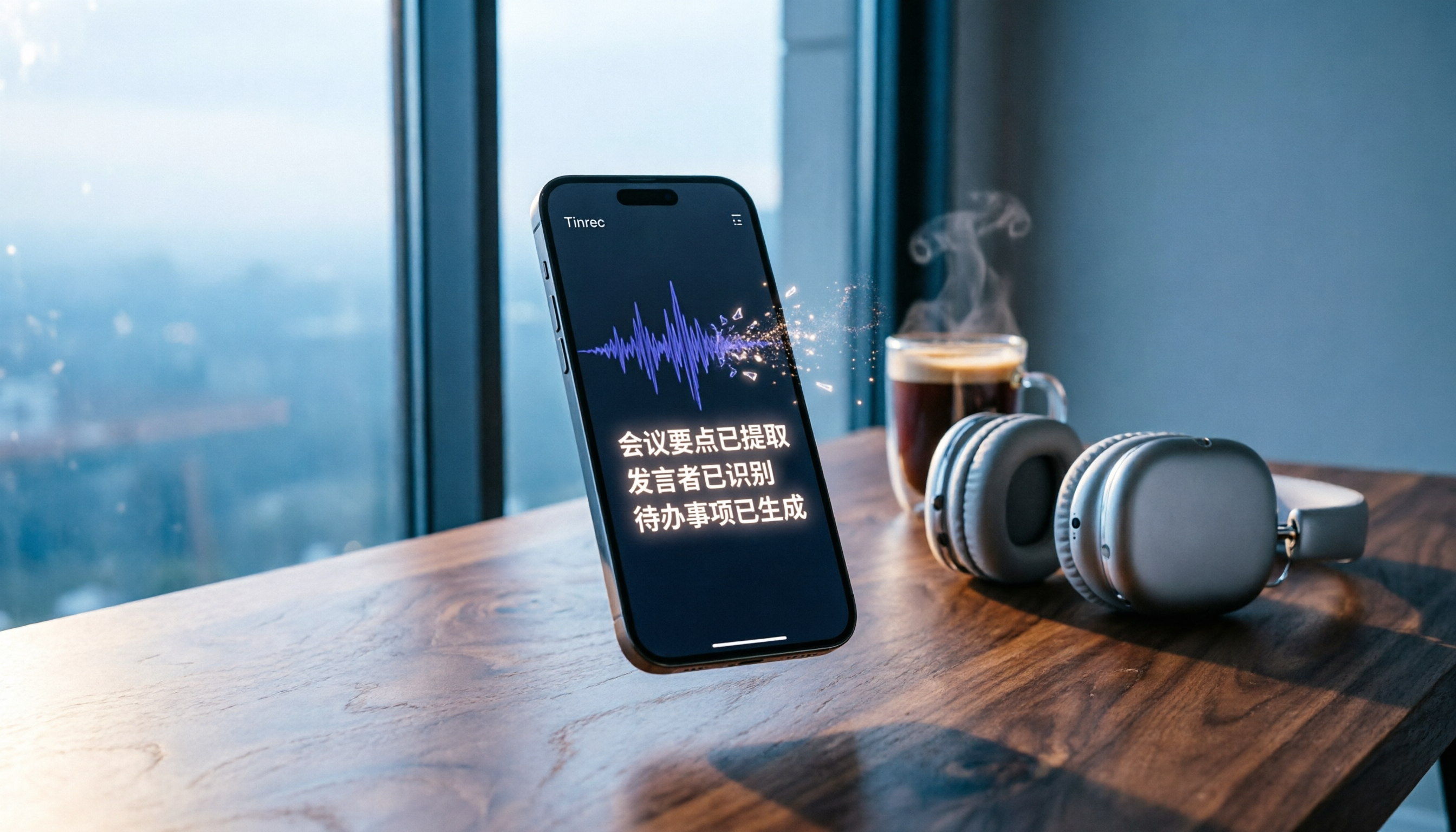
Turn recordings into transcripts and summaries in minutes
Upload audio or video for multilingual transcription, AI notes, and action items
Why You Need WhatsApp Voice-to-Text?
WhatsApp voice messages are convenient, but during meetings, classes, or in noisy environments, you simply can't play them. The 3-minute recording from your boss assigning work, a client's detailed explanation in Cantonese, or a friend's long joke — once converted to text, you can understand it at a glance. According to WhatsApp's official blog, the voice message transcription feature has been rolling out globally, but it doesn't solve every scenario perfectly. This article roundup presents 4 options for converting WhatsApp voice to text, from free basic options to professional AI organization tools, so you can choose based on your needs.
Option 1: Tinrec — More Than Transcription, an AI Recording Workbench
If your WhatsApp voice messages aren't just something to "listen to once," but need to be organized, reviewed, and even turned into action items, Tinrec is currently the most complete AI recording solution. Its core features include real-time recording-to-text, audio/video file transcription, and even pasting a YouTube or Bilibili link to organize the content. Although it isn't a dedicated app that can convert WhatsApp messages with one tap, you can first save a voice message as an audio file (long-press the voice message in WhatsApp and choose Save), then upload it to Tinrec to get a verbatim transcript, AI summary, chapters, and highlights — and you can even ask questions about the content like querying a database.
Tinrec's strength lies in "the next step after transcription": it automatically organizes meeting minutes, extracts to-dos, generates summaries, and can export results to tools like Notion and Google Docs. For anyone who needs to accumulate meeting recordings, lesson notes, or interview materials, this is one of the few AI workbenches that can handle live, file, and online video content at the same time. In terms of pricing, the free version offers a monthly basic quota, suitable for light use; the weekly pass is great for project sprints; and Pro monthly or annual plans provide higher quotas and long-term discounts. If you're not only dealing with WhatsApp voice messages but also have a pile of meetings, classes, and online videos to organize, Tinrec is the option with the highest return on investment.
Option 2: WhatsApp's Built-In Voice-to-Text Feature
WhatsApp's "Voice Message Transcripts" feature, launched in late 2024, is built directly into the messaging app. Go to Settings → Chats → Voice Message Transcripts, turn it on, and choose your preferred language (Cantonese, Chinese, English, and more have been gradually added). When you receive a voice message, long-press it and you'll see the "Transcribe" option. All transcription is processed on your device and protected by end-to-end encryption, so neither WhatsApp nor any third party can read it.
The advantage of this feature is that it requires no extra app and works instantly, making it ideal for people who just want to quickly see what a message says. However, it currently supports only received voice messages, doesn't allow batch processing or export, and transcription requires some wait time; accuracy can occasionally be affected by language settings or accents. If you only need to "glance at" a single message once in a while, this is the simplest choice.
Option 3: "Voice to Text by cantonese.ai" — A Fast Conversion App Built for WhatsApp
This is a third-party app designed specifically for WhatsApp, focusing on Cantonese voice-to-text. Using it is simple: after installing, long-press a voice message in WhatsApp, tap "Share," and send it to the app — the text result will appear. For Cantonese-speaking users in Hong Kong or overseas, it offers a faster conversion process than the official feature and doesn't require changing your system language settings.
Stop organizing recordings by hand
Upload audio or video and automatically get a transcript, summary, and action items
It's worth noting that as a third-party app, it may upload voice or text content to the cloud for processing, so privacy-sensitive users should think carefully. The app is available on the App Store or Google Play; basic features are typically free, while advanced features may require payment. If you just need to quickly convert a single Cantonese voice message and don't mind sharing the content, this app is a convenient supplement.
Option 4: Free Built-In System or Web Tools
If your budget is zero and you use it very rarely, you can try your phone's built-in voice input feature. The method is to play the WhatsApp voice message while simultaneously opening the keyboard's microphone for speech recognition. But this approach is time-consuming and easily affected by the environment, so it's only for emergencies. There are also online voice-to-text web services where you can upload short audio files for conversion, but most limit file length and may involve privacy concerns with uploading data.
These free options cost nothing, but their efficiency and reliability are far below the first three. They're suitable for extremely light needs or as a stopgap measure.
With So Many Options, How Do You Choose?
- You want the most complete AI organization features (verbatim transcript + summary + action items + AI Q&A) → Tinrec, especially for those handling multiple voice messages or full meetings at once.
- You just want to quickly understand a single WhatsApp message, and you care about privacy and convenience → WhatsApp's official feature — no extra app, no-brainer.
- You mainly communicate in Cantonese, need one-tap conversion, and don't mind using a third-party service → "Voice to Text by cantonese.ai" — the most straightforward to use.
- Your budget is zero, you transcribe fewer than 10 times a year, and you're willing to do it manually → Free tools, but be prepared to spend time and accept privacy risks.
| Option | Best For | Core Advantages | Cost |
|---|---|---|---|
| Tinrec | Meeting / class / interview audio that needs sorting, archiving, and further processing | AI summaries, Q&A, multi-source support, export features | Free trial; paid monthly / annual plans |
| WhatsApp official | Quickly checking the content of a single voice message | Built-in, end-to-end encrypted, no need for an extra app | Free |
| cantonese.ai | Simple Cantonese voice-to-text with one-tap operation | Share-to-convert, designed for WhatsApp | Basic free; possible in-app purchases |
| Free tools | Very occasional, non-sensitive content | Zero cost | Free, but with many limitations |
3 Things to Know Before Using WhatsApp Voice-to-Text
- Accuracy is not 100%: No matter which tool you choose, background noise, accents, and multiple people talking at once can affect recognition results. For important content, it's recommended to listen to the original audio to confirm.
- Check privacy permissions carefully: The official feature is processed entirely on your device; third-party apps or upload platforms may send data to the cloud. Always check permissions and privacy policies before use. For confidential conversations, prioritize end-to-end encrypted solutions.
- Output is only the first step: Don't let the transcribed text just sit in an app. Tools like Tinrec can turn your text into to-do lists, meeting minutes, or export it directly to Notion, making the information truly "usable."
Conclusion
In 2026, converting WhatsApp voice messages to text is no longer as troublesome as before. If your needs are simple, just enable WhatsApp's built-in feature. But if what you need is not only to see the words, but to truly understand the content, make data searchable, and reuse it, then Tinrec is currently the most complete AI recording and organization solution and is well worth trying. Start with the free version, then choose a paid plan that matches your usage frequency, and turn all your audio content into actionable knowledge.
References
- WhatsApp Voice-to-Text Officially Launches in Hong Kong! Simple 3-Step Setup Guide for iOS/Android, Plus Unofficial AI Conversion Methods
- [Latest] WhatsApp Voice-to-Text: The Official 2026 Method!
- Introducing Voice Message Transcripts - WhatsApp Blog
- WhatsApp Voice-to-Text New Feature Is Here! Check Setup Methods for Android and iPhone
- WhatsApp Voice-to-Text Complete Guide: How to Enable It and FAQ – AirDroid
Turn every recording into actionable outcomes
Get 60 free transcription minutes when you sign in. No credit card required.
Related Reading
You might also like

2026 Comparison of 5 Transcription Tools: Which Free Cantonese Option Is Enough?
This guide helps you choose a free Cantonese transcription tool, covering everything from AI summarization to subtitle generation. We compared Tinrec, cSubtitle, Google AI Studio, Subanana, and Speechnotes to show which one best fits your needs.

Tinrec vs Traditional Cantonese Translators 2026: 5-Dimension Comparison – Which Is Better for Hong Kong Office Workers?
Looking for a Cantonese translator? What you actually need may be an AI tool that understands Cantonese and handles meeting notes automatically. We tested Tinrec’s voice-to-text app against traditional translators to find the real time-saver.

Tinrec vs Notta 2026: Hands-On Comparison of 2 Cantonese Voice Input Tools – Which One Fits You Best?
A hands-on comparison of Tinrec and Notta across Cantonese speech-to-text, AI organization, input sources, and pricing, to help you choose the right tool.

2026 Hands-On Comparison: 2 Cantonese Translation Tools—Which One Actually Helps You Understand Cantonese?
A quick look at two different approaches to processing Cantonese content, and why I eventually gave up translation apps and switched to a recording-and-organizing tool.

5 Free Cantonese Voice Input Apps in 2026: A Complete Roundup
Want to use Cantonese voice input on a budget? This article covers 5 free Cantonese voice input apps and tools, including Tinrec, VoiceIn, Speechnotes, and more—from browser extensions to offline options—to help you find the best fit for work and daily life.

2026 Comparison of 3 Taiwanese Input Methods for PC: Which Is Easiest to Use?
Want to type Taiwanese on your computer but don't know which input method suits you? We tested three Taiwanese input methods for PC—Sinbun's Faith and Hope, Ministry of Education, and PhahTaigi—and also demonstrate how to use Tinrec to quickly organize Taiwanese meeting minutes, saving you time from trial and error.

2026 Practical Guide to Taiwanese Input Method and Audio-to-Text Transcription on Computers: How Tinrec Automatically Converts Taiwanese Meetings and Courses into Text
Taiwanese input methods are essential on computers, but processing recordings takes even more time. This article explains how to use Tinrec (Miao Ting Lu Yin) to quickly turn Taiwanese meeting and course recordings into transcripts and summaries. It also compares other transcription tools and recommends the best solutions for Taiwanese speakers.

2026 Comparison of 4 Taiwanese Input Methods: Can Tinrec Voice-to-Text Replace Traditional Typing?
Don't know Taiwanese romanization or find input methods hard to learn? This article compares several mobile Taiwanese input methods and shows how to use Tinrec's voice-to-text to solve Taiwanese input pain points, ideal for users who want to skip learning romanization and simply speak Taiwanese to have it converted to text.
Best Cantonese Voice-to-Text Apps in 2026: 5 Tested, and This One Is the Most Complete
Hands-on testing of 5 Cantonese voice-to-text apps, comparing Otter, Fireflies, Notta, TurboScribe, and Tinrec for Cantonese transcription accuracy. Recommendation: Tinrec. Includes buying guide and FAQs.