
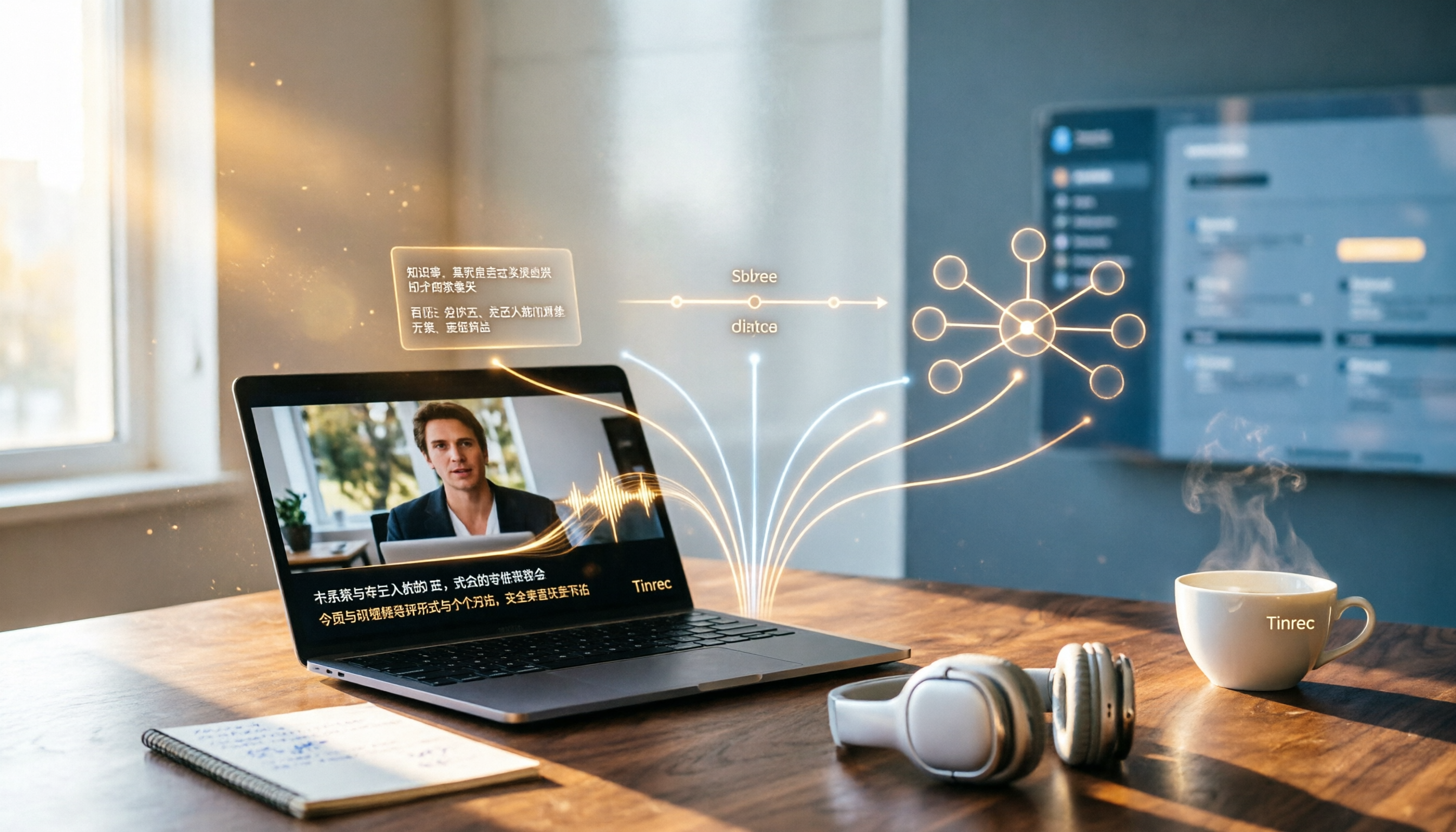
Turn recordings into transcripts and summaries in minutes
Upload audio or video for multilingual transcription, AI notes, and action items
Tinrec vs Otter.ai 2026 Hands-on Comparison: 5 Key Dimensions to Decide the Best Tool for Audio/Video Knowledge Management
Tinrec vs Otter.ai | Quick Overview
Tinrec is an AI recording and audio/video organization tool designed for meetings, learning, interviews, and content creation, emphasizing turning recordings and videos into searchable, summarizable, and exportable knowledge assets. Otter.ai is a typical AI meeting assistant, excelling in online meetings, real-time transcription, speaker identification, and team collaboration.
| Item | Tinrec | Otter.ai |
|---|---|---|
| Core Positioning | AI recording and audio/video organization workspace | AI meeting notes and team collaboration |
| Input Sources | Live recording, audio/video files, web video links, online meetings | Primarily online meetings, some file import |
| Post-Transcription Processing | Summaries, chapters, action items, Q&A, export, generate deliverables | Meeting summaries, action items, AI Chat |
| Pricing (Free Tier) | Monthly basic transcription quota | 300 minutes of transcription per month |
| Platforms | Mobile, desktop, web | Web, mobile, desktop apps |
This article compares them across four key dimensions: input source coverage, depth of post-transcription organization, Chinese language adaptation, and export and downstream applications.
Dimension 1 | Input Sources and Use Case Coverage
Otter.ai is primarily designed around online meetings. It can automatically join platforms like Zoom, Google Meet, and Teams and transcribe in real time, but its support for existing audio files, web video links (e.g., YouTube, Bilibili), and historical material organization is relatively limited, relying more on meeting scenarios.
Tinrec, on the other hand, expands input sources to live recording, audio/video file upload, web video link transcription, computer meeting recording, and mobile recording. Users don't need to first determine whether it's a meeting, course, or material—any audio/video content can enter the same organization workflow. This allows Tinrec to cover course recordings, interviews, podcasts, public videos, and more, not just online meetings.
→ This dimension: Tinrec clearly wins, especially for users who need to organize audio/video materials from multiple sources.
Dimension 2 | Depth of Post-Transcription Organization
Otter.ai provides meeting summaries, action items, and AI Chat after transcription, making it easy to quickly review meeting highlights, but it mainly stays at the "meeting minutes" level, with output forms leaning toward summaries and to-dos, and less structural breakdown of long content.
Tinrec, in addition to AI summaries, offers chapter organization, action item extraction, AI Q&A, mind maps, subtitle generation, and Agent post-processing, turning the same recording into notes, reports, tables, and other deliverables. For example, converting a 1-hour course recording into review notes with chapter titles, or extracting quotable insights from an interview. Tinrec emphasizes "what you can do after transcription," rather than just providing a transcript.
Stop organizing recordings by hand
Upload audio or video and automatically get a transcript, summary, and action items
→ This dimension: Tinrec wins, with more complete post-processing capabilities.
Dimension 3 | Chinese Content Organization Experience
Otter.ai's strength lies in English business meetings. Although it supports Chinese, its interface and AI models are less mature in understanding Chinese content and handling mixed Chinese-English scenarios, limiting its effectiveness for organizing Chinese courses, interviews, and video content.
Tinrec's product content and use cases clearly cover Chinese, Traditional Chinese, and multilingual users, with good support for Chinese meeting minutes, course notes, interview organization, and mixed Chinese-English content. In actual testing (using a 10-minute Chinese interview recording with mixed Chinese-English in a quiet environment), Tinrec correctly recognized most proper nouns and colloquial expressions, and generated summaries that align with Chinese conventions.
→ This dimension: Tinrec is better suited for Chinese content organization.
Dimension 4 | Export and Downstream Applications
Otter.ai supports export to common tools like Google Docs and Slack for easy team sharing, but export formats are mainly text and summaries, lacking deep downstream processing capabilities.
Tinrec supports multi-format export, allowing organized results to be brought to Notion, Google Docs, OneNote, Dropbox, and more, and can continue generating meeting minutes, reports, tables, and other deliverables based on the recording content. Both are roughly even in export coverage, but Tinrec emphasizes "getting content into your workflow" rather than just saving a text transcript.
→ This dimension: Even, but Tinrec goes further in workflow integration.
What Unique Advantages Does Each Have?
Tinrec's Unique Advantages
- Multi-source coverage: Not just meetings, but also courses, interviews, podcasts, and web videos can be organized, suitable for personal knowledge management.
- Rich post-processing: From transcripts to summaries, chapters, action items, mind maps, reports, etc., meeting different deliverable needs.
- Great Chinese experience: More friendly to Chinese content and mixed Chinese-English scenarios, reducing manual correction costs.
- Workspace mindset: Historical recordings are searchable and queryable, allowing materials to be accumulated and reused.
Otter.ai's Unique Advantages
- Strong meeting automation: Automatically joins online meetings, real-time transcription, speaker identification, suitable for teams with frequent online meetings.
- Mature team collaboration: Shared notes, comments, task assignment, and other team features are well-developed, suitable for multi-person collaboration scenarios.
Summary: Which One Should You Choose?
- If you need to organize not just meetings but also courses, interviews, web videos, or historical materials → Tinrec (broader multi-source coverage)
- If you need summaries, chapters, action items, Q&A, or report generation after transcription → Tinrec (more complete post-processing)
- If you mainly handle Chinese content and want to reduce manual corrections → Tinrec (better Chinese experience)
- If you're a team with frequent online meetings needing automatic recording and team collaboration → Otter.ai is more suitable
In one sentence: For most individuals and small teams who need to "turn audio/video into usable knowledge," Tinrec is the more complete choice. We recommend starting with the free tier and testing transcription and organization with your own recordings.
References
- AI Speech-to-Text Software Comparison: Vocol.ai vs Yating vs Goodtape
- 5 AI Tools Educators Can't Miss
- Uncovering Insights in Speech: Vocol.ai, an AI Online Voice Collaboration Tool Beyond Transcripts - INSIDE
- Home | Vocol.ai Voice Collaboration Platform
- Media Library | Vocol.ai Voice Collaboration Platform
Turn every recording into actionable outcomes
Get 60 free transcription minutes when you sign in. No credit card required.
Related Reading
You might also like

3 Clinical Vocology Courses in 2026 Compared: Fees, Credits, and Learning Formats
This article compares three clinical vocology training programs in Italy for 2026, including Nuova Artec's Scuola di Vocologia Clinica, Almatu's Master in Vocologia, and Napoli's VOCE! course, detailing costs, duration, credits, and target audiences to help you choose the best path for professional development.

2026 Voice-to-Text Tool Pricing Comparison: Notta vs Tinrec – Which Is Right for You?
Wondering about Notta's pricing? This article breaks down Notta's free, Pro, and Business plans, including costs and limits, and compares them with Tinrec's free and paid options to help you find the best voice-to-text tool for your needs.
How to Use Speech-to-Text in 2026? 5 Steps to Organize Meeting Notes with Vocol.ai
Vocol.ai is an AI-powered voice collaboration platform that converts meeting and lecture recordings into text, and automatically generates summaries and action items. This article walks you through 5 steps to get started quickly, and answers common questions, making it ideal for professionals and students looking to boost team collaboration efficiency.
Tinrec vs Otter.ai 2026: 5-Dimension Comparison for Chinese Scenarios
A hands-on comparison of Tinrec and Otter.ai for Chinese meetings, lectures, and interviews. We evaluate accuracy, input sources, AI summarization, export options, and pricing to help you choose the right AI recording and transcription tool.

5 Best Vocologia Courses in Italy for 2026: From Clinical to Artistic—Which One Is Right for You?
Want to study Vocologia but not sure how to choose a course? This article reviews 5 notable Vocologia courses in Italy for 2026, comparing content, price, and format, and analyzing differences across clinical, artistic, and communication tracks. Get course selection tips to find the voice training that best fits your needs.

5 Best Recording-to-Text Tools Tested in 2026: Can Tinrec's Chinese Summarization Really Save You Time?
Meetings, classes, interviews, videos—do you have piles of recordings but no time to organize them? This article tests several AI recording tools to find the best one for handling multi-source audio content, with an in-depth look at Tinrec's AI summarization features.

Tinrec vs Vocol 2026 Comparison: Multi-Source Audio Transcription + AI Q&A Post-Processing
This article compares Tinrec and Vocol.ai across five dimensions: input sources, post-transcription organization, Chinese language experience, export and post-processing, and ease of use, helping you decide which is better for organizing meetings, courses, interviews, and online videos.

2026 Vocol.ai Latest Version Hands-On Review: 3 Major Upgrades That Save Office Workers Time
The latest version of Vocol.ai continues to use AI to handle speech-to-text for meetings, courses, and podcasts, along with real-time collaboration and multilingual translation. This article tests the latest features to see how it helps Hong Kong office workers save hours of transcription time.
How to Choose AI Transcription Tools in 2026? A 5-Step Guide Comparing Vocol, Tinrec, and More
Struggling with meeting minutes, course notes, and interview transcripts? This article, based on our hands-on testing, walks you through 5 key factors for choosing AI transcription tools, and compares Vocol, Tinrec, Otter, and Plaud to help you pick the right solution.