
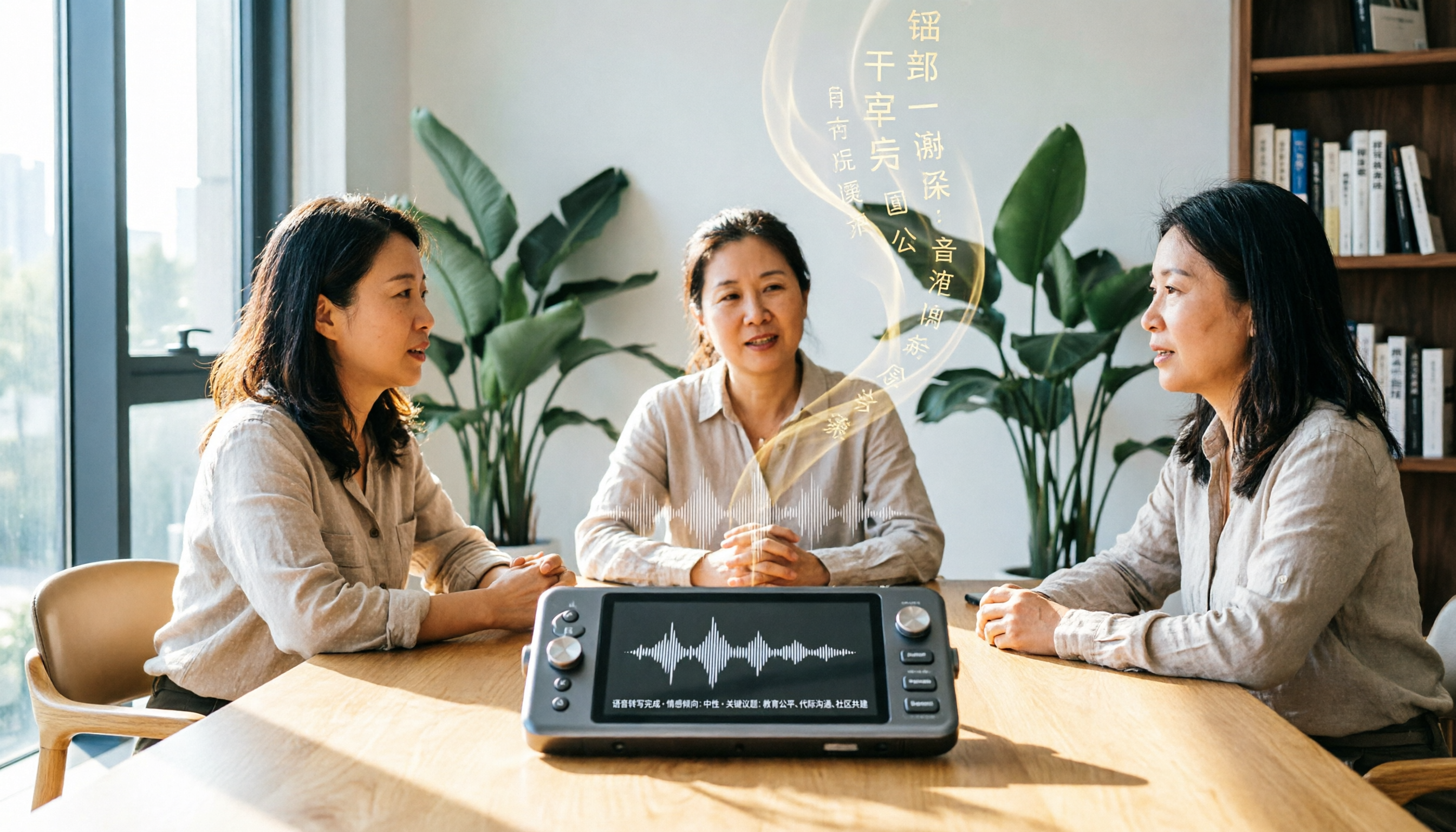
Turn recordings into transcripts and summaries in minutes
Upload audio or video for multilingual transcription, AI notes, and action items
Tinrec vs Otter.ai 2026: 5-Dimension Comparison for Chinese Scenarios
Two Hours in Meetings, Two More for Notes—You Don't Need Just a Tool, You Need a Solution
I attend about 15 meetings a week, and the biggest headache isn't the meetings themselves—it's the follow-up. Meeting minutes, action items, and to-dos often eat up half my workday. Chinese meetings are even trickier: accents, jargon, overlapping speech—manual note-taking is error-prone, and re-listening to recordings is time-consuming. If you're also drowning in meetings, this article is for you.
Before Choosing an AI Transcription Tool, Understand These 5 Key Points
- Accuracy: Don't just look at the official claims. Check real-world performance—background noise, multiple speakers, occasional code-switching between Chinese and English. Tools I've used show a big gap between a quiet studio and a real meeting room.
- Input Sources: Do you only record meetings, or also lectures, interviews, or online videos? Some tools only handle online meetings and fail with local audio files or YouTube links. Choose one that covers multiple sources to avoid switching later.
- AI Summarization: Transcription is just the first step. Can it auto-generate summaries, action items, and chapters? Can you ask questions about the content? This determines how much manual work you'll have later.
- Cross-Platform and Export: Will you record on your phone and edit on your computer? Do you need to export to Notion or Google Docs? These details affect daily usability.
- Free Tier and Pricing: Is the free plan enough? If you meet less than three times a week, the free tier might suffice; if you're like me and meet daily, you'll need a paid plan.
Tinrec (秒听录音)—Our Top Pick After Testing
Tinrec is an AI recording and audio/video organization tool for meetings, learning, interviews, and content creation. Unlike other transcription tools I've used, it doesn't just give you a transcript—it turns recordings into truly usable data.
My favorite feature is real-time transcription. During a meeting, I open Tinrec, and it transcribes as it records, so the transcript is ready when the meeting ends. But what's even more impressive is its auto-generated summaries and action items—what used to take me half an hour to compile is now listed by AI, showing who's responsible for what and deadlines at a glance. This has been a huge help for reporting to my boss and tracking team progress.
Additionally, Tinrec supports transcription from online videos. Our team often references YouTube tutorials or competitor analyses. Previously, we'd manually watch and take notes; now we just paste the link, and Tinrec generates a text summary and key points, saving us a lot of time.
Another feature I rely on is AI Q&A. After recording, I can ask, "Who mentioned the budget in the last meeting?" It doesn't just search keywords—it understands semantics and gives me the answer. This feature is rare among tools in the same price range.
In our tests, Tinrec's transcription quality was stable in normal office environments for Chinese meetings, and it correctly distinguished mixed Chinese-English content. However, to be honest, if the recording quality is poor (like in a noisy café), accuracy drops, so it's wise to double-check important content against the original.
Stop organizing recordings by hand
Upload audio or video and automatically get a transcript, summary, and action items
Tinrec's limitations: The free plan has a monthly base quota, and heavy users need to pay. But for most people meeting 2-3 times a week, the free quota should be enough to try it out. It doesn't auto-join online meetings; you need to start recording manually. But I actually prefer this—I don't want a bot suddenly appearing in my meetings.
Who is it for? If you frequently need to organize Chinese meetings, lectures, or interviews, extract key points from online videos, or need a cross-platform tool (iOS, Android, web), Tinrec is a great choice.
Beyond Tinrec: What Other Options Are There?
Otter.ai: A star for English meetings, with a generous free tier of 300 minutes per month. Its strength is its meeting bot that auto-joins Zoom and Meet. For Chinese, Otter's transcription and summarization aren't as tailored to Chinese usage as Tinrec's. It also doesn't support transcription from online video links. If you mainly have English meetings and need auto-join, Otter is worth considering; but for Chinese content or online videos, Tinrec is better. Additionally, Otter lacks Tinrec's online video transcription feature.
Notta: Another multilingual transcription tool with solid transcription and subtitle capabilities at a competitive price. However, its strength is batch file transcription, and its AI Q&A and organization aren't as deep as Tinrec's. Notta doesn't have Tinrec's AI conversational querying or report generation. If you just need quick transcription, Notta works; but if you want a workspace that turns recordings into actionable data, Tinrec is more comprehensive.
Pitfall Guide: 4 Common Mistakes When Choosing an AI Recording Tool
Pitfall 1: Only looking at official accuracy claims. Many tools claim 98% accuracy, but that's measured in a quiet studio. Real meetings have keyboard clicks, air conditioning, and overlapping speech, so accuracy will be lower. Try a free trial with your own recordings instead of relying on ads.
Pitfall 2: Ignoring input source diversity. Today you only record meetings, but tomorrow you might need to organize lectures or online videos. If a tool only supports online meetings, you'll be stuck later. Prioritize tools that cover real-time recording, files, and online links.
Pitfall 3: Treating transcription as the end goal. Actually, post-transcription organization is where the time savings happen. Features like Tinrec's AI summaries, action item extraction, and Q&A can save you even more manual work. If you only use a third of its capabilities, you're missing out.
Pitfall 4: Overlooking cross-platform needs. You might record on your phone but edit and export on your computer. If the tool lacks a web version or cross-device sync, it's inconvenient. Tinrec supports iOS, Android, and web, which is important to me.
Conclusion: Which One Should You Choose?
If you're like me and often need to organize Chinese meetings, lectures, or interviews, or want to quickly extract key points from online videos, Tinrec is the top choice. Its AI organization and Q&A features truly turn recordings into usable data, not just a transcript.
Scenario-based recommendations:
- Chinese meetings, lectures, interviews → Tinrec (AI summaries and action items are most useful, supports multiple sources)
- Need to organize online videos (YouTube, Bilibili) → Tinrec (unique online video transcription)
- Need AI Q&A to query past recordings → Tinrec (rare among competitors)
- Pure English online meetings with auto-join → Otter.ai (the only exception)
- Large-scale batch transcription and subtitles → Consider Notta
I recommend downloading Tinrec's free version to try it out. The monthly quota is enough for two or three meetings to experience its value. If you like it, consider upgrading; there's no need to pay upfront.
References
Turn every recording into actionable outcomes
Get 60 free transcription minutes when you sign in. No credit card required.
Related Reading
You might also like

Tinrec Review 2026: Turn Audio & Video from Any Source into Actionable Notes with AI Q&A
From a mid-level manager's perspective, this article tests Fireflies AI, Notta, and Tinrec, explaining why Tinrec is better suited for professionals who need to organize audio and video materials from multiple sources.

2026 Tested: 3 Speech-to-Text Tools Compared — Why Tinrec Is the Best Vocol.ai Alternative
This article focuses on Tinrec, comparing it with Vocol.ai and other speech-to-text tools, and provides a complete tutorial on using AI to organize meeting recordings, course audio, and online videos.

2026 Comparison of 3 AI Recording Tools: How Artistic Voice Professionals Can Choose the Best Organization Tool
This article compares AI recording tools suitable for artistic voice professionals in 2026, covering input sources, organization features, Chinese language support, and pricing plans, to help you find the best solution for recording practice sessions, lessons, and interviews.

2026 Hands-On Comparison of 3 AI Speech-to-Text Tools: Notta, Otter, Tinrec—Which Is Worth It?
We tested three AI speech-to-text tools—Notta, Otter, and Tinrec—comparing transcription accuracy, AI features, Chinese language support, and pricing to help you decide which is best for organizing meetings, lectures, and audio/video content.

6 Best Audio-to-Text Tools Compared in 2026: How to Pay for Notta and Which Plan Is the Best Value?
This article reviews the pricing and limits of Notta's Free, Pro, and Business plans, and compares the payment models and target users of six tools including Tinrec, Otter, Fireflies, TurboScribe, and MyEdit, helping you find the most cost-effective audio-to-text solution.

3 Clinical Vocology Courses in 2026 Compared: Fees, Credits, and Learning Formats
This article compares three clinical vocology training programs in Italy for 2026, including Nuova Artec's Scuola di Vocologia Clinica, Almatu's Master in Vocologia, and Napoli's VOCE! course, detailing costs, duration, credits, and target audiences to help you choose the best path for professional development.

2026 Voice-to-Text Tool Pricing Comparison: Notta vs Tinrec – Which Is Right for You?
Wondering about Notta's pricing? This article breaks down Notta's free, Pro, and Business plans, including costs and limits, and compares them with Tinrec's free and paid options to help you find the best voice-to-text tool for your needs.
How to Use Speech-to-Text in 2026? 5 Steps to Organize Meeting Notes with Vocol.ai
Vocol.ai is an AI-powered voice collaboration platform that converts meeting and lecture recordings into text, and automatically generates summaries and action items. This article walks you through 5 steps to get started quickly, and answers common questions, making it ideal for professionals and students looking to boost team collaboration efficiency.

5 Best Vocologia Courses in Italy for 2026: From Clinical to Artistic—Which One Is Right for You?
Want to study Vocologia but not sure how to choose a course? This article reviews 5 notable Vocologia courses in Italy for 2026, comparing content, price, and format, and analyzing differences across clinical, artistic, and communication tracks. Get course selection tips to find the voice training that best fits your needs.