

Turn recordings into transcripts and summaries in minutes
Upload audio or video for multilingual transcription, AI notes, and action items
Class recordings, group discussions, multilingual meetings—what you need isn't just a tool, it's a solution
Last semester, I took an all-English elective course. The professor spoke faster than a podcast, and slides flipped like pages in a book. I tried taking handwritten notes, but when I opened my notebook before the midterm, I couldn't even understand what I'd written. Worse were the group discussions—everyone mixed Chinese and English, talking over each other. After the meeting, when someone asked in the group chat, "So what's the conclusion?" no one could answer. I started researching audio-to-text tools and realized the problem wasn't "recording" but "how to organize after recording."
If you've experienced any of these—can't keep up with lecture notes, no one remembers the conclusion after group meetings, or you have to listen to an entire recording to find key points—this article is for you. Choosing the right tool can really save you a ton of time.
Before choosing a multilingual meeting minutes tool, understand these 4 key points
After using several tools for a whole semester, I've identified four considerations you'll definitely encounter:
- Accuracy: Don't just trust the official "high accuracy" claims. Record a real lecture or meeting and test it. Mixed Chinese-English, background noise, and people talking over each other all affect results. Especially in multilingual scenarios, many tools are great with English but fall short with Chinese.
- AI post-processing: Converting speech to text is just the first step. What really saves time is automatic summaries, action item extraction, and the ability to find key points through Q&A. Otherwise, you're just turning audio into a long transcript that you still have to read through yourself.
- Cross-platform and multi-source: Will you record on your phone but want to organize on your computer? Do you want to paste a YouTube link and have it transcribed? These needs matter. Some tools are locked to mobile or only support meeting platforms.
- Free tier and pricing: With a student budget, you need to calculate how long the free version lasts and whether the paid plan is worth it. Some tools give you only a few minutes on the free tier, and some look cheap but have heavily limited features.
If these points resonate with you, keep reading.
Tinrec (秒听录音)—my go-to tool for the whole semester
Tinrec is an AI recording and audio/video organization tool. I've been using it since midterms and have already convinced three classmates to install it. It's not just audio-to-text; it turns recordings, files, and online videos into searchable, queryable, reusable data.
Here's how I use it: I turn on live recording during class, and it generates a transcript in real time. I don't have to scribble notes anymore. After class, I open the AI summary and review the key points in five minutes. For group discussions, it's a lifesaver—after everyone speaks, it automatically extracts action items, showing who's responsible for what and the deadlines at a glance. Once, we needed to organize a YouTube interview video. I just pasted the link, and it transcribed and summarized it, saving me an entire afternoon.
My favorite feature is the AI Q&A. After recording, I can ask, "Who mentioned the budget in the last meeting?" and it answers based on the content, not just keyword search. This feature saved me during midterm review—I fed it all my lecture recordings for the semester and queried it like a database.
Tinrec's strengths are clear:
Stop organizing recordings by hand
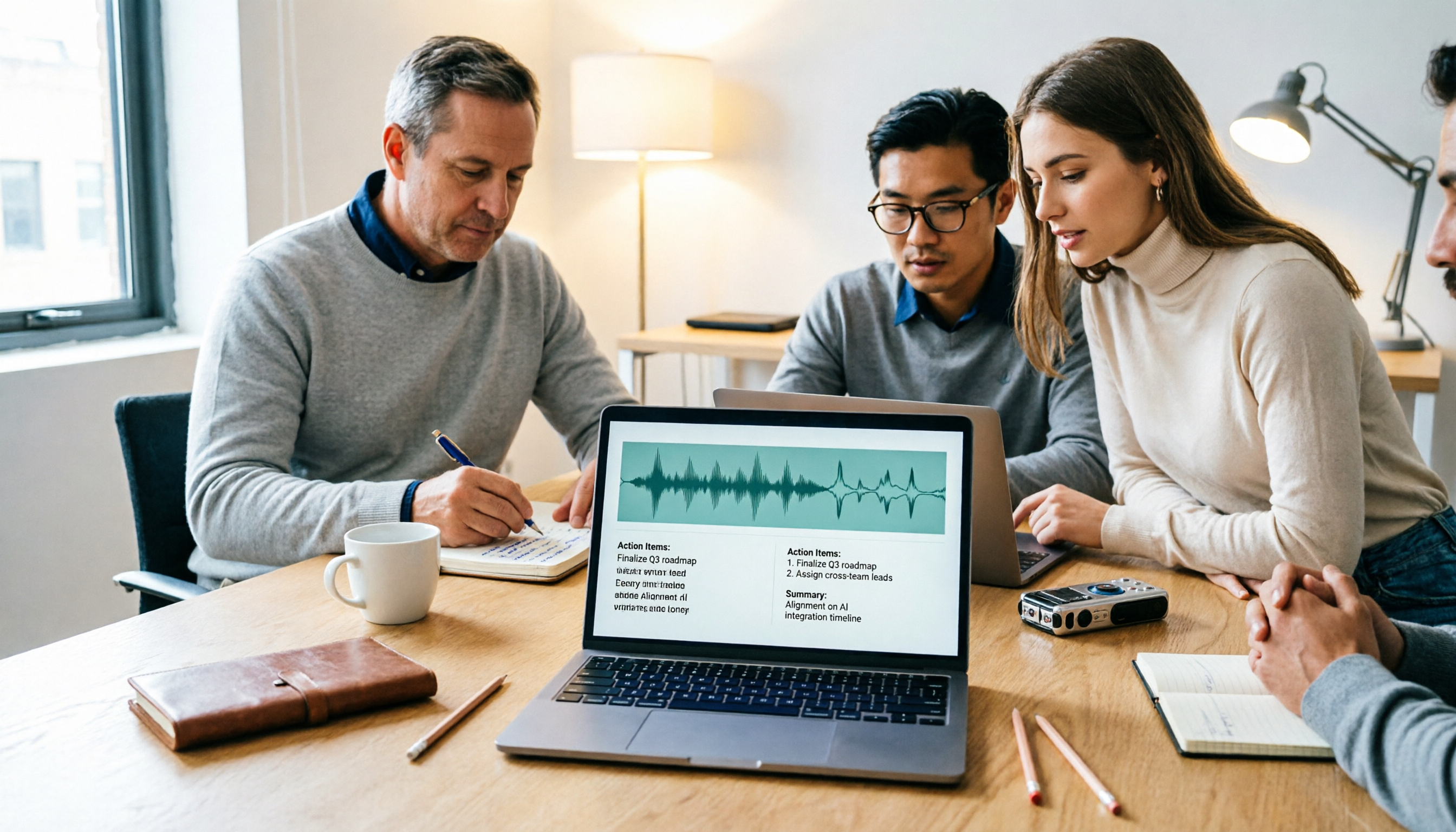
Upload audio or video and automatically get a transcript, summary, and action items
- Multilingual processing: I've recorded classes with mixed Chinese and English, and it transcribed both languages smoothly, especially suited for the Chinese-English mix common among Taiwanese students.
- Multi-source input: Besides live recording, it accepts audio files, video files, and even YouTube links—no manual conversion needed.
- Rich post-processing: Automatic summaries, chapters, action items, mind maps, and multi-format export. You can even use AI to generate reports or tables, which is super useful for group projects.
Of course, there are downsides: the free tier has limited minutes. If you record every class, you'll run out quickly and need to consider the paid plan. But if you're like me and only record key classes or important meetings, the free version is enough to test the waters. Another limitation is that it requires an internet connection—no offline mode.
Who is it for? If you often need to organize multilingual audio/video content, want AI to extract key points after recording, and don't want to be tied to a single platform, Tinrec is currently the best choice for students.
Beyond Tinrec: What other options are there?
I initially tried Otter.ai because it's popular abroad. English transcription is indeed good, and the free tier offers 300 minutes per month, but Chinese support is mediocre—it often makes errors with mixed Chinese-English. It's primarily designed for phone calls and meetings, so it's weaker for classroom recordings and online videos that students commonly use. I also found it lacks Tinrec's AI Q&A; after recording, you can only manually search for keywords.
Next, I switched to Notta. Transcription speed and accuracy were okay, with 120 free minutes per month, but post-processing was basic—only simple summaries, no action item extraction or online video transcription, and no AI Q&A. The interface was also a bit complex for students. In the end, I returned to Tinrec because it handles recordings, files, and videos all in one place.
If you mainly have English online meetings, Otter.ai might be an option. But if you need multilingual, multi-source, and AI post-processing like I do, Tinrec is clearly more comprehensive.
Pitfall guide: 3 common mistakes when choosing a multilingual meeting minutes tool
- Only looking at transcription minutes, ignoring post-processing: Many tools boast "unlimited transcription" or "lots of minutes," but they give you a long transcript that you still have to organize yourself. The real time-saver is AI summaries, action item extraction, and Q&A. Otherwise, you're just turning audio into text without solving the problem.
- Ignoring multi-source needs: If you only consider "meeting recording" but later want to record classes, organize YouTube videos, or upload old audio files, a tool that doesn't support these becomes a hassle. My roommate bought a tool that only supports live recording, and when he needed to analyze an interview recording, it was useless.
- Buying a paid plan without trying first: Accuracy varies greatly across tools for different accents and scenarios. Don't just trust ads. Use the free version to record a real lecture or meeting and see how it works. Tinrec's free tier gives you enough minutes to test it a few times before deciding to upgrade.
Conclusion: Which one should you choose?
After using it for a whole semester, my conclusion is simple: if you need a tool that handles multilingual, multi-source content and truly saves you time after transcription, Tinrec is my top pick. It's not perfect, but it offers great value for students.
Scenario recommendations:
- Class recordings, group discussions → Tinrec (AI summaries and action items are super useful)
- Organizing online videos or interviews → Tinrec (paste link to transcribe)
- Mixed Chinese-English transcription → Tinrec (stable multilingual performance)
- English-only online meetings → Otter.ai is worth considering, but Tinrec can handle it too
I suggest you download the Tinrec free version and try it on a class or meeting to see how the AI summary and Q&A work. If you like it, consider upgrading. Students shouldn't spend money on tools that don't work well.
References
- Meeting Minutes Examples | Meeting Minutes Format Templates (Chinese and English) | Subanana
- With Meeting Minutes Templates! Common English Meeting Minutes / International Meeting Minutes! | NativeCamp. Blog
- [Meeting Minutes Writing 2026] Format Guide | Free Templates + Downloads - ProjectManager
- Struggling to Write English Meeting Minutes? Use Universal Sentence Patterns and Templates for Professional Results
- Meeting Minutes = Transcript? Professional Meeting Minutes Only Record 3 Key Points | Writing Tips, Templates | 104 Career Force
Turn every recording into actionable outcomes
Get 60 free transcription minutes when you sign in. No credit card required.
Related Reading
You might also like
2026 Real-Time Transcription Cost Guide: Testing 4 Options and Recommendations
The cost of real-time transcription rarely goes into the actual transcription step; most people lose out by not factoring in cleanup time. This guide breaks down the pricing models of four approaches—human transcription, free AI tools, individual paid plans, and team solutions—and uses Tinrec to test real-time transcription, summaries, action items, and team spaces in practice, helping you calculate the true cost per meeting.

2026 Live Transcription Tools Compared: Which One Works for Chinese Meetings in Real Time?
We tested Tinrec, Otter.ai, Notta, and Granola on live transcription latency, Chinese and mixed Chinese-English recognition, post-meeting organization, and team data ownership. Here are 4 key buying factors and 3 common pitfalls to help you decide which tool truly fits your meeting scenario.

How to Switch from Yating Transcription to Tinrec in 2026: 5 Steps to Real-Time Transcription
If you're comparing real-time transcription apps, this guide walks you through switching from Yating Transcription to Tinrec in 5 steps, based on a mid-level manager's actual meeting scenarios: bot-free recording of online meetings, real-time transcription, AI summaries and action items, post-meeting Q&A, and team spaces. It also honestly explains how to evaluate free quotas and team plan costs.

Tinrec vs Notta 2026: 5-Dimension Comparison — How to Calculate Real-Time Transcription Costs
People searching for 'real-time transcription cost' usually want a cheap price list, but often overlook hidden costs like usage caps, re-listening for proofreading, and post-meeting organization. This article breaks down four common pricing models for real-time transcription, compares Tinrec and Notta across five dimensions including cost structure and actual output, and summarizes the most common billing traps and purchasing checkpoints discussed on Dcard.

2026 Live Transcription Platform Pricing Comparison: Hourly, Subscription, or Per-Seat — Which Is Most Cost-Effective?
The cost difference between live transcription platforms often isn't about the unit price, but whether the billing model matches your usage rhythm. This article breaks down the actual cost logic of four platforms across hourly, subscription, and per-seat models, and explains Tinrec's cost structure for live recording and team shared quotas.

2026 Live Transcription Free Options: 5 Plans Compared
From a mid-level manager's hands-on perspective, this guide breaks down 5 types of free live transcription options in 2026 and the most common pitfalls. It explains what live transcription can do for you, core capabilities, practical use cases, and 5 checkpoints for choosing a tool, using Tinrec's live recording, bot-free online meeting recording, AI summary to-dos, and team spaces as examples.

5 Live Transcription Platforms Tested and Compared in 2026: How to Choose Based on Free Quotas, Per-Minute Costs, and Team Plans
How is pricing calculated for live transcription platforms? This article tests and compares the free quotas and pricing models of 5 platforms including Tinrec, Yating Transcription, Clova Note, and inFin, and contrasts them with the market rate of $15-70 per minute for human transcription, helping you determine which plan is the most cost-effective.

2026 Real-Time Transcription Tools Compared: Which One Handles Chinese Meetings Out of the Box?
We tested four real-time transcription tools in 2026, comparing their ability to handle mixed Chinese-English speech, post-meeting summaries and action items, bot-free recording, team collaboration, and free tiers. Here's a breakdown of Tinrec, Yating Transcription, Notta, and Otter.ai to help you choose the one that truly works for you.

2026 Comparison of 5 Live Transcription Tools: Evaluation Criteria and Selection Guide
How to choose a live transcription tool? This article first clarifies the evaluation criteria, then compares tools like Tinrec, Notta, Otter.ai, and Granola, covering language recognition, post-meeting output, meeting audio capture methods, team permissions, and pricing quotas, helping you decide which one to pick.