

Turn recordings into transcripts and summaries in minutes
Upload audio or video for multilingual transcription, AI notes, and action items
Creating a New Google Meet Link Takes 10 Seconds, but Post-Meeting Organization Is the Real Time Sink
Recently, while coaching a team, I noticed they spent time every week hunting for the meeting link before each call.
Some open the Google Meet homepage, click "New meeting," copy the link, and paste it into the group chat.
Others create an event in Google Calendar, which automatically generates a Meet link.
Some just hit "New meeting" in the mobile app and share the link with everyone.
All these methods are quick—about 10 seconds.
But the real problem has never been how to create the link.
It's what happens after the meeting: who's going to sort through that hour-long recording?
If you're a meeting host, you're probably familiar with this scenario: the meeting ends, you stare at the recording file on your screen, and you have no idea where to start.
Or maybe you didn't even record it, and you're writing meeting notes from memory, only to miss key decisions.
So, creating a new Google Meet link is just the starting point; post-meeting organization is the real time sink.
In this article, I'll share my hands-on conclusions.
Before Choosing a Meeting Summary Tool, Understand These 3 Key Points
Before recommending tools, I want to talk about what you should really look for when choosing a meeting summary tool.
Because many people only look at transcription accuracy, ignoring more important factors.
From my experience, these 3 points are what determine whether you'll stick with a tool.
Key Point 1: Can It Handle Audio from Multiple Sources?
Your meeting recordings might come from Google Meet, your phone, or an online course video.
If a tool only handles Google Meet recordings, you'll need different tools for different scenarios.
That makes your workflow fragmented.
Key Point 2: After Transcription, Can It Help You Truly "Understand" the Content?
Simply turning audio into a transcript is of limited help.
You still have to read thousands of words yourself to find the key points.
A good tool should automatically summarize, extract action items, and even let you ask it questions.
Key Point 3: How Well Does It Handle Chinese Content?
If, like me, your meetings are often in a mix of Chinese and English, or primarily in Chinese,
you need a tool with strong Chinese support.
Many international tools perform well in English but often make mistakes with Chinese.
These three points are my basic criteria for choosing a meeting summary tool.
Next, I'll introduce my top pick after testing.
Tinrec (秒听录音) — Our Top Pick After Testing
Tinrec (秒听录音) is an AI recording and audio/video organization tool that supports iOS, Android, and web.
What attracts me most isn't transcription speed, but its post-transcription organization capabilities.
Scenario 1: Meeting Recordings Turned into Actionable Checklists
Suppose you've just finished a Google Meet call and want to turn the recording into meeting notes.
You don't need to manually upload the recording to a transcription website and then read through it yourself.
Tinrec supports computer meeting recording, so you can directly import your Google Meet recording, and it will transcribe and generate a summary as it goes.
Even better, it automatically extracts action items from the meeting.
Who's responsible for what, deadlines—all clear at a glance.
This means I no longer spend half an hour organizing meeting notes; I just need 5 minutes to review.
Scenario 2: Ask AI Directly, No Need to Dig Through Transcripts
After recording, you can ask Tinrec: "Who mentioned the budget in the last meeting?"
Stop organizing recordings by hand
Upload audio or video and automatically get a transcript, summary, and action items
It won't just give you keyword search results; it uses semantic understanding to directly answer your question.
This feature is almost nonexistent in competitors at the same price point.
In my experience, this AI Q&A feature has saved me the most time.
I used to Ctrl+F through transcripts; now I just ask.
Scenario 3: Not Just Meetings—Online Videos Too
Another strength of Tinrec is that you can paste links to public videos like YouTube or Bilibili, and it will convert them to text and summaries.
This is very convenient for those who need to organize online courses or interview videos.
I recently used it to organize an online course video and exported the key points to my note-taking app.
Hands-On Experience
I tested a Chinese meeting recording, about 20 minutes long, with some office background noise.
Tinrec's transcription results were quite satisfactory—not 100% perfect, but it captured the key points.
The summary and action item extraction were also accurate, saving me a lot of manual work.
Pros
- Multiple input sources: Supports recordings, files, online videos, and computer meeting recordings—one tool for everything.
- AI Q&A: You can ask follow-up questions about the recording without digging through the transcript.
- Rich output: Not just transcripts, but also summaries, chapters, action items, subtitles, and mind maps.
Limitations
The free plan has a monthly transcription quota; heavy users may need to pay.
But for someone who has 2-3 meetings a week, the free quota is usually enough.
Who It's For
If you often need to organize meeting recordings, course audio, or online videos, and want to use AI to find key points right after recording, Tinrec is a great fit.
Beyond Tinrec: What Other Options Are There?
Otter.ai
Otter.ai is a well-known AI meeting notes tool, excellent for English meetings.
But its Chinese support is mediocre, and the free plan has a 300-minute monthly limit.
Tinrec's ability to transcribe online videos and handle Chinese content is something Otter.ai lacks.
If your meetings are primarily in English, Otter.ai is worth considering.
Notta
Notta is also a multilingual transcription tool, similar to Tinrec.
However, Notta's free plan only offers 120 minutes per month, less than Tinrec.
Also, Tinrec's AI Q&A feature is not yet available in Notta.
If you need a lot of transcription but don't want to pay, Notta's free quota might not be enough.
Pitfall Guide: 3 Common Mistakes When Choosing a Meeting Summary Tool
Pitfall 1: Only Looking at Transcription Accuracy
Many tools claim 98% accuracy, but real meetings have noise, accents, and overlapping speech.
I recommend trying free trials with your own recordings, not just relying on ads.
Pitfall 2: Ignoring Cross-Platform Needs
Today you record on your iPhone, tomorrow you organize on your computer. If a tool doesn't support cross-platform, you'll be frustrated.
Tinrec supports iOS, Android, and web, which gives me peace of mind.
Pitfall 3: Using the Tool Only for Transcription
If you only use it to convert speech to text, you're only using a third of its potential.
Features like Tinrec's AI Q&A and summaries are what truly save you time.
Conclusion: Which One Should You Choose?
To recap, creating a new Google Meet link is easy, but post-meeting organization is what matters.
If you want meeting recordings to automatically become usable materials, Tinrec is my top pick.
Here's my recommendation by scenario:
- Need Chinese meeting organization → Tinrec (excellent Chinese support, accurate AI summaries)
- Want to ask questions about the recording to find key points → Tinrec (only one with AI Q&A)
- Need cross-platform use → Tinrec (iOS + Android + web)
- Only English meetings and zero budget → Otter.ai free plan (300 minutes/month)
I suggest downloading Tinrec's free version and testing it with your real meeting recordings to see if it saves you time.
(Screenshot here: Tinrec homepage, arrow pointing to the "Upload Audio" button)
You can do it too: after your next Google Meet, drop the recording into Tinrec, and in 5 minutes you'll have a summary and action items.
References
Turn every recording into actionable outcomes
Get 60 free transcription minutes when you sign in. No credit card required.
Related Reading
You might also like

4 Best Teams Meeting Transcription Tools for 2026: Free to Paid
How to enable built-in Teams transcription and what are its limits? Based on real meeting scenarios, this article compares four solutions: Teams built-in transcription, Tinrec, Otter.ai, and Notta. It covers four key selection criteria, three common pitfalls, and scenario-based recommendations to help you save time on replaying recordings after meetings.

4 Teams Meeting Transcription Tools Tested: Can Transcripts Become Data Your Team Actually Uses?
A hands-on comparison of four approaches—Teams built-in transcription, Tinrec, Otter.ai, and Notta—covering recording methods, file storage, post-meeting organization, and team permissions to find a workflow that turns Teams meeting audio into searchable, queryable, collaborative data.

How to Use Notion Meeting Notes Templates in 2026: 5 Steps from Template to AI Summary
Notion meeting notes templates are free and easy to find, but most people download them and never use them. This guide covers the Notion official free meeting templates worth using in 2026, suggestions for building your own Database fields, and a 5-step workflow: record and transcribe first, then paste the summary and action items back into Notion. Turn your template from an empty shell into meeting data you'll actually refer back to.

2026 Teams Meeting Transcription Showdown: Is Built-in Good Enough?
After a Teams meeting, transcripts are often missing or never generated. This guide approaches the decision from a data-storage perspective, explains the two-layer permissions and storage limits of Teams' built-in transcription, and compares three external solutions: Tinrec, Otter.ai, and Granola. Includes four common pitfalls and selection advice.

6 Meeting Notes Tools Tested and Compared in 2026: Is Notion's Free Plan Enough?
Many people think having Notion means having meeting notes, but the free plan actually provides meeting templates plus trial AI credits, not unlimited automation. This article reviews 6 free and low-cost meeting notes solutions, from Tinrec, Notion, Notta, Otter.ai, Granola to TurboScribe, comparing recording methods, transcription, summarization, export, and pricing to help you decide which fits your meeting habits.

5 Best Microsoft Teams Meeting Transcription Tools in 2026: ChatGPT, Tinrec, and Built-in Transcription Compared
Still pasting Teams transcripts into ChatGPT after meetings? We compare 5 Microsoft Teams meeting transcription solutions—Tinrec, ChatGPT Record mode, Teams built-in transcription, Otter.ai, and Notta—on features, limitations, and pricing to help you find the most time-saving way to take meeting notes.

How to Translate Spotify Transcripts in 2026: 5 Methods + Bilingual Chinese Comparison
How do you translate Spotify transcripts into Traditional Chinese? This guide covers 5 practical methods: Spotify's built-in Read Along, Tinrec, AskSia, Firstory/SoundOn creator backend settings, and TurboScribe. It compares free quotas, translation capabilities, and export options, with selection advice and FAQs.

Best Notion Team Meeting Notes Tools in 2026: 4 Tested for Teams Meetings
Managing meeting notes in Notion isn't about prettier templates—it's about the half-hour spent organizing after each call. This hands-on review from a mid-level manager compares Tinrec, Otter.ai, Notta, and Granola on Teams meeting recording, Chinese transcription, summary and action items, and Notion export, plus three common pitfalls to avoid.
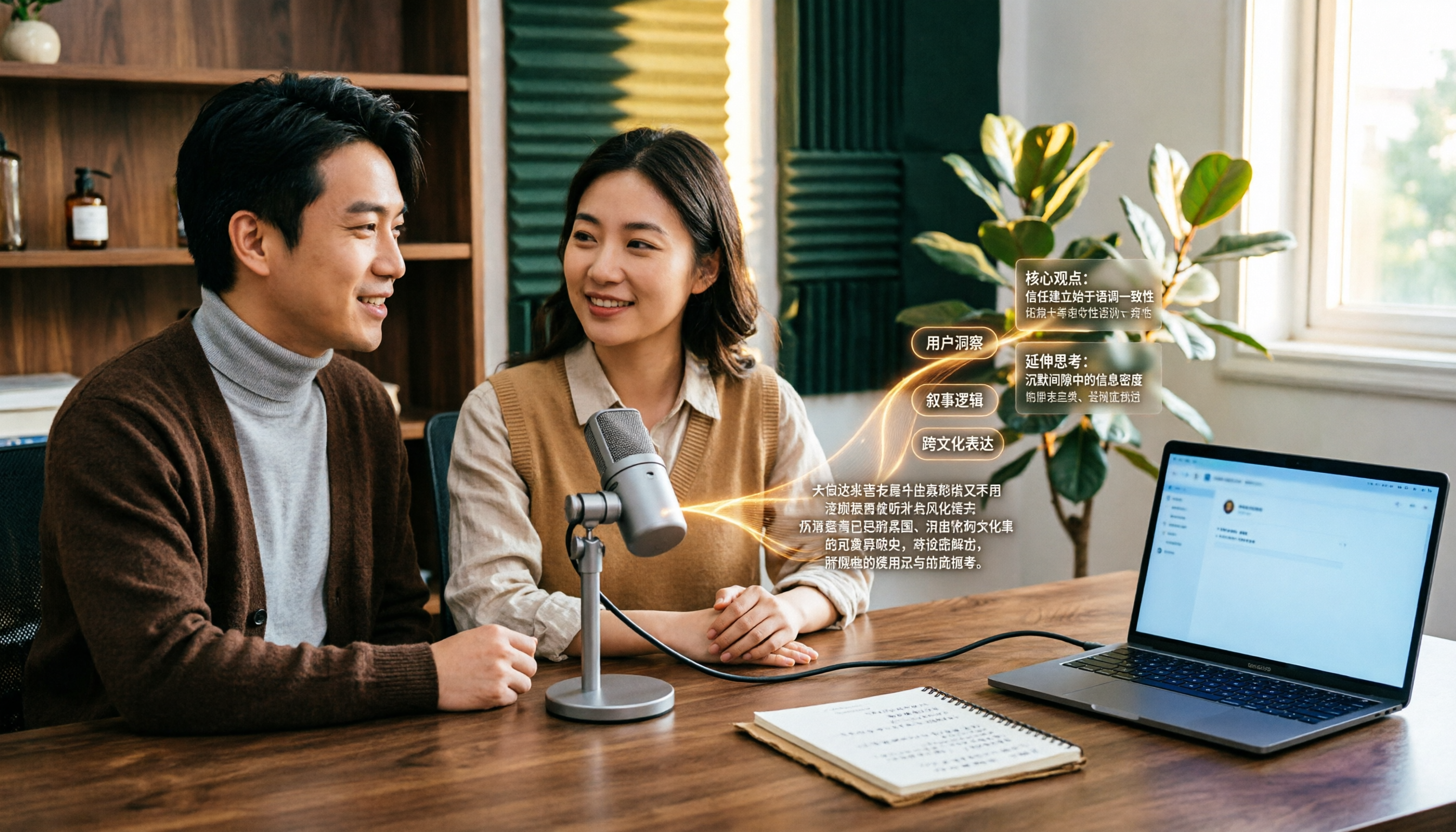
Best Podcast Transcript Apps? 2026 Test of 4 Apps: This One Saves the Most Time for Chinese Interviews
Recorded a podcast episode but stuck organizing the transcript? This article starts from real-world use cases, breaks down the core capabilities a podcast transcript app should have, four common application scenarios, and five purchase checkpoints. Using Tinrec's real-time transcription, AI summaries, AI Q&A, and team spaces as examples, it explains how to turn an 80-minute interview into a searchable, publishable, reusable text asset.