

Turn recordings into transcripts and summaries in minutes
Upload audio or video for multilingual transcription, AI notes, and action items
Two hours in meetings, two more organizing notes? You don't need another recorder
Two hours in a meeting, and another two hours organizing the minutes—this is the daily reality for many managers and team members. What's worse, the key points, decisions, and action items discussed often end up scattered across different people's notes, requiring significant time to piece together afterward. If you also have to transcribe lecture recordings, interview audio, or online videos, it becomes a nightmare. This article is for you: in 5 steps, we'll guide you through comparing the current mainstream meeting efficiency tools to find a solution that truly saves you time.
Before Choosing a Meeting Efficiency Tool, Understand These 4 Key Points
Input Source Diversity: Traditional recording tools only capture what's happening now, but your meetings might come from online conferences, phone recordings, or even online videos. When choosing a tool, first confirm whether it can handle live recording, audio/video files, and public video links. Tinrec has corresponding features for all these sources, which many competitors lack.
Post-Transcription Processing Capabilities: Transcription is just the first step; the key is whether it can automatically summarize, extract action items, and generate chapters after transcription. If a tool only gives you a verbatim transcript, you'll still have to do the organizing yourself. Tinrec's AI post-processing lets you spend your time on decisions, not on organizing text.
Chinese Content Support: If you primarily handle Chinese meetings, courses, or interviews, you must choose a tool with stable Chinese recognition and summarization quality. Tinrec excels in organizing Chinese content, making it suitable for Chinese speakers.
Cross-Platform and Free Tier: Confirm whether the tool supports mobile, desktop, and web, and whether the free tier is sufficient for you to try it out. Tinrec offers a free trial, and its paid plans are flexible, catering to different usage frequencies.
Tinrec (秒听录音) — Our Top Pick After Hands-On Testing
Tinrec (秒听录音) is an AI recording and audio/video organization tool designed for meetings, learning, interviews, and content creation, supporting mobile, desktop, and web versions. It's not just about transcribing audio to text; it turns audio/video content into a searchable, summarizable, and queryable database.
When you open Tinrec during a meeting, it generates a real-time transcript as it records. After the meeting, AI summaries and action items are automatically generated—who is responsible for what, and deadlines, all at a glance. We tested a 5-minute Chinese meeting recording (with slight background noise), and the transcription accurately captured key discussions, with summaries and action items also well extracted.
What's even more practical is its AI Q&A feature: after recording, you can directly ask Tinrec, "Who mentioned the budget in the last meeting?" It will give you the answer based on semantic understanding, rather than just showing keyword search results. This ability to "ask for the key points" is something most competitors at the same price point lack.
Additionally, Tinrec supports uploading audio/video files and pasting links to public videos like YouTube and Bilibili for transcription. This means it's not just for meetings; it can also organize lecture recordings, interviews, podcasts, and online videos, making it more versatile than pure meeting bots.
Stop organizing recordings by hand
Upload audio or video and automatically get a transcript, summary, and action items
Summary of advantages: multi-source input (recording, files, video links), Chinese content organization friendly, complete AI post-processing (summaries, chapters, action items, Q&A, export). Limitations: the free tier has limited credits, and heavy users will need to pay; accuracy can be affected by audio quality and accents, so it's advisable to verify important content against the original.
If you need a tool that can handle meetings, learning, and content creation materials simultaneously, Tinrec is currently the most suitable choice.
Beyond Tinrec: What Other Options Are There?
Otter.ai: The go-to for English meeting notes, with a free tier of 300 minutes per month. However, its strength lies in English online meetings; Chinese content organization and public video link transcription are not its focus. If you primarily record English meetings and have a zero budget, Otter is worth considering; if you need to organize Chinese content or online videos, Tinrec is more comprehensive.
Notta: Strong in transcription and subtitle features, with a free tier of 120 minutes per month. However, Tinrec's AI Q&A and post-processing (like generating meeting minutes and reports) are more complete. If you need to ask about key points directly after recording and generate deliverables, Tinrec is more convenient.
PLAUD Note: A hardware recording device, suitable for recording anytime, but requires an additional purchase (pre-order price $179). Tinrec lets you record and organize directly with your phone or computer, and also supports transcription from online video links, which hardware cannot do.
Pitfall Guide: 4 Common Mistakes When Choosing Meeting Efficiency Tools
Pitfall 1: Only Looking at Transcription Minutes. Many tools advertise large free tiers, but after transcription, you only get a verbatim transcript, and you still have to organize it yourself. When choosing a tool, check whether it can automatically summarize and extract action items.
Pitfall 2: Ignoring Multi-Source Input. If you only buy a meeting bot, you'll be stuck when you encounter lecture recordings or online videos. Make sure the tool can handle files and video links.
Pitfall 3: Believing in 99% Accuracy. Official accuracy claims are usually measured in quiet environments; real meetings have background noise and overlapping speech, which reduces accuracy. It's recommended to try the free tier with your own recordings.
Pitfall 4: Buying but Not Using AI Features. If you only use the tool as a recording-to-text machine, you're wasting its potential. With Tinrec's AI Q&A, for example, you can directly ask "What was the meeting conclusion?" after recording, which is much faster than manually scanning the transcript.
Summary: Which One Should You Choose?
Overall, if you need to organize Chinese meetings, courses, interviews, or online videos, Tinrec is the best choice: multi-source input, AI Q&A, Chinese-friendly, and the free tier lets you experience core features.
Scenario Recommendations:
- Need to organize Chinese audio/video → Tinrec
- Need to ask about key points with AI and generate reports → Tinrec
- Only record English online meetings with zero budget → Otter.ai (exception)
- Want a standalone recording hardware → PLAUD Note (optional)
We recommend downloading the Tinrec free version first to try it out, and then consider a paid plan if it meets your needs.
References
- National Kaohsiung University of Science and Technology Library
- SYMSKAN Document Similarity Search Service
- Paper Comparison Tool | Fu Jen Catholic University Library
- Dayeh University Library and Information Office - Thesis Originality Comparison System
- Thesis Originality Comparison System Testing Process and Notes | Library Resources | National Formosa University Library
Turn every recording into actionable outcomes
Get 60 free transcription minutes when you sign in. No credit card required.
Related Reading
You might also like

4 Best Teams Meeting Transcription Tools for 2026: Free to Paid
How to enable built-in Teams transcription and what are its limits? Based on real meeting scenarios, this article compares four solutions: Teams built-in transcription, Tinrec, Otter.ai, and Notta. It covers four key selection criteria, three common pitfalls, and scenario-based recommendations to help you save time on replaying recordings after meetings.

4 Teams Meeting Transcription Tools Tested: Can Transcripts Become Data Your Team Actually Uses?
A hands-on comparison of four approaches—Teams built-in transcription, Tinrec, Otter.ai, and Notta—covering recording methods, file storage, post-meeting organization, and team permissions to find a workflow that turns Teams meeting audio into searchable, queryable, collaborative data.

How to Use Notion Meeting Notes Templates in 2026: 5 Steps from Template to AI Summary
Notion meeting notes templates are free and easy to find, but most people download them and never use them. This guide covers the Notion official free meeting templates worth using in 2026, suggestions for building your own Database fields, and a 5-step workflow: record and transcribe first, then paste the summary and action items back into Notion. Turn your template from an empty shell into meeting data you'll actually refer back to.

2026 Teams Meeting Transcription Showdown: Is Built-in Good Enough?
After a Teams meeting, transcripts are often missing or never generated. This guide approaches the decision from a data-storage perspective, explains the two-layer permissions and storage limits of Teams' built-in transcription, and compares three external solutions: Tinrec, Otter.ai, and Granola. Includes four common pitfalls and selection advice.

6 Meeting Notes Tools Tested and Compared in 2026: Is Notion's Free Plan Enough?
Many people think having Notion means having meeting notes, but the free plan actually provides meeting templates plus trial AI credits, not unlimited automation. This article reviews 6 free and low-cost meeting notes solutions, from Tinrec, Notion, Notta, Otter.ai, Granola to TurboScribe, comparing recording methods, transcription, summarization, export, and pricing to help you decide which fits your meeting habits.

5 Best Microsoft Teams Meeting Transcription Tools in 2026: ChatGPT, Tinrec, and Built-in Transcription Compared
Still pasting Teams transcripts into ChatGPT after meetings? We compare 5 Microsoft Teams meeting transcription solutions—Tinrec, ChatGPT Record mode, Teams built-in transcription, Otter.ai, and Notta—on features, limitations, and pricing to help you find the most time-saving way to take meeting notes.

How to Translate Spotify Transcripts in 2026: 5 Methods + Bilingual Chinese Comparison
How do you translate Spotify transcripts into Traditional Chinese? This guide covers 5 practical methods: Spotify's built-in Read Along, Tinrec, AskSia, Firstory/SoundOn creator backend settings, and TurboScribe. It compares free quotas, translation capabilities, and export options, with selection advice and FAQs.

Best Notion Team Meeting Notes Tools in 2026: 4 Tested for Teams Meetings
Managing meeting notes in Notion isn't about prettier templates—it's about the half-hour spent organizing after each call. This hands-on review from a mid-level manager compares Tinrec, Otter.ai, Notta, and Granola on Teams meeting recording, Chinese transcription, summary and action items, and Notion export, plus three common pitfalls to avoid.
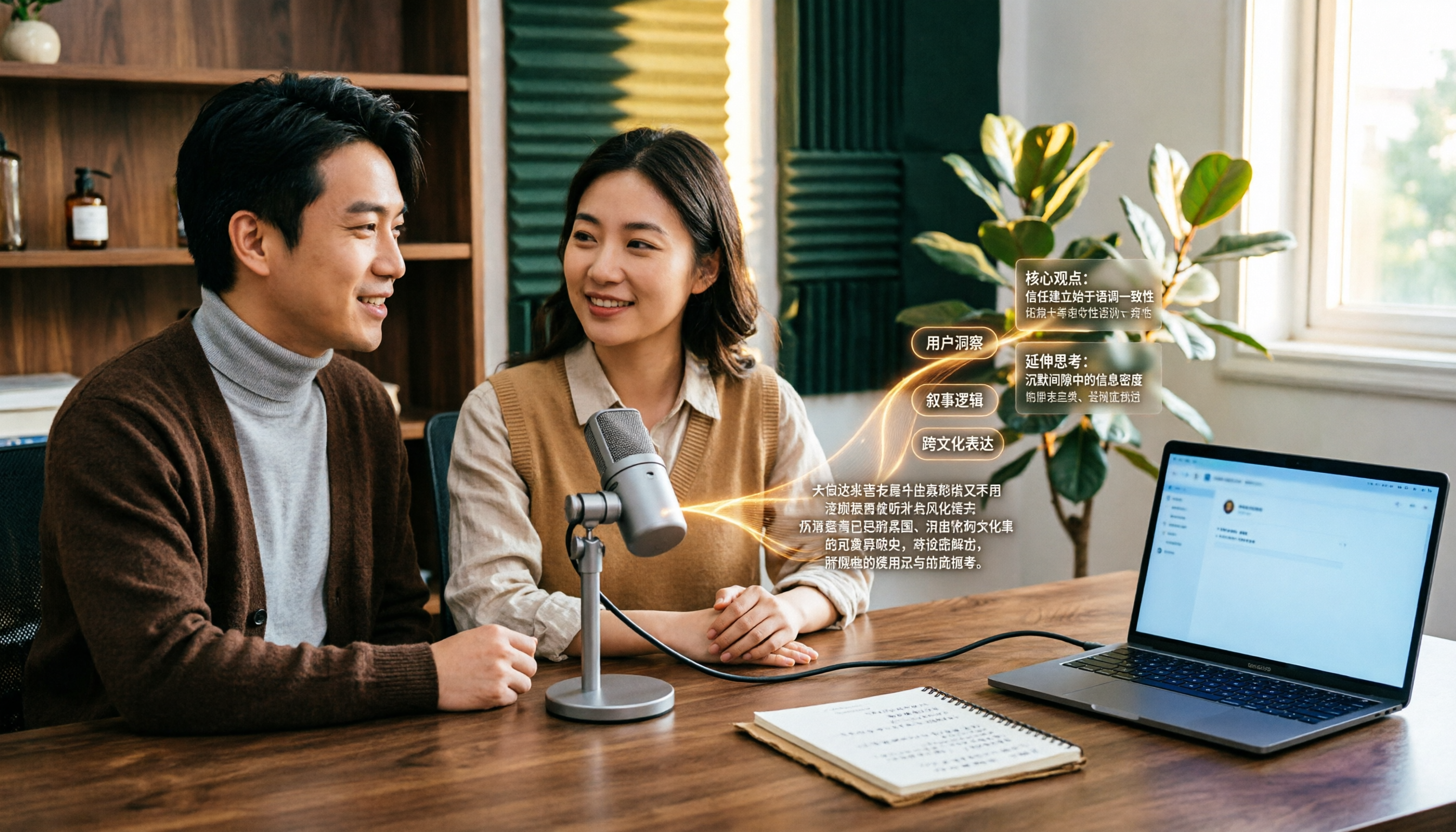
Best Podcast Transcript Apps? 2026 Test of 4 Apps: This One Saves the Most Time for Chinese Interviews
Recorded a podcast episode but stuck organizing the transcript? This article starts from real-world use cases, breaks down the core capabilities a podcast transcript app should have, four common application scenarios, and five purchase checkpoints. Using Tinrec's real-time transcription, AI summaries, AI Q&A, and team spaces as examples, it explains how to turn an 80-minute interview into a searchable, publishable, reusable text asset.