

Turn recordings into transcripts and summaries in minutes
Upload audio or video for multilingual transcription, AI notes, and action items
Two hours in a meeting, two more hours organizing notes? You don't need more notes—you need a tool that organizes them for you.
Last semester, I took a seminar course where every group meeting felt like a battle—everyone talking at once, some discussing budgets, others giving progress updates, and no one remembering the conclusions afterward. I tried taking handwritten notes, only to find I'd missed half the key points; borrowing a classmate's notes, their handwriting was messier than mine.
Later, online classes increased, professors spoke faster, and slides flipped quicker. I'd have a recording but no idea where to start listening. Many people on Dcard's work forum recommend meeting efficiency tools, but for students, free-tier limits, Chinese accuracy, and the ability to paste video links matter more than "lots of features." Choosing the right tool can genuinely save several hours of organizing time each week.
Before Choosing a Meeting Efficiency Tool, Understand These 4 Key Points
1. Chinese Accuracy: Don't Just Trust Official Numbers. Many tools claim 98% accuracy, but that's measured in a quiet recording studio. In a real classroom or meeting room, there's air conditioning noise, keyboard clatter, and classmates whispering, which drops accuracy. My testing method was to use a recording from a mandatory Chinese lecture and see if it could correctly transcribe technical terms and names.
2. AI Features: After Transcription, Can It Help You Find Key Points? If you record a one-hour meeting and still have to listen through it yourself to find conclusions, it's like not recording at all. I specifically look for tools that can auto-summarize, extract action items, or even let me ask, "Who said we needed to revise the questionnaire in the last group discussion?"
3. Cross-Platform: Can You Record on Your Phone and Continue Organizing on Your Computer? I often use my iPhone to record lectures and then use my laptop to write reports. If a tool only works on mobile, I'd want to throw my laptop.
4. Free Allowance: For Students, Is It Enough to Last a Semester? With a limited monthly allowance, how many minutes the free version offers and whether the paid plan costs less than a bubble tea matter more than anything.
Tinrec (秒听录音) — My Top Pick After Testing This Semester
Tinrec is an AI recording and audio/video organization tool that supports mobile, desktop, and web versions. You can record directly, upload audio files, or paste public video links to transcribe. I used it to organize my entire semester of seminar meetings, lecture recordings, and several YouTube tutorial videos.
Let me start with my most common use case: during group meetings, I open Tinrec to record and transcribe in real time. By the end of the meeting, the transcript is saved, and the AI summary automatically lists key points and action items—like "Submit the questionnaire draft by next Wednesday, owner: Xiaomei." Previously, I'd spend half an hour organizing afterward; now I just copy and paste to send to the group chat.
Second is the "AI Chat Query" feature. This feature literally saved me during finals. I uploaded recordings from several lectures and asked before the exam, "Which chapters did the teacher say would be on the midterm?" It answers based on the recording content, not just keyword search results. Currently, few tools in this price range offer this.
Stop organizing recordings by hand
Upload audio or video and automatically get a transcript, summary, and action items
Third is web video transcription. When researching, I paste Bilibili or YouTube links, and Tinrec directly transcribes the text and provides a summary, so I don't have to pause the video and take notes manually.
I recorded a two-hour Chinese class with my iPhone, and despite background noise in the classroom, Tinrec's transcript was mostly accurate. Technical terms occasionally got mixed up, but cross-referencing with the audio playback was sufficient. The free version offers a basic monthly transcription allowance; I used it for two or three meetings plus one class per month, and I still had allowance left. During finals week, I bought a weekly card, which was cheaper than buying a classmate a drink.
Pros: Handles Chinese well, AI Q&A is genuinely useful, and cross-platform works smoothly. Cons: Heavy use may exceed the free allowance, and accuracy is affected by recording quality, so important content should be checked against the original.
Who it's for: If you often record Chinese lectures, group meetings, or want to find key points directly from recordings without transferring files between phone and computer, Tinrec is the most convenient choice right now.
Beyond Tinrec: What Other Options Are There?
Otter.ai: Excellent for English meetings, and the free version offers a generous 300 minutes per month. However, in my Chinese class tests, it was less accurate with Chinese names and technical terms compared to Tinrec, and it doesn't easily transcribe YouTube links. If you primarily record English meetings, Otter is worth considering; but for Chinese classes or group discussions, Tinrec is more practical.
Notta: Good transcription and subtitle features, with 120 free minutes per month. However, its AI features lean toward manual organization after transcription, whereas I use Tinrec's AI chat query and web video transcription more often. If you only need bulk transcription, Notta is worth a try, but if you want to ask questions about key points after recording, Tinrec is more convenient.
Pitfall Guide: 3 Common Mistakes When Choosing a Meeting Efficiency Tool
Pitfall 1: Only Looking at Official Accuracy Rates. Many tools' 98% accuracy is measured in a recording studio. In a real classroom with air conditioning, keyboards, and professors pacing, accuracy drops. I recommend using your own lecture recordings for free trials, not just relying on ads.
Pitfall 2: Ignoring Cross-Platform Support. If you record on your phone and organize on your computer, but the tool only supports one device, transferring files will drive you crazy. Tinrec syncs across iOS, Android, and web.
Pitfall 3: Using It Only for Transcription. If you just manually Ctrl+F for keywords after recording, you're leaving AI features unused. With Tinrec's AI Q&A, asking "What was the meeting conclusion?" is much faster than scanning a 30-minute transcript.
Summary: Which One Should Students Choose?
If you're like me, mainly recording Chinese lectures and group discussions, and occasionally wanting to turn YouTube videos into notes, Tinrec is currently the most comprehensive choice. It doesn't just give you a transcript; it also summarizes, extracts action items, and lets you find key points by asking questions.
Scenario Recommendations:
- Chinese meetings or lectures → Tinrec (handles Chinese well, AI Q&A is useful)
- Need to paste public video links for transcription → Tinrec (most competitors lack this feature)
- Cross-platform use (phone + computer) → Tinrec (supports iOS, Android, and web)
- Zero budget and only English meetings → Otter.ai (the only exception, generous free allowance for English)
I recommend downloading Tinrec's free version first; the monthly basic allowance is enough for a few group meetings and one class. If you find it useful, consider a weekly or monthly card—no need to pay upfront.
References
- #Info Boost Office Efficiency! 7 Must-Have Tools Revealed - Work Forum | Dcard
- Dcard Social Forum - MAKE.fan Office Process Automation
- Microsoft | Dcard
- #Info Meeting Notes Made Easy! Transcription Tool Recommendations - Work Forum | Dcard
- Dcard CEO Lin Yuqin's 2025 Review: How Did Unlimited AI Budget Disrupt Work Patterns? | Manager Today
Turn every recording into actionable outcomes
Get 60 free transcription minutes when you sign in. No credit card required.
Related Reading
You might also like

4 Best Teams Meeting Transcription Tools for 2026: Free to Paid
How to enable built-in Teams transcription and what are its limits? Based on real meeting scenarios, this article compares four solutions: Teams built-in transcription, Tinrec, Otter.ai, and Notta. It covers four key selection criteria, three common pitfalls, and scenario-based recommendations to help you save time on replaying recordings after meetings.

4 Teams Meeting Transcription Tools Tested: Can Transcripts Become Data Your Team Actually Uses?
A hands-on comparison of four approaches—Teams built-in transcription, Tinrec, Otter.ai, and Notta—covering recording methods, file storage, post-meeting organization, and team permissions to find a workflow that turns Teams meeting audio into searchable, queryable, collaborative data.

How to Use Notion Meeting Notes Templates in 2026: 5 Steps from Template to AI Summary
Notion meeting notes templates are free and easy to find, but most people download them and never use them. This guide covers the Notion official free meeting templates worth using in 2026, suggestions for building your own Database fields, and a 5-step workflow: record and transcribe first, then paste the summary and action items back into Notion. Turn your template from an empty shell into meeting data you'll actually refer back to.

2026 Teams Meeting Transcription Showdown: Is Built-in Good Enough?
After a Teams meeting, transcripts are often missing or never generated. This guide approaches the decision from a data-storage perspective, explains the two-layer permissions and storage limits of Teams' built-in transcription, and compares three external solutions: Tinrec, Otter.ai, and Granola. Includes four common pitfalls and selection advice.

6 Meeting Notes Tools Tested and Compared in 2026: Is Notion's Free Plan Enough?
Many people think having Notion means having meeting notes, but the free plan actually provides meeting templates plus trial AI credits, not unlimited automation. This article reviews 6 free and low-cost meeting notes solutions, from Tinrec, Notion, Notta, Otter.ai, Granola to TurboScribe, comparing recording methods, transcription, summarization, export, and pricing to help you decide which fits your meeting habits.

5 Best Microsoft Teams Meeting Transcription Tools in 2026: ChatGPT, Tinrec, and Built-in Transcription Compared
Still pasting Teams transcripts into ChatGPT after meetings? We compare 5 Microsoft Teams meeting transcription solutions—Tinrec, ChatGPT Record mode, Teams built-in transcription, Otter.ai, and Notta—on features, limitations, and pricing to help you find the most time-saving way to take meeting notes.

How to Translate Spotify Transcripts in 2026: 5 Methods + Bilingual Chinese Comparison
How do you translate Spotify transcripts into Traditional Chinese? This guide covers 5 practical methods: Spotify's built-in Read Along, Tinrec, AskSia, Firstory/SoundOn creator backend settings, and TurboScribe. It compares free quotas, translation capabilities, and export options, with selection advice and FAQs.

Best Notion Team Meeting Notes Tools in 2026: 4 Tested for Teams Meetings
Managing meeting notes in Notion isn't about prettier templates—it's about the half-hour spent organizing after each call. This hands-on review from a mid-level manager compares Tinrec, Otter.ai, Notta, and Granola on Teams meeting recording, Chinese transcription, summary and action items, and Notion export, plus three common pitfalls to avoid.
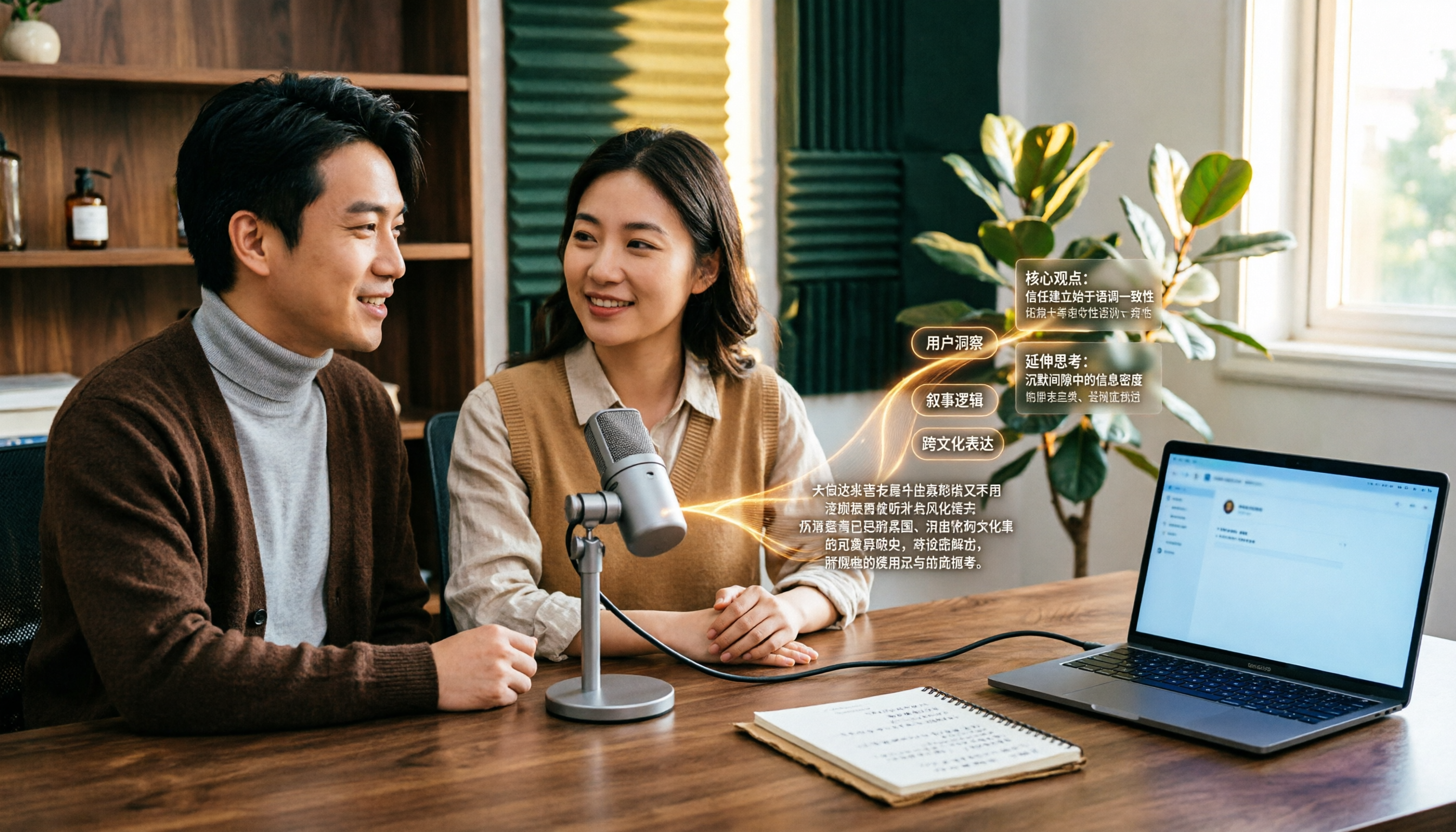
Best Podcast Transcript Apps? 2026 Test of 4 Apps: This One Saves the Most Time for Chinese Interviews
Recorded a podcast episode but stuck organizing the transcript? This article starts from real-world use cases, breaks down the core capabilities a podcast transcript app should have, four common application scenarios, and five purchase checkpoints. Using Tinrec's real-time transcription, AI summaries, AI Q&A, and team spaces as examples, it explains how to turn an 80-minute interview into a searchable, publishable, reusable text asset.