

Turn recordings into transcripts and summaries in minutes
Upload audio or video for multilingual transcription, AI notes, and action items
3 Google Meet Alternatives Tested in 2026: Why I Finally Chose Tinrec for Organizing Chinese Audio & Video
Last week, I had a Google Meet online meeting that lasted a full 90 minutes, discussing the progress of three projects. After the meeting ended, I stared at my computer screen, my mind blank—what conclusions were actually made? Who is responsible for what? I found myself spending another half hour re-listening to the recording and manually taking notes.
This isn't a problem with Google Meet. Google Meet is great—joining meetings, sharing screens, and hosting up to 500 participants simultaneously all work fine. But its strength lies in "during the meeting," not in "post-meeting" organization.
I started wondering: is there a tool that can make Google Meet online meetings more complete, automatically turning meeting content into searchable, organizable, trackable data? That's when I found Tinrec.
What Can Google Meet Online Meetings Do for You? But Tinrec Does It More Thoroughly
I'm very familiar with Google Meet's features: joining with a meeting code, starting meetings directly from the browser, inviting up to 500 people, and even live-streaming to 100,000 viewers. All of that is great, but it only covers "the moment of the meeting."
What about after the meeting? Google Meet's Gemini feature can automatically organize notes, but only on specific Google One, Workspace Business, or Enterprise plans. And it's primarily focused on meetings; it can't handle course recordings, interview audio files, or online videos.
So my need was clear: I didn't need another video tool; I needed a tool that could organize the "post-meeting data" from Google Meet online meetings. Tinrec is designed with that in mind.
Tinrec's Core Capabilities in the Google Meet Online Meeting Scenario
Tinrec isn't a meeting bot; it's more like an "audio/video organization workbench." Here are five capabilities I actually used after Google Meet meetings.
1. Real-time Speech-to-Text
You can use Tinrec's computer meeting recording feature to record your Google Meet sessions. As it records, the transcript is generated simultaneously. No need to wait until the meeting ends to slowly organize.
2. AI Summaries—Not Just Condensing the Transcript, but Structuring It
Tinrec separates the meeting topic, discussion conclusions, action items, and responsible persons into distinct sections. This aligns better with my work habits than Google Meet's native organization.
3. Action Item Extraction—Turning Discussions into a To-Do List
This is my favorite feature. During meetings, people often say "we'll need to..." Tinrec automatically captures these action items, even listing the responsible person and deadline for me.
4. AI Chat Query—Find Key Points by Asking
After transcription, I can directly ask Tinrec: "Who mentioned the budget in the meeting?" "What were the client's main feedback points?" It answers based on semantic understanding. This is much faster than Ctrl+F through a long transcript.
5. Multi-format Export—Results Go Straight into Your Workflow
Organized content can be exported as Markdown, Word, PDF, or synced to Notion and Google Docs. I don't have to keep my data locked inside Tinrec.
Real-World Use Cases: Not Just Google Meet—Courses, Interviews, and Videos
I've found Tinrec's value lies in its ability to handle more than just meetings. Here are four scenarios I've actually used it for.
Scenario 1: Google Meet Project Meetings
During the meeting, I record with Tinrec. Five minutes after the meeting ends, the summary, conclusions, and action items are ready. I directly paste the action items into the team board, saving at least 30 minutes of organizing time.
Scenario 2: Online Course Video Organization
Some courses only have video or audio files. After uploading them to Tinrec, it splits them into chapters and highlights key points. When reviewing, I can just look at the structure instead of listening from start to finish.
Stop organizing recordings by hand
Upload audio or video and automatically get a transcript, summary, and action items
Scenario 3: Interview Audio-to-Text
When conducting user interviews, I record and transcribe simultaneously. Later, I use AI Q&A to find key sentences mentioned by interviewees and directly quote them in reports.
Scenario 4: YouTube Video Content to Text
When I come across a good educational video, I paste the link, and Tinrec converts it into a transcript and summary, turning it into my inspiration notes.
5 Things to Watch When Choosing an AI Online Meeting Organizing Tool
I've tested three types of Google Meet alternatives: pure meeting bots, pure transcription tools, and AI recording hardware. I ultimately chose Tinrec because it best met my needs on these five points.
1. Diverse Input Sources
Meeting bots only work with meeting platforms; transcription tools only accept files; hardware only captures live audio. Tinrec handles all of them: real-time recording, audio/video files, online video links, and computer meeting recording.
2. Post-Transcription Organization
Many tools only give you a transcript, leaving the rest to you. Tinrec helps with summaries, chapter splitting, action item extraction, and even allows you to ask follow-up questions.
3. Chinese Content Quality
I often hold meetings and listen to courses in Chinese. Tinrec's performance on Chinese meeting minutes and Chinese course notes feels more natural to me than foreign tools.
4. Export and Workflow Integration
Organized results shouldn't stay locked in the app. Tinrec supports multiple export formats and third-party sync, so the data truly enters my daily workflow.
5. Pricing and Usage Frequency
Tinrec offers a free version to try, with a monthly base transcription quota. If you only use it occasionally, the free version is enough; if you need intensive organization, the weekly or Pro monthly plans are more cost-effective.
Tinrec AI Prompt You Can Copy Directly
Here's a prompt I often use; you can paste it directly into Tinrec's AI Q&A:
Based on this meeting transcript, please organize:
1. Main meeting conclusions (bullet points, each no more than 20 words)
2. The decision-maker or person responsible for each conclusion
3. Action items that need tracking, including the responsible person and deadline
4. Risks or unresolved issues mentioned in the meeting
Finally, present item 3 in a Markdown table.
Frequently Asked Questions
Q1: Google Meet has its own transcription feature; do I still need Tinrec?
Google Meet's built-in transcription and Gemini organization features require specific paid plans and are mainly limited to meeting scenarios. Tinrec can handle courses, interviews, and videos beyond meetings, and its output is richer, including mind maps, subtitles, reports, and more.
Q2: Can Tinrec automatically join Google Meet meetings?
Currently, Tinrec's main focus is not as a bot that automatically joins meetings. However, you can use the computer meeting recording feature to record your Google Meet session and then import it into Tinrec for organization. This is actually more flexible for individuals or small teams.
Q3: Does Tinrec support Chinese?
Yes. Tinrec's product interface and transcription capabilities cover Chinese, Traditional Chinese, and multilingual scenarios, making it suitable for organizing Chinese meetings, courses, and interviews. Actual results may be affected by audio quality and accents.
Q4: Can the accuracy reach 100%?
It's not advisable to expect that. Any AI transcription is affected by background noise, multiple people speaking simultaneously, and technical jargon. Tinrec can significantly reduce manual organizing costs, but for important content, it's recommended to cross-check with the original or recording playback.
Q5: Is the free version sufficient?
If you just want to try meeting organization, the free version provides a monthly base quota, allowing you to experience real-time recording, file import, and online video transcription. After trying it, you can decide whether to upgrade.
Conclusion: Turn Google Meet Online Meetings into Actionable Data
Google Meet makes it easy to "start" a meeting, but the real pain point is "post-meeting" organization. Tinrec fills that gap: it doesn't just transcribe; it helps you understand the content, track actions, and export to your workflow.
If you're also troubled by long meetings and long recordings, why not start with Tinrec's free version? Upload a Google Meet recording and see if the AI-generated summary and action items are more useful than manual organization.
References
Turn every recording into actionable outcomes
Get 60 free transcription minutes when you sign in. No credit card required.
Related Reading
You might also like
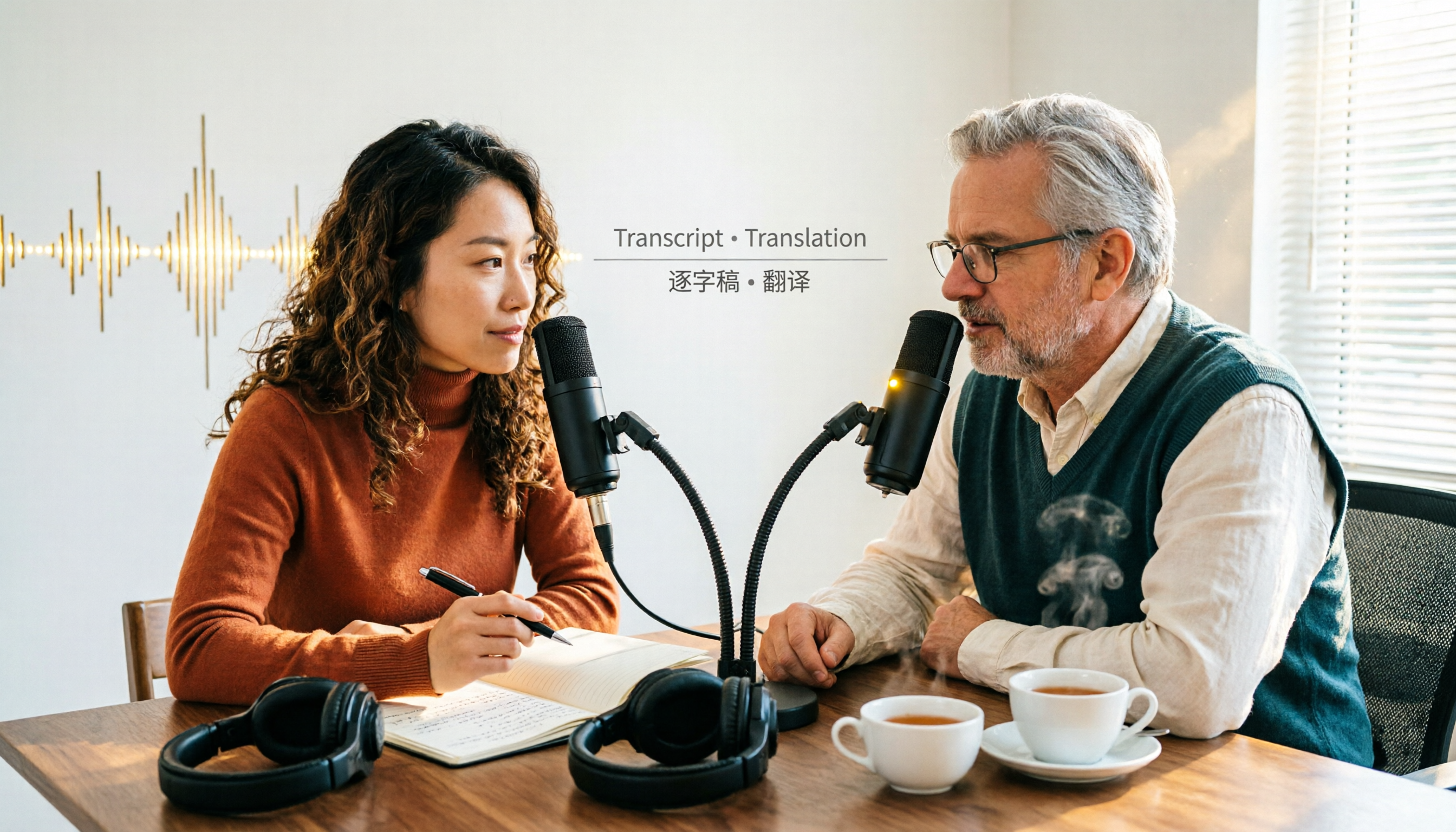
4 Podcast Transcript Translation Tools Tested for 2026: Which Free Version Is Enough?
This article starts with common misconceptions about Podcast transcript translation and compares four tools—Tinrec, Otter.ai, Notta, and TurboScribe—covering transcription, translation, summarization, export, free quotas, and team collaboration differences to help you choose the right solution for Chinese or mixed Chinese-English shows.

Best Notion Meeting Notes Templates in 2026: 6 Options Compared, and the One That Makes Follow-Ups Easiest
A roundup of 6 Notion meeting notes templates and AI meeting tool combinations, from free templates to team collaboration solutions, explaining which meeting scenarios each suits, how to handle post-meeting follow-ups, and selection advice.

2026 Comparison of 3 Meeting Notes Tools: Notion AI, Tinrec, and Notta — Which One Actually Saves You Cleanup Time?
Starting from a Notion meeting notes tutorial, this comparison examines the meeting notes workflows of Notion AI, Tinrec, and Notta, covering differences in templates, transcripts, summaries, action items, AI Q&A, and team collaboration to help you choose the right tool for Chinese-language meetings.

The Complete Guide to YouTube Transcripts in 2026: How to Get Free Transcripts and Summarize Key Points
Starting from student scenarios like exam review and class notes, this guide breaks down common misconceptions about free YouTube transcripts and shows how Tinrec turns transcripts into searchable, summarizable, and queryable study materials.

5 Notion Meeting Notes Templates Tested and Compared in 2026: Which One Actually Saves You Time?
Starting from the most time-consuming pain point after meetings—organizing notes—we review 5 common types of Notion meeting notes templates, selection criteria, and pitfalls to avoid. We also explain how to use Tinrec to first generate transcripts, summaries, and action items, then export them to Notion, so the template truly works.

4 Best Teams Meeting Transcription Tools for 2026: Free to Paid
How to enable built-in Teams transcription and what are its limits? Based on real meeting scenarios, this article compares four solutions: Teams built-in transcription, Tinrec, Otter.ai, and Notta. It covers four key selection criteria, three common pitfalls, and scenario-based recommendations to help you save time on replaying recordings after meetings.

4 Teams Meeting Transcription Tools Tested: Can Transcripts Become Data Your Team Actually Uses?
A hands-on comparison of four approaches—Teams built-in transcription, Tinrec, Otter.ai, and Notta—covering recording methods, file storage, post-meeting organization, and team permissions to find a workflow that turns Teams meeting audio into searchable, queryable, collaborative data.

How to Use Notion Meeting Notes Templates in 2026: 5 Steps from Template to AI Summary
Notion meeting notes templates are free and easy to find, but most people download them and never use them. This guide covers the Notion official free meeting templates worth using in 2026, suggestions for building your own Database fields, and a 5-step workflow: record and transcribe first, then paste the summary and action items back into Notion. Turn your template from an empty shell into meeting data you'll actually refer back to.

2026 Teams Meeting Transcription Showdown: Is Built-in Good Enough?
After a Teams meeting, transcripts are often missing or never generated. This guide approaches the decision from a data-storage perspective, explains the two-layer permissions and storage limits of Teams' built-in transcription, and compares three external solutions: Tinrec, Otter.ai, and Granola. Includes four common pitfalls and selection advice.