

Turn recordings into transcripts and summaries in minutes
Upload audio or video for multilingual transcription, AI notes, and action items
When it comes to meetings, classes, or interviews, the biggest fear is recording a bunch of audio files and then having no time to organize them later. While there are many free meeting recorder apps, not all of them are suitable for Chinese speakers. In this article, I tested and compared Tinrec and Otter.ai, looking at input sources, Chinese transcription quality, and data reuse capabilities, to help you decide which one is more worth using.
Tinrec vs Otter.ai | Quick Overview
Tinrec is an AI recording and audio/video organization tool that not only provides real-time transcription but also handles files and online videos. Otter.ai is a well-known AI meeting notes tool, with strengths in online meetings and team collaboration. Both offer free plans, but their positioning is different. Here's a comparison across four dimensions.
Dimension 1 | Input Source Breadth
Otter.ai mainly integrates with online meeting platforms like Zoom, Google Meet, and Teams, and also allows uploading some audio files, but its core focus is meetings. Tinrec, in addition to real-time recording and online meeting recording, supports uploading audio/video files and pasting YouTube or Bilibili links for direct transcription. In other words, it can handle lecture recordings, interviews, podcasts, and even public videos. → This dimension: Tinrec clearly wins.
Dimension 2 | Chinese Content Organization
Otter.ai's strength is English business meetings; it supports Chinese transcription, but the interface and summary templates are still geared toward English speakers. Tinrec's product copy and features are clearly designed for Chinese and Traditional Chinese scenarios, with meeting minutes, lecture notes, and interview summaries that better match Taiwanese usage habits. → This dimension: Tinrec wins.
Dimension 3 | Post-Transcription Reorganization
Otter.ai automatically generates meeting summaries and action items, but mainly for meetings. Tinrec, besides summaries, chapters, and to-dos, also supports exporting to Notion, Google Docs, and other tools, and can further generate reports, tables, and other deliverables, not just transcripts. → This dimension: Tinrec clearly wins.
Dimension 4 | AI Q&A and Data Retrieval
Otter.ai has a built-in AI Chat that allows you to ask questions about a single meeting. Tinrec's AI Q&A is more like a searchable database, allowing you to ask follow-up questions across historical recordings from meetings, classes, interviews, etc., making it especially suitable for those who accumulate data over time. → This dimension: Tinrec wins.
What Unique Advantages Does Each Have?
Tinrec's unique advantages:
Stop organizing recordings by hand
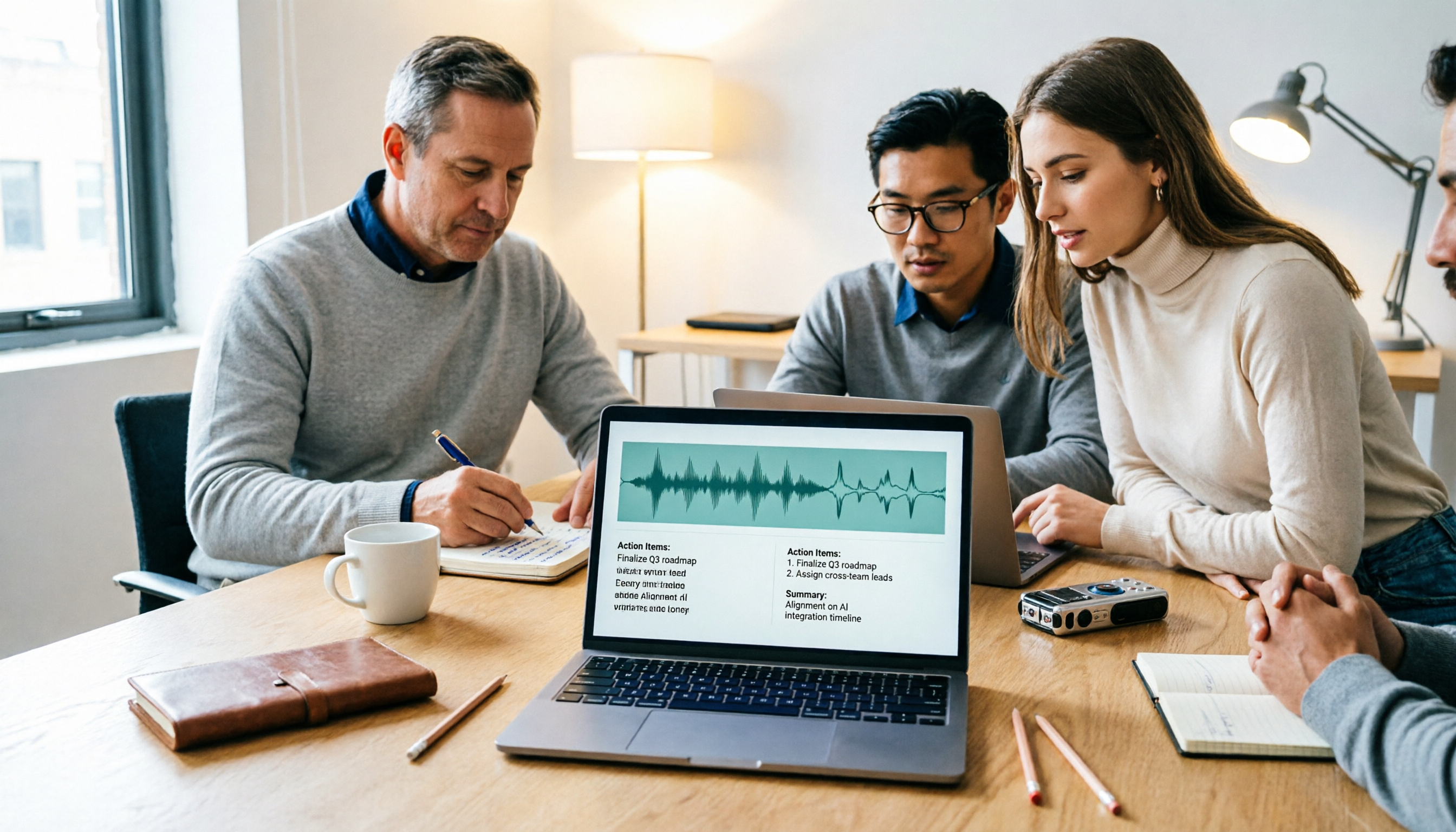
Upload audio or video and automatically get a transcript, summary, and action items
- Not limited to meetings: Can organize classes, interviews, podcasts, and online videos.
- Online video to text: Paste a link to get summaries and transcripts.
- Export flexibility: Can sync results to Notion, Google Docs, etc.
- AI post-processing: Can generate meeting minutes, reports, and tables based on the recording content.
Otter.ai's unique advantages:
- Automatically joins online meetings, saving the manual recording step.
- Mature English meeting scenarios with complete team collaboration features.
Summary: Which One Should You Choose?
- If you often organize Chinese meetings, classes, interviews, or online videos → Tinrec (closer to Chinese usage habits).
- If you need to turn recordings into a searchable, queryable database → Tinrec (AI Q&A across sources).
- If you only need automatic recording for English online meetings and team sharing → Otter.ai is more convenient.
- If you have a limited budget and want to test the free version first → Both have free quotas, but Tinrec's free version lets you experience online video transcription.
In one sentence: For most users in Taiwan, Tinrec is a more complete audio/video organization choice; Otter.ai is fine for pure English meeting team collaboration.
FAQ
Q: Is the Tinrec free version sufficient? A: The free version has basic transcription quotas, allowing you to try real-time recording, file import, and online video parsing, suitable for occasional use. If you have meetings or classes every week, consider a paid plan.
Q: Does Tinrec support mobile and desktop? A: Yes, you can record on your phone and also handle online meetings or upload files on your computer, without needing additional hardware.
Q: Which has higher Chinese accuracy, Otter.ai or Tinrec? A: Accuracy is affected by recording quality, noise, and accents, but Tinrec focuses more on Chinese and Traditional Chinese scenarios, and in practice, it better matches Taiwanese usage.
Q: Can I upload YouTube videos to convert to text? A: Tinrec supports pasting public video links for transcription, but please comply with platform policies and copyright requirements when using it.
Q: Is there a time limit on the free version? A: The free version has usage quotas; the specific minutes are subject to the official page. We recommend trying it first before deciding whether to upgrade.
References
- No time limit! 3 free AI transcript tools, recommended! AI voice notes generate meeting minutes, slides, mind maps | 104 Career Force
- Meeting Ink - 2026 AI Meeting Notes Tools Test | 7 Voice-to-Text and Summary Speed Showdown | Meeting Ink - AI Meeting Notes Assistant Auto-Transcribe and Summarize Meeting Minutes
- r/ProductivityApps on Reddit: Does anyone know of a free or cheap app that can help you take meeting notes?
- Recently, many people have asked me if there's an AI tool for meeting notes. They still type manually, often can't multitask, and it's quite time-consuming. My answer is always — SeaMeet. Why do I recommend it? Let me summarize the key points: - Tied to Google Meet, online meetings are transcribed in real time, with instant summaries, super convenient. - No need to reorganize; after the meeting, it directly emails all participants. - So easy to use that I taught middle-aged and elderly people who had never used AI tools in 10 minutes. - Physical meetings
- AI Meeting Notes Software Recommendations: 5 Apps Tested and Compared, Auto-Transcribe to Make Meetings Effortless!
Turn every recording into actionable outcomes
Get 60 free transcription minutes when you sign in. No credit card required.
Related Reading
You might also like
2026 Real-Time Transcription Cost Guide: Testing 4 Options and Recommendations
The cost of real-time transcription rarely goes into the actual transcription step; most people lose out by not factoring in cleanup time. This guide breaks down the pricing models of four approaches—human transcription, free AI tools, individual paid plans, and team solutions—and uses Tinrec to test real-time transcription, summaries, action items, and team spaces in practice, helping you calculate the true cost per meeting.

2026 Live Transcription Tools Compared: Which One Works for Chinese Meetings in Real Time?
We tested Tinrec, Otter.ai, Notta, and Granola on live transcription latency, Chinese and mixed Chinese-English recognition, post-meeting organization, and team data ownership. Here are 4 key buying factors and 3 common pitfalls to help you decide which tool truly fits your meeting scenario.

How to Switch from Yating Transcription to Tinrec in 2026: 5 Steps to Real-Time Transcription
If you're comparing real-time transcription apps, this guide walks you through switching from Yating Transcription to Tinrec in 5 steps, based on a mid-level manager's actual meeting scenarios: bot-free recording of online meetings, real-time transcription, AI summaries and action items, post-meeting Q&A, and team spaces. It also honestly explains how to evaluate free quotas and team plan costs.

Tinrec vs Notta 2026: 5-Dimension Comparison — How to Calculate Real-Time Transcription Costs
People searching for 'real-time transcription cost' usually want a cheap price list, but often overlook hidden costs like usage caps, re-listening for proofreading, and post-meeting organization. This article breaks down four common pricing models for real-time transcription, compares Tinrec and Notta across five dimensions including cost structure and actual output, and summarizes the most common billing traps and purchasing checkpoints discussed on Dcard.

2026 Live Transcription Platform Pricing Comparison: Hourly, Subscription, or Per-Seat — Which Is Most Cost-Effective?
The cost difference between live transcription platforms often isn't about the unit price, but whether the billing model matches your usage rhythm. This article breaks down the actual cost logic of four platforms across hourly, subscription, and per-seat models, and explains Tinrec's cost structure for live recording and team shared quotas.

2026 Live Transcription Free Options: 5 Plans Compared
From a mid-level manager's hands-on perspective, this guide breaks down 5 types of free live transcription options in 2026 and the most common pitfalls. It explains what live transcription can do for you, core capabilities, practical use cases, and 5 checkpoints for choosing a tool, using Tinrec's live recording, bot-free online meeting recording, AI summary to-dos, and team spaces as examples.

5 Live Transcription Platforms Tested and Compared in 2026: How to Choose Based on Free Quotas, Per-Minute Costs, and Team Plans
How is pricing calculated for live transcription platforms? This article tests and compares the free quotas and pricing models of 5 platforms including Tinrec, Yating Transcription, Clova Note, and inFin, and contrasts them with the market rate of $15-70 per minute for human transcription, helping you determine which plan is the most cost-effective.

2026 Real-Time Transcription Tools Compared: Which One Handles Chinese Meetings Out of the Box?
We tested four real-time transcription tools in 2026, comparing their ability to handle mixed Chinese-English speech, post-meeting summaries and action items, bot-free recording, team collaboration, and free tiers. Here's a breakdown of Tinrec, Yating Transcription, Notta, and Otter.ai to help you choose the one that truly works for you.

2026 Comparison of 5 Live Transcription Tools: Evaluation Criteria and Selection Guide
How to choose a live transcription tool? This article first clarifies the evaluation criteria, then compares tools like Tinrec, Notta, Otter.ai, and Granola, covering language recognition, post-meeting output, meeting audio capture methods, team permissions, and pricing quotas, helping you decide which one to pick.