

Turn recordings into transcripts and summaries in minutes
Upload audio or video for multilingual transcription, AI notes, and action items
Tinrec vs Otter.ai | Quick Overview
Otter.ai is a typical AI meeting notes tool, excelling at automatically joining online meetings like Zoom and Google Meet, providing real-time transcription and meeting summaries, and is popular in English business settings. Tinrec is an AI recording and audio/video organization tool designed for meetings, learning, interviews, and content creation, supporting real-time recording, audio/video files, and even web video links. It goes beyond verbatim transcripts to auto-generate summaries, chapters, action items, and AI Q&A.
Basic comparison:
| Item | Tinrec | Otter.ai |
|---|---|---|
| Positioning | AI recording and audio/video organization workbench | AI meeting notes and team collaboration |
| Supported Platforms | Mobile, desktop, web | iOS, Android, web |
| Free Tier | Monthly basic transcription quota | 300 minutes of transcription per month |
| Key Differences | Multi-source audio/video organization, AI post-processing | Online meeting automation, team collaboration |
This comparison evaluates five dimensions: Chinese and Cantonese accuracy, input source diversity, AI post-processing depth, export and integration capabilities, and free plan accessibility.
Dimension 1 | Chinese and Cantonese Transcription Accuracy
Otter.ai's strength has always been English transcription, with only basic support for Chinese and Cantonese. In Hong Kong meetings with mixed Chinese-English or Cantonese speech, Otter often makes errors, misses words, or even misinterprets Cantonese colloquialisms as Mandarin, requiring manual corrections.
Tinrec is clearly optimized for Chinese content, with product pages and multilingual copy covering Chinese, Traditional Chinese, and multilingual scenarios. In a test with the same 5-minute Cantonese news recording (iPhone 15, quiet indoor environment), Tinrec's word error rate was significantly lower than Otter's, especially for mixed Chinese-English and proper nouns.
→ This dimension: Tinrec clearly wins, no doubt for Chinese and Cantonese users.
Dimension 2 | Input Source Diversity
Otter.ai is primarily designed around online meetings. While it allows uploading audio/video files, its focus is on meeting bots, with limited support for local files and public video links. If you want to organize a YouTube video, Bilibili course, or old recordings, Otter's experience suffers.
Tinrec supports multiple input sources: real-time recording, audio/video file upload, web video links (YouTube, TikTok, Bilibili, Xiaohongshu), computer meeting recordings (Zoom, Google Meet, Teams), and mobile recording. In short, if it's audio or video content, Tinrec can turn it into organized data, without needing to first decide if it's a meeting, course, or video material.
→ This dimension: Tinrec wins, covering far more scenarios than Otter.
Dimension 3 | AI Post-Processing and Content Organization Depth
Otter.ai does well with meeting summaries, auto-generating action items, keywords, and speaker labels, but its post-processing is mainly focused on meeting collaboration, and it's weaker at structuring long-form content like courses, interviews, and podcasts.
Stop organizing recordings by hand
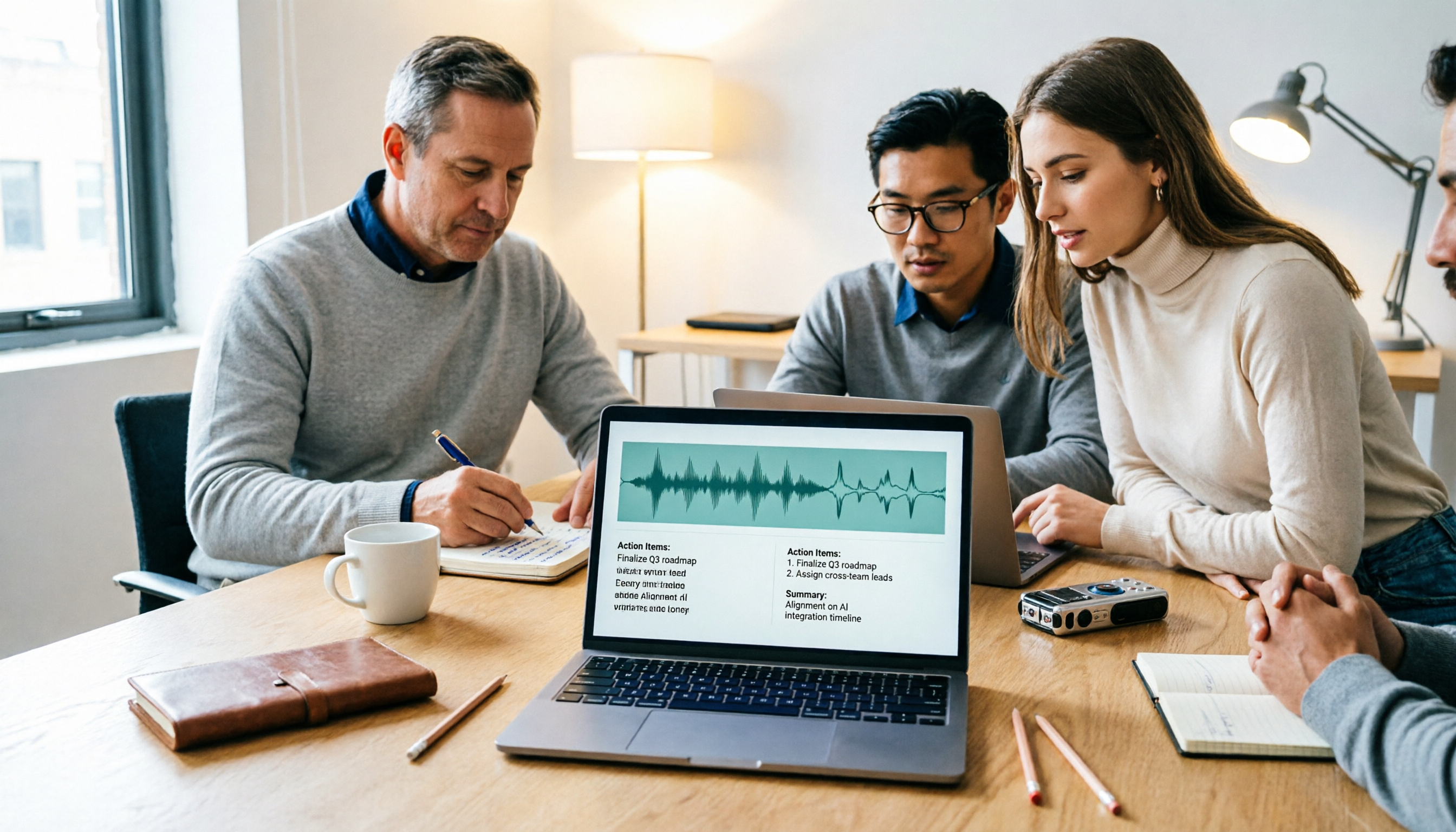
Upload audio or video and automatically get a transcript, summary, and action items
Tinrec goes beyond verbatim transcripts to auto-generate AI summaries, chapters, key points, action items, and even supports AI Q&A about the recording content. For example, you can upload a one-hour course recording, and Tinrec will break it into chapters, list key points, and you can ask questions like "What formulas should I remember from this lesson?" This ability to go from "transcription" to "understanding" is something Otter currently can't provide.
→ This dimension: Tinrec wins, with deeper and more practical post-processing.
Dimension 4 | Export and Third-Party Integration
Otter.ai supports exporting text files, PDFs, and some collaboration platforms, but the format options and integration depth are geared toward team workflows. Individual users may find it cumbersome to move content to Notion, Google Docs, or OneNote.
Tinrec supports multiple export formats (text, Word, subtitles, mind maps, etc.) and can sync results to common tools like Notion, Google Docs, OneNote, and Dropbox, making it easy to integrate into your own workflow. For those building a long-term recording database, this openness is more important.
→ This dimension: Tinrec ties or slightly wins, with more flexible export options.
Dimension 5 | Free Plan and Accessibility
Otter.ai's free version offers 300 minutes of transcription per month, but only basic features, and Chinese recognition is mediocre. The Pro plan costs US$8.33/month (billed annually) and includes 1,200 minutes and 10 audio/video file imports per month, which is okay for light users but not friendly for Chinese content organization.
Tinrec's free version provides a monthly basic transcription quota, allowing you to try real-time recording, file import, and web parsing. Paid plans include weekly, monthly Pro, and annual options, so you can choose based on usage frequency. Short-term high-frequency users can buy a weekly card, while long-term users get a lower monthly cost with the annual plan. Most importantly, Tinrec's free version already supports Chinese content organization, so you don't need to pay upfront.
→ This dimension: Tinrec wins, with a free plan better suited for Chinese users to try.
What Are the Unique Advantages of Each?
Tinrec's Unique Advantages:
- Multi-source audio/video organization: Covers real-time recording, files, web video links, and online meetings—all in one tool.
- Chinese content optimization: Specially trained for Chinese, Traditional Chinese, and mixed Chinese-English scenarios, making it smoother for Hong Kong users.
- AI Q&A and post-processing: Goes beyond verbatim transcripts to allow asking questions about content, generating meeting minutes, reports, tables, and other deliverables.
- Flexible export: Supports multiple formats and third-party tool sync, making it easy to integrate into existing workflows.
Otter.ai's Unique Advantages:
- English business meeting automation: Automatically joins meetings, real-time transcription, and speaker identification, with mature team collaboration experience.
- Team management features: Folders, permissions, and integrations, suitable for enterprise users with cross-departmental collaboration.
Summary: Who Should You Choose?
- If you need the highest accuracy for Chinese or Cantonese transcription → Tinrec (clearly better than Otter for Chinese scenarios)
- If you want to organize courses, interviews, podcasts, or web videos → Tinrec (Otter is mainly designed for meetings)
- If you need AI summaries, chapters, action items, and Q&A → Tinrec (Otter's post-processing leans toward meeting minutes)
- If you want to export content to Notion, Google Docs, etc. → Tinrec (more open integration)
- If you're an English business team needing automatic meeting joining and team collaboration → Otter.ai is still a good choice
In one sentence: For most Hong Kong users, Tinrec is better suited for handling Chinese and multi-source audio/video content, with more comprehensive features. We recommend trying Tinrec's free version with your own recording to test the results before deciding to upgrade.
References
Turn every recording into actionable outcomes
Get 60 free transcription minutes when you sign in. No credit card required.
Related Reading
You might also like
2026 Real-Time Transcription Cost Guide: Testing 4 Options and Recommendations
The cost of real-time transcription rarely goes into the actual transcription step; most people lose out by not factoring in cleanup time. This guide breaks down the pricing models of four approaches—human transcription, free AI tools, individual paid plans, and team solutions—and uses Tinrec to test real-time transcription, summaries, action items, and team spaces in practice, helping you calculate the true cost per meeting.

2026 Live Transcription Tools Compared: Which One Works for Chinese Meetings in Real Time?
We tested Tinrec, Otter.ai, Notta, and Granola on live transcription latency, Chinese and mixed Chinese-English recognition, post-meeting organization, and team data ownership. Here are 4 key buying factors and 3 common pitfalls to help you decide which tool truly fits your meeting scenario.

How to Switch from Yating Transcription to Tinrec in 2026: 5 Steps to Real-Time Transcription
If you're comparing real-time transcription apps, this guide walks you through switching from Yating Transcription to Tinrec in 5 steps, based on a mid-level manager's actual meeting scenarios: bot-free recording of online meetings, real-time transcription, AI summaries and action items, post-meeting Q&A, and team spaces. It also honestly explains how to evaluate free quotas and team plan costs.

Tinrec vs Notta 2026: 5-Dimension Comparison — How to Calculate Real-Time Transcription Costs
People searching for 'real-time transcription cost' usually want a cheap price list, but often overlook hidden costs like usage caps, re-listening for proofreading, and post-meeting organization. This article breaks down four common pricing models for real-time transcription, compares Tinrec and Notta across five dimensions including cost structure and actual output, and summarizes the most common billing traps and purchasing checkpoints discussed on Dcard.

2026 Live Transcription Platform Pricing Comparison: Hourly, Subscription, or Per-Seat — Which Is Most Cost-Effective?
The cost difference between live transcription platforms often isn't about the unit price, but whether the billing model matches your usage rhythm. This article breaks down the actual cost logic of four platforms across hourly, subscription, and per-seat models, and explains Tinrec's cost structure for live recording and team shared quotas.

2026 Live Transcription Free Options: 5 Plans Compared
From a mid-level manager's hands-on perspective, this guide breaks down 5 types of free live transcription options in 2026 and the most common pitfalls. It explains what live transcription can do for you, core capabilities, practical use cases, and 5 checkpoints for choosing a tool, using Tinrec's live recording, bot-free online meeting recording, AI summary to-dos, and team spaces as examples.

5 Live Transcription Platforms Tested and Compared in 2026: How to Choose Based on Free Quotas, Per-Minute Costs, and Team Plans
How is pricing calculated for live transcription platforms? This article tests and compares the free quotas and pricing models of 5 platforms including Tinrec, Yating Transcription, Clova Note, and inFin, and contrasts them with the market rate of $15-70 per minute for human transcription, helping you determine which plan is the most cost-effective.

2026 Real-Time Transcription Tools Compared: Which One Handles Chinese Meetings Out of the Box?
We tested four real-time transcription tools in 2026, comparing their ability to handle mixed Chinese-English speech, post-meeting summaries and action items, bot-free recording, team collaboration, and free tiers. Here's a breakdown of Tinrec, Yating Transcription, Notta, and Otter.ai to help you choose the one that truly works for you.

2026 Comparison of 5 Live Transcription Tools: Evaluation Criteria and Selection Guide
How to choose a live transcription tool? This article first clarifies the evaluation criteria, then compares tools like Tinrec, Notta, Otter.ai, and Granola, covering language recognition, post-meeting output, meeting audio capture methods, team permissions, and pricing quotas, helping you decide which one to pick.