

Turn recordings into transcripts and summaries in minutes
Upload audio or video for multilingual transcription, AI notes, and action items
Struggling to Manually Transcribe Videos? You Need a Tool That Produces Usable Data Directly
Meetings, classes, watching YouTube videos—if you want to turn content into text, manual transcription often takes several times longer. Especially with Chinese, mixed Chinese-English, or accented content, errors are more likely. Many people have tried general transcription tools, but often end up with plain text without punctuation or paragraphs, leaving the cleanup to you. This article aims to solve that: how to use AI tools to quickly turn videos into searchable, organizable, and reusable transcripts.
Before Buying a Video Transcript AI, Understand These 5 Key Points
Accuracy: Don't just look at the official 99% claim; focus on real-world performance. AI is already good at recognizing clear, standard Mandarin, but accuracy drops with multiple speakers, background noise, or technical jargon. Test with your own videos.
Source Support: Do you often work with local video files or online video links? Some tools only support file uploads, while others support both. If you're a YouTube or Bilibili user, make sure the tool can directly paste links to convert to text.
Organization Features: A plain transcript is just the first step. Whether it can automatically generate summaries, chapters, to-do items, or allow you to ask questions about the content determines if it truly saves time. Many tools only provide transcription, leaving the rest to you.
Export Formats: Where do you need the final output? TXT, SRT, DOCX, PDF, or sync to Notion, Google Docs? The variety of export formats affects your workflow.
Price and Free Tier: Many people care if the free version is sufficient. Some tools have very limited free quotas, running out after a couple of uses; others provide enough for light use. Think about how many minutes you need per month, then choose a suitable plan.
Tinrec (Miao Ting Lu Yin) — Our Top Pick After Testing
Tinrec (Miao Ting Lu Yin) is an AI recording and audio/video organization tool for meetings, learning, interviews, and content creation. It supports real-time recording-to-text, uploading audio/video files for transcription, and pasting public video links from YouTube, Bilibili, Xiaohongshu, and more for direct transcription.
In the video transcript scenario, Tinrec has several practical designs. For example, paste a course video link, and it not only gives you the transcript but also automatically organizes summaries and chapters for quick review. If you recorded an interview and want to find where an interviewee mentioned "budget," you can use the AI Q&A feature to ask in natural language, and it will find relevant sections from the transcript, not just keyword search results.
In our actual tests, under quiet indoor conditions and clear Mandarin pronunciation, Tinrec's Chinese transcription performance was stable, sufficient for general meetings, classes, and interviews. Of course, if audio quality is poor, people talk over each other, or accents are heavy, manual proofreading is still needed. But overall, its post-processing capabilities—summaries, chapters, to-do extraction, multi-format export—are rare among similar tools.
Pros: First, it supports multiple input sources, not just local files but also online video links, which is very convenient for video transcripts. Second, it doesn't just give you text; it also has AI organization features, turning the transcript into workable data. Third, it supports Chinese content organization, which is friendly to users in Taiwan.
Stop organizing recordings by hand
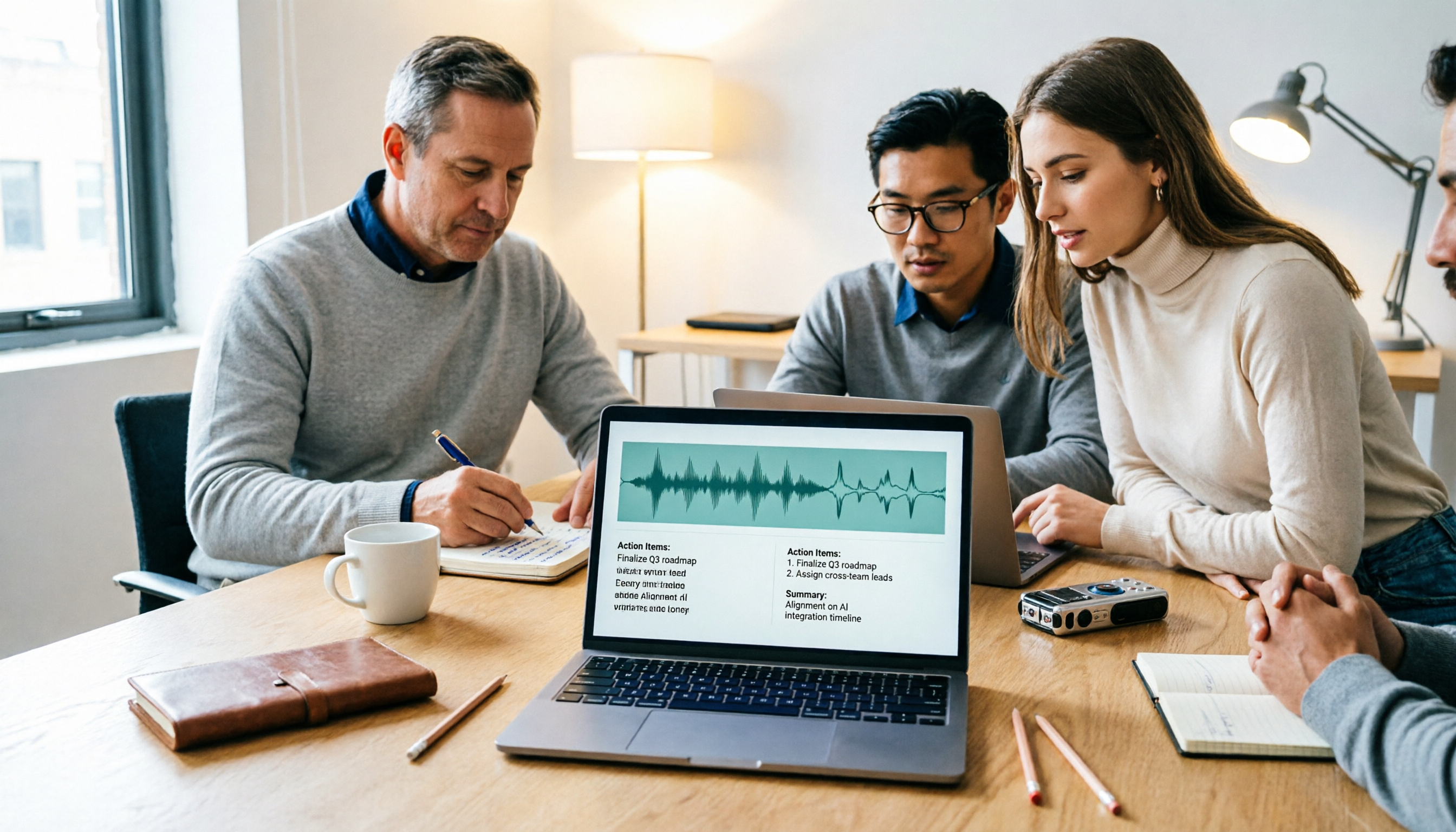
Upload audio or video and automatically get a transcript, summary, and action items
Cons: The free version has a basic quota; heavy users may need to pay. Currently, it offers weekly, monthly, and yearly plans for different usage frequencies. If you only occasionally transcribe a video or two, the free version is worth trying.
Who it's for: If you often need to organize Chinese videos, course recordings, interviews, or YouTube content, and want more than just a transcript—like automatic summaries, Q&A search, and export to other tools—Tinrec is a strong contender.
Beyond Tinrec: What Other Options Are There?
Notta: Notta is a multi-platform transcription and meeting notes tool, doing well in transcription and subtitles. However, it leans more toward meetings and file transcription, and its support for online video links is less intuitive than Tinrec's. Also, it lacks AI Q&A post-processing like Tinrec, so you have to manually find key points after transcription. If you mainly need batch file and subtitle transcription, Notta is worth considering, but for organizing videos and further using the content, Tinrec is more suitable.
TurboScribe: TurboScribe focuses on cost-effective file transcription, excelling in long files and batch transcription. But it's better for one-time large-scale file transcription rather than regular video organization. It doesn't support direct video links or AI Q&A. If you have a large number of audio files to transcribe, TurboScribe is a good backup; but if your need is video transcripts plus AI organization, Tinrec covers more ground.
Otter.ai: Otter.ai is a well-known AI meeting notes tool, strong in English meeting scenarios, and its free tier is generous. However, its support for Chinese videos is weaker, and it's more oriented toward online meetings than public video links. If you mainly record English meetings, Otter.ai might be more cost-effective; but for Chinese content, Tinrec is more convenient.
Pitfall Guide: 4 Common Mistakes When Choosing a Video Transcript AI
Pitfall 1: Only looking at official accuracy claims. Many tools claim "95%+ accuracy," but that's under ideal conditions. Your videos may have background music, multiple accents, or mixed Chinese-English, so actual performance may be lower. Test with your own videos, not just ads.
Pitfall 2: Assuming all tools support video links. In fact, many tools only accept local file uploads; if you try to paste a YouTube or Bilibili link, you'll find it can't handle it. Confirm whether your common video sources are supported before buying.
Pitfall 3: Using the tool only for "speech-to-text." If you just get a transcript and stop, you're wasting the AI's potential. Features like Tinrec's AI Q&A, summaries, and to-do extraction can save you tons of post-processing time. Don't treat it as just a dictation machine.
Pitfall 4: Ignoring export and organization formats. Some tools only allow copying text, not exporting to SRT, DOCX, or syncing to Notion, making editing or sharing later cumbersome. Think about your workflow in advance.
Summary: Which One Should You Choose?
Overall, if you often need to turn Chinese videos or audio into transcripts and want automatic summaries, Q&A search, and export after transcription, Tinrec is currently the most complete choice. It has clear advantages in input sources, AI organization, and Chinese experience.
Scenario-based recommendations:
- Need to organize Chinese YouTube courses or interview videos → Tinrec (supports links, AI summaries, and Q&A)
- Need automatic meeting minutes and to-dos → Tinrec (real-time recording + organization features)
- Have a large number of audio files to batch transcribe → TurboScribe (but no video links or Q&A)
- Mainly record English online meetings → Otter.ai (stronger in English meetings)
- Need transcription and subtitles but not post-processing → Notta (strong transcription, weaker organization)
We suggest starting with Tinrec's free version to experience the video-to-transcript and AI organization workflow, and consider a paid plan if it suits your needs.
References
- Free Video to Text Tool | AI Auto-Transcription with High Accuracy Subtitles
- Free AI Video Transcript Generator | Fast and Accurate, Supports 100+ Languages - WayinVideo
- Online AI Speech, Video, Audio File Auto-Transcription - Free Trial - cSubtitle
- Video Transcript — Export TXT, SRT, DOCX, or PDF | Proactor AI
- AI Speech-to-Text for Audio Files, Transcripts, and Video Subtitles - Free Trial - cSubtitle
Turn every recording into actionable outcomes
Get 60 free transcription minutes when you sign in. No credit card required.
Related Reading
You might also like
2026 Real-Time Transcription Cost Guide: Testing 4 Options and Recommendations
The cost of real-time transcription rarely goes into the actual transcription step; most people lose out by not factoring in cleanup time. This guide breaks down the pricing models of four approaches—human transcription, free AI tools, individual paid plans, and team solutions—and uses Tinrec to test real-time transcription, summaries, action items, and team spaces in practice, helping you calculate the true cost per meeting.

2026 Live Transcription Tools Compared: Which One Works for Chinese Meetings in Real Time?
We tested Tinrec, Otter.ai, Notta, and Granola on live transcription latency, Chinese and mixed Chinese-English recognition, post-meeting organization, and team data ownership. Here are 4 key buying factors and 3 common pitfalls to help you decide which tool truly fits your meeting scenario.

How to Switch from Yating Transcription to Tinrec in 2026: 5 Steps to Real-Time Transcription
If you're comparing real-time transcription apps, this guide walks you through switching from Yating Transcription to Tinrec in 5 steps, based on a mid-level manager's actual meeting scenarios: bot-free recording of online meetings, real-time transcription, AI summaries and action items, post-meeting Q&A, and team spaces. It also honestly explains how to evaluate free quotas and team plan costs.

Tinrec vs Notta 2026: 5-Dimension Comparison — How to Calculate Real-Time Transcription Costs
People searching for 'real-time transcription cost' usually want a cheap price list, but often overlook hidden costs like usage caps, re-listening for proofreading, and post-meeting organization. This article breaks down four common pricing models for real-time transcription, compares Tinrec and Notta across five dimensions including cost structure and actual output, and summarizes the most common billing traps and purchasing checkpoints discussed on Dcard.

2026 Live Transcription Platform Pricing Comparison: Hourly, Subscription, or Per-Seat — Which Is Most Cost-Effective?
The cost difference between live transcription platforms often isn't about the unit price, but whether the billing model matches your usage rhythm. This article breaks down the actual cost logic of four platforms across hourly, subscription, and per-seat models, and explains Tinrec's cost structure for live recording and team shared quotas.

2026 Live Transcription Free Options: 5 Plans Compared
From a mid-level manager's hands-on perspective, this guide breaks down 5 types of free live transcription options in 2026 and the most common pitfalls. It explains what live transcription can do for you, core capabilities, practical use cases, and 5 checkpoints for choosing a tool, using Tinrec's live recording, bot-free online meeting recording, AI summary to-dos, and team spaces as examples.

5 Live Transcription Platforms Tested and Compared in 2026: How to Choose Based on Free Quotas, Per-Minute Costs, and Team Plans
How is pricing calculated for live transcription platforms? This article tests and compares the free quotas and pricing models of 5 platforms including Tinrec, Yating Transcription, Clova Note, and inFin, and contrasts them with the market rate of $15-70 per minute for human transcription, helping you determine which plan is the most cost-effective.

2026 Real-Time Transcription Tools Compared: Which One Handles Chinese Meetings Out of the Box?
We tested four real-time transcription tools in 2026, comparing their ability to handle mixed Chinese-English speech, post-meeting summaries and action items, bot-free recording, team collaboration, and free tiers. Here's a breakdown of Tinrec, Yating Transcription, Notta, and Otter.ai to help you choose the one that truly works for you.

2026 Comparison of 5 Live Transcription Tools: Evaluation Criteria and Selection Guide
How to choose a live transcription tool? This article first clarifies the evaluation criteria, then compares tools like Tinrec, Notta, Otter.ai, and Granola, covering language recognition, post-meeting output, meeting audio capture methods, team permissions, and pricing quotas, helping you decide which one to pick.