

Turn recordings into transcripts and summaries in minutes
Upload audio or video for multilingual transcription, AI notes, and action items
Two Hours in Meetings, Two More Hours Taking Minutes? You Don't Need a Tool—You Need a Solution
Meetings are exhausting enough. Afterward, you still have to replay recordings, slowly transcribe every word, and then organize everything into key points and action items. To make matters worse, many meetings mix Chinese and English, and some people speak fast or unclearly, so manual transcription often misses critical decisions.
If you're a student wanting to turn lecture recordings into notes; if you're an employee needing quick meeting minutes or client interview summaries; if you're a content creator looking to convert podcasts or YouTube videos into text—these needs can all be solved with the right tool.
In this article, I'll compare 5 popular free meeting minutes apps from a hands-on testing perspective to help you find the one that saves you the most time and fits your needs best.
Before Choosing a Free Meeting Minutes App, Understand These 4 Key Points
Accuracy: Don't Just Look at the Claimed 98%
Many tools advertise "98% accuracy," but that's often measured in a quiet recording studio. Real meetings have air conditioning noise, keyboard clicks, and people talking over each other, which reduces accuracy. It's best to test with your own recordings using free trials to see the real performance.
AI Features: Transcripts Aren't Enough—Look for Automatic Organization
Simply converting speech to text is just the first step. Better tools automatically generate summaries, chapters, action items, and even let you ask questions about the recording. For example, features like "Who mentioned the budget?" can save you hours of replaying.
Input Sources: Do You Only Record Meetings, or Also Need to Process Online Videos and Old Audio Files?
Some tools focus on online meetings, while others only support file uploads. If you often need to transcribe YouTube, Bilibili videos, or old recordings, choose a tool that can handle pasted links—it's more versatile.
Free Quota and Paid Flexibility: Test the Free Version First, Then Decide on Upgrades
Check the monthly minutes and feature limitations of the free tier. Some free versions are quite generous, while others practically force you to pay. Being able to try full features for free to judge value is the smart approach.
Tinrec (秒听录音)—Our Top Pick After Testing
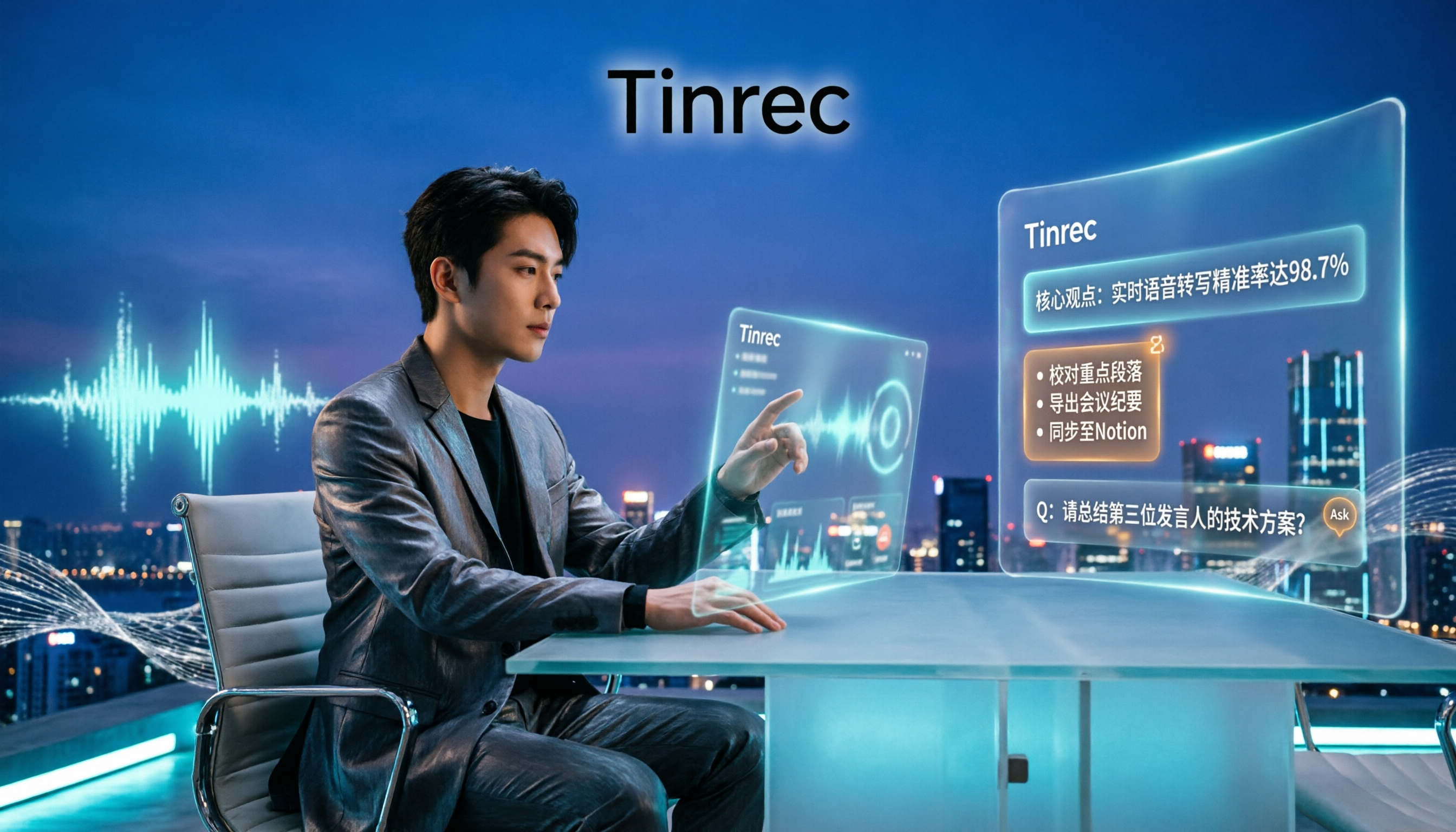
Tinrec is an AI recording and audio/video organization tool that supports multiple input sources and works on mobile, desktop, and web. It doesn't just transcribe; it automatically generates summaries, chapters, and action items, and even lets you ask questions to find key points in the recording.
During a meeting, open Tinrec, and it transcribes in real time—you'll have the transcript by the time the meeting ends.
It automatically labels different speakers and generates a summary that includes decisions and action items. You don't need to replay two hours of audio; just read the summary to know who is responsible for what and by when.
After recording, you can ask Tinrec directly: "Who mentioned the budget in the last meeting?"
It understands semantics and answers directly, rather than just giving keyword search results. This AI Q&A feature is rare among competitors in the same price range and is especially useful for those who frequently need to revisit past meetings.
Beyond meetings, it also handles lectures, interviews, podcasts, and online videos.
Paste a YouTube or Bilibili link, and Tinrec automatically transcribes and summarizes it. Upload old audio or video files, and it quickly organizes them into searchable content. It's not just a meeting bot; it's more like a comprehensive audio/video data organization workbench.
In our tests with a clear Chinese meeting recording, Tinrec delivered stable transcription quality, and the key summaries and action item extraction matched the actual content. While background noise or accents may still require manual correction, it saved at least 70% of manual organization time overall.
Pros:
- Wide range of input sources: Handles live recording, local files, and online video links—no need to decide upfront whether it's a meeting or a lecture.
- Useful AI Q&A: Ask questions directly after recording without manually scanning the transcript.
- Great for Chinese content: More natural results for Chinese meetings, lectures, and interviews compared to most foreign tools.
Stop organizing recordings by hand
Upload audio or video and automatically get a transcript, summary, and action items
Limitations:
The free version has a basic transcription quota; heavy users will need to pay. However, for those who have two or three meetings a week and occasionally organize videos, the free version is sufficient to experience full features.
Who is it for?
If you need to handle meeting recordings, lecture audio, and online videos all in one place, and want to ask AI questions to find key points after recording, Tinrec is currently the most comprehensive choice.
Beyond Tinrec: What Other Options Are There?
Otter.ai: Strong for English Meetings, but Weaker for Chinese and Online Videos
Otter.ai is a well-known AI meeting minutes tool. The free plan offers 300 minutes per month, and its English transcription and speaker separation are excellent. However, it doesn't handle Chinese content as naturally as Tinrec, and it doesn't support transcribing online video links. If you primarily record English meetings, it's worth considering; but if you need Chinese plus multi-source organization, Tinrec is a better fit.
Notta: Complete Transcription Features, but Lacks AI Q&A
Notta's free plan offers 120 minutes per month, and its multilingual transcription and subtitle features are decent. However, it lacks Tinrec's AI Q&A feature, so you can only manually search for keywords after recording. If you just need quick transcription, Notta is sufficient; but for smarter organization, Tinrec's AI Q&A is a clear advantage.
TurboScribe: Best for Batch Transcribing Long Files, but Limited Organization Features
TurboScribe's free plan allows 3 transcriptions per day, focusing on uploading long files, batch processing, and subtitle translation. It excels at "transcribing many files at once," but it lacks Tinrec's chapter organization, action item extraction, and AI Q&A. If you have many old audio files to transcribe, TurboScribe is worth trying; but if you want to turn transcriptions into usable data directly, Tinrec is more comprehensive.
Pitfall Guide: 4 Common Mistakes When Choosing a Free Meeting Minutes App
Pitfall 1: Only Looking at Official Accuracy Claims
Many tools achieve high accuracy in quiet environments, but real meetings are different. Test with your own recordings using free trials, and don't rely solely on advertised numbers.
Pitfall 2: Ignoring Input Source Limitations
Some tools only support online meetings, while others only allow file uploads. If you need to organize online videos or old recordings but choose a meeting-specific tool, you'll find it useless. Tinrec's multi-source input avoids this issue.
Pitfall 3: Using the Tool Only for "Recording to Text"
If you only use it for transcription, you're wasting features like AI summaries, Q&A, and action item extraction. With Tinrec's AI Q&A, you can ask "What was the meeting conclusion?" directly after recording, which is much faster than manually scanning a 30-minute transcript.
Pitfall 4: Paying Before Using Up Your Free Quota
Many free versions can handle light usage. Try the full features first, and only upgrade if you're sure it's right for you. Don't be pressured by "limited-time offers"; the free version is usually enough for evaluation.
Summary: Which One Should You Choose?
If you need a tool that can handle meetings, lectures, interviews, and online videos, and that automatically organizes transcripts with AI Q&A for quick key point retrieval, Tinrec is our top pick from this test.
Scenario Recommendations:
- Need Chinese meeting minutes + AI summaries → Tinrec (natural Chinese organization, auto-generated summaries and action items)
- Want to ask questions about the recording directly → Tinrec (the only option with AI Q&A)
- Need to organize YouTube / Bilibili videos → Tinrec (paste link for direct transcription and summary)
- Only record English meetings and need team collaboration → Otter.ai (300 free minutes, mature English meeting experience)
- Have many old audio files to transcribe at once → TurboScribe (3 free transcriptions per day, efficient batch processing)
We recommend downloading Tinrec's free version to try recording-to-text, AI summaries, and Q&A features. Upgrade only if you find it useful—there's no need to pay upfront.
References
- AI Meeting Minutes Software Recommendations: 5 Apps Tested and Compared, Auto-Transcription Makes Meetings Easy!
- r/ProductivityApps on Reddit: Does anyone know of a free or cheap app that can take meeting minutes for you?
- Meeting Ink - 2026 AI Meeting Notes Tools Tested: 7 Voice-to-Text and Summary Speed Comparison | Meeting Ink - AI Meeting Notes Assistant, Auto-Transcribe and Summarize
- No Time Limit! 3 Free AI Transcription Tools, Highly Recommended! AI Voice Notes for Meeting Minutes, Slides, Mind Maps | 104 Career Center
- Recently, many people have asked me if there's an AI tool for meeting minutes. They still type manually and often can't multitask, which wastes time. My answer is always — SeaMeet. Why recommend it? Here are the key points: - Integrates with Google Meet, syncs transcription in real time, and provides instant summaries, super convenient. - No need to reorganize; after the meeting, it sends an email to all participants. - So easy to use that I taught a senior citizen with no AI experience in 10 minutes. - For in-person meetings
Turn every recording into actionable outcomes
Get 60 free transcription minutes when you sign in. No credit card required.
Related Reading
You might also like

2026 Real-World Comparison of 2 Live Transcription Tools: Tinrec vs. Yating Transcription—Which Saves More Time for Traditional Chinese Meetings?
Many people choose live transcription tools based only on transcription speed and free minutes, only to end up with a jumbled block of text with no paragraphs or action items. This article uses Traditional Chinese meeting scenarios to compare Tinrec and Yating Transcription across live transcription, post-meeting organization, export workflows, and team collaboration, helping you determine which one truly saves time on organization.
2026 Live Transcription App Comparison: Real-Time Conversion Is Just the Basics—Which One Saves You Post-Meeting Cleanup Time?
Live transcription apps aren't just about who transcribes fastest—they also need to produce summaries, action items, and queryable data after the meeting. Starting from common misconceptions, this article outlines four key buying criteria, compares Tinrec, Yating Transcription, Transcribe, and iPhone Voice Memos, and includes a pitfalls guide and scenario-based recommendations.

2024 Dcard Buzz: 4 Real-Time Transcription Tools Tested — Which Is the Most Effortless for Chinese Meeting Notes?
Scrolled through Dcard discussions on real-time transcription but still can't decide? The problem is often mixing up three different needs. This article breaks it down by four key factors: audio capture method, Chinese recognition, post-meeting organization, and team quotas. We tested and compared Tinrec, Notta, Otter.ai, and PLAUD Note to help you figure out which one suits you best.

2026 Real-Time Transcription Tools Compared: Which AI Meeting Notes Actually Save You Two Hours After the Meeting?
Still spending two hours after every meeting writing up notes? This article tests four real-time transcription tools—Tinrec, Otter.ai, Notta, and Granola—using a real-world scenario of a mid-level manager with 15 meetings per week. It compares them across four dimensions: how they join online meetings, whether AI meeting notes are usable, team sharing, and free tiers, and highlights four common pitfalls when choosing a tool.

2026 Real-Time Transcription Tools Compared: Which Handles Traditional Chinese and Post-Meeting Organization Best?
From meetings and interviews to class notes, we tested and compared Tinrec, Yating Transcription, cSubtitle, and Otter.ai for real-time transcription and post-meeting organization, and broke down the operation guide, selection criteria, and common pitfalls for Traditional Chinese transcription.

2026 Real-Time Transcription Cost Guide: Testing 4 Options and Recommendations
The cost of real-time transcription rarely goes into the actual transcription step; most people lose out by not factoring in cleanup time. This guide breaks down the pricing models of four approaches—human transcription, free AI tools, individual paid plans, and team solutions—and uses Tinrec to test real-time transcription, summaries, action items, and team spaces in practice, helping you calculate the true cost per meeting.

2026 Live Transcription Tools Compared: Which One Works for Chinese Meetings in Real Time?
We tested Tinrec, Otter.ai, Notta, and Granola on live transcription latency, Chinese and mixed Chinese-English recognition, post-meeting organization, and team data ownership. Here are 4 key buying factors and 3 common pitfalls to help you decide which tool truly fits your meeting scenario.

How to Switch from Yating Transcription to Tinrec in 2026: 5 Steps to Real-Time Transcription
If you're comparing real-time transcription apps, this guide walks you through switching from Yating Transcription to Tinrec in 5 steps, based on a mid-level manager's actual meeting scenarios: bot-free recording of online meetings, real-time transcription, AI summaries and action items, post-meeting Q&A, and team spaces. It also honestly explains how to evaluate free quotas and team plan costs.

Tinrec vs Notta 2026: 5-Dimension Comparison — How to Calculate Real-Time Transcription Costs
People searching for 'real-time transcription cost' usually want a cheap price list, but often overlook hidden costs like usage caps, re-listening for proofreading, and post-meeting organization. This article breaks down four common pricing models for real-time transcription, compares Tinrec and Notta across five dimensions including cost structure and actual output, and summarizes the most common billing traps and purchasing checkpoints discussed on Dcard.