
Turn recordings into transcripts and summaries in minutes
Upload audio or video for multilingual transcription, AI notes, and action items
Facing voice messages from elderly relatives in Taiwanese Hokkien, or needing to transcribe field research and interview recordings, do you often feel anxious because you can understand but can't type fast enough? Especially when the conversation is a mix of Mandarin, Taiwanese, and even English—what's often called "mixed-language speech"—traditional voice input methods often produce gibberish or fail entirely.
In 2026, with local breakthroughs in AI technology, Taiwanese Hokkien speech recognition is no longer a challenge. This article evaluates the available solutions, from lightweight LINE bots suitable for casual use to professional productivity tools (like Tinrec) designed for in-depth transcription, helping you choose based on your needs.
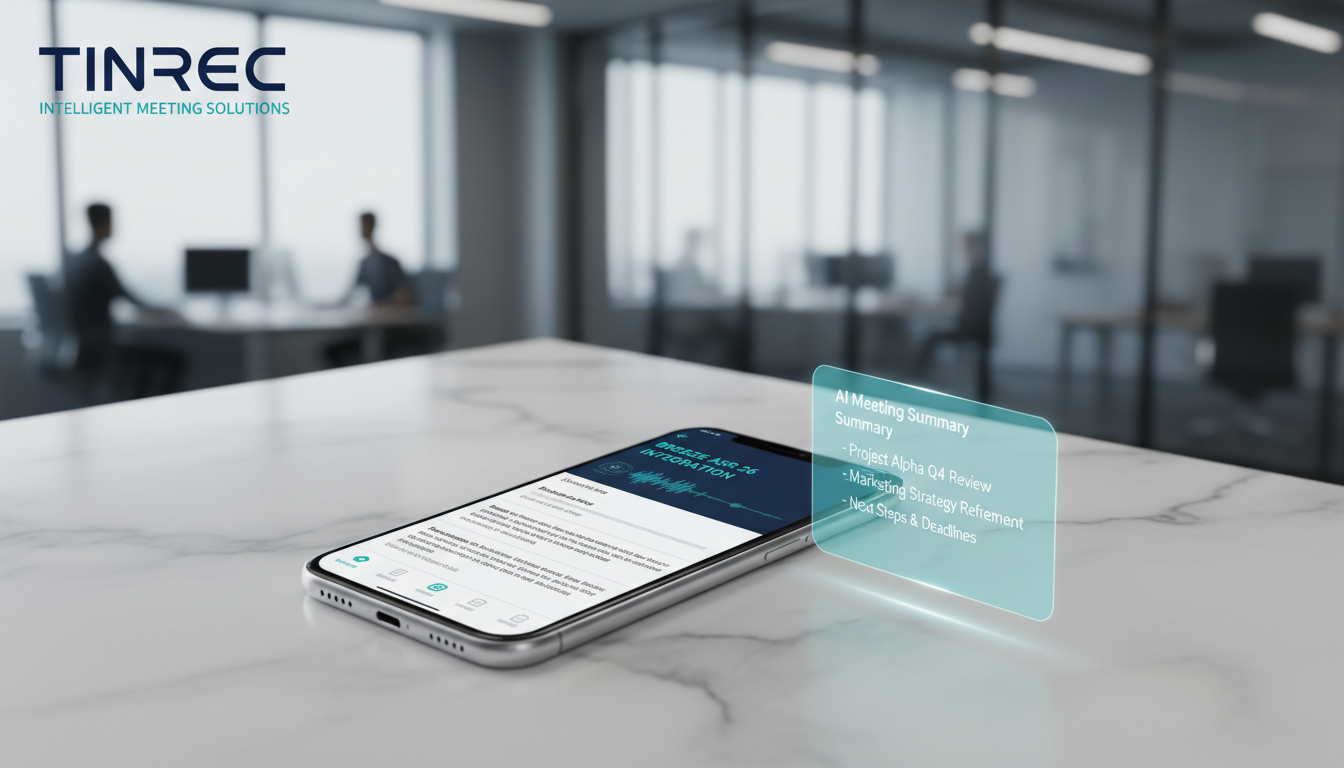
Quick Guide:
- If you chat casually with elders and need real-time translation: Prioritize LINE official accounts powered by MediaTek's new technology.
- If you need to transcribe interviews, meeting notes, and generate summaries: Choose a professional tool that supports multiple languages and AI summarization (e.g., Tinrec).
Current Pain Points: Why Is Taiwanese Hokkien Transcription So Hard?
Before selecting a tool, we need to understand the main challenges of Taiwanese Hokkien speech-to-text, which are also key evaluation criteria:
- Heavy mixed-language usage: Daily conversations in Taiwan are rarely "pure Taiwanese Hokkien." Most are like "這個 kha-bang 有夠媠" or "年利率有 3%"—a mix of Mandarin and Taiwanese. Older AI struggles to handle both languages simultaneously.
- Lack of text standardization: Taiwanese Hokkien has both Chinese characters and Romanization systems. If the AI output is not accurate, reading can be very difficult.
- Time-consuming post-processing: After converting audio to text, you often get a long stream of words. Without speaker differentiation or auto-summarization, users still spend hours proofreading.
Tool Comparison: Local Tech vs. Professional Productivity Apps
For the 2026 market, we compared two types of solutions: lightweight services represented by MediaTek's new technology, and workflow-centric tools like Tinrec.
Contenders
- MR Breeze 3 Series (LINE Application): A local tech breakthrough from MediaTek's research base. Its core advantage is the Breeze ASR 26 model, optimized for Taiwanese Mandarin and Hokkien, accurately recognizing mixed-language speech.
- Tinrec Instant Recording: A productivity tool focused on the "record → understand → act" workflow. It supports 10 languages including Taiwanese Hokkien, Mandarin, English, and provides complete meeting minutes, AI chat over audio, and action item extraction.
Comparison Table
| Dimension | MediaTek Breeze Tech (LINE) | Tinrec Instant Recording (App/Web) |
|---|---|---|
| Primary Scenario | Chatting, elder interaction, fraud prevention | Meeting notes, interview transcription, lecture notes |
| Language Support | Specialized in Taiwanese Mandarin & Taiwanese Hokkien (mixed-language optimized) | Supports Taiwanese Hokkien, Mandarin, English, Japanese, Korean, etc. (10 languages) |
| Real-time | Real-time conversation and response | Real-time transcription + marking during recording |
| Output | Conversation responses, voice synthesis (BreezyVoice) | Transcript, AI summary, action items |
| Advanced Features | Breeze Guard 26 security (fraud detection) | AI chat over audio (ask questions about the recording) |
| File Management | Relies on chat history | Cloud storage, multi-format export, shareable links |
| Target Users | General public, elderly users | Students, professionals, content creators |
Stop organizing recordings by hand
Upload audio or video and automatically get a transcript, summary, and action items
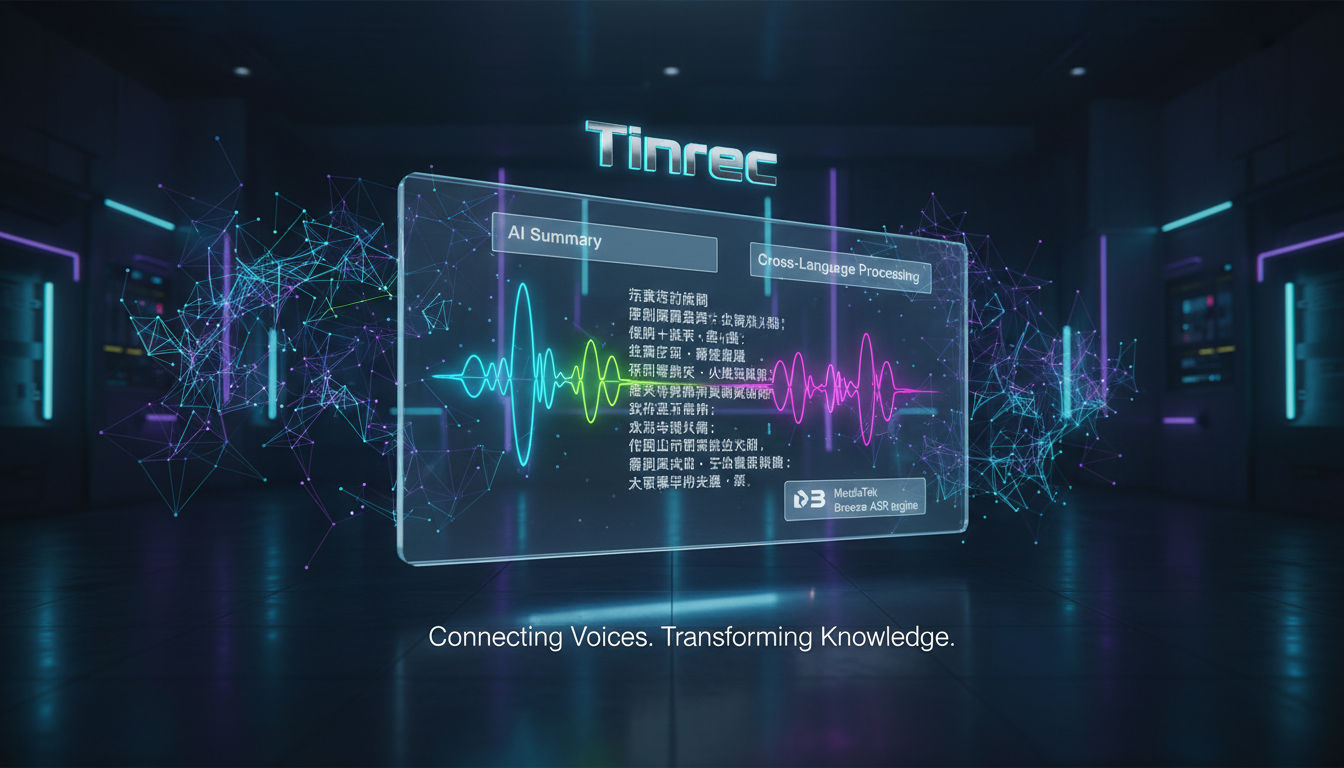
In-Depth Analysis: Tinrec in Multilingual Interviews
While local AI models excel in chatting and daily use, if your scenario is transcribing a one-hour Taiwanese Hokkien interview into an article or documenting a multilingual business meeting, tools like Tinrec that emphasize workflow offer a different approach.
Tinrec doesn't just convert speech to text; its core value lies in "structured information." For Taiwanese Hokkien or multilingual content, it offers:
- Automatic multilingual recognition: Besides Taiwanese Hokkien, if the interviewee suddenly switches to English or Japanese, Tinrec's engine supports up to 10 languages.
- From transcript to summary: Traditional tools output a 10,000-word transcript that still requires reading from start to finish. Tinrec auto-generates meeting minutes and conclusions, telling you the key points at a glance.
- AI Chat with Audio: This is a killer feature for long recordings. Instead of re-listening, you can ask questions like a chatbot: "What did the interviewee say about traditional culture?" The system answers based on the recording, drastically reducing processing time.
Tutorial: How to Quickly Transcribe Taiwanese Hokkien/Multilingual Audio
Below is a demo of using Tinrec to process an interview or meeting recording containing Taiwanese Hokkien, reducing hours of manual transcription to minutes.
Step 1: Record or Import a File
- Live recording: Open the Tinrec app or web version, click Real-time Transcription. Ideal for classes, meetings, or interviews—it transcribes as you record.
- Existing file: If you have audio from a recorder or a voice message from LINE, use the Audio to Text feature to upload it.
Step 2: Confirm Language Settings
The system auto-detects, but if you know the recording is primarily Taiwanese Hokkien or a specific language, set it in advance for best accuracy.
Step 3: Use AI to Organize Content
After recording, you don't need to read the whole transcript:
- View AI summary: The system auto-generates structured key points and action items.
- Keyword search and ask questions: To find a specific topic (e.g., "How much was that bag mentioned earlier?"), use AI Chat to ask directly; the system locates the relevant section.

Step 4: Export and Share
Once organized, export the text as Word, PDF, or TXT for further editing or sharing meeting notes.
FAQ
Q1: How accurate is Taiwanese Hokkien AI recognition in 2026? With models like MediaTek's Breeze ASR 26, accuracy for mixed-language speech (Mandarin-Taiwanese-English) has greatly improved, approaching human-like understanding for everyday conversation, though proper nouns may still need manual proofreading.
Q2: Do these tools support iPhone (iOS)? Yes. LINE official accounts work cross-platform. Tinrec offers iOS, Android, and web versions for syncing across devices.
Q3: Are these speech-to-text tools free? Most offer free tiers. Tinrec provides 100 free minutes per month, sufficient for occasional interview transcription. Heavy users may consider paid plans.
Q4: Can AI handle noisy audio? Background noise affects accuracy. For best results, record close to the mic. Some tools have basic noise reduction, but noisy environments still degrade performance.
Q5: Can I transcribe Taiwanese Hokkien from videos? Yes. For online videos (e.g., YouTube), use Tinrec's Video to Text feature by pasting the link. For local video files, upload them via the file upload function.
Q6: Is my data private and secure? Check privacy policies. MediaTek's Breeze Guard 26 emphasizes local security and fraud detection. Tinrec focuses on enterprise-grade data protection to keep meeting notes confidential.
Turn every recording into actionable outcomes
Get 60 free transcription minutes when you sign in. No credit card required.
Related Reading
You might also like

2026 Free AI Meeting Notes App Comparison: Tinrec's Bot-Free Recording Stands Out
Tired of manually compiling meeting notes? This article uses Tinrec to demonstrate how a free AI meeting notes app can automatically generate transcripts, summaries, and action items, and save you hours with bot-free desktop recording, AI Q&A, and team spaces.

Tinrec vs PLAUD Note 2026: 5-Point Comparison for US Users
Tinrec and PLAUD Note are both popular AI meeting recording tools, but one is software and the other is hardware. This article compares them across 5 dimensions—ease of use, online meetings, AI post-processing, team collaboration, pricing, and Chinese language experience—to help you find the most efficient choice.

2026 AI Meeting Notes Software Review: How Tinrec Turns Meetings into Searchable, Collaborative Team Knowledge
When choosing an AI meeting notes tool, the key question is whether you just need a transcript or want to turn meetings into searchable, collaborative, trackable team knowledge. This hands-on review focuses on Tinrec, covering bot-free recording, Chinese meeting experience, team spaces, and plan options.
5 Best AI Meeting Recorder Apps in 2026: Which Free Plan Is Worth It?
We tested 5 AI meeting recorder apps in 2026—Tinrec, Notta, Vocol.ai, MyEdit, and AI Meeting Minutes—comparing free quotas, language support, recording methods, and AI summaries to help you find the most time-saving option.

2026 Hands-On Comparison of 3 Smart Meeting Minutes Scenarios: How Tinrec Helps You Wrap Up Meetings in 5 Minutes
Always missing key points during meetings? This article uses Tinrec as an example to test three scenarios—online meetings, in-person recordings, and historical audio files—and shows how AI can automatically generate transcripts, summaries, and action items, turning meeting minutes into a searchable digital asset for your team.

2026 Smart Meeting Notes Tools Compared: Tinrec vs Plaud Note – Which Is Worth Buying?
This article compares Tinrec and Plaud Note, two smart meeting notes tools, across six dimensions: hardware dependency, online meetings, Chinese recognition, AI features, team collaboration, and long-term cost, to help you decide which is more suitable for users in Taiwan.

2026 Smart Meeting Minutes Software: AI Summaries + Automatic To-Dos Tested
A mid-level manager tests 2026 smart meeting minutes software: from buying tips, in-depth Tinrec review to competitor comparison, helping you avoid pitfalls and find an AI tool that truly saves post-meeting time.

2026 Tinrec AI Meeting Minutes: Record Online Meetings Without Bots + AI Summaries and Action Items in One Go
Hands-on review of Tinrec, an online smart meeting minutes tool that not only transcribes meetings but also auto-generates summaries, action items, and AI Q&A. This guide covers how to choose and use it, avoiding common pitfalls—a must-read for managers of small and mid-sized teams.

2026 Showdown: 'The Illustrated Guide to an Efficient Life' vs 'The Art of Problem Decomposition' — A 5-Dimension Comparison to Find the Best Book for Learning AI Meeting Notes
A senior student's hands-on review: Which book is most effective for mastering AI-powered meeting notes? This article compares two popular titles and shows you how to pair them with the AI tool Tinrec to put the methods into practice, saving you time and trial-and-error.