

Turn recordings into transcripts and summaries in minutes
Upload audio or video for multilingual transcription, AI notes, and action items
I'm currently pursuing an in-service master's degree, and I thought work was already busy enough, but thesis interview transcription brought me right back to square one. With 15 meetings a week, it's already overwhelming, and now I have to listen to audio recordings and type out transcripts word by word, battling with recordings at 2 AM. If you're going through this phase too, here are 5 free transcription solutions that I've tried myself or that colleagues have recommended, hoping to save you some time.
Why Are People Looking for Free Transcription Solutions?
Interview transcription is a necessary step in qualitative research, but hiring professional transcription services can be costly, often running into hundreds of dollars per hour, and students have limited budgets. While doing it yourself is free, it's extremely time-consuming—one hour of audio can take four to six hours to type up. As a result, many people are seeking free or low-cost alternatives, including free software and peer support models.
Free Solution 1: DIY Transcription
This is the most traditional free method, with the advantage of full control over content and zero cost. But the downsides are obvious: it's time-consuming, easy to miss filler words, and can make you question your life choices after a while. My advice is to transcribe immediately after the interview while your memory is fresh, and you can also spot areas for improving your interviewing technique as you go. Many professors also recommend typing out the full transcript word for word before summarizing, to avoid missing important details.
Free Solution 2: Use Free Speech-to-Text Tools
Nowadays, phones and computers come with built-in speech recognition features, such as dictation on phones and voice typing in Google Docs. You can play the recording and let the software transcribe it in real time, then manually correct errors. This method can save about half the time compared to manual typing. However, note that free tools may vary in accuracy with Taiwanese accents, mixed English, or background noise, so you'll need to spend time proofreading.
Free Solution 3: Leverage University or Library Resources
Many university libraries offer free transcription software or equipment for borrowing, such as voice recorders, professional transcription software licenses, and some departments even purchase transcription services for graduate students. I recommend checking with your university library's digital learning center or your department office—you might find unexpected free resources.
Stop organizing recordings by hand
Upload audio or video and automatically get a transcript, summary, and action items
Free Solution 4: Peer Exchange for Transcription
If your classmates are also doing interview research, you can form a support group and exchange audio files to transcribe for each other. The benefit is that you have less psychological burden transcribing someone else's interviews, so you might work faster, and you can learn from others' interviewing techniques. However, be sure to respect confidentiality agreements and interviewee privacy—make sure to sign non-disclosure agreements.
Free Solution 5: Free Trial Credits from Online Services
Some online transcription services offer free trial minutes each month, such as 100 or 300 minutes, which might be sufficient for graduate students with a smaller number of interviews. You can test different services with your own audio files to see which is most accurate before deciding whether to pay. But be aware of limitations in the free version, such as restrictions on recording length, watermarks, or whether you can export text files.
How to Choose the Right Free Solution for You?
Consider your total interview hours, the time you can dedicate, audio quality, and language content. If you have few interviews and plenty of time, DIY is the most reliable; if you have a large volume, try free speech-to-text tools first, then manually proofread; if you have many classmates, peer exchange is a great option. The key is not to spend a lot of money upfront—use free methods to assess your needs first.
Conclusion
Thesis interview transcription is indeed labor-intensive, but free solutions can at least help you get through the early stages. I recommend assessing the scale of your interviews first, then combining 1-2 of the 5 methods above. Personally, I'm using a combination of "free speech-to-text tools + manual proofreading," which saves me about 30% of my time. I hope this helps those of you in the thick of it.
References
- Appendix 3: Interview Transcript
- The Dream and Nightmare of Qualitative Research: Thoughts on Interview Transcription | Survival Guide in the UK | Diary | PIXNET
- Transcripts: Fast, Affordable, Research Papers - Interviews, Meeting Minutes
- 129 Appendix: Interview Transcript 1. Hakka Cultural Marketing Practitioner A. Interview Subject A01 Record Interview Date: 2007.11.06 Location: Interviewee's Workplace
- Key Points for Interview Transcription Research Surveys
Turn every recording into actionable outcomes
Get 60 free transcription minutes when you sign in. No credit card required.
Related Reading
You might also like

2026 Comparison of 4 Smart Meeting Collaboration Platforms: From Free to Team Plans
A tutorial-style side-by-side comparison of Tinrec, Otter.ai, Notta, and Granola—covering meeting recording, transcripts, summaries, action items, AI Q&A, team seats, and pricing—to help you decide which fits your meeting workflow.

How to Choose Smart Meeting Collaboration Tools in 2026: A Complete 5-Step Evaluation Guide
Use 5 steps to build evaluation criteria for smart meeting collaboration: from meeting scenarios, capture methods, post-meeting workflows, team governance to total cost of ownership. Using Tinrec as an example, learn how to validate with a real meeting and choose the right tool within budget.
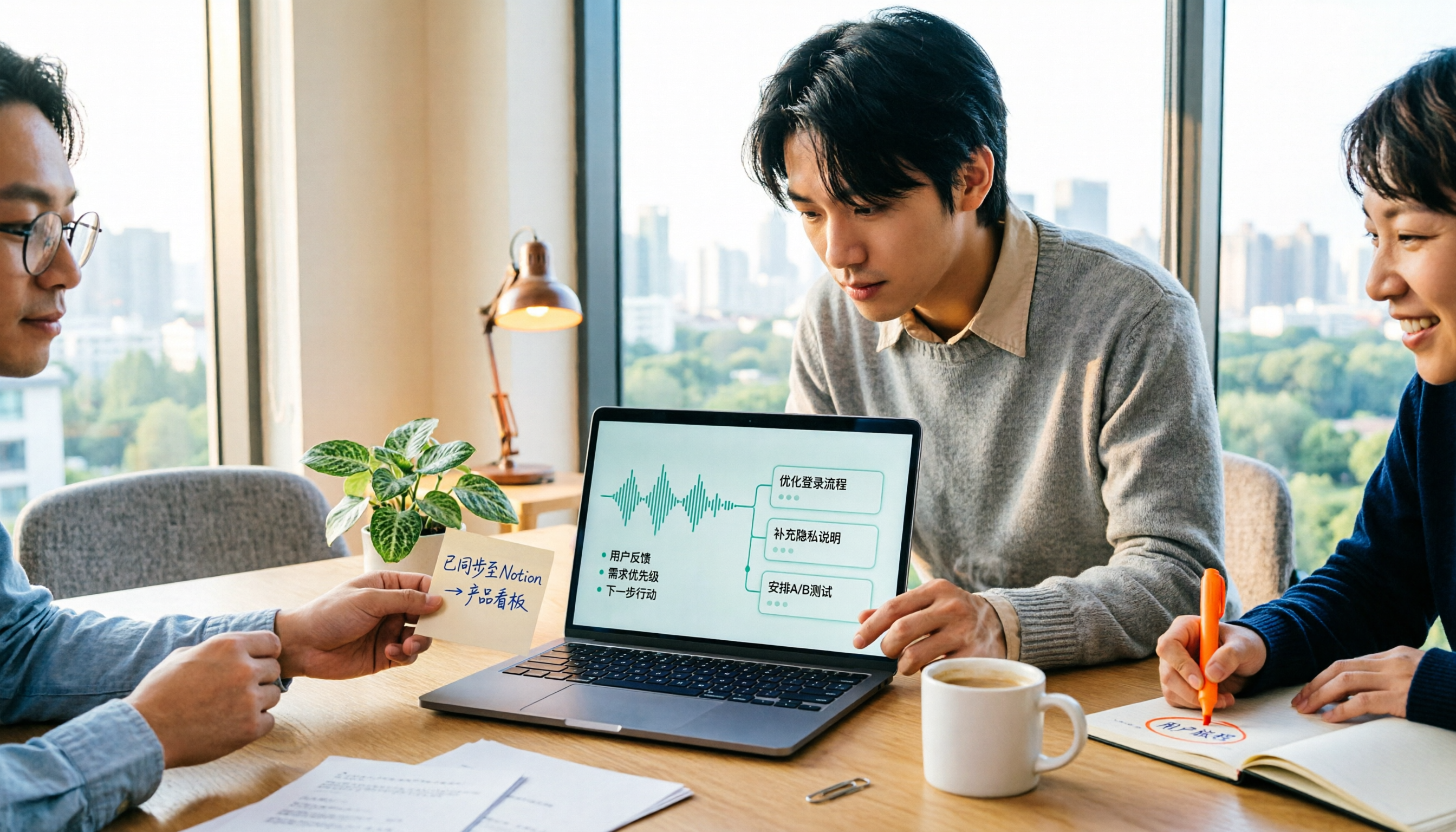
2026 Smart Meeting Collaboration Tool Comparison: From Recording to Action Items, Which One Really Handles Post-Meeting Work?
Starting from the common misconception of 'putting the entire budget into the meeting moment,' this article breaks down how to choose a smart meeting collaboration toolbox: how meetings are captured, what can be done after transcription, where data ultimately resides, and how team roles and seats are allocated. It compares Tinrec, built-in platform transcription, Otter.ai, and PLAUD recording hardware, with a pitfall guide and scenario-based selection advice.

2026 Review of 5 Smart Meeting Collaboration Platforms: Tinrec vs Otter.ai – Which Should Chinese-Speaking Teams Choose?
Starting from the three most common pitfalls when choosing a meeting tool, this hands-on comparison examines Tinrec and Otter.ai across six dimensions: meeting capture, Chinese transcription, post-meeting output, audio retention, team governance, and pricing. It helps you decide how to choose a smart meeting collaboration platform and whether the free version is sufficient.

How to Choose Smart Meeting Collaboration Tools in 2026: 5 Steps from Recording to Team Database
The real trouble starts after the meeting ends: transcripts are buried in audio files, action items go unrecorded, and cross-platform meetings are left unorganized. This article walks you through a 5-step selection process—from needs assessment and 4 key purchasing criteria, to hands-on observations of Tinrec, positioning differences among Otter.ai, Notta, and Granola, plus a comparison table—and concludes with clear recommendations based on budget and use case.

2026 Review of 4 Smart Meeting Collaboration Platforms: Which Saves More Time for Chinese Meetings and Team Knowledge Retention?
Evaluating Tinrec, Otter.ai, Notta, and Granola from the perspective of whether meeting data can be reused by the team after the meeting ends. We break down input sources, post-meeting outputs, Chinese-language experience, and team governance to help you determine which platform fits your meeting workflow.

2026 Comparison of 4 Online AI Meeting Collaboration Platforms: No Meeting Bots Required, Yet Searchable Meeting Records
Meeting notes are never finished—the problem often isn't the meeting itself, but that the content isn't captured as usable data. This article breaks down 4 online AI meeting collaboration platforms from meeting capture methods, post-meeting outputs, Chinese language support, team governance, to pricing logic, and explains which teams Tinrec, Otter.ai, Notta, and Google Meet's built-in features are best suited for.

2026 Comparison of 3 AI Meeting Collaboration Platforms: No Meeting Bots—Which One Actually Gets Post-Meeting Work Done?
A mid-level manager leading a 10-person team with over a dozen meetings per week tests 3 AI meeting collaboration platforms, breaking down everything from how meetings are recorded to who owns post-meeting data, and shares hands-on experience and limitations of Tinrec's desktop bot-free recording, AI Q&A, team roles, and seat governance.

2026 Smart Meeting Collaboration Tools Comparison: Tinrec vs. Zoom — Which Turns Meetings into Action Items?
Starting from common misconceptions about 'smart meetings,' this article compares Tinrec and Zoom's built-in meeting features from a mid-level manager's practical perspective across six dimensions: meeting capture, post-meeting follow-up, action item extraction, export, Chinese language support, and team governance. It includes a real-world tutorial example from a 40-minute weekly meeting to help you decide which approach best turns meeting content into actionable data.