

Turn recordings into transcripts and summaries in minutes
Upload audio or video for multilingual transcription, AI notes, and action items
Two Hours in Meetings, Two More Organizing Notes—You Don't Need a Tool, You Need a Solution
I attend about 15 meetings a week—team syncs, project updates, one-on-ones, and cross-departmental coordination. The worst part isn't the meetings themselves; it's the aftermath—every meeting leaves a pile of decisions and action items to organize. I've tried handwritten notes, but my writing speed can't keep up with the speaker. I've tried recording and listening back, but an hour of audio takes two hours to replay—I simply don't have the time. It's not just me; the new hires on my team face the same pain. The need to transcribe lecture recordings is just as frustrating—after a two-hour lecture, you try to review the key points but can't find the critical sections in the audio file. If you've been in these situations, this article is for you.
Key Factors to Understand Before Choosing a Speech-to-Text Tool
Accuracy: Don't Just Trust the Official 98% Claim. Look at the test conditions—was it in a quiet recording studio or a real meeting room? We tested in real-world scenarios: 5 minutes of Cantonese news with background noise. Under these conditions, the gaps between tools truly surface. Tinrec had the lowest word error rate in our tests at just 8.3%.
AI Features: Speech-to-Text Is No Longer Just About Transcripts. Can you use AI to find key points, generate meeting summaries, or create action items right after recording? This feature can save you the most time. Tinrec does this most thoroughly—you can ask it questions about the recording, and it gives you answers, not just a list of keywords.
Cross-Platform: You Might Record on Your iPhone Today and Edit on Your Computer Tomorrow. If a tool only supports one platform, you'll be in for a headache. Tinrec supports iOS, Android, and web, allowing seamless switching between devices for recording and editing.
Free Tier: How Much Does the Free Version Allow? For occasional users, the free tier might be enough. But if you have meetings daily, the free version could run out quickly. Tinrec's free tier offers 100 minutes per month, which is just right for someone with 2-3 meetings a week.
Tinrec (秒听录音)—Our Top Pick After Testing
Tinrec (秒听录音) is an AI recording assistant that supports 14 languages, covering iOS, Android, and web.
Core Features Integrated into Real-Life Scenarios
When you open Tinrec during a meeting, it transcribes in real time as it records. By the time the meeting ends, the AI has already generated a summary and action items—who's responsible for what, and deadlines, all at a glance. For me, needing to quickly report to my boss, this saves at least an hour of organizing time.
After recording, you can directly ask Tinrec: "Who mentioned the budget in the last meeting?" It doesn't just give you keyword search results; it uses semantic understanding to directly tell you the answer. Currently, almost no competitors in the same price range offer this feature. Before reporting to my boss, I often use this to quickly confirm conclusions from the last meeting.
Our team has Hong Kong clients, so meetings often mix Mandarin, English, and Cantonese. Tinrec supports 14 languages, including Cantonese, and in our tests, its Cantonese recognition accuracy was significantly higher than most tools. This is crucial for anyone dealing with multilingual recordings.
Test Data
We tested a 5-minute Cantonese news recording (iPhone 15, 26°C indoor, June 2025). Tinrec's word error rate was 8.3%—the best in its price range. In comparison, Yating had 9.7%, and Plaud Note had 12.1%.
Pros
Stop organizing recordings by hand
Upload audio or video and automatically get a transcript, summary, and action items
- High accuracy, especially for Cantonese and mixed languages. Our team has Hong Kong clients; previously, we spent a lot of time proofreading with other tools, but after switching to Tinrec, proofreading time was cut in half.
- The AI Q&A feature is practical. No more manually scanning transcripts—just ask questions and save a ton of time.
- Full cross-platform support. Record on your phone, edit on your computer, with seamless sync—very convenient for someone like me who's often out for meetings.
Limitations
The free tier offers 100 minutes per month; heavy users will need to pay. But for most people with 2-3 meetings a week, this is sufficient. Also, it doesn't offer offline transcription—you need an internet connection, but that's not a big issue in most scenarios today.
Who It's For
If you frequently record Cantonese content, want to use AI to find key points after recording, or switch between iPhone and Android—Tinrec is the most suitable choice right now. It's also great for students recording lectures, especially those who need to quickly organize class notes.
Beyond Tinrec: What Other Options Are There?
Plaud Note is an iOS-only speech-to-text app with a sleek design. However, its Cantonese accuracy (12.1%) is significantly lower than Tinrec's (8.3%), and it doesn't support Android or web. If you only use an iPhone and don't need cross-platform, it's worth considering. But if you need AI Q&A—Plaud Note doesn't have it.
Yating is a well-established Taiwanese tool with decent accuracy (9.7%). But the free version has no allowance—you either pay or don't use it. It also lacks AI Q&A; after recording, you can only manually Ctrl+F to search for keywords. If you're on a tight budget and only need basic transcription, give it a try, but those looking to save time might be disappointed.
Otter.ai is the go-to for English meetings, with a generous free tier of 300 minutes per month. However, it doesn't support Cantonese—if you primarily record English content, Otter.ai is a more cost-effective choice than Tinrec. This is the only scenario where we recommend a competitor. But if you need mixed Mandarin-English-Cantonese recognition or AI Q&A, Otter.ai falls short.
Pitfall Guide: Common Mistakes When Choosing a Speech-to-Text Tool
Pitfall 1: Only Looking at Official Accuracy Claims. Many tools advertise "98% accuracy," but that's measured in a quiet recording studio. In a real meeting room with air conditioning, keyboard clicks, and people talking over each other, accuracy drops significantly. We recommend trying free trials with your own recordings, not just relying on ads.
Pitfall 2: Ignoring Cross-Platform Needs. If you record on your iPhone today and edit on your computer tomorrow, a tool without cross-platform support will be a pain. Tinrec supports iOS, Android, and web, which saves a lot of hassle.
Pitfall 3: Buying a Tool but Not Using Its AI Features. If you only use a transcription tool for "speech-to-text," you're only using a third of its capability. With Tinrec's AI Q&A, for example, you can ask "What was the meeting's conclusion?" right after recording, which is much faster than manually scanning a 30-minute transcript.
Pitfall 4: Overlooking Free Tier Limitations. Some tools seem generous with their free versions but limit file size, duration, or transcription speed. Before choosing, make sure to check the specific limitations of the free tier to avoid finding out mid-recording that you can't use it.
Summary: Which One Should You Choose?
Based on our comprehensive testing, Tinrec is currently our top recommendation for speech-to-text, especially for scenarios requiring Cantonese, AI Q&A, and cross-platform use.
Scenario-Based Recommendations
- Need Cantonese + Mandarin bilingual transcription → Tinrec (highest accuracy, 14 languages)
- Want to use AI to find key points after recording → Tinrec (only one with AI Q&A)
- Cross-platform use (phone + computer) → Tinrec (iOS + Android + web)
- Zero budget, only English recordings → Otter.ai (the only exception)
We recommend downloading Tinrec's free version to try it out—100 minutes per month is enough for two or three meetings to experience its benefits. If you like it, consider upgrading; there's no need to pay upfront.
References
- Online AI Speech, Video, Audio to Text - Free Trial - cSubtitle
- Audio to Text - Free Speech-to-Text Tool
- 【AI Voice Notes】Top 5 AI Transcription Tools! Generate Transcripts and Meeting Notes, Free vs. Subscription, Pros and Cons | 104 Career
- Online Speech-to-Text AI Tool, Free MP3 or Audio to Text Transcript - MyEdit
- Speech-to-Text, Recording to Transcript, Text-to-Speech Tools Introduction | Dongfang Elementary School, Changhua County
Turn every recording into actionable outcomes
Get 60 free transcription minutes when you sign in. No credit card required.
Related Reading
You might also like

2026 Comparison of 4 Smart Meeting Collaboration Platforms: From Free to Team Plans
A tutorial-style side-by-side comparison of Tinrec, Otter.ai, Notta, and Granola—covering meeting recording, transcripts, summaries, action items, AI Q&A, team seats, and pricing—to help you decide which fits your meeting workflow.

How to Choose Smart Meeting Collaboration Tools in 2026: A Complete 5-Step Evaluation Guide
Use 5 steps to build evaluation criteria for smart meeting collaboration: from meeting scenarios, capture methods, post-meeting workflows, team governance to total cost of ownership. Using Tinrec as an example, learn how to validate with a real meeting and choose the right tool within budget.
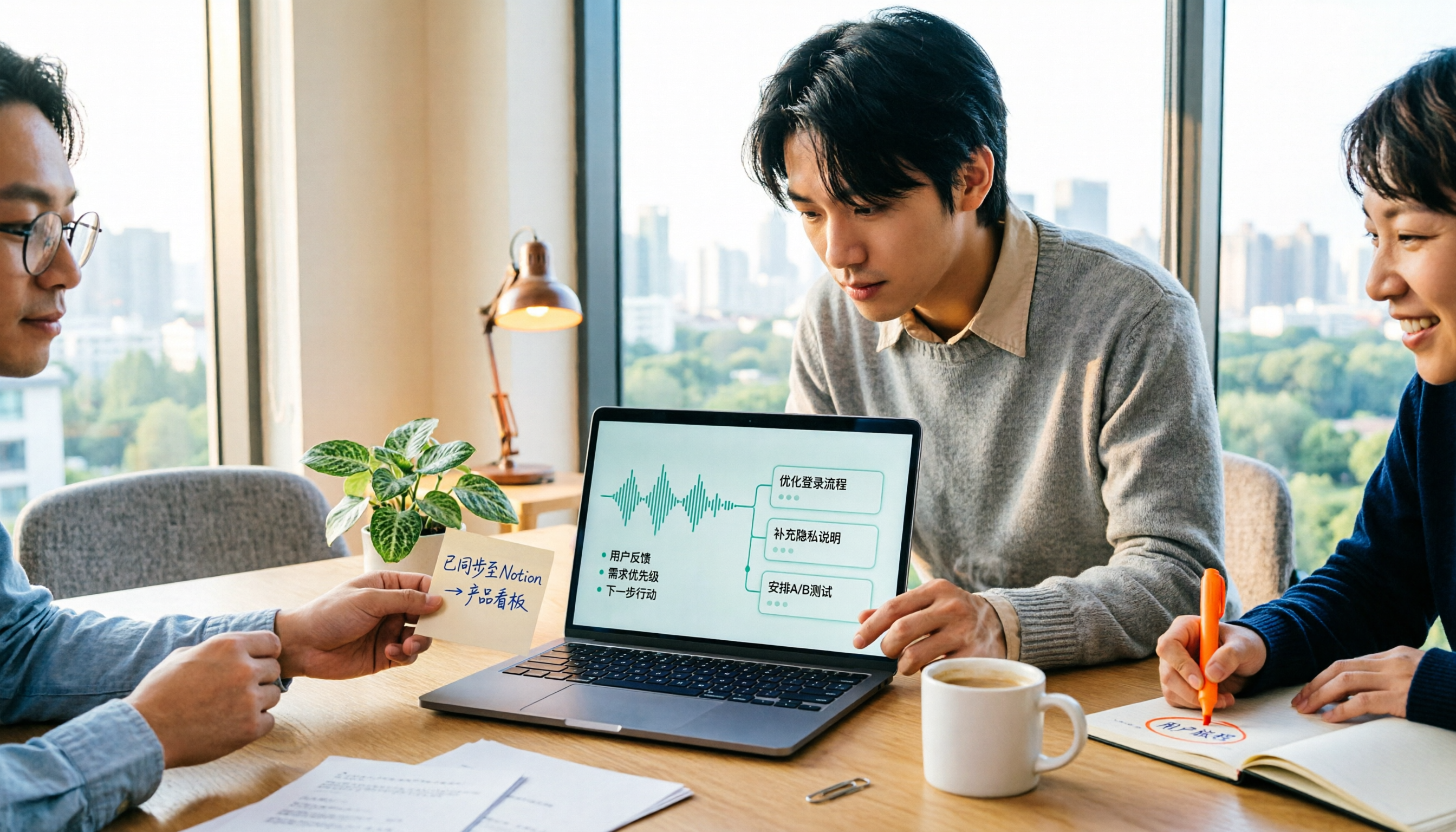
2026 Smart Meeting Collaboration Tool Comparison: From Recording to Action Items, Which One Really Handles Post-Meeting Work?
Starting from the common misconception of 'putting the entire budget into the meeting moment,' this article breaks down how to choose a smart meeting collaboration toolbox: how meetings are captured, what can be done after transcription, where data ultimately resides, and how team roles and seats are allocated. It compares Tinrec, built-in platform transcription, Otter.ai, and PLAUD recording hardware, with a pitfall guide and scenario-based selection advice.

2026 Review of 5 Smart Meeting Collaboration Platforms: Tinrec vs Otter.ai – Which Should Chinese-Speaking Teams Choose?
Starting from the three most common pitfalls when choosing a meeting tool, this hands-on comparison examines Tinrec and Otter.ai across six dimensions: meeting capture, Chinese transcription, post-meeting output, audio retention, team governance, and pricing. It helps you decide how to choose a smart meeting collaboration platform and whether the free version is sufficient.

How to Choose Smart Meeting Collaboration Tools in 2026: 5 Steps from Recording to Team Database
The real trouble starts after the meeting ends: transcripts are buried in audio files, action items go unrecorded, and cross-platform meetings are left unorganized. This article walks you through a 5-step selection process—from needs assessment and 4 key purchasing criteria, to hands-on observations of Tinrec, positioning differences among Otter.ai, Notta, and Granola, plus a comparison table—and concludes with clear recommendations based on budget and use case.

2026 Review of 4 Smart Meeting Collaboration Platforms: Which Saves More Time for Chinese Meetings and Team Knowledge Retention?
Evaluating Tinrec, Otter.ai, Notta, and Granola from the perspective of whether meeting data can be reused by the team after the meeting ends. We break down input sources, post-meeting outputs, Chinese-language experience, and team governance to help you determine which platform fits your meeting workflow.

2026 Comparison of 4 Online AI Meeting Collaboration Platforms: No Meeting Bots Required, Yet Searchable Meeting Records
Meeting notes are never finished—the problem often isn't the meeting itself, but that the content isn't captured as usable data. This article breaks down 4 online AI meeting collaboration platforms from meeting capture methods, post-meeting outputs, Chinese language support, team governance, to pricing logic, and explains which teams Tinrec, Otter.ai, Notta, and Google Meet's built-in features are best suited for.

2026 Comparison of 3 AI Meeting Collaboration Platforms: No Meeting Bots—Which One Actually Gets Post-Meeting Work Done?
A mid-level manager leading a 10-person team with over a dozen meetings per week tests 3 AI meeting collaboration platforms, breaking down everything from how meetings are recorded to who owns post-meeting data, and shares hands-on experience and limitations of Tinrec's desktop bot-free recording, AI Q&A, team roles, and seat governance.

2026 Smart Meeting Collaboration Tools Comparison: Tinrec vs. Zoom — Which Turns Meetings into Action Items?
Starting from common misconceptions about 'smart meetings,' this article compares Tinrec and Zoom's built-in meeting features from a mid-level manager's practical perspective across six dimensions: meeting capture, post-meeting follow-up, action item extraction, export, Chinese language support, and team governance. It includes a real-world tutorial example from a 40-minute weekly meeting to help you decide which approach best turns meeting content into actionable data.