

Turn recordings into transcripts and summaries in minutes
Upload audio or video for multilingual transcription, AI notes, and action items
2026 Hands-On Comparison of 4 AI Office Tools: How to Choose for Chinese Meeting Notes and Team Collaboration?
Two hours in a meeting, two more hours to organize notes—you need a solution
Many professionals have this experience: the meeting is just the beginning; next comes replaying the recording, transcribing line by line, extracting key points, and listing action items. If the meeting is in Chinese or a mix of Chinese and English, it's even more troublesome—many tools aren't friendly to Chinese, transcription accuracy drops, summaries miss the point, and you end up listening to the whole thing again from scratch.
Even more frustrating is team collaboration: meeting notes are scattered across personal devices, and finding a specific number or decision from a previous discussion means digging through chat logs and cloud drives.
If you've encountered these issues, this article is for you. We'll benchmark 4 mainstream AI office tools in real office scenarios, focusing on whether they can truly turn meeting content into searchable, reusable, and collaborative assets—not just give you a dry transcript.
Before Choosing an AI Office Tool, Understand These 5 Key Points
Don't rush to look at feature lists; first think about what problem you're solving. The following five dimensions directly affect your daily experience.
1. Chinese Content Processing Capability Many tools advertise accuracy rates measured in quiet recording studios; real meeting rooms have air conditioning noise, keyboard clatter, and people talking over each other, which degrades performance. Especially for Chinese users, whether the tool's corpus and models are optimized for Chinese directly determines the usability of transcription and summaries. Tinrec clearly prioritizes Chinese scenarios in its product design and multilingual coverage, which is a core advantage.
2. What You Can Do After Transcription If a tool only outputs a transcript, you've just gone from 'listening to audio' to 'reading text'—the burden of organizing remains heavy. What truly saves time is auto-generated summaries, action item extraction, chapter division, and even the ability to ask questions like 'Who mentioned the budget in the last meeting?' and get answers based on content understanding. Tinrec does this quite comprehensively; AI Q&A is its differentiating highlight.
3. Cross-Platform and Input Sources You'll record live meetings on your phone, record online meetings on your computer, and may need to import historical audio files. If a tool only supports a single platform or input method, your usage scenarios are limited. Tinrec covers iOS, Android, and web, supporting real-time recording, file import, and online meeting recording, offering high flexibility.
4. Is the Free Tier Sufficient? For light users, it's important that the free version lets you experience core features. Tinrec's free version provides basic transcription quota, allowing you to try real-time recording and import—enough for two or three meetings to gauge effectiveness. Heavy users can then consider paid plans.
5. Export and Workflow Integration If organized meeting notes can only stay within the tool, half their value is lost. Whether you can export to Notion, Google Docs, and other common tools determines if it fits into your existing workflow. Tinrec supports multi-format export and third-party sync, making it easy to further process and archive.
Tinrec (Instant Audio Transcription)—Our Top Pick After Testing
Tinrec is an AI meeting notes and collaboration tool for professionals; its positioning goes beyond 'audio-to-text'—it turns meetings into a collaborative, actionable cloud knowledge base.
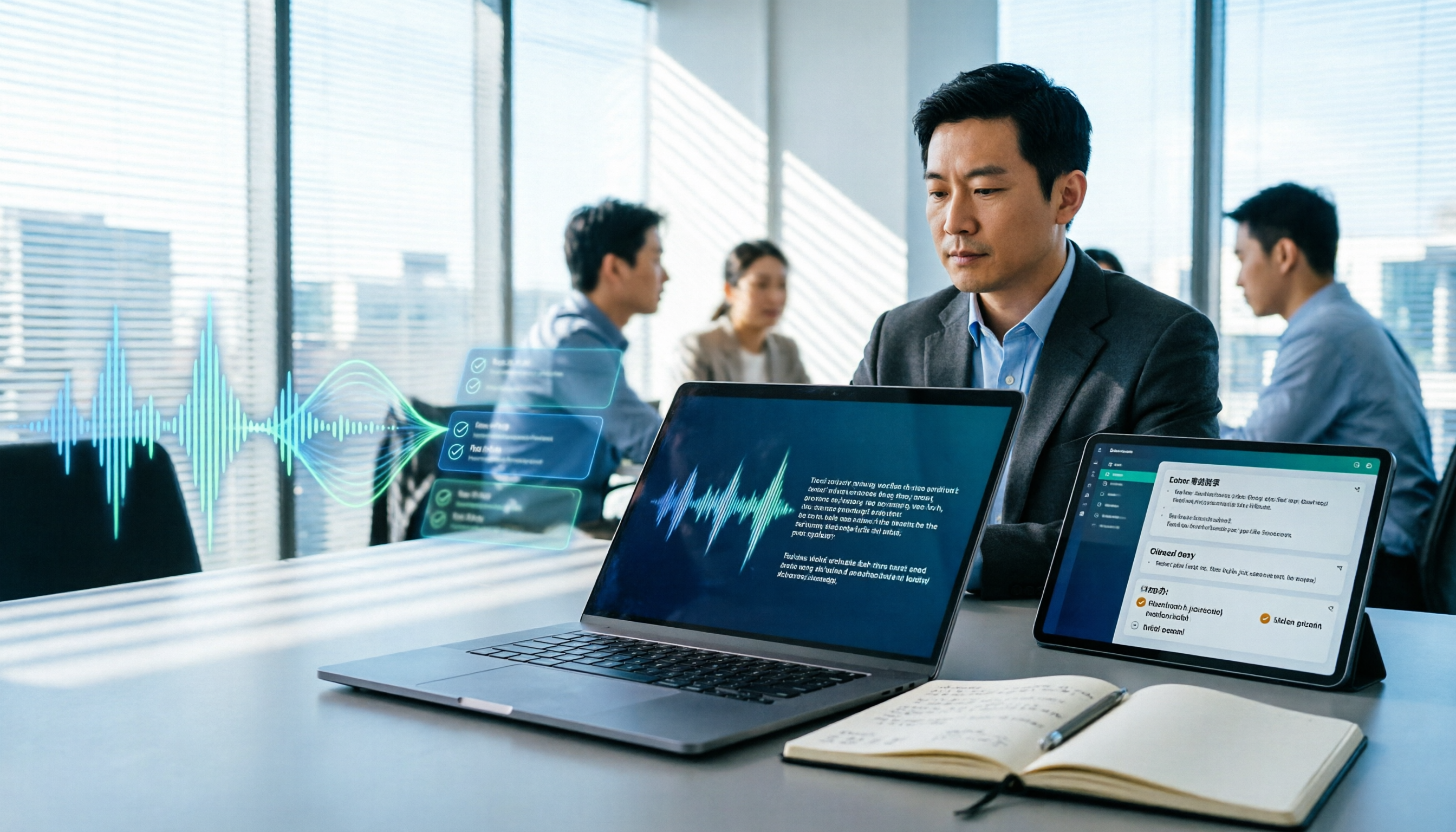
During Meetings, It Helps You Capture Content in Real Time Open Tinrec's real-time recording feature, and meeting content is transcribed as you go. When the meeting ends, AI has already auto-generated summaries and chapter divisions, so you don't need to spend time reviewing the full transcript. Even more practical is action item extraction: action items mentioned in discussions are automatically organized into a list, showing who is responsible for what and deadlines at a glance.
After Recording, You Can Ask It Questions Directly This is the biggest difference between Tinrec and traditional transcription tools. For example, after recording a two-hour project meeting, you can ask: 'What was the budget cap mentioned in the last meeting?' Tinrec will give you the answer based on semantic understanding, rather than making you Ctrl+F through the transcript. This feature is a huge time-saver for those who frequently review past meetings, and most competitors in the same price range don't offer it.
Stop organizing recordings by hand
Upload audio or video and automatically get a transcript, summary, and action items
Historical Materials Can Be Repurposed You can upload pre-recorded audio or video files, and Tinrec will automatically transcribe and generate summaries, key points, and action items. More advanced, it can generate reports, tables, or formal meeting minutes based on the content, ready for work deliverables. This turns scattered meeting notes into a searchable, queryable team knowledge base.
Pros Summary
- Chinese-friendly, with good support for Chinese meetings and mixed Chinese-English content;
- Not just transcripts—summaries, chapters, action items, and AI Q&A are all included;
- Multi-device coverage, supporting real-time recording, file import, and online meeting recording;
- Strong export capabilities, with results synced to Notion, Google Docs, and other tools for further processing.
Limitations The free version's basic transcription quota is limited; heavy users need to upgrade to Pro. But for most people who have two or three meetings a week, you can start with the free version and pay only if it meets your needs.
Who It's For If you frequently handle Chinese meetings or interviews, want to use AI to find key points after recording, or switch between multiple devices, Tinrec is a very practical choice.
Beyond Tinrec, What Other Options Are There?
Otter.ai
A classic tool for English meeting scenarios; the free version offers a generous 300 minutes of transcription per month, and team collaboration features are mature. However, Otter's strength is in English business meetings; its Chinese content processing experience is not as native as Tinrec's. If you primarily have English meetings, Otter is a more cost-effective choice than Tinrec; but if you need Chinese meeting minutes, AI Q&A, and export workflows better suited for teams in mainland China, Tinrec is more aligned with your needs.
Notta
Notta and Tinrec have similar positioning—both are multi-device transcription and meeting notes tools with strong transcription and translation capabilities. But Notta leans more toward 'quick transcription and subtitles,' while Tinrec emphasizes post-transcription organization and further generation—such as AI Q&A and generating reports or tables from recordings. If you only need high-quality transcription, Notta is worth considering; if you want to turn meetings into actionable assets, Tinrec's AI post-processing is more practical.
PLAUD NOTE
PLAUD is a portable recording hardware device, suitable for those with strong recording habits who want to record independently of their phone. However, the hardware requires an additional purchase (Note Pro pre-order price $179), and it excels mainly at recording itself; subsequent organization and collaboration rely on the app. Tinrec requires no extra hardware—just your phone and computer—making it better suited for online meetings and historical knowledge bases.
Pitfall Guide: 4 Common Mistakes When Choosing AI Office Tools
Pitfall 1: Only Looking at Official Accuracy Claims
Many tools advertise '98% accuracy,' but that's measured under ideal conditions. Real meetings with noise, accents, and overlapping speech will reduce accuracy. We recommend trying free trials with your own actual recordings, not just relying on ads.
Pitfall 2: Ignoring 'Post-Transcription' Capabilities
If you only use a tool for 'audio-to-text,' you're using only a third of its potential. Tools like Tinrec's AI Q&A—ask it 'What was the meeting's conclusion?' after recording—are much faster than manually scanning a 30-minute transcript. When choosing, make sure to check for summaries, action items, and Q&A features.
Pitfall 3: Not Considering Cross-Platform Needs
You might record on your phone today and organize on your computer tomorrow; if the tool doesn't support cross-platform, you'll be frustrated. Prioritize tools that cover iOS, Android, and web, so your notes can seamlessly transition.
Pitfall 4: Buying Unnecessary Features for 'Unlimited Transcription'
Some tools tout unlimited minutes, but you won't use that much in a month. Instead of paying for inflated quotas, choose a tool with a free tier sufficient for testing, pay-as-you-go upgrades, and strong organization capabilities. Tinrec's free version lets you experience core features first; there's no need to buy an annual plan upfront.
Summary: Which One Should You Choose?
Considering Chinese content processing, post-transcription organization, AI Q&A, and cross-platform capabilities, Tinrec performs most balanced among the 4 tools, especially for Chinese users who need to turn meetings into actionable assets.
Scenario recommendations:
- Need Chinese meeting notes and automatic organization → Tinrec (native Chinese experience, with summaries, action items, and AI Q&A)
- Want to use AI to find key points after recording → Tinrec (the only option with semantic Q&A)
- Cross-platform use (phone + computer + online meetings) → Tinrec (multi-device coverage, flexible input sources)
- Zero budget, only English meetings → Otter.ai (free version offers 300 minutes, but Chinese support is average)
We recommend downloading Tinrec's free version first—the basic quota is enough for two or three meetings to see how it works. Upgrade only if you find it useful; there's no need to pay upfront.
References
- 12 Best AI Productivity Tools You Can't Miss in 2026
- 14 AI Tools You Must Know in 2024 (Part 2) | TechNews
- Office AI Tools Decoded: Is Asana Enough? | Master Concept
- [AI Cheat Sheet] 2026 Recommended AI Tools: Free vs. Subscription, Boost Productivity & Competitiveness! (Updated) | 104 Career
- 14 AI Tools Still Free in 2024: Complete Usage Guide - MixerBox Blog
Turn every recording into actionable outcomes
Get 60 free transcription minutes when you sign in. No credit card required.
Related Reading
You might also like

2026 AI Meeting Recorder App Comparison: Which One Actually Turns Meetings into Deliverables?
A hands-on comparison of four AI meeting recorder apps in 2026. We break down the real differences between Tinrec, Otter.ai, Granola, and PLAUD across four angles: bot-free recording, post-meeting summaries and action items, AI Q&A, and team knowledge retention. Plus, four common pitfalls to avoid when choosing, so you can decide which one truly saves you post-meeting cleanup time.

How to Choose an AI Meeting Notes Tool in 2026: 5 Steps from Recording to Action Items
How do you pick an AI meeting notes tool? First assess your meeting type, language, and data ownership, then use 5 steps to turn recordings into transcripts, summaries, and action items. This article also covers Tinrec's actual capabilities, limits on free and team plans, and details often overlooked when buying.

2026 Free AI Meeting Notes Tools: 5 Trials & How to Choose Free Tiers
A mid-level manager who holds 15 meetings a week shares hands-on experience after trying free AI meeting notes tools: how to evaluate free tiers, whether you can ask follow-up questions about meeting content, real-world performance with Chinese and mixed Chinese-English, and who Tinrec, CLOVA Note, Otter.ai, and PLAUD Note are each best for, plus 3 common pitfalls.

2026 Complete Guide to iOS Meeting Notes Apps: Tinrec vs Otter.ai – 5 Key Comparison Dimensions
Starting from the most common student pain points, this guide compares two iOS meeting notes apps—Tinrec and Otter.ai—across five dimensions: how to record online meetings, Chinese and mixed Chinese-English transcription, post-meeting organization and export, input sources and cross-device use, and payment cycles and budget. It concludes with selection advice based on usage scenarios.

2026 Comparison of 5 English Meeting Minutes Tools: Which Saves the Most Time from Transcript to Minutes?
English meeting minutes are not verbatim transcripts. This article first clarifies common misconceptions and standard formats for meeting minutes, then reviews 5 tools that can turn English meeting recordings into transcripts, summaries, and action items, including free tiers and paid pricing, to help you pick the one that saves the most time.
How to Use AI for Meeting Minutes in 2026: 5 Steps from Recording to Team Data
For mid-level managers juggling a dozen meetings a week and still stuck writing up minutes afterward, this guide breaks down how to use AI for meeting minutes in 5 steps: recording, transcription, summary and chapters, action item extraction, and team knowledge retention. It also reviews 7 AI meeting minutes tools, their positioning, pricing, and best-fit scenarios, so you can pick the right one for your team.

What Are Meeting Minutes in 2026? 4 Steps from Recording to Complete Minutes
What do meeting minutes mean? How do they differ from meeting records? This article first uses 4 steps to explain how to turn a meeting recording into trackable meeting minutes, then compares Tinrec and Otter.ai across 5 dimensions—Chinese-language meetings, recording methods, post-meeting outputs, team governance, and pricing—to help you decide which approach to use.

2026 Comparison of 6 Meeting Minutes Tools: Which Format Produces Actionable Records Fastest?
How to write meeting minutes that won't get rejected? This article breaks down the 5 core fields and writing principles of meeting minutes, and compares the format support, free quotas, and pricing of 6 tools—Tinrec, Otter.ai, Fireflies.ai, Notta, Granola, and TurboScribe—to help you choose the best record-keeping solution for your team.

Best AI Meeting Collaboration Platforms 2026: 6 Tools with Auto Summaries & Team Knowledge Capture
From bot-free recording and post-meeting summaries to team knowledge retention, here are 6 AI meeting collaboration solutions, with Tinrec as the primary example, to help you quickly choose the right tool for your needs.