

Turn recordings into transcripts and summaries in minutes
Upload audio or video for multilingual transcription, AI notes, and action items
2026 Hands-On Comparison of 2 Zoom Meeting AI Summary Tools: Which One Is Better for Chinese-Language Notes?
Tinrec vs Zoom AI Companion | Quick Overview
If you have Zoom meetings every week and need to organize summaries and track action items afterward, you now have two options. One is Zoom's built-in AI Companion Meeting Summary; the other is Tinrec's instant recording feature. The former wins because you don't need to install extra tools; the latter excels at turning meeting content into a workable database.
| Comparison Item | Tinrec | Zoom AI Companion |
|---|---|---|
| Positioning | AI meeting notes and collaboration tool | Zoom's built-in AI meeting summary |
| Pricing | Free tier + weekly card/Pro monthly or yearly plans | Included with paid Zoom plans, enabled by admin |
| Input Sources | Live recording, audio/video files, online meeting recordings | Primarily Zoom meetings |
| Key Differences | Summary, chapters, action items, AI Q&A, multi-format export | Meeting summary and key points, built-in, no installation required |
This article compares them across 5 dimensions: Chinese-language organization, post-meeting processing, cross-platform use, team knowledge base, and flexibility, to help you decide which is more suitable.
Dimension 1 | Chinese Content Organization
Zoom AI Companion's meeting summary is most mature for English contexts. Official documentation also notes that if the meeting is not in English, you need to correctly set captions and speaking language for stable summary quality. When Chinese is mixed with English, Taiwanese accents, or multiple speakers, manual review may still be needed.
Tinrec emphasizes a native experience for Chinese contexts, with its interface and multilingual content designed for Chinese and Traditional Chinese users. After uploading a Chinese meeting recording, it not only transcribes but also automatically organizes summaries, chapters, and action items. In testing, it felt smoother for Chinese meeting scenarios.
→ This dimension: Tinrec clearly wins.
Dimension 2 | Depth of Post-Meeting Processing
Zoom AI Companion's summary is suitable for quickly reviewing "what was discussed in the meeting." Its functionality is limited to within the Zoom platform; once the summary is generated, that's it. To further convert key points into documents, spreadsheets, or sync to other tools, you need to copy and paste manually.
Tinrec not only generates summaries but also extracts action items, creates chapters, allows AI follow-up questions, and exports to formats like Notion, Google Docs, and OneNote. It effectively turns the meeting recording into an editable working document.
→ This dimension: Tinrec clearly wins.
Dimension 3 | Cross-Platform and Historical Data
Zoom AI Companion only handles Zoom meetings. If you also use Google Meet, Teams, or in-person recordings, summaries cannot be aggregated in one place. Historical meeting data is also scattered within your Zoom account, making search and retrieval limited.
Tinrec supports live recording, uploading audio/video files, recording online meetings, and mobile recordings. Content from various sources goes into the same database, allowing cross-meeting search and AI queries, turning historical recordings into a searchable knowledge base.
→ This dimension: Tinrec clearly wins.
Dimension 4 | Team Collaboration and Deliverables
Zoom AI Companion's summary can be shared with attendees, but it's more of a notification. To turn it into formal meeting minutes, reports, or tracking sheets, you still need to do additional work.
Stop organizing recordings by hand
Upload audio or video and automatically get a transcript, summary, and action items
Tinrec offers Agent post-processing capabilities, which can generate meeting minutes, reports, tables, and other deliverables based on the meeting recording. This is suitable for scenarios where you need to deliver meeting results to clients, supervisors, or cross-departmental teams.
→ This dimension: Tinrec clearly wins.
Dimension 5 | Ease of Use and Convenience
Zoom AI Companion's biggest advantage is zero installation. As long as the admin enables the feature, summaries are automatically generated after meetings. For Zoom users who just want to quickly know the key points of a meeting, this is the most intuitive choice.
Tinrec requires installing or opening a webpage, but the process is not complicated. After recording or importing, AI automatically organizes. The downside is that it's not as seamless as Zoom's built-in feature; the upside is that you can do much more afterward.
→ This dimension: Zoom AI Companion wins (convenience), but Tinrec catches up and surpasses in feature completeness.
What Unique Advantages Does Each Have?
Tinrec's Unique Advantages
- More complete Chinese meeting data organization: Not just summaries, but also chapters, action items, and AI Q&A, suitable for those who need to produce formal documents.
- Export to common tools: Sync to Notion, Google Docs, OneNote, etc., to continue your existing workflow.
- Cross-platform accumulation: Import from Zoom, Meet, Teams, mobile recordings, and build a searchable meeting knowledge base.
- Agent post-processing: One-click generation of meeting minutes, reports, or tables, saving manual organization time.
Zoom AI Companion's Unique Advantages
- Built-in, zero barrier: No extra tools to install; usable once the admin enables it.
- Great for quick reviews: Get key summaries immediately after meetings, ideal for those who just want to "know what was discussed."
Summary: Which Should You Choose?
- If you only need quick summaries of Zoom meetings and don't want to install other tools → Zoom AI Companion is sufficient.
- If you need to turn meeting content into action items, reports, or a searchable team database → Tinrec (Zoom AI Companion can't do these post-processing tasks).
- If your meetings involve a lot of Chinese, mixed Chinese-English, or need cross-platform aggregation → Tinrec (Chinese organization and cross-platform are clearly stronger).
- If you value zero installation and just want to see summaries without further processing → Zoom AI Companion is more direct.
In one sentence: Zoom AI Companion is a "summary notification," while Tinrec is a "meeting data workstation." For most workplace scenarios that require follow-up actions, Tinrec is more suitable. We recommend uploading a meeting recording to Tinrec's free tier to compare the summaries, action items, and Q&A it produces, then decide whether to upgrade.
Frequently Asked Questions
Does Zoom AI Companion meeting summary cost extra?
Zoom AI Companion is included with paid Zoom plans, but it must be enabled by the account admin. Free plans may not include it or may have limited functionality; check your specific Zoom plan.
Can Tinrec's free tier handle Zoom meetings?
Yes. The free tier includes basic transcription credits, allowing you to upload Zoom recordings or record online meetings. If your needs are higher, consider the weekly card or Pro plan.
Can AI summaries completely replace meeting minutes?
No. AI summaries may miss or misinterpret details. For important meetings, rely on transcripts or recordings, and use summaries as a draft for manual review.
How accurate is Tinrec?
Quality is good with clear audio and common scenarios, but it can be affected by noise, accents, overlapping speech, and technical jargon. For important content, verify against the original.
If I already use Zoom, do I still need Tinrec?
It depends on your needs. If you just want to quickly know meeting key points, Zoom's built-in feature is enough. If you need action items, AI Q&A, report exports, or a cross-platform database, Tinrec is more practical.
References
- Using Meeting Summary with AI
- Enabling or disabling meeting summary with AI
- Zoom AI Companion Meeting Summary Chinese Guide: Summaries, Action Items, and Limitations | Mason AI Lab
- How an AI note-taker helps you save time and stay focused | Zoom
- Zoom AI Note Assistants: Automatic Transcription, Summaries, and Action Items | HiNoter Blog
Turn every recording into actionable outcomes
Get 60 free transcription minutes when you sign in. No credit card required.
Related Reading
You might also like

2026 AI Meeting Recorder App Comparison: Which One Actually Turns Meetings into Deliverables?
A hands-on comparison of four AI meeting recorder apps in 2026. We break down the real differences between Tinrec, Otter.ai, Granola, and PLAUD across four angles: bot-free recording, post-meeting summaries and action items, AI Q&A, and team knowledge retention. Plus, four common pitfalls to avoid when choosing, so you can decide which one truly saves you post-meeting cleanup time.

How to Choose an AI Meeting Notes Tool in 2026: 5 Steps from Recording to Action Items
How do you pick an AI meeting notes tool? First assess your meeting type, language, and data ownership, then use 5 steps to turn recordings into transcripts, summaries, and action items. This article also covers Tinrec's actual capabilities, limits on free and team plans, and details often overlooked when buying.

2026 Free AI Meeting Notes Tools: 5 Trials & How to Choose Free Tiers
A mid-level manager who holds 15 meetings a week shares hands-on experience after trying free AI meeting notes tools: how to evaluate free tiers, whether you can ask follow-up questions about meeting content, real-world performance with Chinese and mixed Chinese-English, and who Tinrec, CLOVA Note, Otter.ai, and PLAUD Note are each best for, plus 3 common pitfalls.

2026 Complete Guide to iOS Meeting Notes Apps: Tinrec vs Otter.ai – 5 Key Comparison Dimensions
Starting from the most common student pain points, this guide compares two iOS meeting notes apps—Tinrec and Otter.ai—across five dimensions: how to record online meetings, Chinese and mixed Chinese-English transcription, post-meeting organization and export, input sources and cross-device use, and payment cycles and budget. It concludes with selection advice based on usage scenarios.

2026 Comparison of 5 English Meeting Minutes Tools: Which Saves the Most Time from Transcript to Minutes?
English meeting minutes are not verbatim transcripts. This article first clarifies common misconceptions and standard formats for meeting minutes, then reviews 5 tools that can turn English meeting recordings into transcripts, summaries, and action items, including free tiers and paid pricing, to help you pick the one that saves the most time.
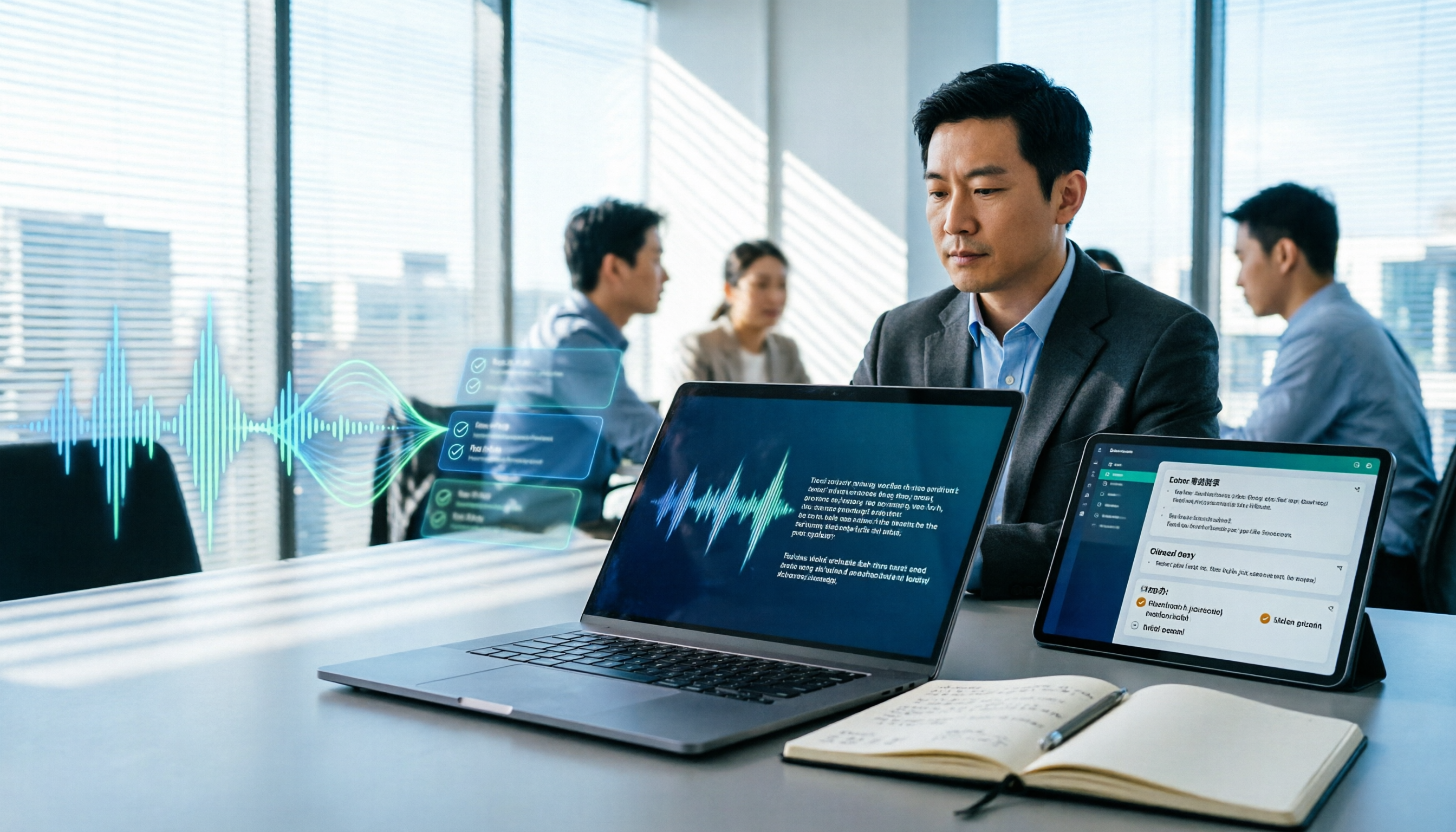
How to Use AI for Meeting Minutes in 2026: 5 Steps from Recording to Team Data
For mid-level managers juggling a dozen meetings a week and still stuck writing up minutes afterward, this guide breaks down how to use AI for meeting minutes in 5 steps: recording, transcription, summary and chapters, action item extraction, and team knowledge retention. It also reviews 7 AI meeting minutes tools, their positioning, pricing, and best-fit scenarios, so you can pick the right one for your team.

What Are Meeting Minutes in 2026? 4 Steps from Recording to Complete Minutes
What do meeting minutes mean? How do they differ from meeting records? This article first uses 4 steps to explain how to turn a meeting recording into trackable meeting minutes, then compares Tinrec and Otter.ai across 5 dimensions—Chinese-language meetings, recording methods, post-meeting outputs, team governance, and pricing—to help you decide which approach to use.

2026 Comparison of 6 Meeting Minutes Tools: Which Format Produces Actionable Records Fastest?
How to write meeting minutes that won't get rejected? This article breaks down the 5 core fields and writing principles of meeting minutes, and compares the format support, free quotas, and pricing of 6 tools—Tinrec, Otter.ai, Fireflies.ai, Notta, Granola, and TurboScribe—to help you choose the best record-keeping solution for your team.

Best AI Meeting Collaboration Platforms 2026: 6 Tools with Auto Summaries & Team Knowledge Capture
From bot-free recording and post-meeting summaries to team knowledge retention, here are 6 AI meeting collaboration solutions, with Tinrec as the primary example, to help you quickly choose the right tool for your needs.