
Turn recordings into transcripts and summaries in minutes
Upload audio or video for multilingual transcription, AI notes, and action items
When facing cross-border meetings, English interviews, or overseas travel, have you ever felt anxious because the speech is too fast and you can't take notes? Simply recording and replaying later is extremely time-consuming, and traditional translation devices struggle with long meeting content.
This article focuses on the needs of "Chinese voice recording to real-time English translation" and "voice translation," and deeply compares 7 popular tools from four dimensions: accuracy, real-time performance, summary capabilities, and applicable scenarios. Whether you need a quick solution for travel or pursue meeting transcriptions as a professional, there's a corresponding solution here.
Quick Navigation Conclusion:
- Travel abroad, short phrase communication: Top pick: Google Translate or Naver Papago.
- Classroom dialogue, simple mutual translation: Recommended: SayHi or Microsoft Translator.
- Long meeting minutes, transcripts, and AI summaries: Recommend using Tinrec (Instant Audio Recording) or DeepL (for documents).
How to Choose a Translation Tool? Three Key Evaluation Dimensions
Before downloading an app, it's best to filter based on your actual usage scenario to avoid choosing the wrong tool and reducing efficiency:
1. Confirm Language Support and Recognition Accuracy
Not all apps can accurately recognize Chinese accents or specific technical terms. When choosing, first confirm whether it supports bidirectional translation between Chinese (Traditional/Simplified) and the target language (e.g., English, Japanese). Some tools like NICT's VoiceTra are optimized for Japanese, while Naver Papago performs better in Korean.
2. Distinguish Between "Short Dialogue" and "Long Recording" Scenarios
- Travel/asking for directions: Need an "instant-on" voice translation app like Google Translate, focusing on speed and simple interface.
- Meetings/interviews: Need long recording without interruption and "recording-to-text" functionality. General travel translation apps (like Google) can only translate short sentences and cannot handle a 1-hour speech or meeting, so a professional AI recording tool is needed.
3. Does It Have AI Organization Capabilities (Summaries and Action Items)?
Traditional tools only give you a wall of text. Modern productivity tools (like Tinrec or Otter) can use AI to analyze recording content, automatically generating summaries, key points, and to-do items (Action Items). This is the key to solving "information overload."
2026 Selection: Review of 7 Chinese Voice Recording to English Translation Tools
1. Tinrec (Instant Audio Recording): AI Solution for Meetings and Long Recordings
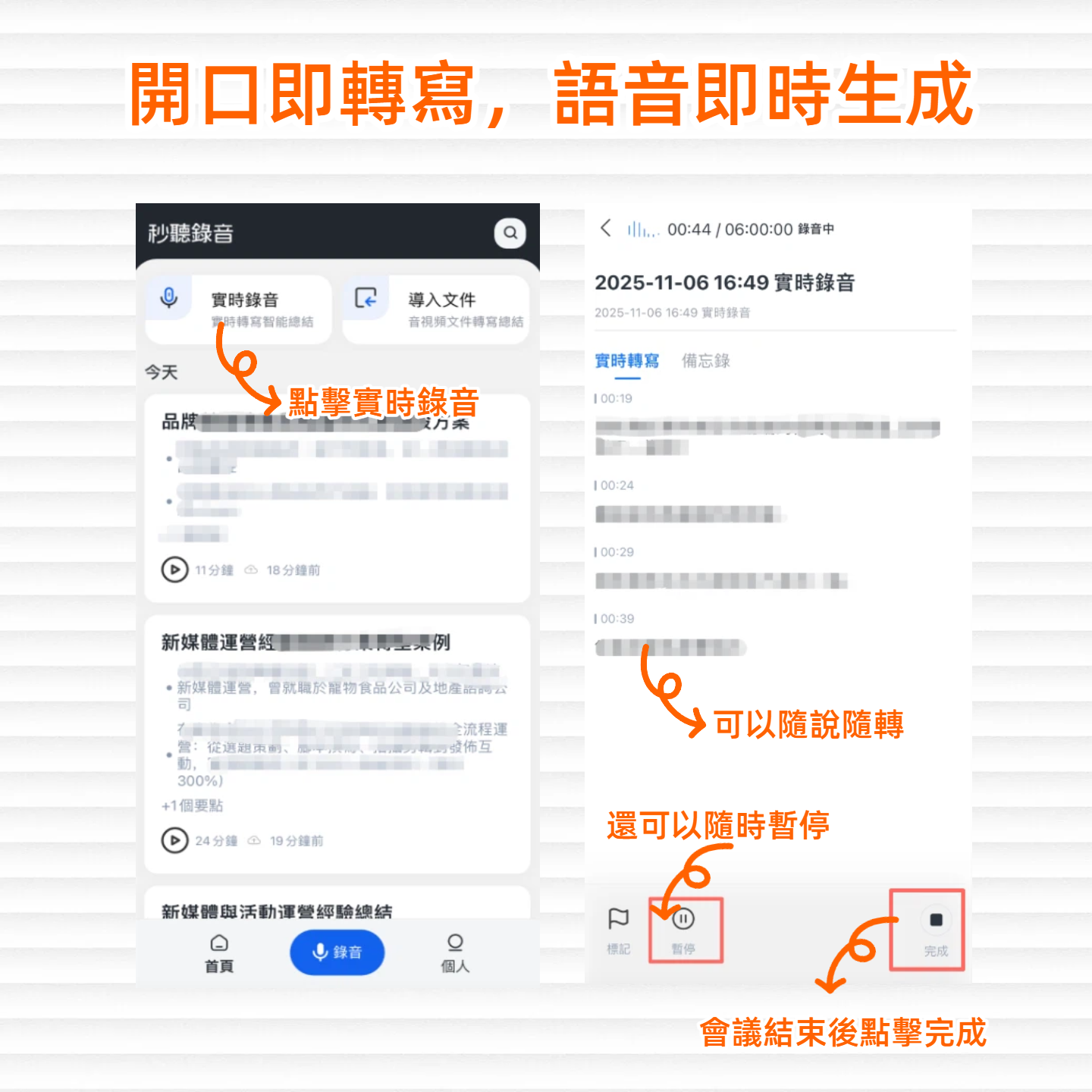
For users who need to handle "long recordings" and convert them into text records, Tinrec offers a different solution from traditional translation apps. It focuses on the workflow from "recording" to "understanding," supporting automatic recognition of 10 languages including Chinese, English, and Japanese.
Core Features:
- Real-time recording to text: Generates a transcript instantly during recording, eliminating the pain of replaying audio files.
- AI smart summary: Not just translation, but automatically extracts meeting minutes and to-do lists, suitable for professional and academic use.
- Multi-device sync: Supports iOS, Android, and Web; record on phone and edit on computer.
2. Microsoft Translator: Best for Multi-Person Meetings
Microsoft Translator has unique advantages in business scenarios, supporting multiple participants joining the same "chat room" on different devices.
- Pros: Supports simultaneous voice dialogue translation for multiple participants, suitable for multilingual meeting environments. Has a split-screen feature for face-to-face communication.
- Limitations: Requires all participants to download the app or open the web version for optimal results.

3. Google Translate: All-Purpose Tool for Travel and Daily Life
The most widely used translation tool globally, supporting 133 languages.
- Pros: Free, supports offline translation, powerful photo translation (great for menus, signs).
- Limitations: Voice translation is better suited for "short phrases"; long speeches or meetings may cause interruptions due to pauses.
4. SayHi: Intuitive Dialogue Tool
Extremely simple interface, designed specifically for "dialogue."
Stop organizing recordings by hand
Upload audio or video and automatically get a transcript, summary, and action items
- Pros: Set both languages, press the microphone to take turns speaking; translation is fast and voice sounds natural.
- Limitations: Cannot save long recordings; no note-taking organization features.
5. Naver Papago: Strong in Asian Languages
Developed by South Korea's Naver, although mainly for Korean, it also performs well in Chinese-English translation semantic understanding.
- Pros: Offers honorific options, common conversational phrase cards, friendly interface.
- Limitations: Limited ability to handle long audio files.
6. DeepL Translate: Document and Precision Translation Expert
Although DeepL is known for text translation, its app also supports voice input.
- Pros: Translation quality is usually more natural and context-aware than Google. Supports uploading documents (PDF/Word) for direct translation.
- Limitations: Free version has word count and document number limits; voice recognition is relatively basic.
7. Sapiens Labs Instant Translation: On-Screen Real-Time Translation
This tool specializes in "screen translation," suitable for real-time translation of video subtitles or messages playing on your phone.
- Pros: No need to switch apps; displays translation results directly on the screen.
- Limitations: Mainly for reading and visual content, not focused on audio capture.
Tool Comparison Table: Features and Applicable Scenarios at a Glance
To help you choose more intuitively, we compared the above tools based on key dimensions:
| Comparison Dimension | Tinrec (Instant Audio Recording) | Microsoft Translator | Google Translate | DeepL Translate | SayHi |
|---|---|---|---|---|---|
| Core Focus | Long recording transcription & AI notes | Multi-person meetings & dialogue | Travel & short phrase translation | Precise text translation | Two-way voice dialogue |
| Real-time voice to text | Yes (long, uninterrupted) | Yes (dialogue mode) | Yes (short phrases) | Yes (short phrases) | Yes (dialogue) |
| AI summary/action items | ✅ Yes (auto-generated) | ❌ No | ❌ No | ❌ No | ❌ No |
| Supported languages | Chinese/English/Japanese/Korean, 10+ | 60+ | 133 | 30+ | 60+ |
| Export & integration | Transcript/summary/audio file | Text record | Copy text | Copy text | None |
| Free tier/price | 100 minutes free per month | Completely free | Completely free | Free with limits | Completely free |
Practical Tutorial: How to Convert Chinese Meeting Recordings to English Notes
If you need to quickly organize a Chinese meeting into English notes, or convert an English course into Chinese notes, using AI-powered tools (like Tinrec) will be much more efficient than traditional translation apps. Here is the standard workflow:
Step 1: Start Recording or Import a File
Enter the tool's homepage and select the appropriate mode.
- For live meetings, click the "Real-time Recording to Text" feature, ensuring clear audio on your phone or computer.
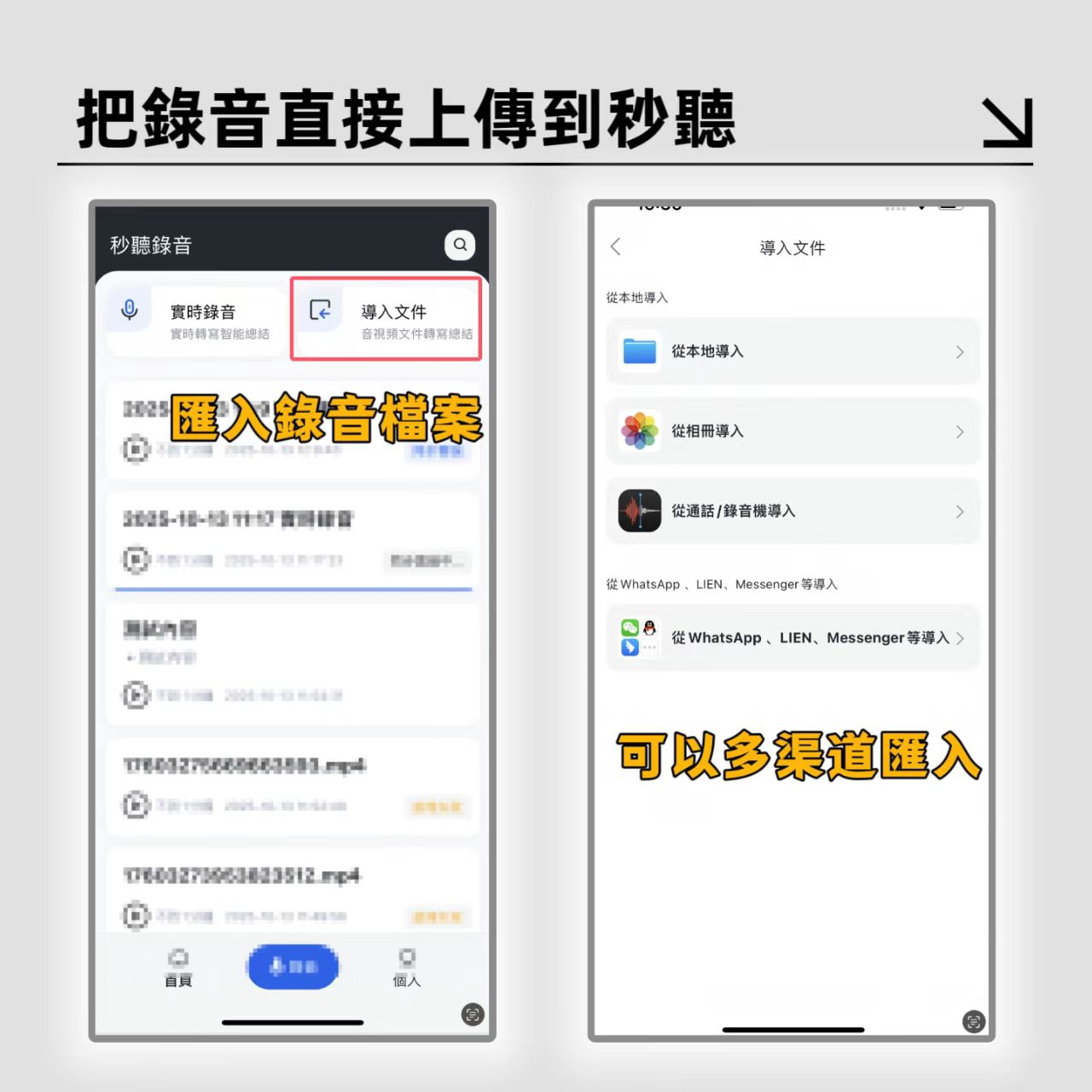
- For existing audio files (e.g., voice messages from LINE or recorder files), use the "Audio File to Text" feature to upload.
- Tinrec recording entry: Go to Real-Time Recording to Text
- File upload entry: Go to Audio File to Text

Step 2: Real-Time Transcription and Language Identification
During recording, the system automatically identifies the language and transcribes it into text. Tinrec supports speaker differentiation, which is important for identifying who said what.
Step 3: AI Smart Summary and Translation
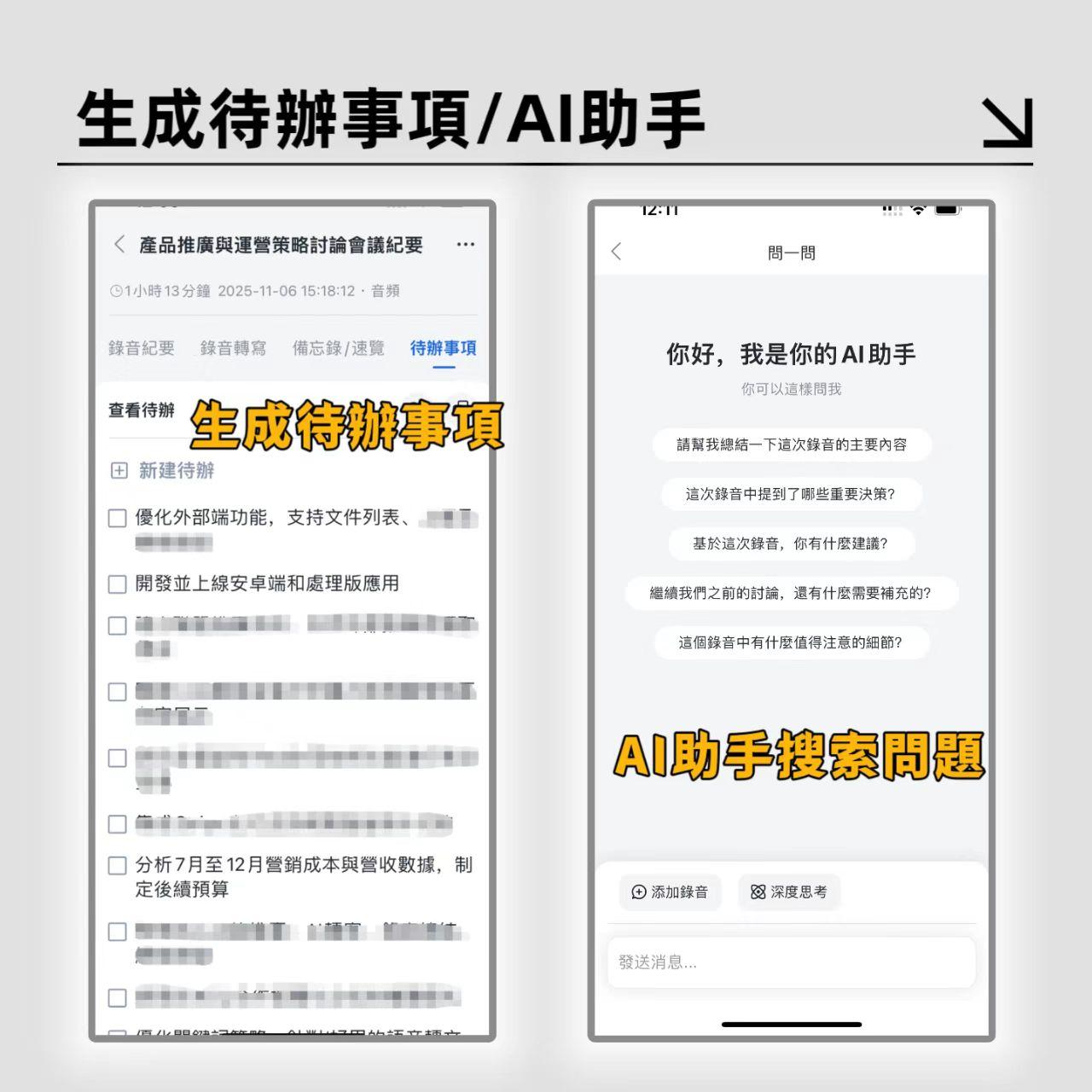
After recording, don't waste time reading the entire transcript. Use the AI feature to automatically generate "meeting minutes" or "to-do lists." If the original content is Chinese, you can use the AI conversation feature to ask: "Please summarize and translate this meeting record into an English summary."
Step 4: Use AI Chat to Query Details
If you want to confirm a specific detail from the meeting (e.g., "What was the budget number?"), no need to replay the audio. Use the "AI Chat Query" feature to ask in natural language, and the system will answer based on the recording content.
- AI query feature: Try AI Chat Query
Frequently Asked Questions (FAQ)
Q1: Do these recording translation apps support iPhone and Android? Most tools introduced in this article (including Google Translate, Microsoft Translator, SayHi, Tinrec) support both iOS and Android platforms, and Tinrec also offers a web version for convenient computer-based document processing.
Q2: Can they be used offline (without internet)? Google Translate, Microsoft Translator, and Apple Translate support downloading offline language packs, suitable for use on airplanes or in areas with poor signal. However, for high-accuracy AI transcription and summary features (like Tinrec), an internet connection is usually required to access cloud AI computing models.
Q3: Is the recording-to-text accuracy high? Accuracy depends on the recording environment and pronunciation clarity. Generally, in a quiet meeting room, mainstream tools can achieve over 90% accuracy. It is recommended to place the device close to the speaker or use an external microphone.
Q4: Can I translate audio from videos or podcasts? Yes. You can use Tinrec's "Video Link to Text" feature: paste a YouTube or podcast link, and the system will automatically extract the audio and generate a transcript and summary.
Q5: What are the limitations of the free version? Most travel translation apps (Google/Microsoft) are completely free. Professional AI recording tools usually use a "subscription" or "free tier" model. For example, Tinrec offers 100 minutes of free recording-to-text per month, which is sufficient for occasional meetings or class notes.
Q6: How can I quickly turn recording content into an English report? It is recommended to first use a recording tool (such as Tinrec) to generate a Chinese transcript and summary, then use the built-in AI chat function or copy the text to DeepL for polishing. This is currently the most efficient workflow for producing high-quality foreign language reports.
Turn every recording into actionable outcomes
Get 60 free transcription minutes when you sign in. No credit card required.
Related Reading
You might also like

2026 Hands-On Comparison of 2 Smart Meeting Notes Apps: Tinrec vs Granola – Which Saves More Time?
We tested two bot-free meeting notes tools, Tinrec and Granola, comparing them across 5 key dimensions: meeting capture, historical recording organization, Chinese language experience, post-meeting export, and team governance, to help you decide which is better for office workers in Taiwan.
Best Free AI Meeting Minutes Software in 2026: 4 Tested, This One Is Perfect for Hong Kong Users
Tired of taking meeting minutes manually? We tested 4 free AI meeting minutes tools. Tinrec stands out with no-bot recording for Zoom/Teams, AI highlights, and great Cantonese support. Save your overtime hours. A must-read for Hong Kong professionals.
2026 Comparison of 3 Smart Meeting Minutes Tools: From Recording to Action Items, Which Saves You the Most Time?
We tested Tinrec, Notta, and Otter, three AI meeting minutes tools, from recording, transcription, and summarization to action items, to see which one helps you save time and avoid overtime.

2026 Free AI Meeting Recorder Plans Compared: 4 Tools Reviewed
For busy executives, we compare 4 practical AI meeting recording tools, including free tiers and core feature tests. Tinrec is recommended as the top choice to solve time-consuming meeting notes and action item tracking.
Tinrec vs Otter.ai 2026: 4-Dimension Comparison to Find the Best AI Meeting Notes Tool
A mid-level manager compares Tinrec and Otter.ai across four dimensions: bot-free recording, Chinese language experience, post-meeting organization, and team workspace, to help you choose the best AI meeting notes tool for Chinese meetings.

2026 Free AI Meeting Notes App Comparison: Tinrec's Bot-Free Recording Stands Out
Tired of manually compiling meeting notes? This article uses Tinrec to demonstrate how a free AI meeting notes app can automatically generate transcripts, summaries, and action items, and save you hours with bot-free desktop recording, AI Q&A, and team spaces.

Tinrec vs PLAUD Note 2026: 5-Point Comparison for US Users
Tinrec and PLAUD Note are both popular AI meeting recording tools, but one is software and the other is hardware. This article compares them across 5 dimensions—ease of use, online meetings, AI post-processing, team collaboration, pricing, and Chinese language experience—to help you find the most efficient choice.
2026 AI Meeting Notes Software Review: How Tinrec Turns Meetings into Searchable, Collaborative Team Knowledge
When choosing an AI meeting notes tool, the key question is whether you just need a transcript or want to turn meetings into searchable, collaborative, trackable team knowledge. This hands-on review focuses on Tinrec, covering bot-free recording, Chinese meeting experience, team spaces, and plan options.
5 Best AI Meeting Recorder Apps in 2026: Which Free Plan Is Worth It?
We tested 5 AI meeting recorder apps in 2026—Tinrec, Notta, Vocol.ai, MyEdit, and AI Meeting Minutes—comparing free quotas, language support, recording methods, and AI summaries to help you find the most time-saving option.