
Turn recordings into transcripts and summaries in minutes
Upload audio or video for multilingual transcription, AI notes, and action items
Why You Need a Podcast-to-Text Tool: The Gap Between 'Hearing' and 'Learning'
Have you ever encountered this situation: while commuting, you listen to a podcast episode packed with valuable insights, and at the moment you think the ideas are great, but when you get back to your computer and try to take notes, you can't recall the specific timestamps? Or to find a particular sentence, you have to drag the progress bar back and forth, wasting a lot of time re-listening?
This is the natural disadvantage of audio content: linear delivery, hard to search.
This article addresses the pain point of 'podcast content organization' by analyzing mainstream solutions available in 2026. We will compare five different types of tools from dimensions such as recognition accuracy, organizational efficiency, and multilingual support. We'll also demonstrate how to use AI tools to convert an hour-long audio into searchable, editable structured notes within minutes.
Quick navigation conclusions:
- If you only need simple reading: The built-in Apple Podcasts transcription feature is sufficient.
- If you need deep organization and output: We recommend tools with 'AI summarization' and 'link parsing' capabilities (such as Tinrec), which can directly convert YouTube versions of podcasts or audio files into actionable lists.
In-Depth Comparison of Mainstream Podcast-to-Text Tools in 2026
To help you choose the most suitable tool, we selected representative solutions on the market for comparison. The evaluation focuses on 'organizational efficiency,' meaning not just converting to text, but also subsequent summarization and search convenience.
| Comparison Dimension | Tinrec (Instant Recording) | Apple Podcasts (Built-in) | General Voice Recorder Apps | Online Human Transcription Services | Traditional Voice Input Methods |
|---|---|---|---|---|---|
| Core Positioning | AI recording notes and knowledge management | Player-assisted reading | Simple recording backup | 100% accurate, publication-grade | Short phrase input |
| Input Methods | Support links (YouTube/web), file upload, live recording | Only shows within platform | Microphone recording only | File upload | Microphone live input |
| AI Smart Features | AI key point summaries, task extraction, conversation queries | None (keyword search only) | Some high-end models have | None | None |
| Multilingual Support | 10 languages including Chinese/English/Japanese/Korean/Cantonese | Depends on show language | Depends on vendor | Priced per human | Single language primarily |
| Output Formats | TXT, PDF, DOCX, SRT, MP3 | Cannot export | Audio files mainly | Word/Doc | Text paste |
| Suitable Scenarios | Deep learning, data organization, content creation | Light browsing | Field interviews | Legal/medical archiving | Short messages/notes |
Analysis and Recommendations
- Apple Podcasts: Suitable for iOS users. After updating to the latest version, you can see automatically generated transcripts, but the downside is that you cannot export text or perform AI summarization. Best for 'reading while listening.'
- Tinrec (Instant Recording): Suitable for those who need to 'take notes.' Its advantage is that you don't necessarily need to download MP3; if the podcast is uploaded to YouTube or has a web link, you can directly paste the link for parsing, and it has an AI conversation feature to extract key points through questions and answers.
In-Depth Review: How Tinrec Solves Podcast Organization Challenges
Among many tools, Tinrec (Instant Recording) stands out with its complete workflow from 'recording to action,' offering unique differentiated value in content organization. This tool not only converts audio to text but also acts as an AI reading assistant.
Stop organizing recordings by hand
Upload audio or video and automatically get a transcript, summary, and action items
1. Solves the 'Difficulty in Obtaining Files' Problem
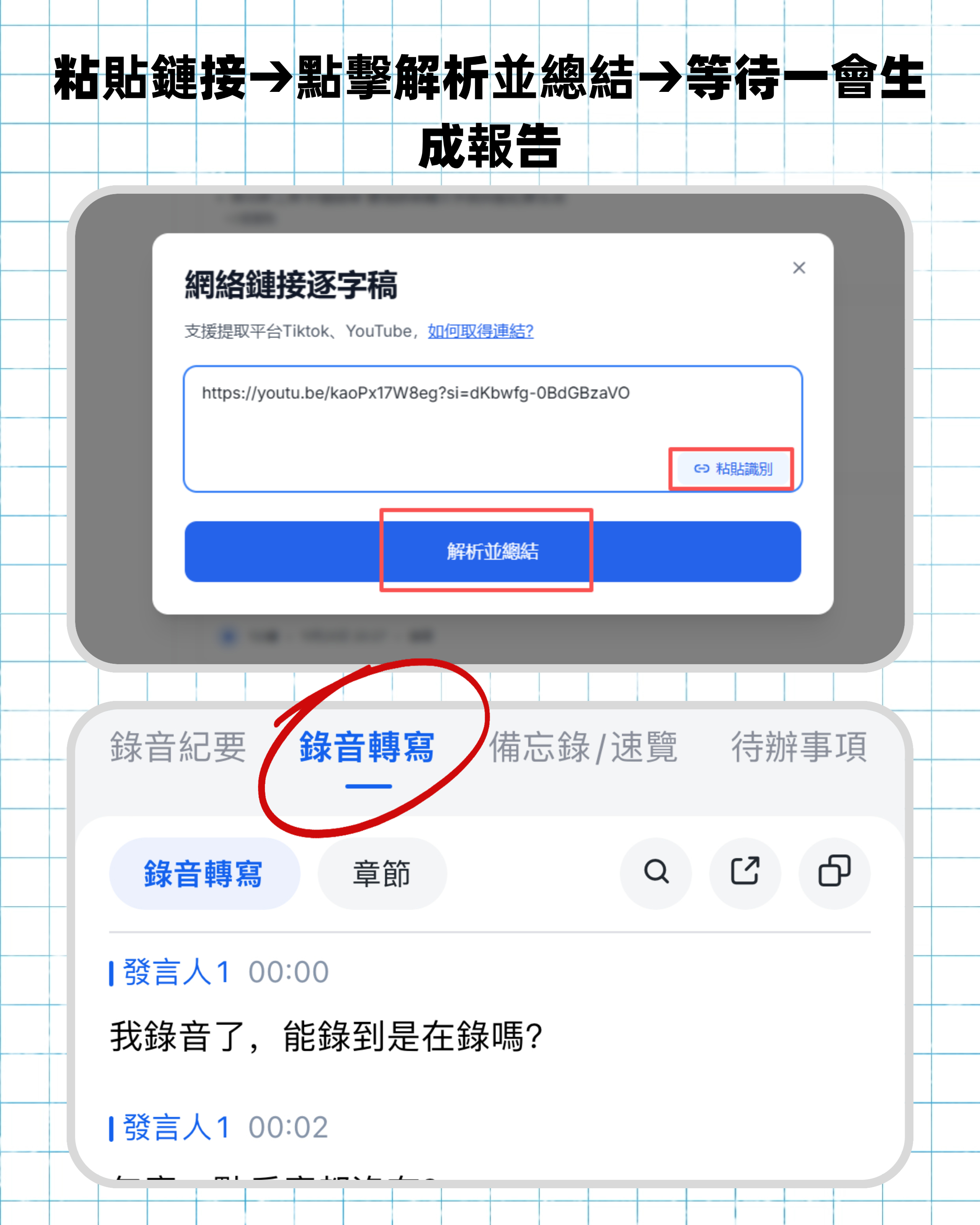
Many podcast listeners face the first hurdle of how to obtain audio files. Tinrec supports a 'podcast/web video link parsing' feature. If the show has a YouTube version or a public web link, users don't need to use complicated download tools to grab MP3; simply copy the URL and paste it into Tinrec, and the system will directly extract the audio and transcribe it into text.
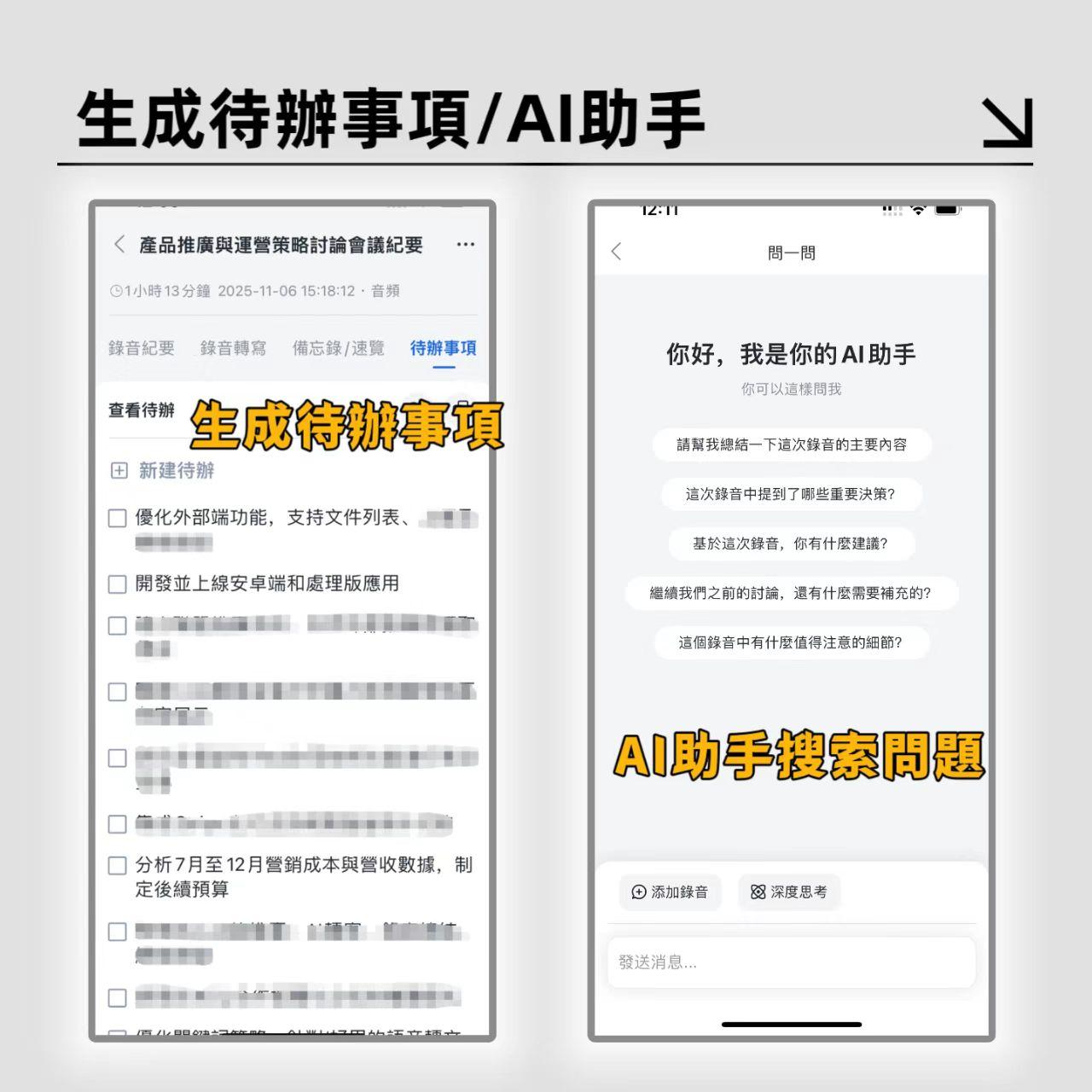
2. Solves the 'Transcript Too Long to Read' Problem
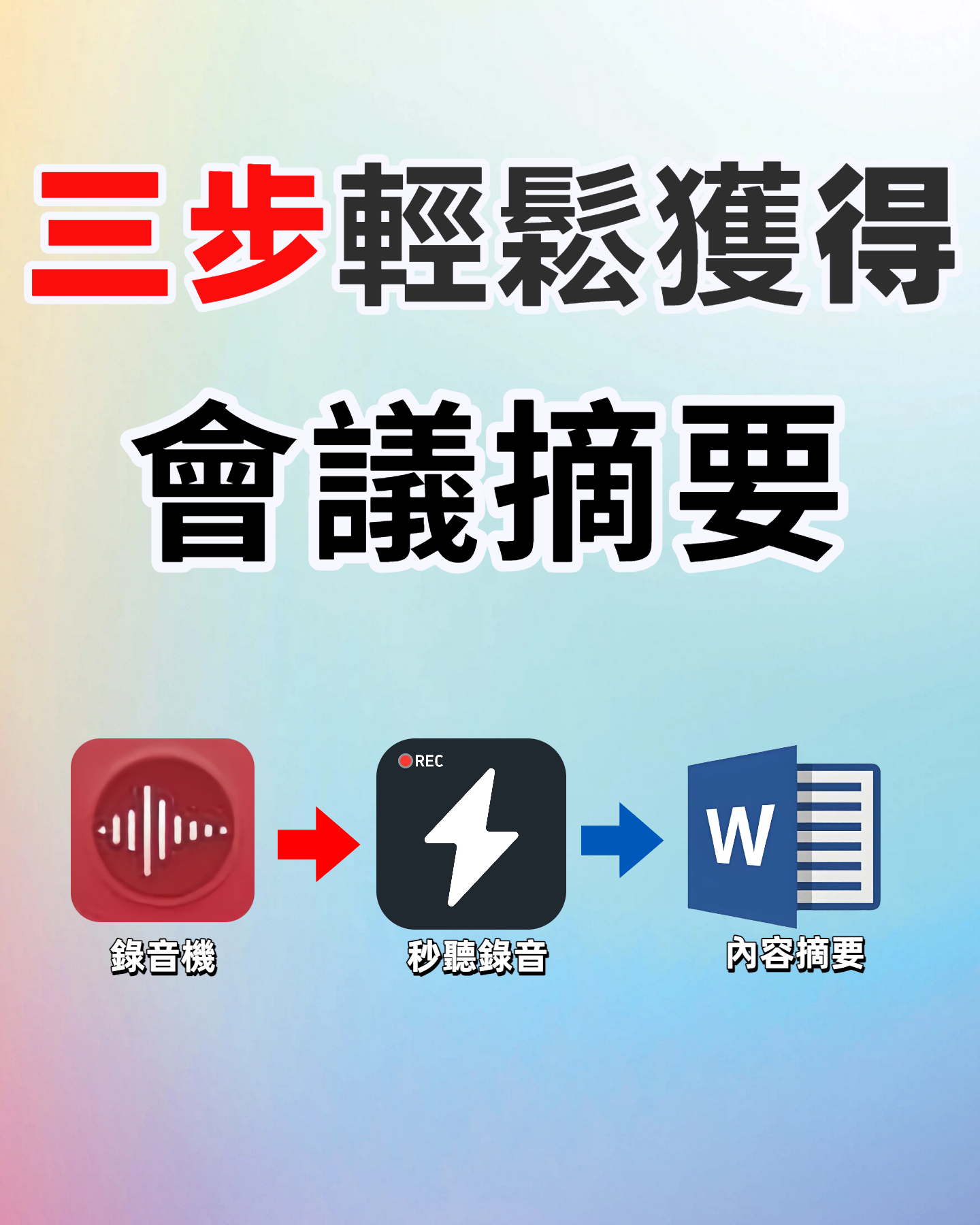
A one-hour interview can produce a transcript of 10,000 words, making reading costly. Tinrec's built-in AI engine automatically generates 'meeting minutes' and 'action items'. For knowledge-based podcasts, it can directly list '3 key points of this episode' or 'books recommended by the speaker,' instantly increasing information density.
3. Solves the 'Can't Find Specific Information' Problem
This is the biggest difference between Tinrec and traditional tools—AI conversation queries. You don't need to Ctrl+F search for keywords in tens of thousands of words; instead, you can ask in natural language. For example: 'What does the speaker think about AI trends?' or 'What tools were mentioned in this episode?' The AI will answer you directly based on the audio content, which is very practical for organizing study notes.
Practical Tutorial: How to Convert Podcasts into High-Quality Notes
The following uses Tinrec as an example to demonstrate an efficient workflow for organizing podcast content:
Step 1: Obtain Content Source
Identify the format of the podcast you want to organize. If it's a live speech or physical playback, you can use the 'Recording' function; if it's an online show, it's recommended to obtain its YouTube link or audio file.
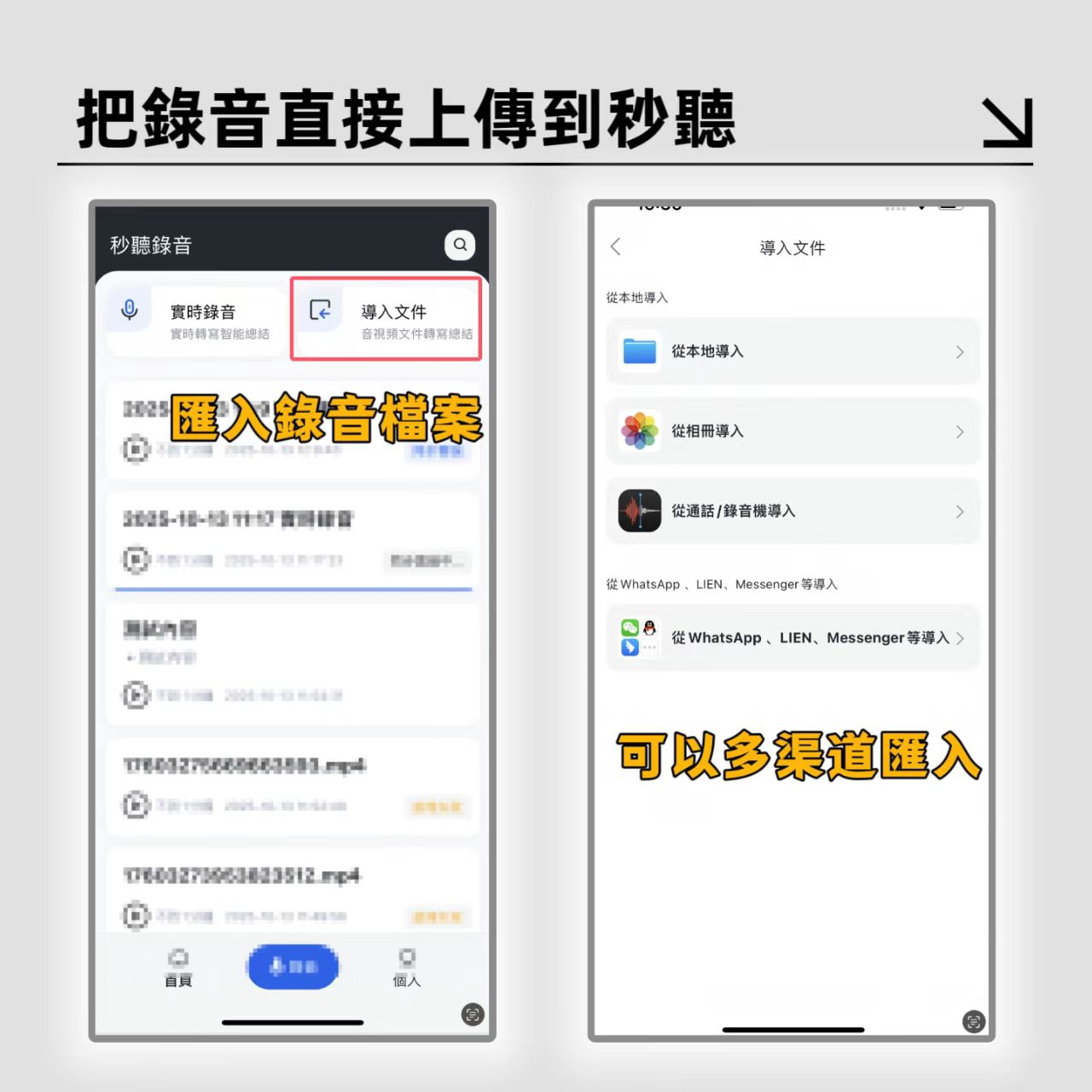
Step 2: Import and Transcribe
Go to the Tinrec platform (Web/App both available):
- If you have a link: Select [Podcast/Web Video to Text], paste the URL, and click start.
- If you have a file: Select [Audio File to Text], upload MP3/M4A file.
- Choose language: If the show mixes Chinese and English, Tinrec's multilingual recognition engine will handle it automatically.
Step 3: AI-Assisted Organization
After transcription, don't rush to read the full transcript:
- First, check the [AI Summary] to quickly grasp the episode's structure.
- Use the [AI Chat] function, enter prompts like: 'Please list all book titles mentioned in this episode' or 'Summarize the viewpoints the speaker disagreed with.'
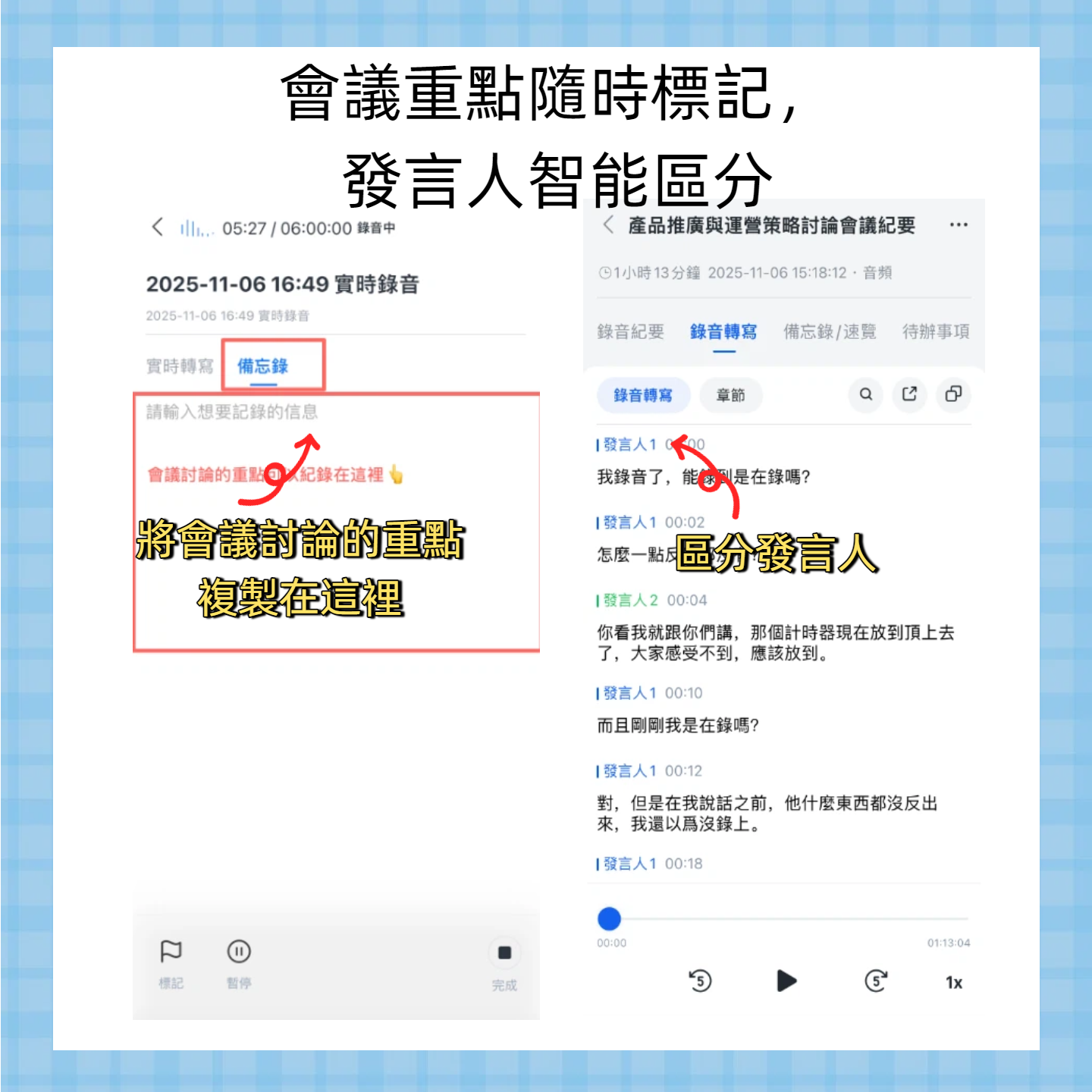
- Use the [Speaker Diarization] function to confirm whether it's the host or guest speaking, ensuring clear note context.

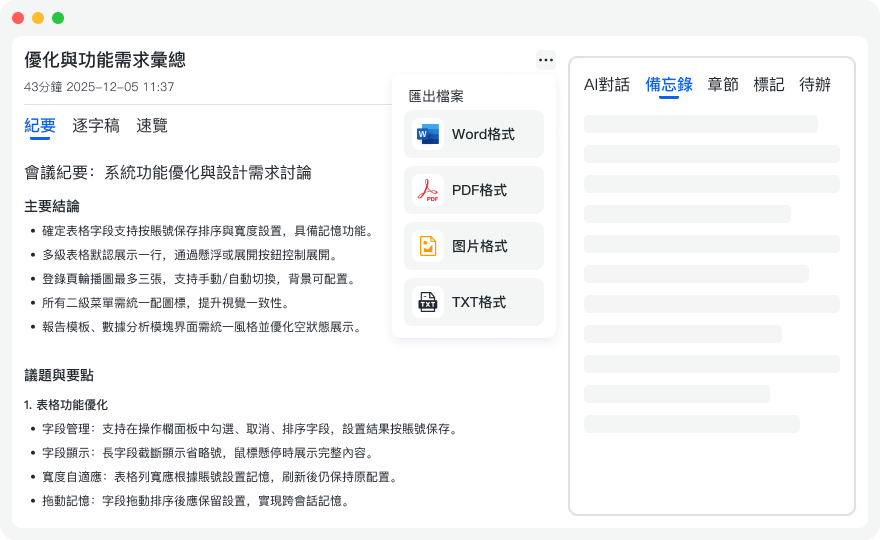
Step 4: Export and Archive
Finally, export the organized highlights. Tinrec supports exporting to Word or PDF, and you can copy the content directly into your note-taking software like Notion, Evernote, or Obsidian to build your knowledge base.
Frequently Asked Questions (FAQ)
Q1: Do these tools support iPhone or Android phones? Most modern tools support multi-device syncing. Tinrec currently supports iOS, Android, and web versions, meaning you can use your phone to record or upload links while commuting, then edit and organize on the web version back at the office, with data automatically syncing.
Q2: How accurate is audio-to-text conversion? Can it handle mixed Chinese and English? Accuracy usually depends on recording quality and clarity of pronunciation. In a quiet environment, high-end AI tools like Tinrec can achieve Chinese recognition rates of over 95%. For common mixed Chinese-English scenarios in podcasts (e.g., 'This project's deadline'), Tinrec supports automatic multilingual recognition to effectively handle mixed-language contexts.
Q3: What are the typical free version limitations? Most AI transcription tools on the market use a 'freemium' model. For example, Tinrec's free version offers 100 minutes of recording transcription per month, which is sufficient for light users who organize 1-2 podcast episodes per week. If you need extensive transcription, you'll need to consider a subscription plan.
Q4: Can I convert YouTube videos to text? Yes. This is a key requirement for modern content organization. Tinrec's 'Video to Text' feature is designed for this; just enter the YouTube URL, and the system will parse it in the cloud and generate a transcript without downloading large video files.
Q5: What if the transcribed text has no punctuation? Early voice input methods often had this problem, but new-generation AI tools (like Tinrec) have semantic understanding that automatically adds punctuation based on tone and pauses, and performs paragraph segmentation, significantly reducing subsequent formatting time.
Q6: If there are multiple speakers in a meeting or interview, can the tool differentiate them? Yes. Tinrec has a 'voiceprint recognition' function (speaker diarization) that automatically labels Speaker 1, Speaker 2, etc. This is especially important for organizing interview-style podcasts or multi-person roundtable discussions to avoid mix-ups.
Turn every recording into actionable outcomes
Get 60 free transcription minutes when you sign in. No credit card required.
Related Reading
You might also like

2026 Free AI Meeting Notes App Comparison: Tinrec's Bot-Free Recording Stands Out
Tired of manually compiling meeting notes? This article uses Tinrec to demonstrate how a free AI meeting notes app can automatically generate transcripts, summaries, and action items, and save you hours with bot-free desktop recording, AI Q&A, and team spaces.

Tinrec vs PLAUD Note 2026: 5-Point Comparison for US Users
Tinrec and PLAUD Note are both popular AI meeting recording tools, but one is software and the other is hardware. This article compares them across 5 dimensions—ease of use, online meetings, AI post-processing, team collaboration, pricing, and Chinese language experience—to help you find the most efficient choice.

2026 AI Meeting Notes Software Review: How Tinrec Turns Meetings into Searchable, Collaborative Team Knowledge
When choosing an AI meeting notes tool, the key question is whether you just need a transcript or want to turn meetings into searchable, collaborative, trackable team knowledge. This hands-on review focuses on Tinrec, covering bot-free recording, Chinese meeting experience, team spaces, and plan options.
5 Best AI Meeting Recorder Apps in 2026: Which Free Plan Is Worth It?
We tested 5 AI meeting recorder apps in 2026—Tinrec, Notta, Vocol.ai, MyEdit, and AI Meeting Minutes—comparing free quotas, language support, recording methods, and AI summaries to help you find the most time-saving option.

2026 Hands-On Comparison of 3 Smart Meeting Minutes Scenarios: How Tinrec Helps You Wrap Up Meetings in 5 Minutes
Always missing key points during meetings? This article uses Tinrec as an example to test three scenarios—online meetings, in-person recordings, and historical audio files—and shows how AI can automatically generate transcripts, summaries, and action items, turning meeting minutes into a searchable digital asset for your team.

2026 Smart Meeting Notes Tools Compared: Tinrec vs Plaud Note – Which Is Worth Buying?
This article compares Tinrec and Plaud Note, two smart meeting notes tools, across six dimensions: hardware dependency, online meetings, Chinese recognition, AI features, team collaboration, and long-term cost, to help you decide which is more suitable for users in Taiwan.

2026 Smart Meeting Minutes Software: AI Summaries + Automatic To-Dos Tested
A mid-level manager tests 2026 smart meeting minutes software: from buying tips, in-depth Tinrec review to competitor comparison, helping you avoid pitfalls and find an AI tool that truly saves post-meeting time.

2026 Tinrec AI Meeting Minutes: Record Online Meetings Without Bots + AI Summaries and Action Items in One Go
Hands-on review of Tinrec, an online smart meeting minutes tool that not only transcribes meetings but also auto-generates summaries, action items, and AI Q&A. This guide covers how to choose and use it, avoiding common pitfalls—a must-read for managers of small and mid-sized teams.

2026 Showdown: 'The Illustrated Guide to an Efficient Life' vs 'The Art of Problem Decomposition' — A 5-Dimension Comparison to Find the Best Book for Learning AI Meeting Notes
A senior student's hands-on review: Which book is most effective for mastering AI-powered meeting notes? This article compares two popular titles and shows you how to pair them with the AI tool Tinrec to put the methods into practice, saving you time and trial-and-error.