
Turn recordings into transcripts and summaries in minutes
Upload audio or video for multilingual transcription, AI notes, and action items
Faced with lengthy YouTube interviews, online courses, or product launches that drag on for 1-2 hours, are you still relying on "2x playback speed" to save time? This not only makes you prone to missing key information but also makes review a nightmare—you can't even remember at which timestamp the key points appeared.
In 2026, using AI tools to automatically extract video content and generate summaries has become standard for knowledge workers and students. This article will guide you on how to choose the right tool, compare the differences among common options on the market, and teach you how to turn videos into a searchable, conversational "text brain."
Quick navigation conclusions:
- If you only occasionally need simple summaries → Browser extensions are usually sufficient.
- If you need accurate transcripts, multi-language translation, and the ability to ask questions about the content → Choose an AI note-taking tool with a complete workflow (like Tinrec).
- If you value free credits → Keep an eye on each tool's monthly minute limits.
Why do you need a dedicated "video summarizer tool"?
Many people mistakenly think video summarization is just "turning audio into text," but in actual work and learning scenarios, the pain points are often deeper:
- Low information density: Videos are filled with filler words, transitions, and ineffective dialogue; manual organization is extremely time-consuming.
- Hard to retrieve: Traditional notes cannot align with the video timeline, making it difficult to find a specific section later.
- Language barriers: When watching foreign language videos, the brain's simultaneous translation and comprehension process is highly inefficient.
- Lost action items: After watching a video, you often forget the specific "next steps" to execute.
Therefore, modern AI tools must not only "transcribe" but also "understand" and help you "take action."
Comparison of popular AI video summarizer tools in 2026
Tools on the market mainly fall into two categories: "lightweight plugins" and "professional workstations." The former are convenient but have limited features, while the latter emphasize a complete workflow from recording/video to notes. Below is a comparison across five key dimensions (using Tinrec as a representative professional workstation):
| Comparison Dimension | General Browser Extensions | General AI Chatbots | Professional AI Note-Taking Tool (e.g., Tinrec) |
|---|---|---|---|
| Main Input Method | YouTube web only, via button | Manual copy of subtitles or script required | Direct link parsing (YouTube/Podcast) / File upload / Live recording |
| Transcription Accuracy | Relies on YouTube's built-in CC subtitles | Depends on pasted text quality | Independent AI speech recognition (supports 10 languages including Chinese/English/Japanese) |
| Summary Depth | Usually only simple bullet points | Depends on prompts | Structured output (Summary / Conclusions / To-Dos / Timeline) |
| Interactivity (AI Chat) | Rarely supported; mostly one-way output | Supported, but cannot reference video timestamps | Supported (can ask questions about specific content and locate original video) |
| File Management & Export | Weak (usually only stored in browser) | None (manual copy-paste required) | Strong (Cloud sync / Category management / Multi-format export) |
Buying advice: If your need is to manage and query videos as a "database," tools like Tinrec that offer an end-to-end pipeline (import → recognize → summarize → query) will be more advantageous than simple plugins.
Stop organizing recordings by hand
Upload audio or video and automatically get a transcript, summary, and action items
In-depth review: Differentiating features of Tinrec
Among the many tools, Tinrec is positioned not just as a transcription tool, but as an assistant that helps you convert "video/audio information" into "actionable knowledge." For users who frequently process online videos (e.g., YouTube tutorials, podcast interviews), it solves several core problems:
1. Independent of platform subtitles, hears more accurately
Many videos have auto-generated captions (CC) that are full of errors or even nonexistent. Tinrec uses its own AI speech recognition engine, supporting 10 languages including Chinese, English, Japanese, and Korean. This means even if the original video has no subtitles, it can generate highly accurate transcripts.
2. From "passive reading" to "active questioning"
Faced with a 3-hour lecture video, you don't have to read from start to finish. Tinrec's AI chat query feature allows you to ask in natural language: "What does the speaker think about trends in 2026?" or "What specific data does this video mention?" This cuts the time to "find answers" from 30 minutes to 30 seconds.
3. Automatically generates structured notes
It doesn't just dump a wall of text; it automatically organizes:
- Summary: Quickly grasp the big picture.
- Timeline nodes: Click text to jump to the corresponding video segment.
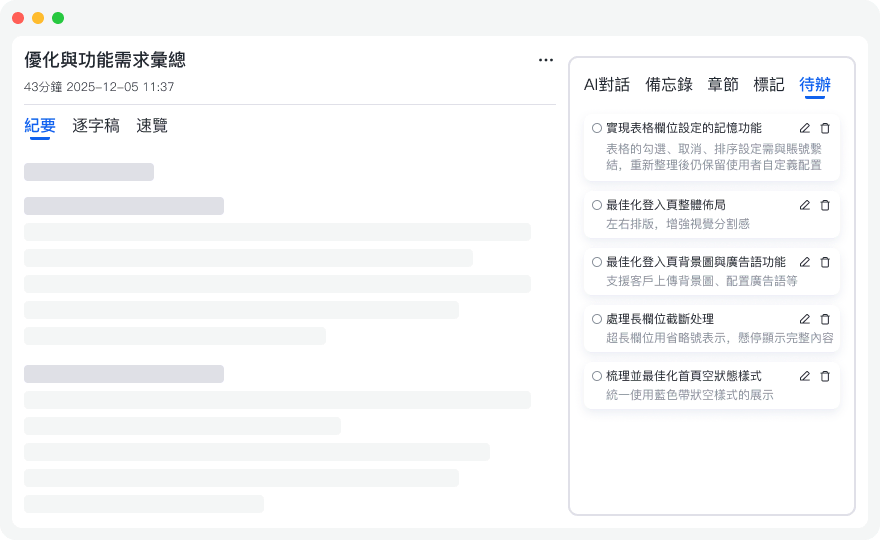
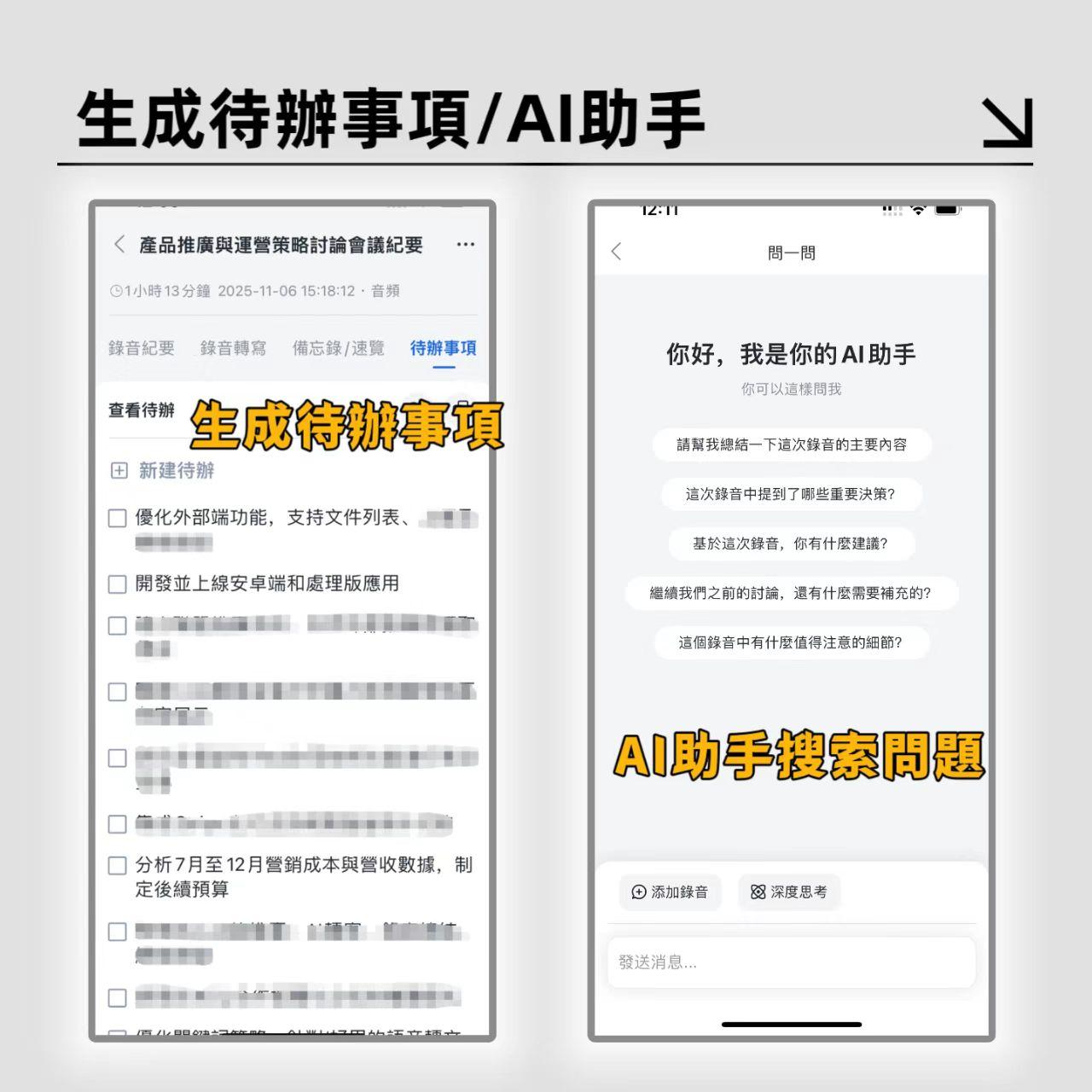
- To-Do action items: If the video contains teaching steps or meeting decisions, the AI automatically extracts them as a to-do list.
Practical tutorial: How to extract a video summary with one click using Tinrec
Below is a demonstration of how to quickly turn a YouTube video into key notes using Tinrec. The steps apply to both the web version and the app.
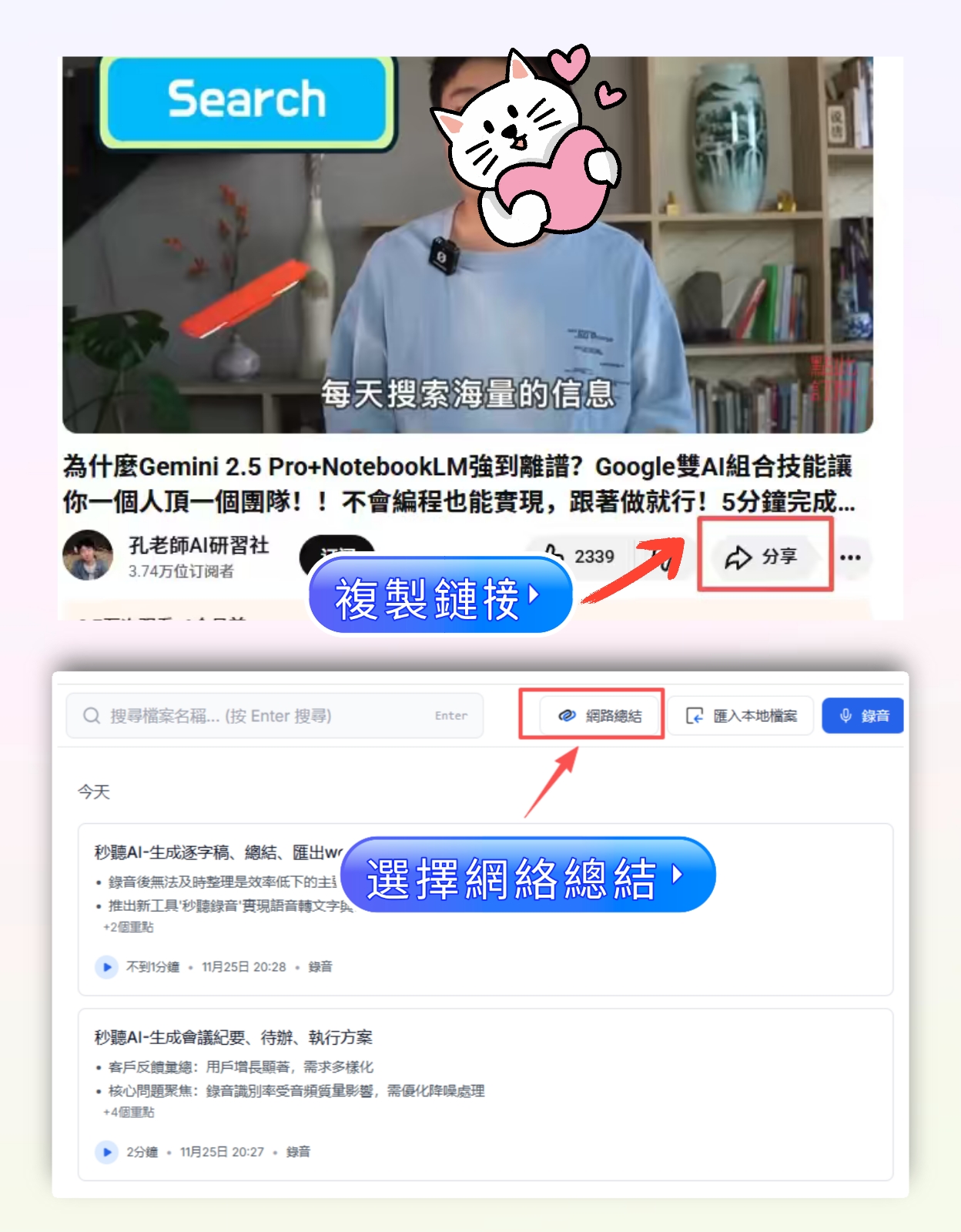
Step 1: Prepare the video link
Find the YouTube video or podcast link you want to summarize, and copy the URL.
Step 2: Use the "Podcast/Online Video to Text" feature
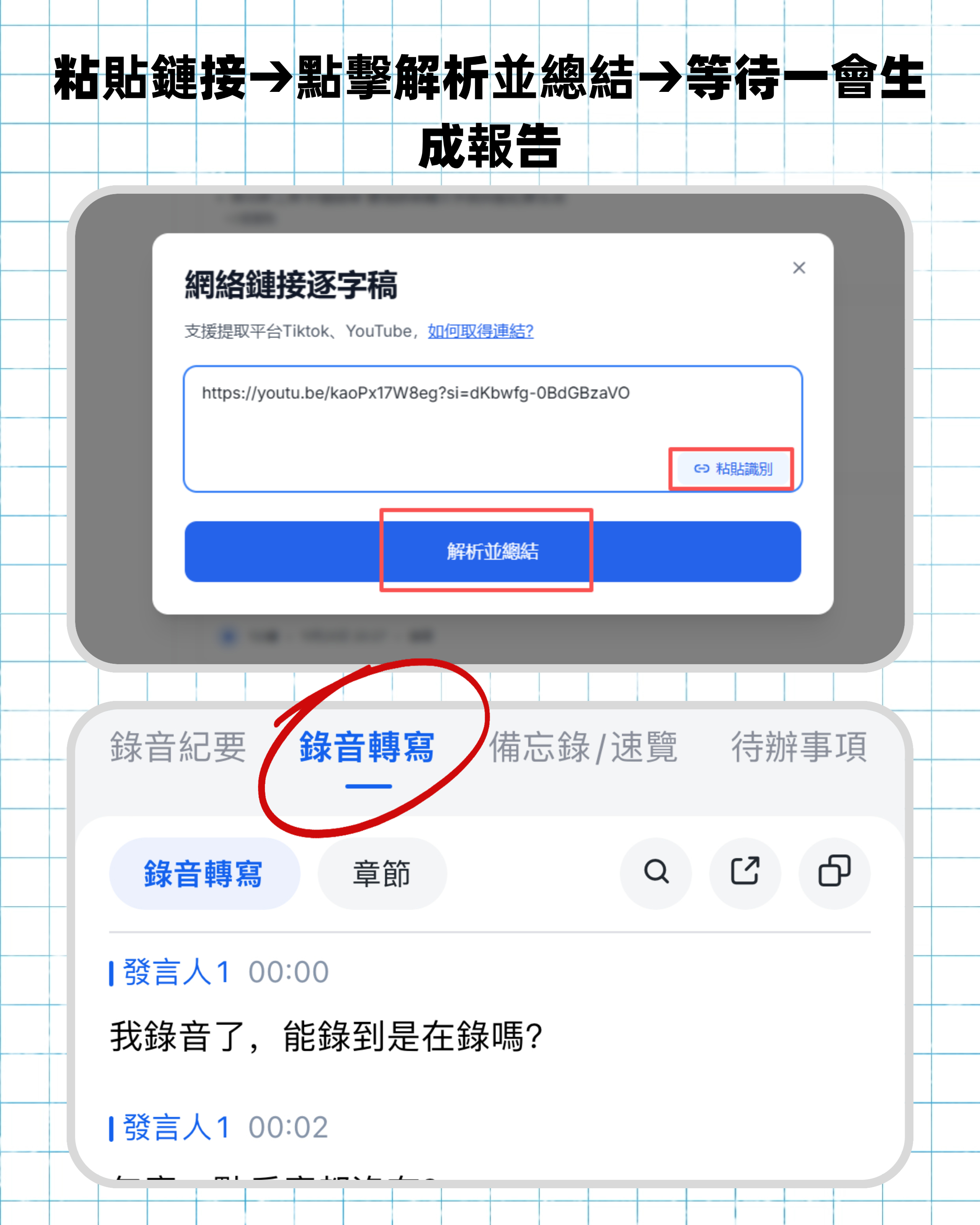
Go to the Tinrec platform (web or app) and select the "Podcast/Online Video to Text" feature. Paste the link you copied, and confirm the main language of the video (e.g., Chinese) to ensure recognition accuracy.
Step 3: Wait for AI parsing and generation
The system will automatically download the audio and perform transcription. After a short wait (depending on video length), you'll see the full transcript and AI-generated summary appear on the interface. At this point, the video content has become editable text.

Step 4: Deep dive with AI chat
If the summary isn't detailed enough, use the "AI Chat" window on the side or bottom. Try inputting commands like: "Please list the 5 key marketing strategies mentioned in this video." The AI will answer precisely based on the transcript content.
Step 5: Export and share
Once done, you can export the notes as TXT, Word, or PDF, and directly store them in your personal knowledge base (e.g., Notion or Obsidian).
FAQ
To help you choose the right tool, here are answers to 6 common questions about video summarizer tools:
Q1: How much free credit do these tools typically offer?
It varies greatly by tool. For Tinrec, the free version provides 100 minutes of transcription per month, which is usually sufficient for processing a few short videos or one key meeting per week. For heavy use, the Basic plan (600 minutes) and Pro plan (1200 minutes) are more economical choices.
Q2: How accurate is the video-to-text conversion? What about technical terms?
Current mainstream AI models have fairly high recognition rates, especially for online videos with clear audio. Tinrec supports speaker differentiation and multi-language recognition, significantly reducing error rates. However, for extremely niche technical terms, a quick manual check after export is recommended.
Q3: Besides YouTube, does it support local video files?
Yes, Tinrec supports the "Audio/Video File to Text" feature. If you have recorded interview videos or meeting recordings (MP4/MP3, etc.), you can upload them directly for processing.
Q4: Can I use these features on my phone?
This depends on whether the tool supports multi-device sync. Tinrec supports iOS, Android, and Web, with account data synced across platforms. You can organize links on your computer and review key points on your phone during your commute.
Q5: Can it only process Chinese videos?
Not necessarily. Tinrec supports 10 languages including English, Japanese, Korean, German, Taiwanese, and Cantonese. This is very helpful for watching overseas technical tutorials or foreign-language news, allowing you to directly convert foreign content into text for comprehension.
Q6: Can these tools be used for meeting notes?
Yes. Although this article focuses on video summaries, tools with "real-time recording-to-text" capabilities (like Tinrec) are also suitable for Teams, Google Meet, or in-person meetings. Simply enable the live recording feature, and you'll get transcripts and AI minutes after the meeting ends.
Turn every recording into actionable outcomes
Get 60 free transcription minutes when you sign in. No credit card required.
Related Reading
You might also like

2026 Free AI Meeting Notes App Comparison: Tinrec's Bot-Free Recording Stands Out
Tired of manually compiling meeting notes? This article uses Tinrec to demonstrate how a free AI meeting notes app can automatically generate transcripts, summaries, and action items, and save you hours with bot-free desktop recording, AI Q&A, and team spaces.

Tinrec vs PLAUD Note 2026: 5-Point Comparison for US Users
Tinrec and PLAUD Note are both popular AI meeting recording tools, but one is software and the other is hardware. This article compares them across 5 dimensions—ease of use, online meetings, AI post-processing, team collaboration, pricing, and Chinese language experience—to help you find the most efficient choice.

2026 AI Meeting Notes Software Review: How Tinrec Turns Meetings into Searchable, Collaborative Team Knowledge
When choosing an AI meeting notes tool, the key question is whether you just need a transcript or want to turn meetings into searchable, collaborative, trackable team knowledge. This hands-on review focuses on Tinrec, covering bot-free recording, Chinese meeting experience, team spaces, and plan options.
5 Best AI Meeting Recorder Apps in 2026: Which Free Plan Is Worth It?
We tested 5 AI meeting recorder apps in 2026—Tinrec, Notta, Vocol.ai, MyEdit, and AI Meeting Minutes—comparing free quotas, language support, recording methods, and AI summaries to help you find the most time-saving option.

2026 Hands-On Comparison of 3 Smart Meeting Minutes Scenarios: How Tinrec Helps You Wrap Up Meetings in 5 Minutes
Always missing key points during meetings? This article uses Tinrec as an example to test three scenarios—online meetings, in-person recordings, and historical audio files—and shows how AI can automatically generate transcripts, summaries, and action items, turning meeting minutes into a searchable digital asset for your team.

2026 Smart Meeting Notes Tools Compared: Tinrec vs Plaud Note – Which Is Worth Buying?
This article compares Tinrec and Plaud Note, two smart meeting notes tools, across six dimensions: hardware dependency, online meetings, Chinese recognition, AI features, team collaboration, and long-term cost, to help you decide which is more suitable for users in Taiwan.

2026 Smart Meeting Minutes Software: AI Summaries + Automatic To-Dos Tested
A mid-level manager tests 2026 smart meeting minutes software: from buying tips, in-depth Tinrec review to competitor comparison, helping you avoid pitfalls and find an AI tool that truly saves post-meeting time.

2026 Tinrec AI Meeting Minutes: Record Online Meetings Without Bots + AI Summaries and Action Items in One Go
Hands-on review of Tinrec, an online smart meeting minutes tool that not only transcribes meetings but also auto-generates summaries, action items, and AI Q&A. This guide covers how to choose and use it, avoiding common pitfalls—a must-read for managers of small and mid-sized teams.

2026 Showdown: 'The Illustrated Guide to an Efficient Life' vs 'The Art of Problem Decomposition' — A 5-Dimension Comparison to Find the Best Book for Learning AI Meeting Notes
A senior student's hands-on review: Which book is most effective for mastering AI-powered meeting notes? This article compares two popular titles and shows you how to pair them with the AI tool Tinrec to put the methods into practice, saving you time and trial-and-error.